
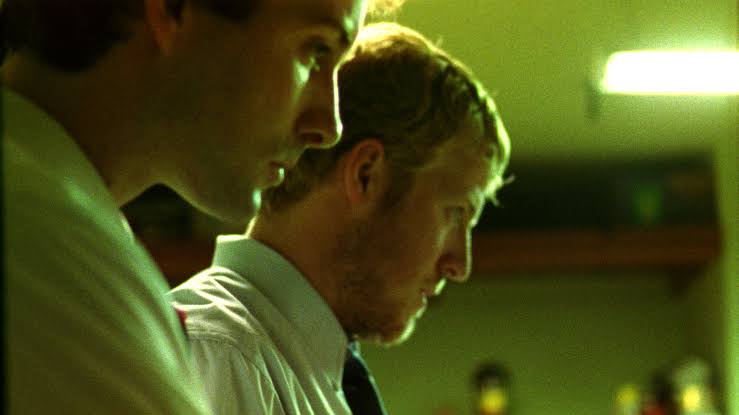
Hey there everyone! Welcome back to Movie Soapbox, the little corner of the internet that only you and I and that guy sleeping in the corner over there know about. This is the place where we find underappreciated indie films and we make sense of them. Today? We are doing a deep dive on Primer, a movie so deliberately, almost aggressively confusing that even the people who love it most will admit they spent two years thinking they understood it before realizing they absolutely did not.
Fair warning before we go any further: everything from this point forward is a spoiler. Not a gentle spoiler, not a “minor plot detail” spoiler, a full surgical dissection of every timeline, every duplicate, every act of quiet betrayal that makes this film what it is. If you have not watched Primer yet, the whole thing is floating around YouTube for free, it has been for years, go watch it and come back. This post will be here when you return. You have been warned, and I will not warn you again. This is one of the greatest movies of all time and I won’t be blamed for spoiling it.
The Mythos that is Primer
Shane Carruth made Primer for somewhere in the neighborhood of seven thousand dollars. He shot it on 16mm, he did his own score, he cast himself and his friends, and he turned in something so precise and so uncompromising that Sundance gave it the Grand Jury Prize in 2004 and then the distribution system spent the next decade not knowing what to do with it. And that is exactly what happens to films like this one. A movie with no stars, no safety net, no second-unit crew, no VP of development sticking his head in to ask whether the third act could be “a little more satisfying” gets to either die quietly or become a cult object, and there is almost no middle ground. Primer became a cult object. But understand what that means: it means the film survived by going around the machine entirely, not through it. Carruth did not get a development deal out of this. He did not get handed a $40 million picture. He spent years in semi-obscurity before Upstream Color arrived a full nine years later. A director who made a film this technically rigorous, this formally ambitious, operating at this level of control over his material, and the industry’s answer was essentially silence. That reshoot scar you see on a lot of films, the bloated, audience-tested third act that explains everything twice and then has a character say it out loud a third time? Primer doesn’t have it. Not because Carruth was protected from that pressure. Because he made the film so far outside the system that the pressure had nowhere to land.
Primer Movie Mechanics
Now. Let’s actually talk about how this movie works, because if you watched it and felt like you were dropped into a conversation that had already been going on for six months, that feeling was entirely intentional and also the whole point.
Four engineers are building things in a garage after their day jobs. Aaron and Abe are the ones who matter. They’re dissatisfied with their other two partners, they split off, they start working independently, and in the process of trying to reduce the weight of an object at the molecular level they accidentally build a time machine. Abe notices it first, specifically because a weeble-wobble left inside the device comes out with six weeks of biological growth on it after sitting inside for a few hours. He takes it to a scientist. The scientist confirms the growth is unremarkable, just accelerated beyond what the timeframe should allow. That’s when Abe understands what they’ve made.
He brings Aaron in by taking him to a field and handing him binoculars. Aaron sees another Abe walking into a storage facility. That other Abe is Abe’s original self, heading into the machine to travel back in time, which means the Abe standing next to Aaron has already traveled back. This is where most viewers nod along and then quietly start drowning, so let’s slow down here completely.
The time machine in Primer does not work the way you are assuming it works. It is not a vehicle you climb into and punch coordinates. It runs on a very specific physical logic and once you have that logic the movie opens up, and without it you are locked outside in the parking lot for the entire runtime.
The machine works like this: you turn it on at, say, 1:00 PM. You remember that time. You wait three hours. At 4:00 PM you climb in. You ride it for three hours. You climb out. The time is now 1:05 PM. You have gone back almost exactly to the moment you turned the machine on. The duration you spend inside the machine equals the distance you travel backward. That is it. That is the whole mechanism. You turn it on, you wait, you get in, you ride, you come out in the past at almost the exact moment it was activated.
Here is the part that broke me for longer than I would like to admit, and if it breaks you too, just stay with it. When You-2 climbs out of the machine at 1:05 PM, You-1 is still standing there. You-1 has been standing there since 1:00 PM waiting for the three hours to elapse so that You-1 can climb in and become You-2. Both of you are present. Both of you are real. And here is the thing that the movie hinges on entirely: You-1 does not have to get into the box. If You-2 decides to tie You-1 up and lock them in an attic, You-1 just continues forward in time alongside You-2 forever. There is no paradox explosion. There is no photograph fading at the edges. You-1 just becomes a duplicate running parallel, and You-2 is now the active version of this person making choices in the world. That is the engine of Primer. Every complication in this film is a variation on that single mechanism, stacked, nested, and repeated until you have lost track of which version of which person is operating on which layer of the timeline.
One more mechanical note before we go deeper: you cannot reuse the same box twice. Once You-2 has exited Box-1, Box-1 is dead to You-2. But, and this matters enormously, if You-1 carried Box-2 into Box-1 before traveling, then You-2 exits Box-1 and can immediately activate Box-2, which allows another jump back almost as far as Box-1 reached. You can nest boxes inside boxes and extend your reach backward in time by that method. This is not a hypothetical. This is what Aaron does, and he does it before we ever meet him in what we believe to be the film’s starting point.
Now here is the single most important piece of information in this entire post, the one that reframes everything you thought you were watching: the timeline we see at the beginning of the film is not the original timeline. We are not watching the story from the start. We are watching a late iteration, a timeline that has already been manipulated and reshaped by time travel that happened before the film’s first frame. When Abe is showing Aaron the time travel discovery in that field, Abe has already traveled back. He has not only already traveled back, he has found his original self, drugged him, and hidden him in an attic. The creature in the attic is Abe. The timeline we’re given as our baseline is already a hostage situation.
The stock market phase, which appears early and feels like the main plot, is almost a red herring in terms of emotional weight. Abe and Aaron identify stocks that make significant gains during the day, travel back to before market open, buy them, and profit. They repeat this Monday through Wednesday in cycles. But cycles have friction. The friction arrives in the form of a party.
Aaron was not originally at this party. Neither was Abe. But something happens at that party, involving a young man named Platt and a shotgun, and Aaron becomes convinced he is responsible for it, or at minimum that he could have prevented it. So Aaron, who by this point has access to time travel, starts going back. Over and over. He is trying to get a specific outcome: Platt removed from the situation, arrested, gone. He rehearses it. He records conversations in advance so he can repeat them verbatim later. He knows what everyone is going to say before they say it because he has lived this day enough times to have it memorized. The Aaron we are watching for most of this film is not the original Aaron. He is a future copy running a rehearsed script on people who believe they are having a natural conversation with their friend.
Granger’s arrival is the rupture in the system. Granger is the friends’ investor, and he shows up looking wrecked, confused, non-functional, the way a person looks when they have traveled back in time and their body has paid for it. Abe and Aaron never figure out why. They never figure out who brought him back, or what future event was so catastrophic that it required someone to pull Granger across a time boundary. And the film never tells you. Granger is the film’s most honest admission that time travel at this scale produces consequences that are completely illegible to the people operating inside the system causing them.
The other thread running beneath all of this is Abe and Aaron’s disintegrating trust. Abe eventually discovers that Aaron has been running failsafe boxes, personal time machines stashed as backup, before any of the activity we see. He finds them, swaps them out for his own, reducing Aaron’s reach. He replaces himself with a wiser version of himself, a version that knows more about what Aaron has been doing. He tries to get ahead of Aaron’s maneuvering. The problem is that Aaron has been a future copy of himself from before the film starts. He has always been several moves ahead. The friendship, already rocky before the machine, cannot survive the discovery of how comprehensively each person has been working around the other while performing friendship. They part. Permanently, or at least the versions of them we’ve been following do.
There are several ways to read what this film is ultimately about, and they are not mutually exclusive.
The first reading is that this is a film about the logical endpoint of unchecked self-interest between people who care about each other. The machine is the stress test. Given infinite ability to redo a choice, would you share that power honestly with your closest friend, or would you quietly optimize for yourself while maintaining the performance of collaboration? Abe and Aaron both answer that question the same way, which is what makes it tragic.
The second reading is that the film is a portrait of a friendship that was already over, and the time travel just makes that legible. The distrust was there before the machine. The machine gives each person the tools to act on what they already secretly believed about the other, which is that neither of them was ever going to share a windfall cleanly.
The third reading, and the one that makes the film feel most specifically like Carruth’s project rather than just a clever puzzle, is that the recursion of the timeline mirrors something about identity itself. When you have made enough copies of yourself that you cannot remember which version made the original choice, in what sense are you still accountable for it? The Aaron we end with is not the Aaron who first heard about the machine. He is the product of dozens of iterations of himself, each one making slightly different choices, burying the original deeper and deeper. At what point does that person stop being himself and become something else wearing his face? Carruth never answers it. The film ends before the answer would arrive, and that is exactly right.
My read is the second one, with the third one running underneath it. The time travel does not corrupt Abe and Aaron. It reveals them. Every version of Aaron has been quietly running a parallel operation from the first moment he had the power to do so, and Abe’s response, once he knows this, is to do the same thing Aaron did, just with more self-awareness about it. Neither of them is the villain. Both of them are. The machine just held up a mirror and neither of them liked what they saw in the other person’s eyes when they both looked at the same time.
Primer ends with Aaron in France, building a larger machine, the implication being that this whole cycle is about to begin again somewhere else, at a larger scale, with no indication that Aaron has learned anything that would make the next version end differently. Abe is gone. The friendship is finished. The machine persists.
Shane Carruth made this film for seven thousand dollars, shot it himself, scored it himself, and delivered something that holds up structurally to the kind of scrutiny that a hundred-million-dollar film cannot survive. That does not happen because the system rewarded careful thinking and formal ambition. It happened because Carruth made the film so small, so cheap, so completely inside his own control, that the system never got its hands on it. The films like this one that do go through the system, you can see exactly where the hands were. You can see the third act that got sanded down, the ending that got tested into meaninglessness, the character who got a redemption arc they did not earn because a room full of people who will never make anything themselves decided the audience needed to feel okay at the end.
Primer does not make you feel okay at the end. That is why it’s still here twenty years later, and most of what those rooms produced is not.
We’ll see you next time at Movie Soapbox, the little corner of the internet that keeps the lights on for films the algorithm forgot. Take care of yourselves out there.
If You Liked Primer…
Things Will Be Different (2024) – Two siblings hide in a farmhouse that exists outside time. Low budget, high concept, and built by people who clearly worship at the Carruth altar.
Synchronicity (2015) – A physicist builds a time machine and immediately makes it worse. Same garage-lab energy as Primer, same “the diagram doesn’t help” confusion.
Frequencies (2013) – Science fiction that runs on ideas instead of budget. The rules of this world are as obsessively constructed as Primer’s timelines.