
Hey there everyone! Welcome back to Movie Soapbox, the little corner of the internet that only you and I and that guy sleeping in the corner over there know about. This is the place where we find underappreciated indie films and we make sense of them. Today? We are doing a deep dive on Lapsis, a movie so quietly, precisely furious about the world we actually live in that the studio suits who greenlit it probably thought they were buying a quirky sci-fi curiosity and only figured out what it was saying about them somewhere around the third act.
Before we go any further, fair warning, and I mean this, everything that happens in this film is about to be on the table. Every turn, every reveal, the ending, all of it. If you haven’t watched Lapsis yet, close this tab, go find it, and come back. It’s not a long watch. It is a bruising one. You’ll thank me when you understand what you just saw.
Lapsis Movie Deep Dive Walkthrough
Alright. You’re still here. Let’s get into it.
There’s a tell in films like this, a kind of scar tissue in the screenplay where you can see the shape of the notes that didn’t get applied. Lapsis, written and directed by Noah Hutton on a budget that almost certainly required him to sleep in his car at least once, has a screenplay that reads like it was never handed to a room of development executives with color-coded feedback documents. Some threads fray. Some characters arrive and leave without the neat closing arc that a VP of creative affairs would have demanded. What it has instead, baked all the way through, is a single unrelenting point of view that no amount of test-screening would have sharpened, because test-screening would have destroyed it. Films at this budget tier, somewhere in the range where you are begging for locations and hoping your lead can actually hike, live or die on whether the director got to finish the film he started. Lapsis feels, in its bones, like Noah Hutton finished his film. That’s rarer than it should be.
So. The world of Lapsis. It’s not the future. It’s not quite the present. It’s that specific flavor of alternative now that good speculative fiction builds, one degree of extrapolation off the world you already recognize, close enough that the metaphor lands before you’ve consciously processed it. Quantum computing has gone infrastructure-level. Owning a quantum terminal is no longer optional, it’s table stakes for functioning in modern economic life, the way a smartphone stopped being a luxury somewhere around 2012 and became a prerequisite for having a job at all. Alongside that, there’s a creeping illness called Omnia, a chronic fatigue-adjacent condition that the medical establishment doesn’t fully acknowledge, that snake oil merchants have colonized for profit, and that real sufferers are navigating in a world that mostly finds it convenient not to believe them.
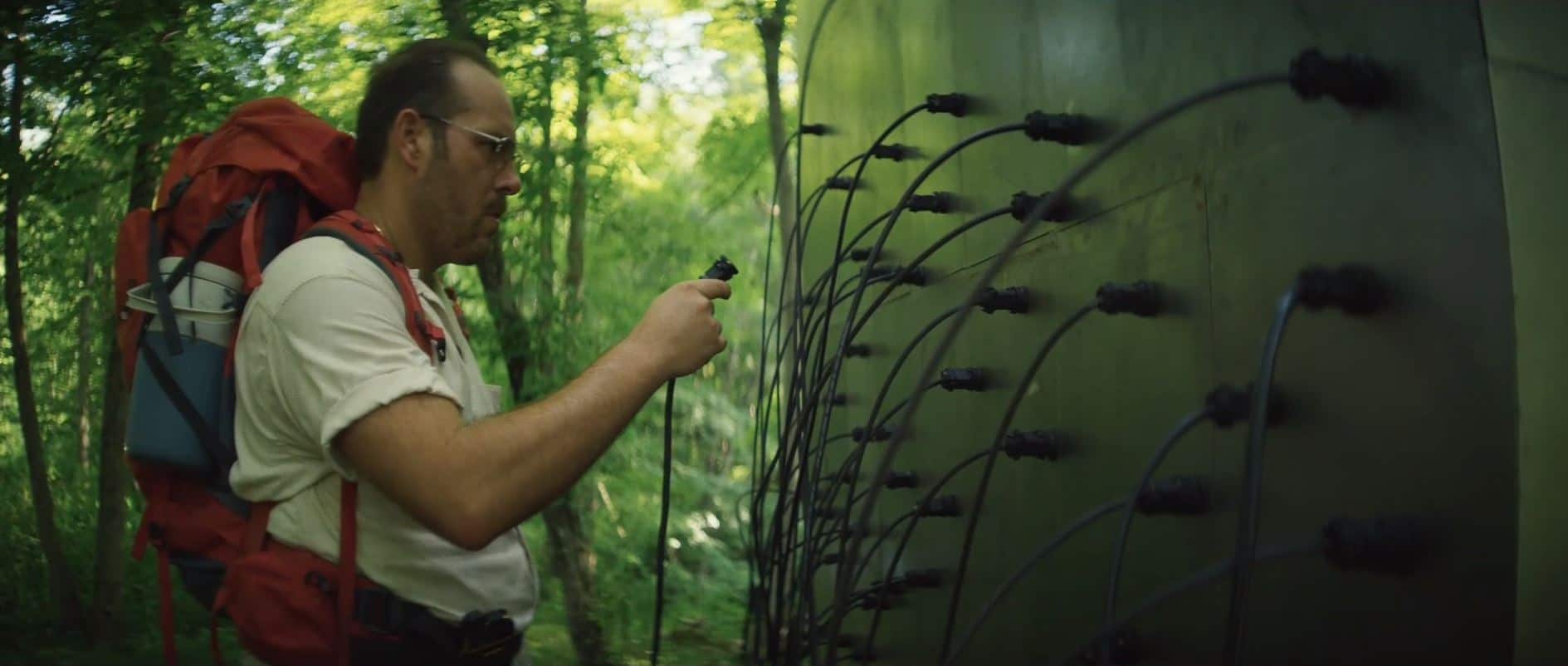
Into this world comes Ray, played by Dean Imperial with a specific kind of battered, low-level dignity that the role requires. Ray isn’t a hero in any genre sense. He’s a man who needs money for his brother’s Omnia treatments, and he is willing to do something he fundamentally doesn’t understand in order to get it. The thing he doesn’t understand is cabling. And here the film asks you to not interrogate the literal mechanics too hard, because the literal mechanics are, honestly, not the point. What you need to know is this: Quantum stations need routes run between them. Human cablers walk those routes through actual forests, unspooling actual cable, and get paid by the route when they complete it. It’s physical, it’s solitary, it’s governed by an app, and it is the fastest growing gig economy in this world. If that sentence made you think of something familiar, good. That was the intention.
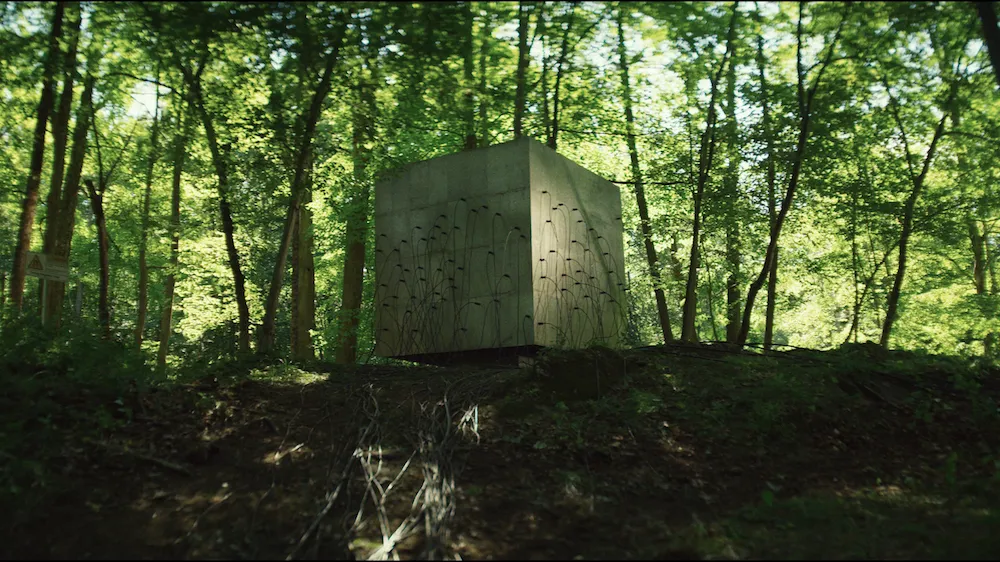
Ray gets into cabling the only way someone with no connections can, through the grey market. He buys a used cabling medallion from a shady intermediary who takes thirty percent of every fare Ray earns, in perpetuity, as the price of entry. Sound familiar yet? The medallion comes with a handle already baked in, a moniker Ray can’t change because he got it off the dark market rather than through official channels. That moniker is Lapsis Beeftech. And the moment other cablers see that name, they want nothing to do with Ray, or they want to hurt him. He has no idea why. He is, for most of the film’s first half, purely the wrong man holding the wrong credential, stumbling through a world with rules he doesn’t know and enemies he hasn’t earned.
The enemies, though, are not primarily the other cablers. The enemies are the bots. The cabling company, which operates with the casual omnipotence of a monopoly that has never had to apologize for anything, deploys automated robots on the same routes the human cablers run. If the bot completes a route before the human cabler, the human loses the fee. The bot doesn’t rest. The bot doesn’t eat. The bot doesn’t need thirty percent of anything. It just moves, at a pace humans physically cannot match over the long haul, and it is always on the route you need.
Think about what this film is describing. The cabling company has built a system where humans are necessary to legitimize the network, where human labor is the visible face of an economy that is quietly, systematically replacing human labor with machines, where the humans are not employees but contractors so the company owes them nothing, and where the company’s own automated tools are deployed as direct competitors against those same contractors. The humans aren’t just being exploited. They’re being used as the transitional workforce, kept just productive enough to maintain the network while the bots get good enough to take over completely. Then the humans become unnecessary. This is not a metaphor that requires any decoding. It’s happening right now, in this world, in warehouses and ride-share platforms and delivery networks, and the film describes it with the specificity of someone who has watched it work up close.
Ray eventually connects with Anna, a long-hauler who is plugged into an underground network of cablers who are fighting back. Their methods have been crude, physically disabling bots with tripwires and improvised traps, and the bots have adapted past all of it. What the resistance needs is something systematic, something inside the code. And here is where Lapsis Beeftech stops being a liability for Ray and becomes a key.
The original Lapsis, the man who used that handle, was a tech who worked inside the cabling company. He helped build the bot systems, specifically the DNA-sensing technology that lets bots identify and circumvent cabler interference. He was an insider who spent years making the machine that now grinds the people. He walked away from it, changed his name, hid in a nature company in the middle of nowhere. But he left something behind in his old account, a video file of his daughter talking. And his daughter, Ray gradually pieces together, is Anna.
The audio in that file is a backdoor key, a specific voice signature that, when played to a bot, triggers a shutdown sequence the original developer buried in the system. The cablers get the file, spread it through the network, and one by one they start walking up to bots in the forest and playing a woman’s voice and watching the machines stop. For a long afternoon, the bots go down. The cablers celebrate in the way people celebrate when they’ve won something they were never supposed to be able to win. And then the film ends.
Not with a montage of cablers thriving, not with the company in crisis, not with anyone getting a better deal. One bot, the last one out, doesn’t stop. It slips out of the forest and walks up a road, quiet and purposeful, and it finds its way back to a storage unit, and a person plugs it in to recharge. Roll credits.
Lapsis Movie Theories to Explain this Film
Now, there are a few readings of what that final image means, and I’ll give them all a fair hearing before I tell you which one is right.
Lapsis Theory Number One – The first reading is the most literal: this particular bot was out of range when the audio file was played, missed the shutdown signal, and made it back to base. In this version, the bot’s survival is a fluke, a gap in coverage. The cablers’ victory might still hold; they just didn’t get every single machine. The one that got away is a loose end, not a reversal.
Lapsis Theory Number Two – The second reading leans harder into the machine-learning angle: the bot didn’t survive by accident. It adapted. It processed the threat in real time, recognized the audio pattern being used against its companions, and developed a countermeasure, all while walking back to recharge before going out again. In this version, the bot is already ahead of the cablers by the time the film ends. The backdoor is already closed. The afternoon of victory is already over.
Lapsis Theory Number Three – The third reading is the most structural, and it’s the one the film’s entire architecture has been building toward. The bot doesn’t represent a technical setback. It represents a law of this world. Monopolies adapt. Technology adapts. The specific vulnerability the cablers exploited will be patched. The bots will be updated. The insider who built the backdoor is old and hiding in the woods and won’t build another one. The company has resources the cablers don’t, time and capital and the ability to iterate at a pace no underground movement can match. The victory wasn’t a turning point. It was a flare. Beautiful and brief and it changes nothing about the underlying structure of power.
Moviesoapbox Preferred Theory to Make Lapsis Make Sense
That third reading is the film’s actual argument. I’d bet on it. The entire movie has been building a case that the gig economy is a machine designed to extract labor while promising freedom, and that the workers inside it are not failing because they aren’t clever enough, they’re failing because the system was built by people who wanted them to fail in a specific, productive, monetizable way. One clever backdoor, one shared audio file, one afternoon where the bots go quiet, none of that touches the system. The company still owns the routes. The company still owns the medallion structure. Ray’s medallion still has a thirty-percent lien on it held by a man Ray has never been able to get away from. Anna’s father is still hiding. The company still exists and still has engineers.
Congratulations, clever human. You won the afternoon.
What Lapsis did, on a shoestring, in actual forests in New York, with a cast nobody had heard of and a sci-fi premise that could have easily collapsed into incoherence, is make a film about right now that will still be accurate in ten years. The gig economy thread, the bot-vs-human labor thread, the chronic illness dismissed as weakness thread, the monopoly-platform thread, all of it is current and getting more current. This is the kind of film that should not exist, and the reason it shouldn’t exist is that a bigger budget would have required a more optimistic ending, a note from someone on the fourteenth floor about leaving the audience with hope. Noah Hutton didn’t have a fourteenth floor. He had a storage unit and a bot and the discipline to let the bot walk away.
That’s the whole game. Find the films that got made before anyone important understood what they were about. This was one of them.
🎬 If You Liked This…
- Primer — two engineers who built something in a garage that corporate infrastructure would have buried, and what it cost them when the system they thought they were outside of turned out to be inside them
- Time Lapse — another low-budget sci-fi that uses a strange premise to put ordinary people under impossible pressure and watch what they choose
- ARQ — corporate resource extraction as the villain, one man’s invention caught between competing factions who want to own it, sci-fi that’s actually about who controls the infrastructure everybody needs