
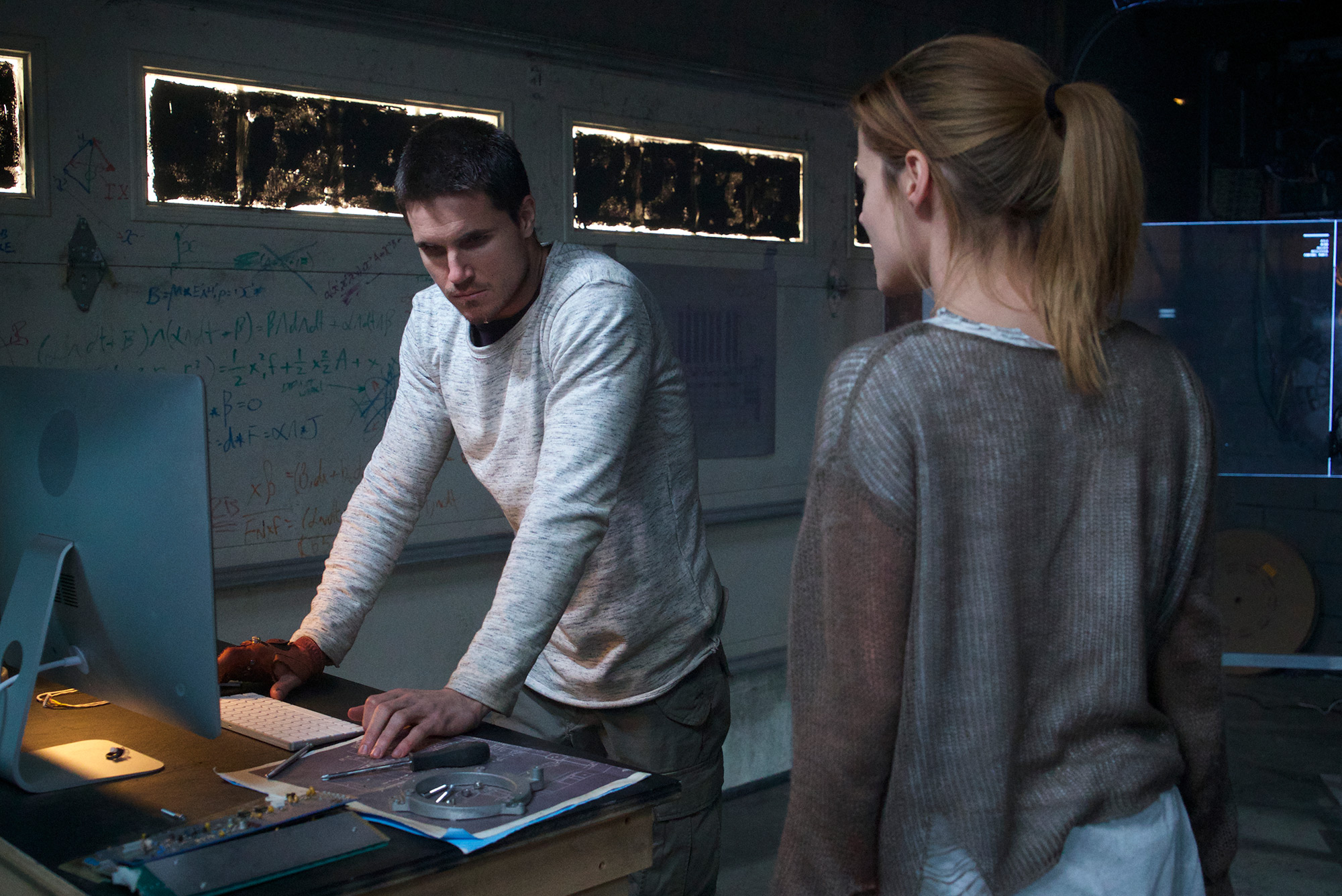
Hey there everyone! Welcome back to Movie Soapbox, the little corner of the internet that only you and I and that guy sleeping in the corner over there know about. This is the place where we find underappreciated indie films and we make sense of them. Today? We are doing a deep dive on ARQ, a Netflix film so recursively, structurally, philosophically dense that the algorithm that recommended it to you almost certainly had no idea what it was recommending.
Alright, fair warning from here on out, we are going wrist-deep into this film’s guts, so if you haven’t watched it yet, close this tab, go find it on Netflix, come back when you’re done, because I’m about to tell you everything that happens including how it ends and why the ending means something completely different than it looks like it means on first watch.
Arq Movie Deep Dive Walkthrough
The setup is tight, almost insultingly simple on its surface: Renton wakes up in bed next to Hannah, his former girlfriend, three masked intruders break in and beat him to death, and then he wakes up again in the same bed at the same moment, next to the same woman, with the same three intruders about to come through the same door. Standard time loop premise, you’ve seen the chassis before. What Tony Elliott did, and what makes this film worth your full, undistracted attention, is that he built an entirely functional internal logic underneath that chassis, the kind of internal logic most studio productions would have a VP of development sand down to nothing because it requires the audience to actually follow a thread for ninety minutes without a hand to hold. The rule system here is real. The world-building is real. The recursion in the title is not decorative. And almost none of that gets to survive in a version of this film with a larger budget, a more recognizable cast, and a greenlight that came with fifteen pages of notes asking for a cleaner, more satisfying resolution.
Elliott wrote for Orphan Black and 12 Monkeys before this, which tells you something about his instincts, but this is him working without a showrunner above him, without a writers’ room to sand the edges, and the edges show in the best possible way. You can feel where a studio version of this would have softened the loop logic, given you a cleaner win condition, and probably ended with Renton and Hannah finally breaking the cycle for good and walking out into whatever passes for sunlight in this ruined world. Instead Elliott left the recursion intact, which is either a choice made from artistic conviction or a choice that survived simply because nobody with the power to change it noticed what it implied until the film was already locked. Both possibilities are equally plausible and equally interesting.
So. Let’s talk about what actually happens in this film.
What ARQ Stands For, and That Name Explanation
Renton built the ARQ for Torus, a multinational energy corporation that functions as the film’s corporate-dystopian villain, a perpetual energy machine, a cylinder fed by fuel that generates enough output to feed itself indefinitely, which lets Renton run air filtration, grow apple trees, maintain something close to a normal domestic existence while the world outside is collapsing. The machine is not built to loop time. It becomes a time loop machine accidentally, when one of the intruders, Cuzz, makes contact with it at a precise moment, 06:11:06:03, and the resulting short causes the ARQ to reset its own timeline in a three-hour-and-fourteen-minute window, pulling everyone within roughly 300 feet back to that same moment in bed.
The name tells you this if you know how to read it. ARQ stands for Arcing Recursive Quine. Arcing, as in the electrical arc that kills Cuzz and triggers the loop. Recursive, as in a function that calls itself. And a quine, for anyone who hasn’t spent time in a computer science context, is a program whose only output is its own source code, a program that reproduces itself perfectly, indefinitely. Stack all three of those words together and what you have is a precise, technical description of what the machine does by accident: it becomes a self-generating loop that outputs itself as its own result, over and over, and the only way to interrupt it is to change something fundamental about the source.
Elliott named the machine after its malfunction before the malfunction existed in the script. That is the kind of structural thinking that does not happen in a committee.
The World Outside the House
The film drops you into a world mid-collapse and doesn’t pause to explain it, which is the correct choice even if it’s a slightly disorienting one. What you piece together across nine iterations of the same morning is something like this: there is a catastrophic global energy crisis. Australia has effectively ceased to exist as a functioning society. The air outside is unbreathable without filtration equipment. A corporation called Torus, which has a robot army and a demonstrated willingness to torture and kill civilians, is fighting a war against a resistance movement called the Bloc. The Bloc’s leader, referred to as The Pope, may or may not have been captured. Renton’s energy machine, if it falls into Torus hands, ends the war. If it reaches the Bloc, it might not.
This is a world that Elliott extrapolated deliberately from current trajectories, corporate consolidation, environmental collapse, the privatization of basic infrastructure, and he’s said as much in interviews. The point is not that this world is fantastical. The point is that it is a logical extension. Which makes the loop not just a sci-fi premise but a structural metaphor, and we’ll get to that in the theories section.
How the Loop Actually Works: The Rules
The rules matter here and they are internally consistent, which is rarer than it should be in this genre. The loop runs from 06:11:06:03 to 09:25:21:09, a window of roughly three hours and fourteen minutes. The anomaly has a physical boundary, approximately 300 feet around the house. The critical rule, the one that the film withholds until you’re paying close enough attention, is the memory rule: those closest to the ARQ remember less across iterations, those furthest from it retain more. Which is why Hannah, sleeping in the bed farthest from the machine in the basement, begins to develop awareness faster than Renton, who built the thing and sleeps practically on top of it.
But the loop rule that changes everything, the one the film buries in a screen readout that most viewers blow past, is this: the loop runs nine times, then resets. Not just resets to the beginning of the morning. Resets the memory. Every nine iterations, the session clears. Renton and Hannah lose everything they learned. They start over with nothing.
Elliott put the evidence of this on the ARQ’s own screen, in a log that shows sub-routine threads completing and restarting, a mainline loop counter incrementing, and a memory discard command executing after every ninth iteration. You have to pause the film and actually read it to catch it, and the film knows you probably won’t, and it structures the ending around the possibility that you did or you didn’t.
Think about what that means for the scale of this. Renton and Hannah are not trapped in nine loops. They are trapped in millions of loops, grouped into sets of nine, at the end of each set their minds wiped clean, starting again from nothing. The nine iterations we watch are not the beginning. They are one batch among an unknowable number of identical batches, all of which ended the same way.
Arq Movie Ending, Explained
By the final iteration of the nine we watch, Renton has figured out enough to leave himself a message inside the ARQ’s own recording system, a video, a piece of information that will persist across the memory wipe because it is stored in the machine rather than in his head. The message is the lifeline. It is Memento’s tattoo system, reconstructed in code. If Renton in the next batch finds it early enough, reads it carefully enough, acts on it fast enough, the theory goes that he might be able to change the outcome: get Hannah out, protect the machine, survive the morning in a way that actually sticks.
The film ends before we see whether that works. It ends on the loop resetting, on that familiar waking moment, on the implication that the next batch is beginning with slightly better odds than the last one did.
That is not a happy ending or a sad one. It is a precise one.
Arq Movie Theories
Arq Movie Explanation Theory 1: Optimism
Elliott has said in interviews that the film’s system is designed to model the human impulse to keep trying despite failure. You fall. You learn something. You reset. You try again slightly better. In this read, the video message is genuine progress, not a gesture toward progress, and the recursive structure is ultimately hopeful because progress accumulates even when memory doesn’t, because the habit of trying persists across the wipe even if the specific knowledge doesn’t. This is the reading Elliott seems to prefer, and it’s worth taking seriously because he built the machine.
Arq Movie Explanation Theory 2: Pessimism
In this read, the video message is a gesture that looks like progress but almost certainly isn’t, because Renton has almost certainly recorded some version of that same message hundreds of thousands of times before, and none of those versions broke the loop, and there is no structural reason this version will either. The ARQ is Sisyphus as a closed-box thriller. The rock goes back down the hill every nine loops, and the gods, meaning the machine itself, the world outside, the structural conditions of the thing, are not going to let it stay up. The only way out is an intervention from outside the loop entirely, which the film gives you no reason to expect.
Arq Movie Explanation Theory 3: Plato’s Cave
The loop as a modern version of Plato’s allegory, Renton and Hannah as the philosophers who have seen behind the wall of appearances and are trying to return to the cave to change things, the reset as the mechanism by which the cave keeps reasserting itself, keeps making the philosophers forget what they saw. In this reading the film is asking a genuinely uncomfortable question about whether the knowledge of how systems work actually helps you change them, or whether the systems are self-sealing in a way that consumes anyone who tries.
Arq Movie Explanation Theory 4: Cautionary Tale
The world of ARQ, the air you can’t breathe, the corporation with a robot army, the Bloc fighting a losing war with no resources, is a projection of current trajectories, and the loop is what happens when you don’t change course. You don’t get a sudden catastrophe. You get the same morning, over and over, slightly worse each time, until the memory of why it started doesn’t exist anymore.
Movie Soapbox Theory Pick
I totally vibe with theory number two personally, with a blend toward theory three. The video message is not progress, it’s the illusion of progress, and the reason it’s the illusion of progress is that the machine is the problem and neither Renton nor Hannah can dismantle the machine from inside the loop the machine is generating. Elliott built an airtight trap and put two people in it who are smart enough to see exactly how airtight it is and not quite free enough to do anything about it. The optimism reading requires you to believe that recording information is categorically different from retaining it, and I don’t think the film earns that distinction. What the film earns is this: the attempt is worth something even if it changes nothing. That is not optimism. That is dignity. Which is a different and considerably more serious thing.
Tony Elliott wrote a film about people doing their best work inside a system designed to make their best work disappear. He got it made on a tight budget, on Netflix, with a cast that committed fully to an internal logic most audiences won’t fully decode on first watch, and the thing is still there, available, intact, unflattened. The loop didn’t get him. This time.
If You Liked ARQ…
Infinity Chamber (2016) – A man trapped in an automated prison cell reliving the same loop with an AI that might be helping or might be the cage. Same single-room, infinite-reset energy.
Containment (2015) – People wake up sealed inside their apartments with no explanation. Closed box paranoia where the rules reveal themselves one catastrophe at a time.
The Incident (2015) – A stairwell and a highway that never end. The loop isn’t a puzzle to solve — it’s a prison to endure. One of the most underrated loop films ever made.