
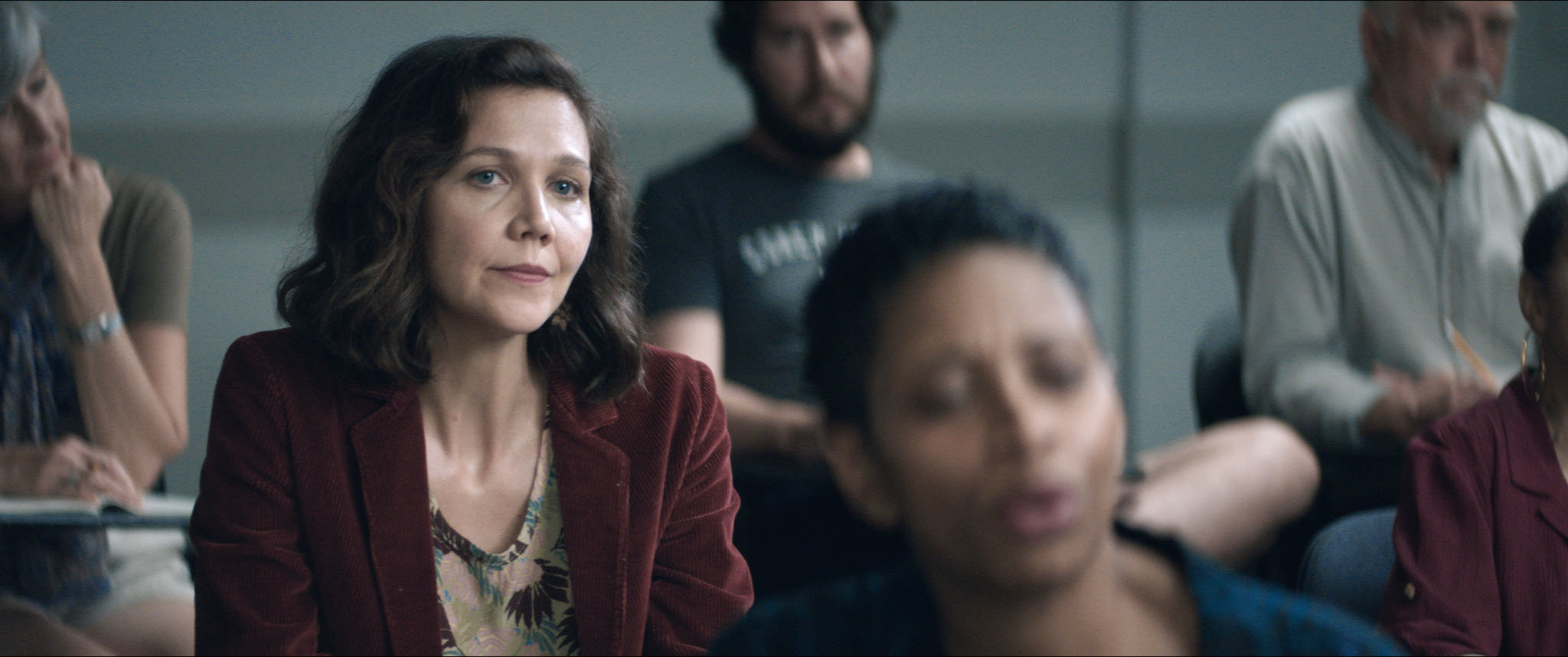
Hey there everyone! Welcome back to Movie Soapbox, the little corner of the internet that only you and I and that guy sleeping in the corner over there know about. This is the place where we find underappreciated indie films and we make sense of them. Today? We are doing a deep dive on The Kindergarten Teacher, a movie so quietly devastating, so precise in its discomfort, that the people who laughed at it in test screenings probably went home and watched three hours of reality television and felt absolutely nothing.
Alright. Before we go any further, you need to know this: everything from this point forward is the whole movie, ending included, no filters, no warnings except this one. If you haven’t watched The Kindergarten Teacher yet, stop, go watch it, come back. I’ll be here. What follows assumes you’ve seen it and you’re still sitting with whatever that ending did to you.
Kindergarten Teacher Movie Walkthrough
So. Lisa Spinelli, played by Maggie Gyllenhaal in a performance so internally precise it barely registers as acting until it’s already broken something in you. She’s a kindergarten teacher in Staten Island, married, two kids who’ve stopped talking to her in any real way, signed up for a poetry class because something in her recognizes that she is running out of time to become the person she thought she was going to be. The problem is she’s not a good poet. She knows she’s not a good poet. The class knows it too, in the polite, crushing way that workshop culture delivers that verdict.
Then one of her five-year-old students, Jimmy Roy, starts reciting poems. Not cute poems. Not the kind of thing you put on the refrigerator. Real poems, strange and crystalline and fully formed, the kind that land on you sideways before you’ve decided how to feel about them. Lisa brings one to her class, passing it off as her own work. They love it. Her instructor loves it. And something shifts in Lisa that the movie never quite names but never needs to.
From there, the film’s architecture is simple: Lisa’s obsession with Jimmy escalates, Jimmy’s father starts pulling back, Lisa starts lying, and eventually, in a move the movie doesn’t flinch from, she abducts him. Takes him from his new school, puts him in her car, drives toward the ferry with a five-year-old sitting next to her who she loves, genuinely loves, in the most destructive way a person can love something they’ve decided to save.
She gets arrested on the ferry. That’s where the film ends her story. But before the police take her away, Jimmy says four words to no one in particular, or maybe to the air, or maybe to the version of this world where someone would actually stop and listen. “I have a poem.” Nobody stops. Nobody listens. The movie ends.
Wait, What the Heck Happened?
Now. Before we go further into what that means, let me tell you something about the kind of film you just watched, because it matters for understanding why it exists at all.
A movie like The Kindergarten Teacher arrives at Netflix in a very specific condition. Sara Colangelo wrote and directed it, adapted from an Israeli film, budgeted at a level where you don’t have the luxury of a single wasted day on set, and the entire structural bet of the film is that an audience will sit with a protagonist who commits an act that is legally and morally indefensible and not be handed a clean way out of caring about her. That is not a note-friendly premise. The instinct at every level of development and acquisition for a film like this is to sand the edges, to give Lisa a scene where she acknowledges she’s crossed a line, to give the father a moment of genuine cruelty that partially justifies her, to do something that lets the audience exhale. The fact that this film does none of that, the fact that it holds the tension absolutely rigid all the way to those four words and then just cuts, tells you something about how hard Colangelo fought to deliver it intact. You can feel the shape of every note this film didn’t take. The absence of those softening gestures is its own kind of craft.
So what is Lisa actually doing, and why does the movie want you to sit with it instead of dismiss it?
There’s a scene where Lisa explains her entire operating theory to Jimmy’s father. She’s not rambling, she’s not unhinged in this moment, she is calm and specific: in other eras, when a child with genuine exceptional talent was identified, the culture built scaffolding around that child immediately. Mozart’s father recognized what was happening at four years old and reorganized his entire life to serve it. The culture recognized what was happening and consecrated it. The result was music that is still reshaping how human beings experience sound three hundred years later. Lisa’s argument isn’t that she has the right to take Jimmy. Her argument is that the mechanism we’ve built for identifying and protecting that kind of talent is completely broken, and Jimmy will be swallowed by it, and she cannot watch that happen.
Is she right? Yes, partially, in the way that the most dangerous people are often right about something real. The film is not interested in whether Lisa’s philosophy is correct. It’s interested in what that philosophy costs when one person decides to act on it unilaterally, without consent, without a system, armed only with conviction.
The deeper current running under all of this is that Lisa believes herself a failure, not in the way people say it conversationally, but in the way that sits in your chest at two in the morning and doesn’t move. Her daughter gets straight A’s. By every metric her family is fine. And it means nothing to her, because she knows the difference between the right edge of the bell curve and off the chart entirely, and she has spent her life on the wrong side of that line, and she knows it, and she met a five-year-old who is on the other side of it, and she cannot let him be wasted the way she feels wasted.
When she passes his poems off as her own in class, she isn’t plagiarizing for vanity. She is testing whether anyone around her can even recognize what they’re hearing. They can. They do. And that validation doesn’t make her feel like a fraud, it makes her feel like a custodian. Like someone who can at least do this one thing, which is carry this talent into rooms that might honor it, even if she has to smuggle it in under her own name.
The Kindergarten Teacher and the Theories To Try and Explain It
There are a few ways to read what Lisa is, and serious viewers of this film have argued all of them.
The Kindergarten Teacher – She’s Pathological
The first read is straightforwardly pathological: Lisa is a woman in a dissociative episode, projecting her own frustrated ambitions onto a child, constructing an elaborate philosophical framework to rationalize obsessive behavior that is, at its core, about her own ego and grief. The film supports this. Her trajectory looks exactly like a person coming apart. The poetry class, the theft, the escalating boundary violations, the abduction, it’s a clean line of deterioration.
The Kindergarten Teacher – Cultural Dissident
The second read is that Lisa is a genuine cultural dissident who happens to be using the wrong tools. Her diagnosis of the problem, that we’ve built a civilization that systematically fails to recognize and protect exceptional talent in favor of the comfortable and the algorithmic, is not wrong. Her method is catastrophically wrong. But the wrongness of the method doesn’t erase the accuracy of the diagnosis. This read asks you to hold both things simultaneously, which is deeply uncomfortable, which is exactly where Colangelo wants you.
The Kindergarten Teacher – I Have a Poem
The third read, the one that requires the most from the viewer, is that the film isn’t really about Lisa’s rightness or wrongness at all. Jimmy says “I have a poem” and no one hears it. The film ends there. That choice is not ambiguous. That choice is Colangelo telling you that the argument is settled, not in Lisa’s favor exactly, not against her exactly, but in favor of the reality that Jimmy is now in a world that will not hear him, and we built that world, and we’re still building it, and we find it very comfortable.
Movie Soapbox’s Read of the Kindergarten Teacher –
I land on the third read, fully, without reservation. The film uses Lisa’s breakdown as the delivery mechanism for a much colder observation about collective taste and collective failure, and it earns the right to make that observation because it refuses to let Lisa be simply sympathetic or simply monstrous. Maggie Gyllenhaal plays her with a level of interior specificity that makes the audience’s laughter, when it comes in the poetry scene, a genuine indictment. You’re laughing at someone in tremendous pain who has organized her entire life around something true. Go ahead and laugh. The film clocked you doing it.
Sara Colangelo made something true. She made it on a budget that didn’t give her a single extra day, with a performance at the center that required an audience willing to sit in genuine moral discomfort for ninety minutes, and she distributed it through a platform that serves it to people between episodes of things designed to ask nothing of them. Jimmy has a poem. You probably scrolled past it. That’s the movie. That’s all the movie is saying. And it’s enough to wreck you if you let it.
🎬 If You Liked This…
- Luce — an adult so dangerously invested in a young person’s narrative that the line between advocacy and obsession dissolves completely, same queasy feeling of watching someone convinced they’re the hero of a story they’re actually destroying
- Audition — a fixation that looks like love until it doesn’t, a person whose obsession reveals something monstrous underneath the ordinary surface of their life, same slow-burn dread of watching someone cross a line they cannot uncross
- Beatriz at Dinner — a woman completely convinced of her own moral clarity while everyone around her watches her come apart, same portrait of a person whose belief in their own rightness is the most dangerous thing about them