
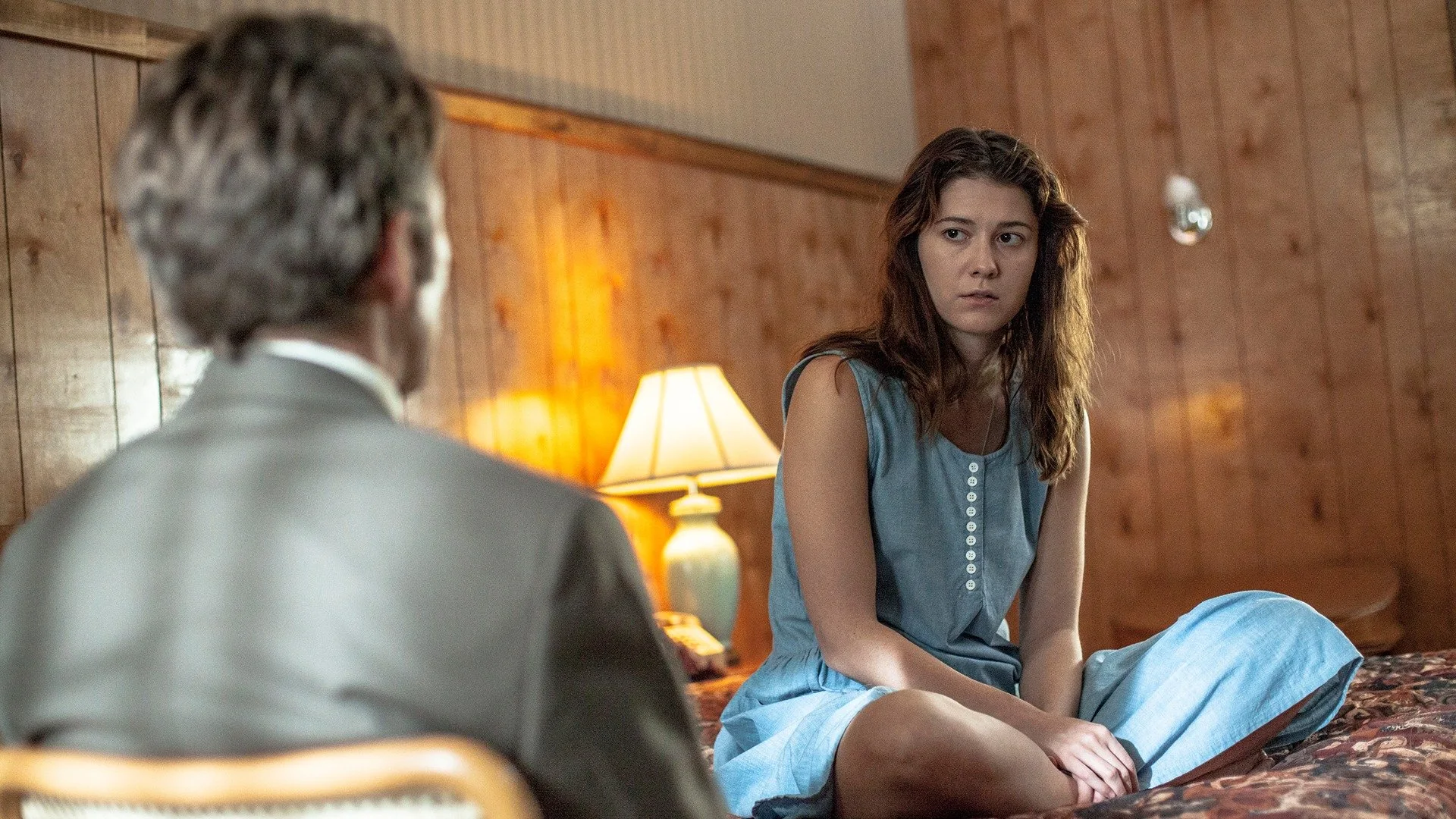
Hey there everyone! Welcome back to Movie Soapbox, the little corner of the internet that only you and I and that guy sleeping in the corner over there know about. This is the place where we find underappreciated indie films and we make sense of them. Today? We are doing a deep dive on Faults, a movie so quietly, surgically ruthless in how it dismantles its own premise that by the time you realize what it’s done to you, you’re already on the floor next to Ansel.
If you haven’t seen Faults yet, go watch it first. Seriously. Close this tab, find it, watch it, come back. Because what I’m about to walk you through will wreck every surprise the film has carefully earned, and this is a film that earned them. You’ve been warned, and I’m not going to warn you again.
Faults Movie Making Of Details
Before we get into the mechanics of what this movie does, let me tell you something about what kind of film this is in industry terms, because that context matters. Faults is a single-location, two-hander psychological thriller built around one genuinely weird, genuinely risky structural inversion. (A brilliant inversion at that.) The kind of script that lands on a development executive’s desk and gets the note, “We love the setup, can we make the cult angle more explained in act two?” You can feel, in the tightness of this film, in the way it refuses to over-explain itself, that someone held the line on a lot of those notes. A film at this budget tier, with a cast anchored by Mary Elizabeth Winstead before she was a name people threw around in greenlight conversations, lives or dies entirely on whether the director trusts the material. Riley Stearns trusted the material. You can tell because the film never flinches into exposition when a lesser version of this script would have. The miracles stay unexplained just long enough, the power dynamic stays ambiguous just long enough, and nobody stops to give you a monologue about what a cult actually is. That restraint is a survival trait. A lot of films like this don’t make it out of post with that restraint intact.
Faults Movie Detailed Walkthrough
So. Ansel. Played by Leland Orser, a man who has made a career out of looking like he is perpetually three bad decisions away from a complete collapse, and who here gets to be the protagonist and the mark simultaneously. Ansel is a fraud and a failure in the most specific, most humiliating way possible: he wrote a book about how to extract people from cults, the book made him briefly successful, and then the actual practice of the thing got people killed. Thirty-eight of them. One of them on camera, on the interview circuit he ran her through, and then she went back. His second book is worthless. His divorce stripped him of the rights to the first one. He owes money to a man named Terry who is not the kind of man you owe money to. Ansel is a con man who conned himself into believing he had a skill he didn’t have, and now the bill is coming due in several directions at once.
Into this wreckage walk two parents. Their daughter Claire, played by Winstead, has been absorbed by a group called Universal Concurrence. They want Ansel to do his thing: abduct her, five days of psychological reprogramming, break her free. He needs the money badly enough to say yes to something he has already demonstrated he cannot do without getting people killed. You are watching a man drown agree to teach a swimming lesson.
Claire arrives at the hotel room. And here is where the film starts doing the thing. She is cooperative. Not resigned, not broken, not the glassy-eyed cult casualty the setup has prepared you for. Cooperative. She sits on the bed. She doesn’t scream. The guard dozes and she doesn’t move. And if you are paying attention, the film has already told you everything. The intervention has already begun. It’s just not Ansel’s.
The reprogramming sequence that follows is the engine of the film. Sleep deprivation, controlled environment, repetition, the slow dismantling of a subject’s grip on their own history. Ansel runs the playbook on Claire. Claire lets him run it, absorbs it, waits. And then, in a locked bathroom that may or may not have been locked at all, she runs it back at him with the precision of someone who has been studying him specifically. Not cults in general. Him. His guilt about Jennifer. His debt to Terry. His professional self-delusion. She names his faults, in the geological sense, the fracture lines where the pressure has been building for years, and she pushes. In fifteen minutes she has him. He murders Terry with a copy of his own book. The intervention worked perfectly. It just wasn’t the one advertised.
Let’s untangle the mechanics for a second, because the film is deliberately elliptical about a few things and that ellipsis is doing real work.
The miracles. Claire appears on the balcony after the room was locked. Claire unlocks the bathroom door from the inside. Ansel, who has spent his career explaining to credulous people how cult tricks work, folds completely at two demonstrations of what are almost certainly mundane physical acts: slipping out before the lock was checked, or the bathroom lock being faulty, or any number of explanations that require zero mysticism. The film never confirms or denies. What it’s showing you is the mechanism of belief: Ansel is so desperately looking for something to be real, so hollowed out by the long accumulation of his own failures, that the bar for a miracle has dropped to a single door lock. That’s the horror of the film. The trick doesn’t have to be good. The mark just has to be ready.
The parents are stranger. They seem real, they seem genuinely worried, but watch them in the interludes. Claire tells her father she is afraid of him, and the scene doesn’t play like a cult member rejecting her family, it plays like something else, something older and more specific. The parents, it becomes clear, are not entirely what they appear to be either. Whether they are complicit in what Claire is doing or simply instruments of it is a question the film leaves deliberately open.
Faults Movie Theories Explained
Now, the interpretations. There are a few serious reads on this film floating around, and they are worth laying out fairly.
Faults Movie Theory #1:
The most straightforward read is the revenge architecture: Claire is a survivor of Universal Concurrence, possibly born into it, and Ansel’s failures, specifically whatever role he played in the death of the 38 who committed suicide, cost her something personal. She targeted him, ran the long game through her parents, engineered the abduction scenario, and used five days to do to him precisely what he has been doing to vulnerable people for years, with the added precision of knowing exactly which psychological wounds to press. Under this reading, the film is a very clean moral inversion: the man who broke people for money gets broken by someone who has been broken by his work. The book inscription she gets at the end is a trophy.
The most straightforward read is the revenge architecture: Claire is a survivor of Universal Concurrence, possibly born into it, and Ansel’s failures, specifically whatever role he played in the death of the 38 who committed suicide, cost her something personal. She targeted him, ran the long game through her parents, engineered the abduction scenario, and used five days to do to him precisely what he has been doing to vulnerable people for years, with the added precision of knowing exactly which psychological wounds to press. Under this reading, the film is a very clean moral inversion: the man who broke people for money gets broken by someone who has been broken by his work. The book inscription she gets at the end is a trophy.
The second read is less about revenge and more about genuine belief. Under this version, Claire really is a member of Universal Concurrence, she really does believe in what she’s offering, and the targeting of Ansel is ideological rather than personal. She believes she is freeing him. The tragedy, under this read, is that Ansel’s freedom consists of murdering a man, and the freedom she’s selling, the freedom from psychological debt, requires subordination to her vision. Freedom from is always a pitch for freedom to, and what she’s offering is a different cage. The film’s title quote lands harder under this reading: a fault becomes a mountain eventually, but right now Ansel is just a fracture, and Claire has filled that fracture with her own ideology.
Faults Movie Theory #3:
The third, thinner read is that Claire is simply a more competent predator operating in the same territory as Ansel, no ideology, no revenge, just the cold recognition that Ansel is an easy mark who can be useful, and the five-day window is an opportunity. This reading makes the film more cynical and less emotionally coherent, so it’s the weakest of the three.
Moviesoapbox Preferred Faults Theory
Here is what I think. The revenge read is the most structurally satisfying and the film has earned it. The specificity of Claire’s psychological attack on Ansel, the way she goes directly for Jennifer, directly for the guilt he has been managing rather than resolving, is too precise to be generic cult outreach. She knows him. She has studied him. The parents are accessories to a long plan. And the book, inscribed to her at the beginning, returned to her at the end after it’s been used as a murder weapon, is the film’s final image for a reason. Whatever Claire lost in the wreckage of Universal Concurrence and Ansel’s incompetent intervention into it, she came to collect. She collected it. The film ends on her terms, with her artifact, with a man who is now completely rebuilt around her narrative of the world. That is not therapy. That is a settlement.
What this film had to survive to exist is the version of it where someone, at some point in development or distribution, decided it needed a cleaner ending. A more legible villain. An Ansel who gets to wake up and understand what happened to him. The version where the hotel room’s ambiguity gets explained in a voiceover, where Claire’s motives get a monologue, where the miracle door gets a rational explanation on screen. That film would have been nothing. The film Riley Stearns made is a small, precise instrument that does exactly what it intends to do and stops. Mary Elizabeth Winstead carries the whole weight of an unexplained character with nothing but presence and control and it is a genuinely great performance in a genuinely small film that almost nobody saw. That’s the thing about films like this. They make it out of the machine intact and then they disappear. You’ve seen it now. Tell somebody.