
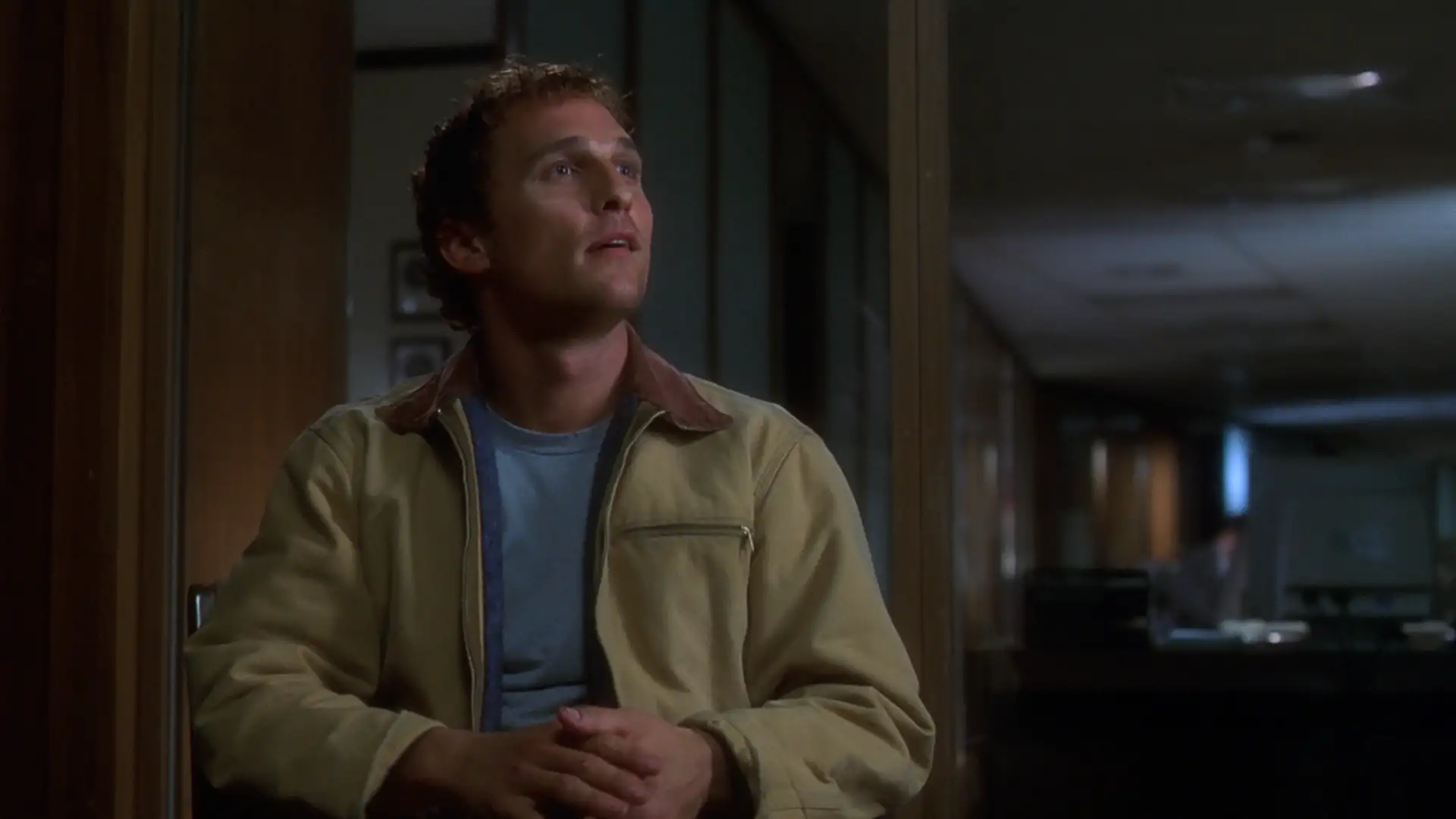
Hey there everyone! Welcome back to Movie Soapbox, the little corner of the internet that only you and I and that guy sleeping in the corner over there know about. This is the place where we find underappreciated indie films and we make sense of them. Today? We are doing a deep dive on Frailty, a movie so quietly, methodically vicious that the first time you watch it you think you’re watching a tragedy about a boy trying to survive a delusional father, and the second time you realize you were watching something much darker root itself into the ground right in front of you the whole time.
Before we get into it, here’s the trailer.
Alright. Full spoilers from this point forward. Everything. The twist, the ending, what it means, who lives, who dies, who was lying to you for the entire runtime. If you haven’t watched Frailty yet, go watch it, come back, and we’ll be here. It’s on most of the major streamers and it will cost you about ninety minutes you will not regret spending. Everyone else, let’s get into it.
Frailty Movie Making Of Details
Bill Paxton directing a serial killer thriller starring himself and a pre-superstardom Matthew McConaughey, shot on a budget that could not have left much room for error, built almost entirely on performance and dread rather than set pieces, released in 2001 when the studio system was firmly in its “if we can’t franchise it, why are we doing this” phase. You want to know what kind of film this is to get made? Films like this don’t get made. They get optioned, they get noted to death, some VP of development asks why the father can’t be more sympathetic in act two, someone else asks if the boys can be aged up to eighteen so the violence feels less uncomfortable, a third person wonders if there’s a way to make the angel real so the audience has someone to root for, and then the project dies in turnaround and Bill Paxton goes back to being the guy from Twister. The fact that Frailty exists as the film it is, uncompromised, with that ending fully intact, is either a miracle of independent financing or the result of a director with enough currency from his acting career to get one clean shot before anyone could stop him. Probably both. You can tell when a film has been protected from the note-giving machinery, and this one was. The third act doesn’t flinch. That’s the tell.
Frailty Movie Detailed Walkthrough
So here’s the setup. A man named Adam walks into the Dallas FBI field office claiming to be his brother Fenton and says he knows who the God’s Hand Killer is. He sits across from Agent Doyle and tells him a story, and the story is what we watch. Their father, Mr. Meiks, woke up one night with a vision. An angel came to him, gave him a list of names, told him these people were demons wearing human skin, and that God needed him to destroy them. Not kill. Destroy. Dad draws a sharp line between those two words and he means it. Adam, the younger boy, believes every word of it from the start, with the total unquestioning conviction of a child who trusts his father completely. Fenton, the older boy, watches his father haul a woman into their shed and beat her to death with a lead pipe and knows exactly what he’s looking at. Two boys. Same father. Same vision relayed to them at the same kitchen table. And they land in completely different places on whether what they are participating in is holy or monstrous.
The mechanics of how this plays out are where Paxton as a director is doing something genuinely smart. He keeps the camera close and domestic, the house looks like a house, the boys look like boys, the father looks like a tired man who loves his kids and is also doing something irreversible in a shed behind the property. There is no gothic architecture, no atmospheric fog, no musical cue telling you how to feel. The horror is entirely behavioral. Dad is calm. Dad is loving. Dad tucks them in. Dad also has a list.
Fenton tries to stop it the only way a child can try to stop something, he tells an adult. He tells Sheriff Smalls. And Smalls comes out to investigate, and Dad kills him. And then Dad, and this is the detail that lodges in you, is angry at Fenton. Not because Fenton told. Because Fenton forced him to kill a person for what Dad experiences as the first time. Until that moment, in Dad’s framework, he had not been killing anyone. He had been destroying demons. Smalls wasn’t a demon on the list. Smalls was a person. And so Fenton’s interference made Dad cross a line Dad did not believe he had crossed before. That distinction, the father’s interior accounting of what he has and hasn’t done, is the movie’s most unsettling idea and it arrives quietly, in a single scene, and Paxton plays it without underlining it.
Dad locks Fenton in the cellar. Starves him. Waits. Eventually brings him back up and tells him the angel has spoken about Fenton, which you understand to mean Fenton’s name has been added to the list. To demonstrate to Fenton what destruction feels like when you can see what a person really is, Dad has Fenton deliver the killing blow on the next victim. Fenton takes the axe. And kills his father instead. The hostage is still alive. Adam, who has been watching all of this, kills the hostage. And now there are two bodies in the rose garden instead of one, and Adam has completed his first destruction without his father’s guidance, and something has been settled in him that is not going to unsettle.
Years later. The man sitting across from Agent Doyle, the man who has been telling this story as though he is the survivor, the damaged witness, the one who escaped, reveals that he is Adam. Not Fenton. He has been Adam the entire time. Fenton is dead, buried, and Adam has assumed his identity in order to sit in this room, in this building, with this specific federal agent, because when Adam touches Doyle’s hand he sees what Doyle actually is. Doyle killed his own mother. Doyle is on the list. Doyle’s name was always going to bring Adam here eventually. And then the axe comes out and Doyle is gone and Adam walks out of the building and no camera catches his face clearly and no witness remembers him being there.
That last sequence, the way Adam’s exit is supernaturally smoothed over, is where the film forces you to make a decision. Either the universe is genuinely protecting Adam because what he is doing is what the universe wants done, or someone or something else is running interference for him, and that something is not the force he believes it to be. The film does not resolve this for you. It holds both possibilities open and hands you the axe and walks away.
Frailty Movie Clarifying Questions
A few things that trip people up on a first watch. The frame narrative is doing heavy lifting and it’s easy to miss how completely it recontextualizes. Every piece of what you think is Fenton’s testimony, his horror at the murders, his framing of himself as the boy who saw the truth clearly, is actually Adam speaking. Adam is not a confused or reluctant participant narrating his own victimhood. He is a man who loved what his father taught him, completed the mission after his father died, assumed his brother’s identity to give himself cover, and is now executing the last name on the current list while sitting in a federal building. The sympathy the framing generates for the narrator is entirely intentional and entirely false. Every moment of apparent torment you read on McConaughey’s face in that interview room is either performance or the specific satisfaction of a man watching his plan close around its target.
The killing of Sheriff Smalls is worth untangling separately because it’s the scene that reveals the theological machinery the film is running on. Dad insists that Smalls was a person, not a demon, and that killing him was wrong in a way that destroying the others was not. This is not a throw-away detail. The film is genuinely interested in what it means to have a framework for violence that includes its own internal moral logic. Dad’s framework is not random. He has rules. He follows them. The problem is that the rules were given to him by something he cannot verify, and the rules require him to do something that any external moral system would classify as murder regardless of the classification he applies to the victim. The movie is not saying religion is dangerous. It’s saying unchecked private revelation with no accountability structure and no external verification is dangerous, and that the psychological profile of a man who receives that revelation and acts on it without question is indistinguishable, from the outside, from the profile of a man who is simply killing people and constructing a justification afterward.
Theories to Explain the Movie Frailty
Now the theories. There are essentially three reads on what Frailty actually is.
Frailty Movie Theory Number One:
The first read is the purely materialist one. Dad is a schizophrenic or delusionally disordered man who has experienced a psychotic break and constructed an elaborate religious framework around his violence. His sons are traumatized children shaped by his delusion. Adam is the one who was shaped most completely, who internalized the framework so fully that it became load-bearing for his identity. The supernatural events at the end, the cameras, the witnesses not remembering, are coincidence, or Adam’s own interference, or simply the kind of gaps in surveillance that exist in any real building. Doyle was a bad man and Adam knew it through research or luck or prior contact. This read is coherent and it’s the one most secular viewers land on.
Frailty Movie Theory Number Two:
The second read is the one the film’s final act is designed to make uncomfortable to dismiss. What if the visions were real. What if the people on the list were genuinely something other than ordinary humans. What if the protection Adam receives on his way out of the building is exactly what it looks like. This read is not comfortable for most viewers because it asks you to accept that a film about a man who beats people to death with a pipe in a shed might be presenting that man as an instrument of genuine cosmic justice, and that the narrative sympathy the film builds for the Fenton-who-is-really-Adam position is not sympathy for a killer, but recognition of a soldier. The film earns this read. It doesn’t argue for it. It just makes sure you can’t fully dismiss it.
Frailty Movie Theory Number Three:
The third read is the one that splits the difference and I think it’s the least interesting. That the film is agnostic, that it wants you to feel uncertain, that the uncertainty itself is the point. Thematically this is defensible but it lets the film off the hook for the commitment it actually makes in that final sequence.
Moviesoapbox’s Preferred Reading of the Movie Frailty:
My read is the second one, and I’ll tell you why. The film is not structured as a tragedy about delusion. It’s structured as a revelation about identity, and the revelation is not that Adam is secretly a monster, it’s that the story you were told was always the story of the man who believed. The frame narrative gives Adam the last word, the last image, and the last moment of apparent peace. Films that want you to leave horrified don’t give their killers that. They give them a cell, or a bullet, or at minimum an expression of vacancy or madness. Adam gets a drive home to a pregnant wife and a statement of completion. The film respects his framework enough to let him close it out. Whether that’s a moral endorsement or the most disturbing choice a filmmaker can make, I’ll leave that to you.
What Bill Paxton did with this film, as a first-time director working with a script he didn’t write, on a budget that required him to find every single effect inside his actors rather than in a production design budget, is the kind of thing that factory Hollywood would have smoothed into a different film entirely. A film where someone explains the theology at the end. Where a federal agent connects the final dots for the audience. Where the ambiguity gets resolved in a post-credits scene or a tagline or a sequel announcement. None of that happened here. Paxton trusted the material, trusted his actors, and got out of the way. We don’t get nearly enough of that. When we do get it, you should watch it twice.
Thanks for spending some time at Movie Soapbox. We’ll see you on the next one.