
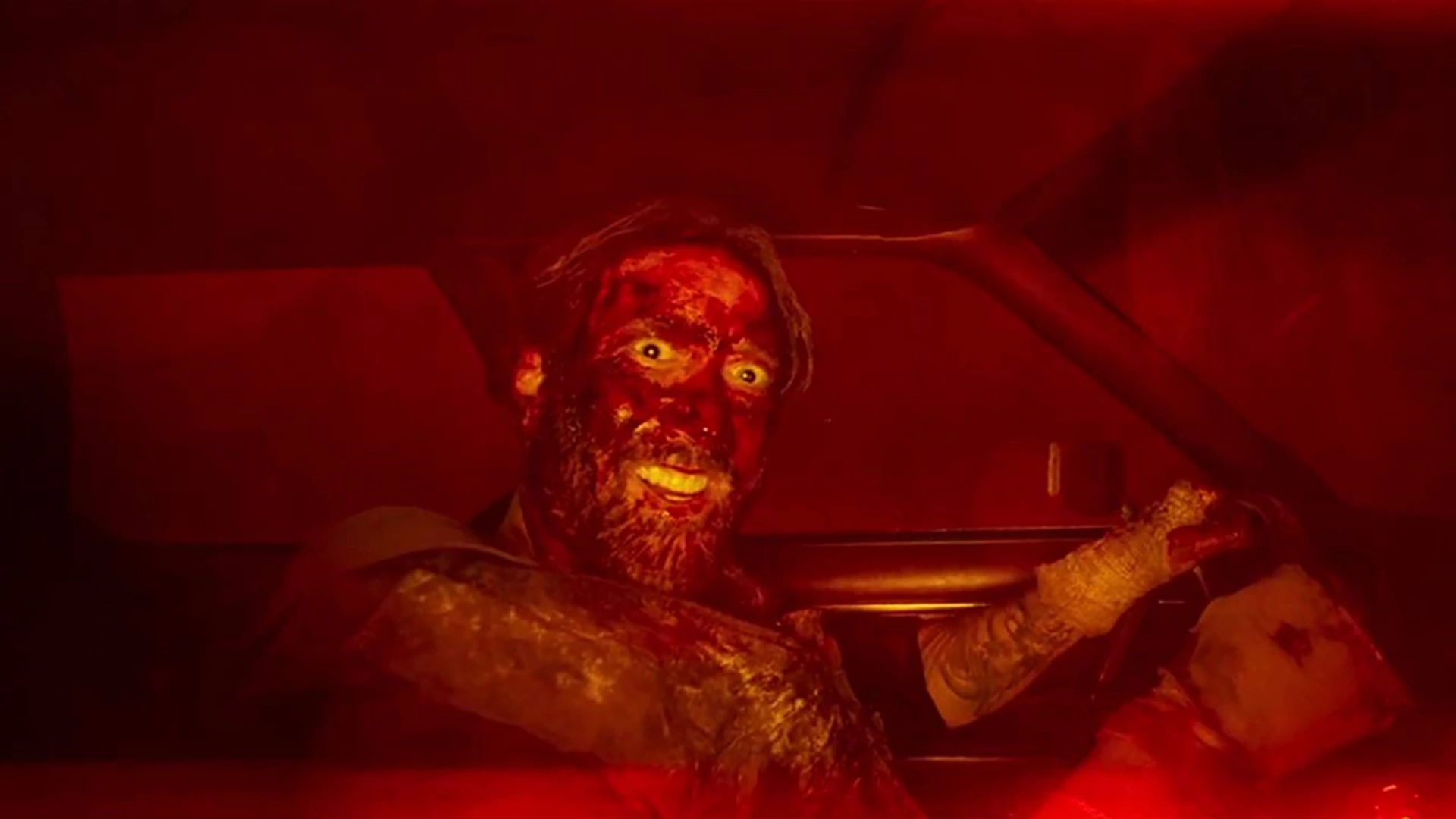
Hey there everyone! Welcome back to Movie Soapbox, the little corner of the internet that only you and I and that guy sleeping in the corner over there know about. This is the place where we find underappreciated films and we make sense of them, really make sense of them, past the plot summary and into the machinery underneath. Today? We are doing a full deep dive on Mandy, a 2018 Panos Cosmatos film so cosmologically unhinged, so drenched in neon blood and Jungian nightmare fuel, that the suits who greenlit it have almost certainly convinced themselves they understood it at the time.
Fair warning before we go any further: everything that happens in this film is about to be laid out on the table, beat by beat, no protective covers. If you haven’t seen Mandy yet and you want to go in cold, stop here, go watch it, come back. I’ll wait. For everyone else, the ones who watched it and felt something crack loose in their skull and need someone to explain why, buckle in, because we are going all the way down.
The Movie Mandy and the Making Of
Before we get into the film itself, let me tell you what this movie is and where it lives in the ecosystem, because that context matters. Mandy is the kind of film that gets made exactly once, by exactly the right director, at exactly the budget tier where a studio can’t afford to fully destroy it but a streaming platform can afford to let it breathe. Cosmatos came in with Beyond the Black Rainbow already on his record, which is a film that most distribution executives couldn’t sit through to the end, and that reputation is a two-edged thing. On one hand, nobody’s calling him a safe pair of hands. On the other hand, nobody’s going to pretend they don’t want him at the table. When a film arrives with Nicolas Cage attached at a budget that doesn’t require a global opening weekend to survive, you get a very specific window of creative latitude, and what you can see in Mandy, if you watch for it, is Cosmatos using every inch of that window before anyone could call a meeting about it. The third act of this film has none of the test-screening flinch. No hedged landing, no softened emotional resolution, no studio note in the world that says “but does the audience feel hopeful at the end.” That’s not luck. That’s what a director does when he gets the ball across the line before the committee convenes.
The First Third: Red, Mandy, and the World That Gets Broken
The opening third of this film exists entirely to make you feel the weight of what’s going to be destroyed. Red Miller, played by Cage doing something genuinely strange and genuinely right, is a lumberjack living in the Pacific Northwest wilderness in 1983, and his relationship with Mandy Bloom (Andrea Riseborough, who is doing work here that most actors couldn’t locate in themselves on their best day) is the emotional architecture the rest of the film is built on top of. You need to feel that this is real, and complete, and worth grieving, because the film’s second half only functions if the first half lands.
Watch the moment Mandy walks out of the lake toward a fire on the shore, and watch what Cosmatos and his cinematographer Benjamin Loeb do with the camera speed. It drops. Deliberately, unmistakably. She is not moving at the speed of ordinary people in ordinary films. The film is telling you something about what she is, and it isn’t subtle about it. She is from somewhere else. Not metaphorically from somewhere else, the film is operating in a register where the mythology is literal, and Mandy exists in this story the way a figure from an older kind of story exists: as a quality, a state, a thing the world is capable of producing but not of keeping.
There is a scene where Mandy finds a dead baby deer in a field and just stops. And then she tells Red the story of her father and the starlings, how he recruited the children to help him bludgeon them, how she refused and ran. If you have ever watched a starling murmuration, you know these are not ordinary birds doing ordinary bird things. They move in patterns that look like something willed into existence, and the story of a man systematically killing them one by one is the story of a certain kind of person encountering a certain kind of beauty and deciding the correct response is elimination. Mandy refused. That refusal is her entire character, and the film remembers it all the way to the end.
The Cult, the Horn of Abraxas, and What Evil Actually Wants
Jeremiah Sand (Linus Roache) sees Mandy walking on a road from the window of a van and decides he has to possess her. The mechanism here is straightforward even when the mythology is not: Jeremiah is a man who has built an entire theology around his own appetites, who has surrounded himself with people whose function is to execute those appetites, and when he sees something genuinely pure his instinct is to consume it. Evil doesn’t want to coexist with purity. It wants to incorporate it, stain it, prove that it was never really pure to begin with.
So he summons his lieutenant Brother Swan, and he orders him to use the Horn of Abraxas. Let’s stop there, because Abraxas is doing real work in this film and it’s worth understanding where the name comes from before the movie buries you in what it means. Abraxas is a figure that traces back through Egyptian, Greek, and Roman occult traditions, picked up by Gnostic theology, and then lodged in the historical record as a kind of supreme being who sits above both good and evil, or, in the darker readings, as a demon who passes himself off as the highest god. A trickster at the cosmological level. The horn summons his minions, and that summoning has a price: Jeremiah offers Brother Hanker as payment. A life for a life. This is what blood covenants look like in the film’s grammar.
Mandy is delivered to Jeremiah, drugged, and stung by a hallucinogenic beetle as a kind of grotesque sacrament. And then Jeremiah, this man who has spent his entire adult life building a mythology around his own significance, tries to perform that significance at Mandy. He monologues. He reveals himself. And she laughs at him.
That laugh is the pivot point of the entire film. Mandy has been drugged, terrorized, and prepared for violation, and her response to Jeremiah Sand’s self-presentation is laughter, because she sees him clearly, completely, without the fog of his own mythology, and what she sees is nothing. He is hollow all the way through. And the laugh cripples him so completely that his only recourse is her death. Red, tied up and forced to watch, sees Mandy hoisted and burned. She dies at the exact midpoint of the film. Everything after is a different movie.
Carl Jung, the Red Book, and Why This Film Is That Book
Carl Jung, early twentieth century, breaks from Freud over a disagreement that looks simple from the outside but is enormous in its implications: Freud sees the unconscious as primarily personal and primarily sexual, Jung sees it as containing something older and shared, a collective layer of imagery and archetype that belongs to the species and not just to the individual. Jung calls this the collective unconscious, and he spends years trying to access it directly, through self-induced hallucinations and confrontations with the figures he finds there, all of which he records in a manuscript called the Red Book.
Here is what matters for Mandy: the chief figure Jung encounters in those sessions, the entity presiding over the spirits crowding against his door, is Abraxas. Jung’s Abraxas is not simply evil and not simply good, he is the force that holds both together and exceeds both, the engine underneath the moral categories we use to organize our experience. And in Jung’s cosmology, the way you deal with this force is not by defeating it from the outside but by undergoing it from the inside, by letting it move through you until you understand what it is. Red Miller’s second half is not a revenge narrative in the Hollywood sense. It is a descent. The film is structured as a Jungian integration crisis rendered in Technicolor fire and chainsaw.
Watch what Red does in the second half. He shows mercy on the Chemist, who is surrounded by darkness and knows it. He lets Sister Lucy go. He is not killing indiscriminately, he is moving through a specific architecture of evil, culling only the unrepentant, following a path toward the source. And when he reaches Jeremiah Sand and takes his life, his response is not grief, not relief, not the weary justice-is-done exhale of a standard revenge narrative. It is something that looks like euphoria. That’s the reshoot scar that no studio film can afford to leave in, the implication that the destruction of the thing that destroyed you might feel less like closure and more like completion of a circuit you didn’t choose to close. Cosmatos left it in. Nobody made him round the edges off.
The Shirt, the Double, and the Jungian Read That Ties It Together
Late in the film, in the closing flashback sequence, there is an image that rewards multiple viewings: Red and Mandy, in the early days of their relationship, are both wearing what appears to be the same shirt. The same shirt, on two separate people, in the same frame. Then in the car at the end, same image. Then Mandy in her Led Zeppelin shirt from earlier, and Red in his bloodied final-act clothes, two states of the same person layered in the same shot.
What is the film doing here? The reading that holds up under pressure is the Jungian one: Mandy is Red’s anima. In Jungian psychology, the anima is the interior feminine aspect of a man’s psyche, the part of him that is capable of connection, of art, of the kind of perception that lets you see a murmuration as beautiful rather than as an inconvenience to eliminate. Mandy sketches. Red admires the sketches. Mandy sees the dead deer and stops. Red watches her see it and understands something he couldn’t have found on his own. She is the part of him that the world, in the form of Jeremiah Sand and everything he represents, tried to extinguish.
The post-credits sketch, Mandy’s drawing of Red alongside a tiger, closes the loop. The tiger the Chemist releases near the end of the film is not a random image. In the drawing it sits beside Red as his double, the caged animal loosed, the instinct that was waiting behind all that patient lumberjack quietude. The Jungian reading of the whole film lands here: this is an integration story. Red recovers the part of himself that was destroyed, not by getting her back, because she is gone, but by becoming the thing that was capable of burning the world down for her. That’s what it cost. That’s what it took.
The Competing Reads
There are a few other serious interpretations worth laying out fairly before I tell you which one I think is right.
Mandy Movie Explanation Theory #1 – The first is the pure grief allegory read. Cosmatos has said publicly that he wrote Mandy while processing the deaths of both his parents. Under this reading, the film is an exteriorization of what grief does to the interior architecture of a person, the way it splits you into the part that still exists in the ordinary world and the part that has been incinerated and has to reconstitute itself in fire. Red’s second half is what the grief work of losing something irreplaceable actually feels like from the inside, which is less like healing and more like controlled demolition.
Mandy Movie Explanation Theory #2 – The second is the straightforward supernatural reading. The demons are real, Abraxas is real as a cosmic force operating in the world of the film, and what we are watching is a genuine spiritual war in which a man is selected, tested, and forged into a weapon capable of closing a wound in the fabric of the world. Under this reading the film is closer to a dark fantasy than to psychological horror, and the imagery earns that reading, the Hell’s Angels biker demons summoned by the horn, the whole visual vocabulary of the film, it all holds together as literal mythology.
Mandy Movie Explanation Theory #3 – The third is the Cage-as-performance read, less a theory about what the film means and more a theory about what it is, the argument that Mandy is primarily a platform for Cage to do something in the second half that no other actor alive could do, and that the film’s meaning is secondary to its function as a delivery mechanism for that performance. This is the weakest of the three reads as interpretation, but as a description of what the film feels like in your body while you watch it, it has something.
Moviesoapbox’s Read on Nicolas Cage’s Mandy
The Jungian integration reading is the one that holds everything together without leaving anything loose on the floor. The Abraxas connection is not a coincidence or an aesthetic choice, it is the key. Cosmatos read Jung’s Red Book, or absorbed it through whatever channel he absorbed it, and he built a film that is structurally, not just thematically, a cinematic expression of the confrontation Jung describes. The collective unconscious surfacing through grief. The anima destroyed and the self that has to reconstitute itself in the aftermath. The demons you have to move through rather than around.
The shirt image at the end is the director telling you directly: these were never two separate people in the way this film’s plot suggests. Red and Mandy are the same psyche in two modes, and the story is about what happens when the world takes a chainsaw to the half of you that was capable of beauty, and what the surviving half becomes in response. Cosmatos processed his parents’ deaths by making a film about what it costs to lose the part of yourself that made ordinary life bearable. And he did it in a movie that looks like a blacklight poster and sounds like a dying synthesizer and contains what might be the best thing Nicolas Cage has ever done on screen.
No committee wrote this film. No VP with a coverage note and a greenlight calendar got within a hundred miles of this third act. That’s why it exists the way it exists, which is the only way it could exist. Most films like this one get sanded down to a finish you can present to a test audience in a multiplex in Burbank and walk away from without needing a drink. This one didn’t. Whatever kept it intact, whether it was the budget tier, the cast attachment, the distributor relationship, the specific alignment of whoever was in the room when someone tried to call a meeting about it, something held. The result is one of the rare films where you can feel the absence of the notes that were never given. And that absence is the whole movie.
Go watch it again – see if it makes more sense now. We are ready to discuss it in the comments.