
Hey there everyone! Welcome back to Movie Soapbox, the little corner of the internet that only you and I and that guy sleeping in the corner over there know about. This is the place where we find underappreciated indie films and we make sense of them. Today? We are doing a deep dive on The Changeling, the Apple TV+ adaptation of Victor LaValle’s novel, a show so genuinely, uncompromisingly dark that the people who greenlit it were probably already drafting the notes to soften it before the first episode finished rendering.
Before we go any further, a warning in plain English: everything from this point forward is a spoiler. Every beat, every reveal, every image that’s going to sit behind your eyes at 3am. If you haven’t finished the show, or at minimum finished LaValle’s novel, close this tab and go do that first. Come back when you’ve seen the eye. You’ll know what I mean.
Now. Let’s talk about what this show actually is, what it survived to get to your screen, and what that final image means, because it means something specific and the industry machinery that surrounds a show like this is already working very hard to make sure the next chapter means something considerably softer.
Here’s the insider tell, the thing the summary posts won’t mention. A show like The Changeling, literary IP with a Black lead, a horror premise that refuses to resolve its trauma cleanly, premiering on a prestige streaming platform still trying to define its brand, that is a show that arrived at your screen with marks on it. You can feel, in certain episode structures, the tension between the source material’s absolute refusal to comfort the audience and a platform’s structural need to keep subscribers from canceling. The fact that the show ends on an enormous, unblinking eye underground, with nothing answered, no reunion, no catharsis, is a minor miracle. That ending reads like a director gripping the wheel with both hands and refusing to let anyone steer. The budget tier, the platform, the subject matter, all of it points toward a show that should have been walked back from the edge. It wasn’t. Not fully. And that matters.
The Overview of The Changeling
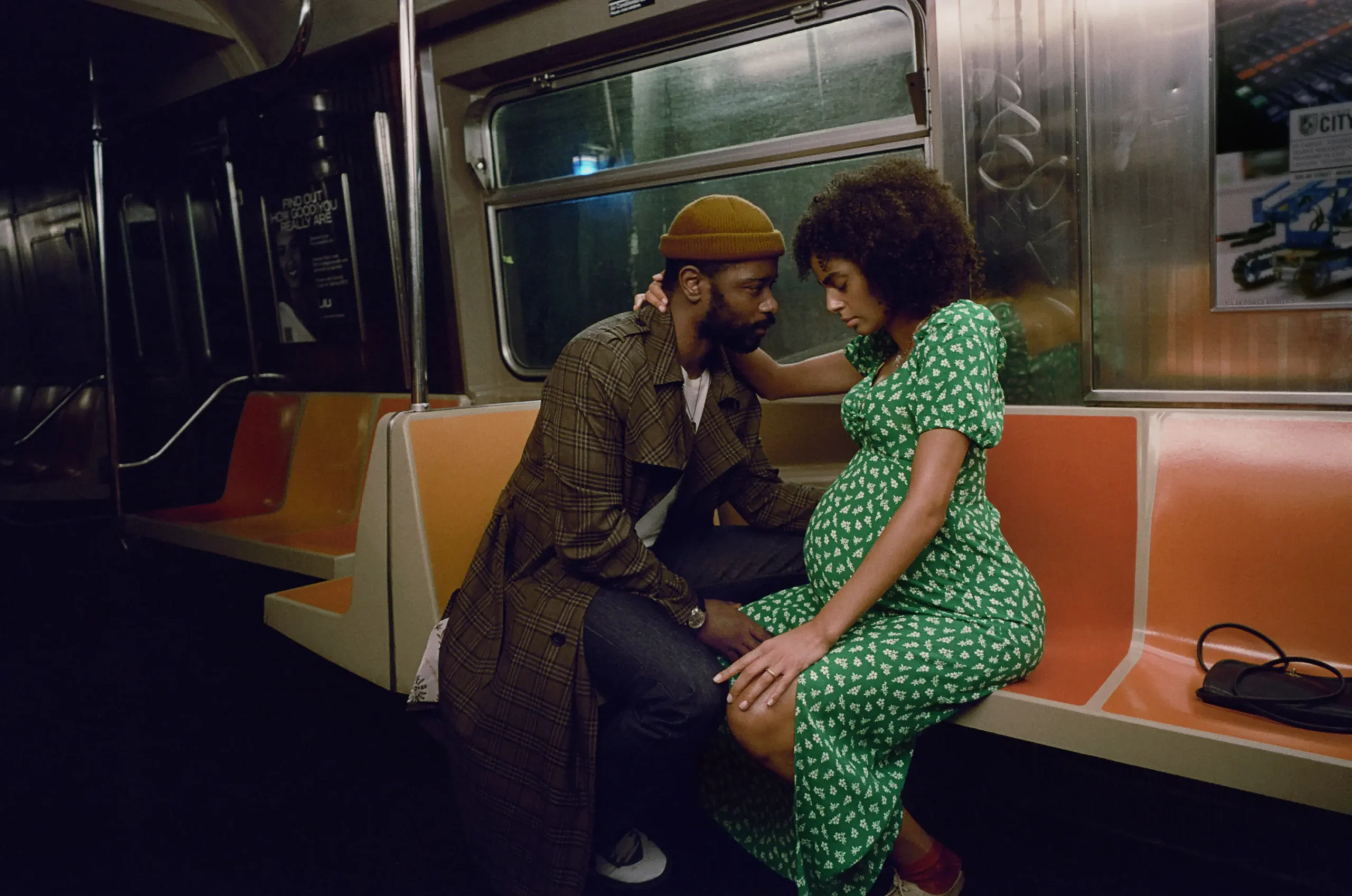
So. Apollo and Emma. New York. A baby named Brian. The setup is domestic and recognizable before it becomes anything else, which is exactly the move, because the horror that follows is not the kind that works if you don’t first believe in what’s being lost. Apollo is present, engaged, stays home with Brian while Emma returns to work at the library. And then postpartum depression begins to move through Emma like weather moving through a house with no walls. The medication doesn’t hold. The messages on her phone keep disappearing. She becomes increasingly certain that the child in the crib is not Brian. And Apollo, to his lasting shame, responds to all of this by wanting her to take more pills and be quieter about it.
What follows is the scene the whole show is built on and built toward simultaneously. Emma chains Apollo up, beats him, and kills Brian with boiling water. Then she vanishes. The show doesn’t flinch from this. It doesn’t cut away at a tasteful moment and let you fill in the blank. It wants you to sit in the full weight of what postpartum psychosis can do when the people around the person suffering decide that management is easier than belief. Apollo didn’t believe her. The cost of that is a dead child and a missing wife and a story that refuses to clean itself up.
While this is happening, there’s a parallel thread that initially reads like a completely different show. Apollo deals in rare books and comes across an extremely scarce first edition of To Kill a Mockingbird. He connects online with a buyer, William Webster Weaver, a transaction that turns out to have nothing to do with the book and everything to do with the fact that William has been tracking Apollo for a while, because something happened to William’s child too, and William is trying to get his wife back. Apollo, at this point, would mostly like the money. The universe has other plans.
William has a boat. He knows about an island. Apollo agrees to go, because at this point he has almost nothing left to lose, which is the exact moment when stories like this one decide to take absolutely everything else. When they arrive, women take them prisoner. Cal, who leads the community on this island, explains what happened to Brian. He was replaced. A changeling. The faerie tale logic that the show has been threading through its imagery since the first episode is now the operating system of the actual plot. And Kinder Garten, which means children’s garden, is not one person, it is a host, a collective, thousands of individuals doing the work of something much larger and much darker, and that larger darker thing has been using Apollo as a key to find an island that exists at the edge of reality, an island Apollo could find precisely because of his grief and his desperation. He walked right through the door and held it open behind him.
What Kinder Garten actually is, the mechanics of it, is this: a legion, a word the show uses carefully and intentionally, possessing and directing human bodies toward a single purpose. The purpose is children. Specifically, stealing them. Replacing them. The faerie mythology the show has been decorating its edges with is the real infrastructure. These are not metaphors dressed up as monsters. The monsters are the point.
The assault on the island is brutal and the escape is costly. Cal and Apollo get the women and children to the boat. Cal drives a stake through the thing wearing William’s body, or through whatever William had become by that point. Apollo leaves. He goes to Central Park because he knows Emma went there, because Emma went there to find Brian, the real Brian, the one who was taken and replaced before she ever had to do what she did. He follows her underground. And then the show gives you the eye. An enormous eye, in the dark, staring back at him from somewhere beneath the earth. And then the credits.
A few things need untangling before we get to what the eye actually means. William Webster Weaver carries Norwegian lineage in his family history, and the show plants a detail early about an ancestor who crossed the ocean on a voyage that the math of wind and sail simply doesn’t account for, a crossing that required something external to ordinary physics. The river monster you see early in the show is part of that same fabric. William was the architect of Emma’s disappearing messages, a tech-driven harassment campaign designed, presumably at the direction of or under the influence of Kinder Garten, to destabilize her, to push her toward what she ultimately did. Cal’s attack on William doesn’t kill him because the show tells you clearly, through the way the attack resolves, that whatever William is connected to dragged him somewhere else for later use. He is not done. The island exists in a liminal space, between coherent geographic reality and something else, which is why it’s effectively unfindable to anyone not operating in a state of sufficient desperation or sufficient darkness. Apollo found it through grief. Kinder Garten found it through Apollo. The island’s defenses are real but they were always going to be insufficient against something that arrived wearing a trusted face.
The fairy tale book that recurs throughout the show is not background decoration. It is the show’s thesis statement delivered through the most disarming possible wrapper. The faerie mythology it contains is the actual account, told in a register that adults dismiss as fiction because that dismissal is useful to the things it’s describing. The faeries in real faerie lore, not the sanitized revision, steal children. They hold them. They do not give them back. The show understands this and takes it seriously. The book is the instruction manual that nobody reads as an instruction manual until it is far too late.
The Changeling Theories to Explain It All
Now, the competing reads.
The first interpretation of the Changeling is the literal one: the supernatural elements are real, Brian was genuinely replaced by a changeling, Emma perceived the truth that no one around her would credit, and her psychosis was not psychosis but accurate perception filtered through a mind that had no framework to hold it. Apollo’s journey confirms this reading completely by the end of the season.
The second interpretation of the Changeling is the Metaphorical Postpartum read: the way institutions, medical and social and familial, fail mothers by pathologizing their distress rather than investigating its cause. In this reading, the monsters are real but they are the monsters of isolation, of disbelief, of a husband who wanted quieter suffering rather than the loud kind. The island, Cal, Kinder Garten, all of it is the internal geography of a woman who was failed at every point.
The third read interpretation of the Changeling is a Mix of both: that the show refuses to arbitrate between the supernatural and the postpartum approach… and is in fact arguing that they are the same thing. That the supernatural horror and the very real horror of postpartum psychosis are not competing explanations but a single truth told in two languages simultaneously.
The Moviesoapbox read would be the third one, but weighted toward the literal. The show earns its monsters. LaValle’s prose earns them too. The dismissal of Emma’s perception is the original sin of the story and it maps precisely onto how postpartum psychosis gets managed in the real world, through medication and minimization rather than genuine belief, but the show is not interested in letting you use that mapping as an escape hatch from the supernatural. The monsters are real. They took Brian. Emma knew. The eye underground is not a symbol of Apollo’s grief. It is an eye. It is looking at him. Whatever it belongs to has been there a very long time and will be there considerably longer.
Which brings us to why season 2 is a problem. LaValle’s novel is one book. There is no sequel. The show ended on an image that is complete, a man staring into the void of something far larger than any single story, with no resolution and no comfort and no promised return of what was lost. That is a faerie tale ending. Not a fairy tale ending, a faerie tale ending, and the difference is everything. Real faerie tales end in grief. Real faerie tales end with the stolen child not coming back. Real faerie tales end with an enormous eye in the dark and no more light. The moment a second season has to manufacture plot, you are one writers’ room conversation away from Brian coming back somehow, from Apollo and Emma getting the closure the first season deliberately refused to give them, from the eye becoming something that can be defeated rather than something that simply is. Every prestige streaming platform has exactly one move when a show ends ambiguously on dark material and gets attention: they make more of it until the darkness is diluted into something the algorithm can sell. That is the machine. The Changeling season one survived it once. I wouldn’t bet the same odds on a second pass.
The show is about the things that take children and the systems, mythological and medical and marital, that make that taking possible. It is about the knowledge that passes through women, mother to daughter, knowledge that gets dismissed as superstition right up until the moment it’s the only thing standing between something ancient and the child in the next room. It got made. It got made dark and unresolved and genuinely strange. That’s the miracle. Leave it where it ended. In the dark, with the eye, with Apollo standing there having finally arrived somewhere the story needed him to go, with no map for what comes next. Some things shouldn’t have a next.
🎬 If You Liked This…
- Midnight Special — a father trying to protect a child with something inexplicable about them, the same desperate parental love driving someone into places the ordinary world refuses to acknowledge exist
- Lamb — the same horror of a parent’s love for something that shouldn’t exist in the form it takes, mythology and the domestic fused so completely that neither can be separated from the other
- Daniel Isn’t Real — the same boundary between psychological horror and genuine supernatural threat, something that attaches itself to someone you love and the people around them trying to understand what they’re actually dealing with