
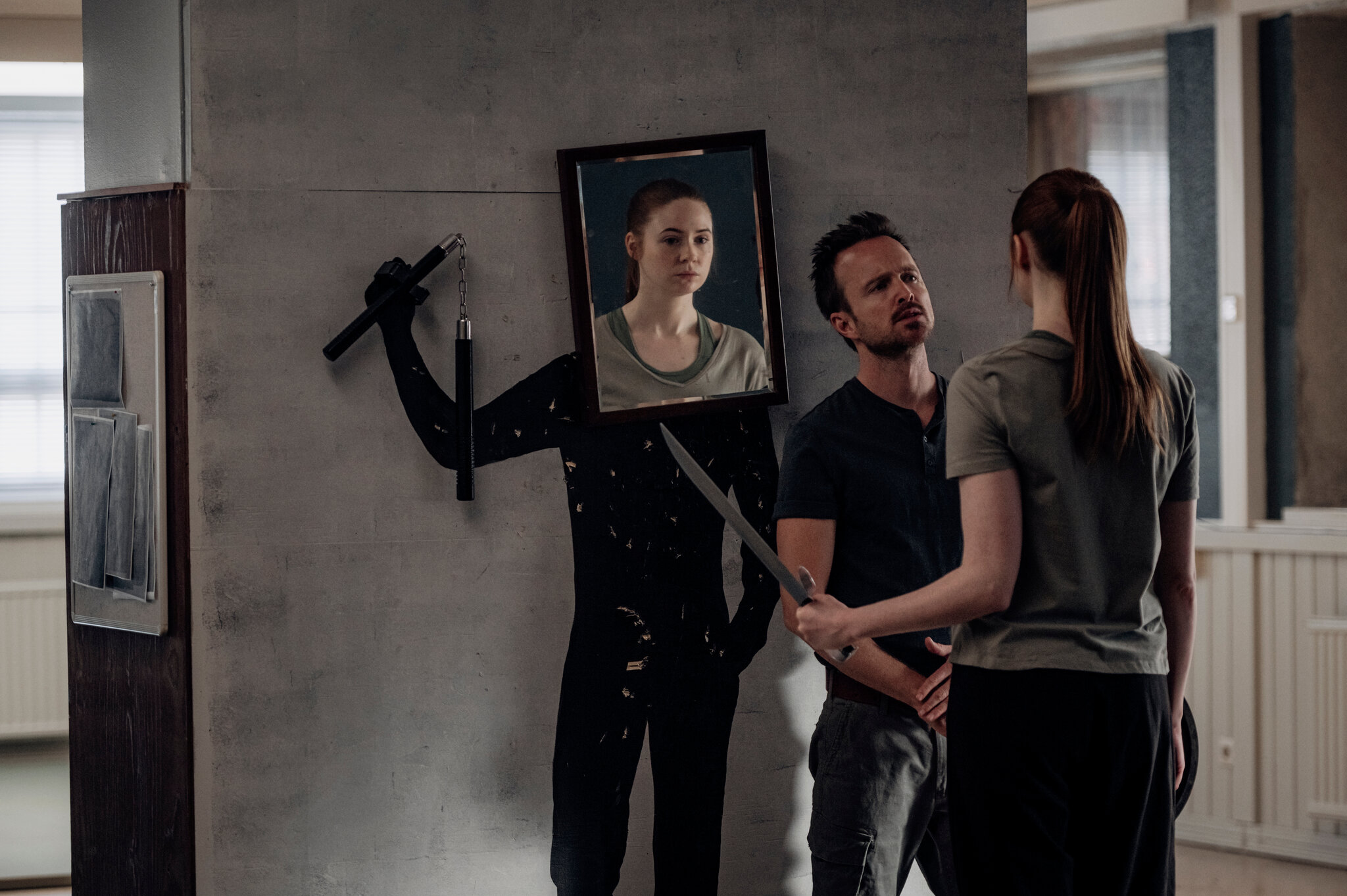
Hey there everyone! Welcome back to Movie Soapbox, the little corner of the internet that only you and I and that guy sleeping in the corner over there know about. This is the place where we find underappreciated indie films and we make sense of them. Today? We are doing a deep dive on Dual, a movie so quietly, surgically bleak that the people who greenlit it probably thought they were buying a quirky sci-fi comedy and only figured out what they actually had somewhere around the third cut of the trailer.
Fair warning: everything past this paragraph is a full, unfiltered walkthrough of the entire film, ending included. If you haven’t watched Dual yet, close this tab, go watch it, then come back. I’ll still be here, still annoyed, still right about the phone screen.
The 2022 Movie Dual Making of Explanation
Riley Stearns made The Art of Self-Defense for somewhere in the neighborhood of two and a half million dollars and it is one of the more precise, unsettling pieces of deadpan filmmaking to come out of that decade. Dual is the same register, the same flat affect stretched over a premise that should be pure genre pulp, and the fact that it exists in this form at all tells you something about how Stearns operates. A film this committed to its own tonal weirdness, this unwilling to reassure the audience that it knows it’s being funny, does not survive five rounds of studio notes. You can tell, watching it, that nobody with a development deal and a greenlight instinct got near this script, because every instinct a development executive has would have been wrong here. The flat delivery would have gotten notes toward “more warmth.” The ending’s deliberate ambiguity would have gotten notes toward “clarity.” The whole thing would have been softened, explained, resolved. The reason Dual lands is precisely because none of that happened. Low budget, tight control, no committee. That’s the only way this movie gets to be this movie.
So here is what you are actually watching.
Dual Movie Deep Dive Walkthrough
Sarah, played by Karen Gillan doing career-level work in a register most actors don’t know exists, gets a terminal diagnosis. Not a maybe, not a could-go-either-way, a 98% mortality certainty with a 2% statistical rounding error that her doctor clearly does not think she should be banking on. In this near future, there is a service: you can be cloned, and your double will step into your life after you’re gone, sparing your loved ones the full weight of grief. It’s a softer version of the clone premise than science fiction usually runs, no organ harvesting, no conspiracy, just a company selling the comfort of continuity. Sarah takes the deal, funds it on loan, and begins the strange work of teaching her double how to be her.
Then Sarah goes into full remission. Complete. And suddenly she has a clone of herself living inside her life, and her husband Peter has, without enormous subtlety, fallen in love with Sarah’s Double, which is, in this film’s magnificently flat naming convention, the clone’s actual legal name. Sarah’s Double files a legal stay against decommissioning. The law accommodates this. The solution the system arrives at is a fight to the death, one year out, televised, regulated, with a trainer assigned to the original Sarah to prepare her for it.
Sarah trains. Obsessively, methodically, for a full year. She is paying divorce fees, medical fees, clone maintenance fees, legal fees, trainer fees, and she does all of it because the thing she actually wants is not survival in the abstract but Peter back, her mother’s warmth back, her life back. And here is the thing you have to write down, because the whole ending turns on it: Peter tells Sarah, clearly and without cruelty, that there is nothing she can do to return to his life. He is in love with Sarah’s Double. That door is closed. Sarah hears this and files it away in the same place she files everything else, and keeps training.
Now: Sarah’s Double is not stupid. She has watched Sarah train for a year and she understands the math. A fair fight is a fight she loses. So she pivots. She manufactures intimacy, engineers a plan, and sells Sarah on the idea of running away together before the fight, crossing into Canada, disappearing into a shared life that renders the whole duel moot. Sarah agrees to this. Stop here and ask yourself why. Sarah has no warmth toward her double. She has no reason to trust her. She has spent a year sharpening herself into someone who can win a sanctioned death match, and she is going to walk away from it because of a detente proposal from the opponent? The answer is that Sarah saw exactly what was happening, and she let it happen on purpose.
In the woods, just short of the border, Sarah’s Double offers water from her own backpack, and she does it with all the subtlety of someone who has never actually had to deceive anyone before. “Drink a lot of this. Take a bigger drink just to be safe.” That is not manipulation, that is a draft of manipulation. Sarah sees it the moment the words leave the double’s mouth. What happens next is the film’s central sleight of hand, the thing it performs without showing you: Sarah does not get poisoned. Sarah kills her double in those woods and buries her. Then she gets in the car and drives it back to the field like someone who has been poisoned and is barely holding on, swerving, crashing, veering, selling the theater of a dying woman making it back just far enough to be declared the winner.
She walks out of that car and tells everyone she is the Original. The field officials confirm it. Peter is there, and her mother, and they accept this immediately, and here is where the film quietly detonates: her mother buys her colored contacts to cover her blue eyes, the way the Double needed, the eyes that Sarah never needed covered because they were always hers. Peter starts talking to her in the exact register he used with Sarah’s Double, gentle and slightly condescending, telling her to take care of herself, that women peak earlier than men. Sarah stands inside it, receiving it, and when Peter suggests Mexican food she says she hates Mexican food, which was never true of Sarah but was always true of the Double, and you can see in Gillan’s face that she is throwing it back at him and he does not notice at all.
Then her mother calls. And Sarah’s phone screen is cracked and mangled in exactly the pattern it was cracked and mangled before. Not the Double’s clean phone. Sarah’s phone. The physical object does not lie even when every character in the frame is accepting one.
Theories to Explain the Movie Dual
Two readings exist for this ending and they are worth laying out fairly.
Theory #1 to Explain the Movie Dual
The reading that roughly ninety percent of first-time viewers land on: Sarah’s Double poisoned Sarah, survived, drove back to the field, and is now living inside Sarah’s life, pretending to be the original while everyone believes her. Under this reading the contacts make obvious sense, the bad driving is the poisoning, and the whole film becomes a story about a woman who did everything right and lost anyway to a lazier but more cold-blooded opponent. Under this reading the film is pure tragedy, mean and airless, a story that punishes every good impulse Sarah ever had.
Theory #2 to Explain the Movie Dual
The reading that the film actually supports, if you follow the physical evidence rather than the emotional comfort of tragedy: Sarah won. Sarah killed her double in those woods, drove badly on purpose to sell the performance, and has now successfully conned her way back into her own life by pretending to be the clone of herself. The contacts aren’t the Double covering her tracks, they’re Sarah accepting a prop she doesn’t need in order to stay in character. The cracked phone screen is the tell. It is Sarah’s phone. Sarah is alive.
The Film Explanation Moviesoapbox Supports
The reason this reading matters more is what it costs Sarah. She trained for a year not to win a fight but to win Peter back, and she did it, and what she won is a husband who talks down to her and a mother who is buying her colored contacts for a disguise she doesn’t need, and she is sitting in a car in a roundabout, crying, because she burned a year of her life and killed a version of herself to get back inside the exact trap she was handed a clean exit from. The film began with Sarah being told she was going to die and responding by trying to preserve her life for the people she loved. It ends with her very much alive, very much with those people, and trapped in a shape of that life that was never quite hers to begin with.
That is the ending Riley Stearns actually made. Not the clean tragic irony of the double winning. The messier, more human tragedy of Sarah winning and discovering what she won.
A film this precisely, stubbornly itself doesn’t come out of a system that was paying attention. It comes out of a director who had enough control and enough budget obscurity to finish the thing before anyone with a testing process could get to it. Most films with this premise get their endings explained to them before they’re released. Dual kept its ending. That’s the whole story.
🎬 If You Liked This…
- The One I Love — a person confronting an alternate version of themselves and having to decide which one gets to continue existing, the same queasy question of what makes you irreplaceable when a better version of you is available
- Infinity Pool — cloning as the mechanism for exploring identity dissolution, the same horror of discovering that your copy might be indistinguishable from you in every way that matters
- ARQ — the same cold Kafkaesque logic of a system with its own rules about who lives and dies regardless of what the humans inside it want, bureaucracy applied to survival with the same deadpan inevitability