
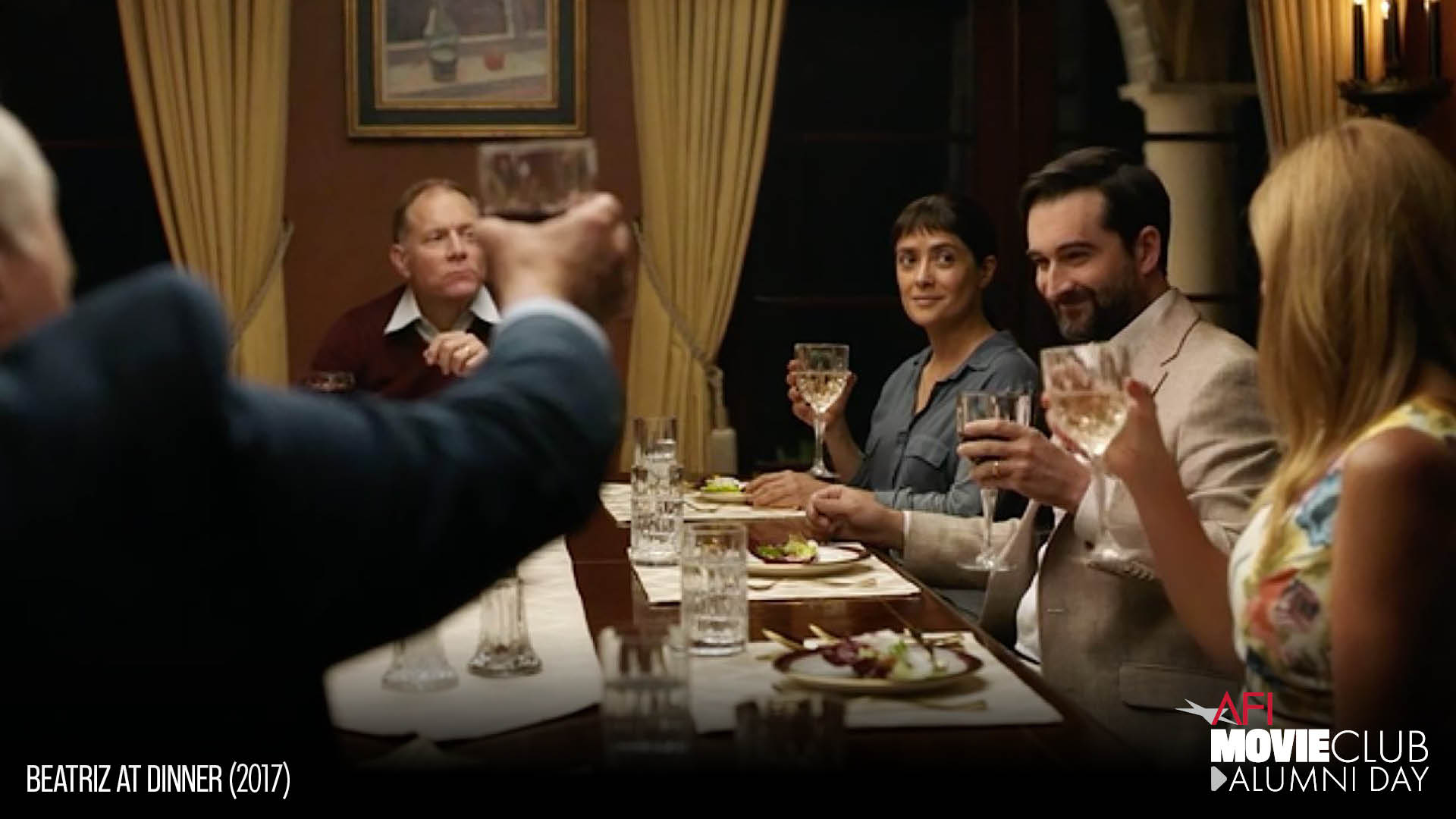
Hey there everyone! Welcome back to Movie Soapbox, the little corner of the internet that only you and I and that guy sleeping in the corner over there know about. This is the place where we find underappreciated indie films and we make sense of them. Today? We are doing a deep dive on Beatriz at Dinner, a movie so quietly savage, so committed to making you sit in your discomfort without handing you a blanket, that even the people who championed it probably needed a drink when the final cut locked.
Before we get into it, here is the trailer.
Full spoilers from this point forward. All of them. The ending, the fantasy sequence, the walk into the ocean, every uncomfortable inch of this thing. If you have not watched the film yet, go do that and come back. It will hit harder if you do not know where it is going, and this is a film that earns its landing.
Still here? Good. Because what Miguel Arteta and screenwriter Mike White actually pulled off with this film is worth understanding at the mechanism level, not just the thematic one.
Films like this, small cast, single-location bottle structure, no action set pieces, no franchise scaffolding, the whole commercial value proposition being two people arguing about the soul of civilization over a dinner table, those films get killed in development every single day. They get killed by the note that says “where is the second act turn” and the note that says “the protagonist needs to be more relatable” and the note that says “can we give her a win somewhere in act two.” The fact that Beatriz arrives at that dinner table exactly as blunt and uncompromising and non-cathartic as she does means somebody held a line somewhere. Salma Hayek attached as producer and star is probably a significant part of why that line held. At this budget tier, at this level of political directness, you do not get to make the ending you actually want to make without a piece of talent in the room who has enough leverage to say no to the note asking you to soften it. Watch this film knowing that version exists somewhere. The version where Beatriz gets a small victory. The version where Doug shows a flicker of conscience. Nobody made you watch that version. You are watching the real one.
The Movie Beatriz at Dinner Walkthrough
So. The setup. Beatriz is a holistic healer, a massage therapist, a woman who works with cancer patients and carries in her the specific exhaustion of someone who has spent her entire adult life trying to push back against entropy, one body at a time. Kathy, one of her clients, is extraordinarily wealthy in the way that has become so normalized it no longer registers to Kathy as a condition. When Beatriz’s car breaks down outside Kathy’s Malibu home before a dinner party, Kathy invites her to stay. The invitation is genuine and it is also completely thoughtless, because Kathy has not paused to consider what she is actually asking Beatriz to walk into.
The dinner is in honor of Doug Strutt, played by John Lithgow with the specific kind of ease that makes him genuinely frightening. Doug is a developer. He has made an enormous amount of money turning things that existed, places that mattered to people, communities, coastlines, into profitable product. He is not cartoonishly evil. He laughs at the right moments. He is charming at the right moments. He is a man who has so thoroughly constructed a moral framework around his own appetites that he experiences himself as reasonable.
The rest of the table fills out the ecosystem around Doug. Grant and Kathy, the hosts, occupy the anxious middle, people with enough conscience to feel the discomfort of what is happening but not enough conviction to do anything about it. Alex and Shannon are the younger iteration of the same arrangement, climbing the same ladder, not looking down. Doug’s wife Jeana orbits him the way people orbit money they did not earn, careful and practiced and quiet.
And then there is Beatriz, who does not know how to perform indifference to things that matter to her.
The rhinoceros is where it breaks open. Doug passes his phone around the table showing a photo of a rhino he killed on safari, and Beatriz throws the phone back at him. Not carefully. Not diplomatically. She throws it. And the table freezes in the particular way people freeze when someone has violated the unspoken contract of a dinner party, which is that everyone agrees to behave as though the things happening outside this room are not happening.
Kathy sends Beatriz to bed to cool down. Beatriz spends the time reading about Doug. The labor disputes, the environmental violations, the long trail of places that used to be something and are now something else. She comes back downstairs with a guitar and sings a song in Spanish about longing for a home that no longer exists. The table receives it better than you expect, because the table does not understand what they are receiving.
What follows is the film’s central confrontation, and Arteta and White refuse to make it operatic. Beatriz does not shout. She delivers her polemic at dinner party volume, measured and precise, and that restraint is what makes it land so hard. She tells Doug that all his pleasure is built on other people’s pain. Doug’s response is genuinely revealing: he is not angry, he is puzzled. He cannot locate the moral framework she is operating from because his own framework has no slot for it.
Grant kicks her out. Doug follows her outside while she waits for her tow truck, smokes a joint, and delivers his argument. We are all dying. The animals are dying. The world is dying. The intelligent response to entropy is to extract as much pleasure as you can before the lights go out. Pure Epicurean logic, stripped of everything Epicurus actually meant, retrofitted to justify Doug’s specific appetites. It is the most honest thing Doug says in the film and it is completely bankrupt.
Beatriz goes into Grant’s study, picks up a letter opener, and in the version of events that plays out in her mind, she crosses the room and drives it into Doug’s neck and holds him while he dies. Then the film cuts to the real version. She walks into the foyer. Doug is on his phone. She drops the letter opener on the floor, loud, in front of him. Deliberate. And she leaves.
Beatriz at Dinner Movie Explanation Theories
Beatriz at Dinner Theory #1
The first read is straightforward psychological realism. Beatriz is a woman with a genuine empathy disorder, meaning empathy so acute and so unmediated that it has become a wound. The dinner is the final data point in a lifetime of evidence that the forces generating the suffering she spends her days trying to repair are not only not stopping, they are being celebrated at dinner parties with very good wine. The murder is a fantasy. The walk into the ocean is a suicide. She has reached the end of what she can absorb.
Beatriz at Dinner Theory #2
The second read is more allegorical and the film earns it. Beatriz is not primarily a character, she is a way of being in the world. The film is asking what happens to that way of being when it makes genuine contact with Doug’s way of being. The answer is that it does not survive. Not because Doug wins the argument, he does not, but because the world Doug has built does not have a place for Beatriz in it, and she knows it, and the ocean is the only place left that does not belong to him.
Beatriz at Dinner Theory #3
The third read, which a fair number of people land on, pushes back on both of the above and argues that the ending is ambiguous on purpose, that Arteta is refusing the catharsis of either resolution, the catharsis of the fantasy kill or the catharsis of the confirmed death, and leaving you exactly as unresolved as the political problem the film is describing.
Moviesoapbox’s Take On Beatriz at Dinner
My read? The second one, hard. The murder fantasy is the film being honest about what pure moral clarity actually feels like from the inside when it is pressed against pure moral blankness, it generates a homicidal rage that Beatriz is too good to act on. The ocean is not ambiguous. The film has been building to it since the opening frame, since the first shot of Beatriz in the water, since every moment she has described her connection to the natural world as the one place she still feels at home. She goes back to the only place that has not been developed. That is the ending. And the fact that Arteta does not show you her going under is not ambiguity, it is the same trust he has extended to you the entire film. He is not going to do everything for you. He has made a film about people who expect everything done for them. He is not making that film twice.
There is a moment near the end where Beatriz tells the tow truck driver that Doug killed her goat. She means it literally and she means it completely figuratively. Doug, or the system Doug represents, has been through her neighborhood, her community, her country of origin, her adopted country, the street she grew up on, the hillside her goat lived on, and taken whatever it wanted and called it development and moved on. She has spent her entire life coming in behind men like Doug and trying to heal what they leave. The goat is everything. She is not being metaphorical. She is telling you the whole film in a single sentence.
This film got made and released in 2017 and went almost entirely unseen, which is either a tragedy or exactly what the film predicted would happen to it. A small, formally perfect, politically uncompromising movie about the people who actually run things, starring a woman of color as the moral center, ending without consolation. You can map the entire commercial calculation against it and understand exactly why it did not get the platform it deserved. That is the film’s argument, made again, by the market, in real time. Some films prove their own thesis just by existing and failing to find an audience. This is one of them. And by the way, the discomfort is the point.
If You Liked Beatriz at Dinner…
The Kindergarten Teacher (2018) – A quiet woman becomes obsessed with protecting something beautiful from a world that doesn’t deserve it. The line between devotion and destruction evaporates.
Miss Sloane (2016) – A woman takes on the most powerful people in the room and wins by being smarter and more ruthless than every single one of them.
Suburbicon (2017) – The rotting underbelly of polite suburban privilege. Clooney directs a Coen brothers script about the violence hiding behind white picket fences.