
Hey there everyone! Welcome back to Movie Soapbox, the little corner of the internet that only you and I and that guy sleeping in the corner over there know about. This is the place where we find under-appreciated films and we make sense of them, argue about them, and occasionally hold a quiet little funeral for the kinds of movies nobody bothers making anymore. Today? We are going deep on the best movies the 1980s ever produced, a decade so dense with genuine craft and legitimate weirdness that the studios have spent forty years strip-mining its corpse and still haven’t hit bottom.
Fair warning: we are going all the way down to number one, and if you have not seen most of these films, you are about to feel the specific shame of a person who has been eating at the Olive Garden and calling it Italian food. This list goes deep. We are covering the teen greats, the action movies, the comedies, the science fiction, and then we are narrowing it to a top five and picking a winner. You have been warned, and also, you’re welcome.
Before we get into the films themselves, let me tell you what this list is actually about, because it is not really about nostalgia, even though nostalgia is the tax you pay for caring about this era. The 1980s were the last decade where a mid-budget studio film could be built entirely around a character who had something specific and strange to say, where the whole engine of the movie was one weird kid’s interiority, and nobody in the greenlight meeting stood up and said, “but where does the franchise go from here?” John Hughes could write a script in a weekend and hand it to a director and two months later you had Sixteen Candles. A film like Heathers, which is genuinely disturbing and shot through with a kind of pitch-black satirical fury that would make a modern studio development executive need a lie-down, got made because the people who made it were allowed to follow the idea all the way to the edge without a committee of VPs pulling them back. You look at the development process for any of these films and you see a lightness, a speed, a willingness to just let the thing be what it wanted to be. That window closed. The decade ended, and then the lawyers arrived, and then the franchise math arrived, and then the IP portfolio arrived, and here we are.
Teen 80s Greats
Heathers (1988) — Christian Slater and Winona Ryder. Murders posed as suicides, a high school social hierarchy used as a killing field, and dialogue so sharp it draws blood on the way out of your speakers. This is the film that should not have gotten made and absolutely, stubbornly, defiantly got made anyway. The premise alone, a romantic comedy in which the love interest is a sociopath who blows up teenagers, should have been killed in the room. The fact that it survived tells you everything about what was possible before the liability lawyers got final approval on creative decisions. Winona Ryder at the height of her powers. Slater doing a Nicholson impression that is so committed it becomes its own thing entirely. Watch it.
Planes, Trains and Automobiles (1987) — Steve Martin and John Candy trying to get home for Christmas while a snowstorm disassembles their dignity piece by piece. One of the greatest road movies ever made, and quietly one of the saddest, because John Candy is doing something in this film that goes about fifteen layers deeper than the premise requires, and Hughes lets him go there. The last ten minutes will gut you if you are not paying attention, and they will gut you harder if you are.
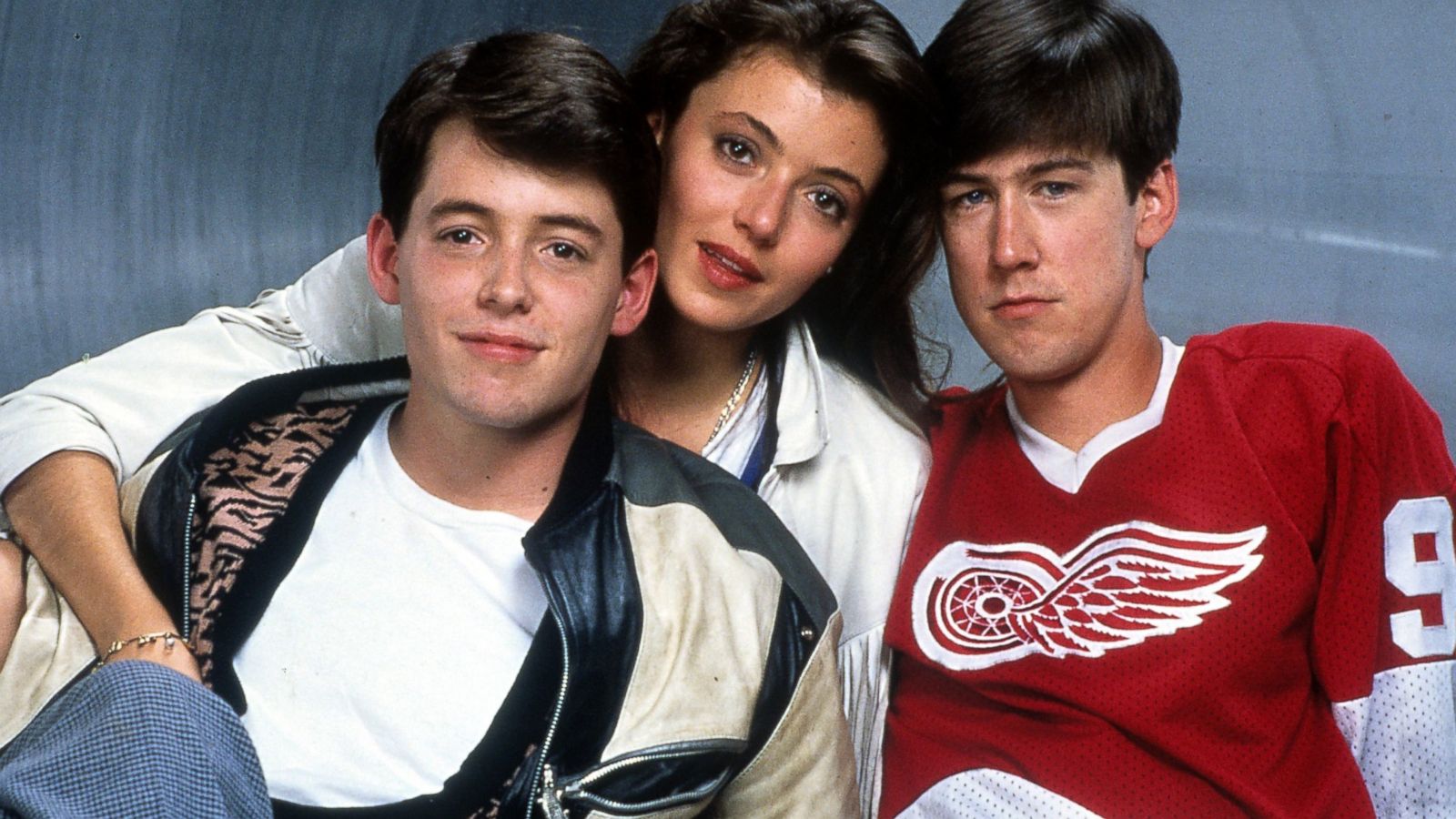
Ferris Bueller’s Day Off (1986) — Matthew Broderick talking directly into the camera, essentially daring you to look away, and you cannot. The “Save Ferris” mythology that half a dozen lesser films have spent thirty years unsuccessfully photocopying. The whole Cameron subplot, which is doing something genuinely poignant about the cost of a certain kind of midwestern repression, embedded inside what the marketing told you was a silly skip-day comedy. Hughes at full velocity. We will come back to this one.
Sixteen Candles (1984) — Molly Ringwald, John Cusack, the dweeb, the jock, the party that destroys the house, and a kind of honest sweetness underneath all of it that the genre spent years trying to replicate without ever quite getting the formula right. The original template. Everything downstream from this is either a tribute or a pale imitation.
The Breakfast Club (1985) — Five archetypes locked in a room, and Hughes trusting his actors enough to let the archetypes crack open and show you something real underneath. Ringwald, Estevez, Judd Nelson, Ally Sheedy, Anthony Michael Hall. The stratified cruelty of high school social hierarchy dismantled over the course of a single Saturday detention. Genius in the architecture. Still holds.
Pretty in Pink (1986) — Yes, it blurs together with Sixteen Candles, and yes, the ending was famously reshot after test audiences rejected the original because they could not handle Andie ending up with Duckie, which tells you something true and depressing about test screening as a creative tool. The reshot ending is the lesser ending. The film is still worth your time. More John Hughes, more Ringwald, more of that specific 1986 feeling of being seventeen and certain that the social order you were trapped in was permanent.
St. Elmo’s Fire (1985) — Seven friends navigating the wreckage of the first year after college, with Demi Moore and Rob Lowe doing things that should be embarrassing but are instead weirdly compelling. The spiritual predecessor to every ensemble “what now” drama that followed it, including Reality Bites, which is a better film but exists entirely in this film’s debt.
Footloose (1984) — Kevin Bacon as the city kid who brings rock music and dancing to a town that has legally prohibited both, and the rebellious-outsider movie essentially writes its own instruction manual here. Every “one charismatic kid shakes up a repressive community” film you have seen since owes this one a royalty check. Bacon is fully committed in a way that refuses to let you write it off as camp even when it is flirting with camp.
Weird Science (1985) — Two teenage boys accidentally create a woman using a Barbie doll and a computer, and the movie is completely sincere about this as a premise, which is the only approach that could possibly work. Anthony Michael Hall at peak Hughes. Kelly LeBrock being effortlessly several levels above everything happening around her. The id of the entire decade distilled into ninety-four minutes.
Can’t Buy Me Love (1987) — Patrick Dempsey in the role that made a generation of awkward kids feel briefly visible. Geek pays to be popular, discovers that popularity is a transaction with terrible terms and conditions, and the movie is smarter about the economics of teenage social status than it has any right to be. Very cute. Very earnest. Holds up better than you’d expect.
Best 80s Action Movies
WarGames (1983) — Matthew Broderick hacks the military’s WOPR supercomputer and nearly starts World War III, and the film is tense and funny and prescient in a way that makes you realize the people who made it were actually thinking about something real. The computer logic still plays. The stakes feel earned. Broderick carries it entirely on charm and that specific energy of a kid who is smarter than the situation he is in.
Raiders of the Lost Ark (1981) — If you need a synopsis of Raiders of the Lost Ark then this list genuinely cannot help you, and I say that with warmth. Harrison Ford, the opening ten minutes, the boulder, all of it. The adventure movie that set the template for every adventure movie that came after it and was never quite equaled by any of them, including its own sequels.
Aliens (1986) — Ridley Scott made Alien, which is a horror film about one creature and pure dread. James Cameron looked at that premise and decided to make a war film about four thousand creatures and pure chaos, and the audacity of that pivot is still staggering. Sigourney Weaver doing things in this film that should have won her every award available. Bill Paxton as the definitive portrait of a man whose panic is proportionally appropriate to the situation. One of the greatest sequels ever made, full stop.
Top Gun (1986) — Tom Cruise, Val Kilmer, beach volleyball, the need for speed, and a soundtrack that was engineered in a lab to be inseparable from the experience of being alive in 1986. You can argue about the film’s relationship to actual human depth all you want, and you would not be wrong, but you would also be missing the point. Top Gun knows exactly what it is and commits to it at full throttle from frame one. That is its own kind of craft.
Red Dawn (1984) — Before Reagan and the wall, the ambient terror of Soviet invasion was a real, lived, background hum in American cultural life, and this film is the purest cinematic artifact of that fear. Swayze and Charlie Sheen and Jennifer Grey as high school kids leading a guerrilla resistance movement in occupied Colorado. More hairspray than is technically necessary. Absolutely worth seeing for what it tells you about the decade’s collective nightmares.
RoboCop (1987) — Cop gets murdered. Cop gets rebuilt as a corporate law enforcement product. Corporate law enforcement product starts remembering he was a person. Paul Verhoeven directed this film, which means what looks like a violent action movie is actually a vicious satire of privatization, corporate personhood, and American brutality, and he hid all of it inside enough gunfire and gore that the studios let him do it. That is the Verhoeven move, every time, and it is a great one.
The Terminator (1984) — Arnold Schwarzenegger as a machine from the future sent to murder the mother of the future resistance leader, and James Cameron’s first major film is so tightly constructed, so genuinely relentless in its internal logic, that it has never stopped feeling urgent. The low budget is completely invisible because every dollar is on the screen. Arnold is terrifying here in a way he was never quite allowed to be terrifying again once he became a movie star.
Lethal Weapon (1987) — Mel Gibson as a cop who is clinically, genuinely suicidal and therefore fearless, paired with Danny Glover as a cop who has too much to lose and therefore reasonable, and the film is smart enough to understand that the tension between those two positions is the whole movie. Shane Black’s script is doing more work than the action sequences get credit for. The buddy cop genre template, set here, never improved upon.
First Blood (1982) — Sylvester Stallone as a Vietnam veteran who gets a parking ticket and then, in a cascade of escalating official stupidity and cruelty, becomes the entire problem the town did not know it had created by the way it treated the men who came home from the war. It is a better, sadder, more genuinely angry film than its sequels allowed it to be remembered as. The original is worth revisiting without the franchise mythology attached to it.
The Untouchables (1987) — De Palma directing Robert De Niro as Al Capone and Kevin Costner as Eliot Ness, with Sean Connery collecting an Oscar for a role that is essentially Sean Connery explaining how things work to a younger man. Fantastically violent. The train station sequence is one of the great set pieces of the decade. Great movie all the way through.
Predator (1987) — Arnold Schwarzenegger in a jungle, a special effects creature that remains genuinely impressive, and a film that has the self-awareness to understand that its plot is a delivery mechanism for its central image, which is the apex predator of the 1980s action movie discovering that it is being hunted. That is the whole film. It is enough.
Die Hard (1988) — Bruce Willis flying to Los Angeles to reconcile with his estranged wife, ending up in a high-rise office building during a hostage situation, and spending the rest of the film bleeding, exhausted, and barefoot while killing terrorists one at a time. John McTiernan directed this film with a spatial clarity and a sense of escalating cost, Willis’s physical and emotional cost, that almost nobody has matched since. The best Christmas movie ever made. That is a settled question and I will not debate it.
Batman (1989) — Tim Burton’s Batman is a film about a genuinely disturbed man who dresses as a creature of the night to process unresolved childhood trauma, and Burton got to make that film inside a major studio superhero picture because the superhero industrial complex had not yet calcified into the thing it became. Jack Nicholson’s Joker is a masterclass in controlled excess. Michael Keaton is doing something genuinely strange and specific that no one has replicated in the role since. The last Batman film that felt like it had an actual auteur’s fingerprints on it.
Young Guns (1988) — Emilio Estevez as Billy the Kid, Kiefer Sutherland, and a cast of young actors doing the thing the Brat Pack did best, which was taking genre material seriously enough to let the human stuff breathe inside it. One of the legitimately great Westerns of the decade and consistently underrated in lists exactly like this one.
The Karate Kid (1984) — A bullied kid, Mr. Miyagi, wax on, wax off, and a third act tournament fight that is structured with the same narrative rigor as a great three-act play. The film understands that the karate is never really about the karate, that it is about the relationship between a boy who has no father and a man who has lost a son, and it earns every emotional beat it collects.
80s Comedy Greats
Big (1988) — Tom Hanks as a twelve-year-old in an adult body, navigating corporate culture and adult desire with the complete sincerity of a child, and the film is genuinely funny and genuinely sad in equal measure. The toy company floor scene. The piano. Hanks doing physical comedy and then turning it off instantly to show you something achingly lonely. A great film disguised as a high-concept comedy.
When Harry Met Sally (1989) — Nora Ephron’s script and Rob Reiner’s direction and two performances, from Meg Ryan and Billy Crystal, that make the central question feel genuinely unresolved right up until the moment it resolves. The deli scene. The New Year’s Eve speech. The whole film is a careful argument that friendship and romantic love are not separate categories and it makes the argument in the funniest possible way.
Raising Arizona (1987) — The Coen Brothers’ second film, Nicolas Cage and Holly Hunter stealing a baby from a furniture magnate who has more than he needs, and the film is so stylistically distinctive, so committed to its own weird grammar, that it still feels like nothing else made in this decade or any other. Probably the funniest film on this entire list, and the Coens were twenty-eight and thirty-three years old when they made it.
The Princess Bride (1987) — A fairy tale told to a grandson by a grandfather, swashbuckling and swordfighting and true love and the ROUS’s and “inconceivable” and the whole magnificent absurdist structure of it. Rob Reiner making his second appearance on this list with a completely different register. Cary Elwes and Robin Wright and Mandy Patinkin and the immortal Inigo Montoya speech. One of those films that is exactly as good as you remember it being when you were nine.
Beverly Hills Cop (1984) — Eddie Murphy at the absolute peak of his powers, running the same basic comedy move, which is a smart man treating a stupid system with the contempt it has earned, through an action movie framework and making it work completely. The Axel Foley laugh. The banana in the tailpipe. Murphy carrying every scene he is in through pure velocity of charisma.
Vacation (1983) — Chevy Chase and the slow, inevitable, catastrophic collapse of the American family road trip, John Hughes again, and the film understands that the comedy and the sadness are not separate things but the same thing viewed from different angles. Clark Griswold is a man undone by his own determination to create a perfect memory, and that is both very funny and genuinely painful if you look at it directly.
Police Academy (1984) — A mainstay of the decade’s comedy landscape whether or not it is anyone’s personal favorite, and I say that as someone whose affection for it is more archaeological than emotional. It is part of the fossil record of 1984 American humor and it belongs on any honest list of the decade’s defining films.
Good Morning, Vietnam (1988) — Robin Williams as a military DJ in 1965 Saigon, and the film gives him enough runway to do the thing Williams did better than anyone, which was use comedy as a pressure valve for something that hurt too much to address directly. The improvised broadcast sequences remain extraordinary. Watch it specifically for those, and then stay for the rest because the rest is better than you expect.
Airplane (1980) — I will tell you exactly what I think of Airplane: it is one of the most influential comedies of the decade and I find almost none of it personally funny, and I recognize that both of those things are true simultaneously and that the second one says more about me than about the film. The slapstick density is genuinely impressive as a technical achievement. The pun delivery is surgical. If this is your register, this is your film. It belongs here.
Caddyshack (1980) — Chevy Chase, Bill Murray, Rodney Dangerfield, a gopher, Harold Ramis directing, and you are asking me to write a synopsis. Stop. Watch it. The Bill Murray scenes alone justify its place in the canon of American comedy.
Mr. Mom (1983) — Michael Keaton taking over as the stay-at-home parent when his engineering job evaporates, and doing it with a physical comedy instinct and a warmth that is completely distinct from the Batman performance he would give six years later. Great early Keaton. A must see if you want the full picture of what this man could do before the franchise claimed him.
The Goonies (1985) — A group of kids from a dying neighborhood go looking for pirate treasure to save their homes from a property developer, and the film is a Spielberg-produced adventure that runs on the specific fuel of children being taken completely seriously as protagonists. Sean Astin and Josh Brolin and the rest of the ensemble. Data’s gadgets. One-Eyed Willy. The first movie a generation of kids saw and felt seen by.
Ghostbusters (1984) — Bill Murray, Dan Aykroyd, Harold Ramis, and Sigourney Weaver in a film that is simultaneously a supernatural comedy, a New York movie, a workplace comedy, and a film about the specific exhaustion of being the only competent people in a crisis. The Murray performance is so casual and so precise that it looks effortless, which is the hardest thing to do. The song. The marshmallow man. All of it.
80s Science Fiction Greats
Blade Runner (1982) — Ridley Scott’s Los Angeles 2019, rain-soaked and neon-lit and dying, Harrison Ford as a detective who hunts artificial humans, and Rutger Hauer delivering the “tears in rain” monologue, which he wrote himself on the last day of shooting, and which remains one of the most quietly devastating moments in the history of science fiction cinema. Deckard is a replicant. I am not apologizing for saying it. Watch it again and pay attention.
Back to the Future (1985) — The time travel movie against which every subsequent time travel movie is measured, including the serious ones, including Primer, including Looper, and none of them have fully displaced it because none of them have its emotional engine, which is a kid who wants his parents to be okay finding out that they were once just kids who wanted to be okay too. Funny, clever, perfectly constructed, and Robert Zemeckis and Bob Gale wrote a first-act setup so efficient that film schools still use it.
E.T. the Extra-Terrestrial (1982) — Spielberg at his most vulnerable and his most technically precise simultaneously, which is an extraordinary combination. A boy, a creature who wants to go home, and a chase by government agents that manages to be genuinely frightening inside what is also a deeply gentle film. The bicycle against the moon. Drew Barrymore. John Williams doing the thing John Williams does, which is write themes so emotionally direct they bypass all your defenses. The Reese’s Pieces, a piece of product placement so organic it became part of the mythology.
Splash (1984) — Tom Hanks and Daryl Hannah in a film that takes its premise, a man falls in love with a mermaid, completely seriously, and that sincerity is what makes it work. Ron Howard directing with the steady hand he always has. Funny throughout, and sweeter than most films of this era were willing to be. An underrated entry in the Hanks canon.
Poltergeist (1982) — “They’re here.” Two words. The suburban home as a site of genuine supernatural horror, the white noise of the television as a portal, a child speaking to the dead through static, and JoBeth Williams doing real work in a film that is often categorized as pure entertainment. Tobe Hooper directed it, Spielberg produced it, the creative authorship question has never been fully settled, and the film is terrifying either way.
Labyrinth (1986) — David Bowie and Jennifer Connelly and Jim Henson’s creature work, and a film that is doing something genuinely strange about adolescence and the specific grief of leaving childhood behind, and doing it through a fantasy framework that is stranger and more committed than almost anything else released in a major studio context in this decade. The contact juggling. The Escher stairs. The goblin city. A film that earns its cult status.
The Top Five
You want the top five. Fine. Here they are, and I am going to tell you exactly why each one is here.
Top Gun sits on this list because when you close your eyes and think “1980s movie,” this is one of the first three images your brain produces. The volleyball scene. The aviators. Kenny Loggins. It had everything the decade wanted to believe about itself, the competence, the cool, the uncomplicated heroism, and it delivered all of it at a volume that has never fully faded. You do not have to defend it. It defends itself.
Sixteen Candles is here because it is the cleanest distillation of what John Hughes understood that nobody else understood, which is that a sixteen-year-old girl’s specific, particular embarrassment and longing and humor are worth the full resources of a studio film. Molly Ringwald and the way she plays this material, which could so easily tip into cute or cloying but never does, is the reason the genre existed at all.
Heathers is here and I am not justifying it. It is the darkest thing on this list and the funniest and the sharpest, and it got made because for one brief window a writer named Daniel Waters and a director named Michael Lehmann were allowed to follow an idea all the way past the point where a sensible studio note would have stopped them. What you are watching when you watch Heathers is a film that was not supposed to exist. That is its whole energy. Christian Slater on fire. Winona Ryder on fire. Dialogue that cuts.
Ferris Bueller’s Day Off needs no defense. So I won’t give one.