
Hey there everyone! Welcome back to Movie Soapbox, the little corner of the internet that only you and I and that guy nervously refreshing his Yelp profile in the corner over there know about. This is the place where we find the films and shows that rewired something in your brain and we actually make sense of them. Today we are going deep on Nosedive, the Black Mirror episode so surgically precise about how social approval actually works that watching it in 2024 feels less like science fiction and more like someone filed a documentary and mislabeled the genre.
Before we get into it, here is the trailer so you know what we are dealing with.
Alright, if you have not watched Nosedive yet, go fix that and come back, because everything from this point forward is a full spoiler walkthrough of the entire episode, beginning to end, and I am not going to slow down for you. You were warned. We are going in.
The script for Nosedive was written by Michael Schur and Rashida Jones, which is a combination that should have produced something warm and funny and humanist, and it does, and that is precisely what makes it devastating. Schur built his entire career on comedies about people failing to be good at being people, Parks and Rec, The Good Place, the architecture is always the same, a basically decent person grinding themselves into dust against a system that rewards performance over substance. What he and Jones understood when they sat down to write this one is that the dystopia they were describing did not require a single new invention. The infrastructure was already laid. They just had to run it out to its logical endpoint and let Bryce Dallas Howard carry the whole thing on her back, which she does, at a full sprint, for the entire runtime, in a way that the Emmy voters somehow managed to sleep through.
Now here is the piece the original write-ups on this episode consistently missed, and it matters for understanding why the episode lands the way it does. Nosedive was developed and shot before it was a Netflix property, back when Black Mirror was still a Channel 4 production with the budget constraints and the creative latitude that implied, and you can feel both of those things pressing on the episode simultaneously. The production design is pastel-saturated and deliberately suffocating in its pleasantness, which is a creative choice, but it is also what you do when you cannot afford to build a fully realized dystopia from scratch, you make the existing world look slightly wrong instead. That constraint became the episode’s visual thesis. The horror is not a different world. The horror is this world with the contrast slider nudged toward beige. Any showrunner who has watched a genuinely sharp premise get committee-noted into something safer and brighter and more palatable should recognize the irony of a show about compulsory pleasantness being forced, by the realities of television production, to look compulsively pleasant. The episode survived that tension. Most don’t.
So here is the setup. Lacie Pound, 4.2 on the universal social rating scale, lives in a world where every human interaction is a scored transaction. You rate your barista. Your barista rates you back. Those ratings determine your apartment tier, your car loan access, your flight upgrades, your social adjacency to people who can push your score up further. The weighting matters here and the episode is smart enough to make sure you understand it before things go sideways. A five-star rating from a 3.2 is worth almost nothing. A five-star rating from a 4.7 is a meaningful bump. The whole system runs on the social capital of whoever is doing the rating, which means proximity to high-scorers is the only currency that actually compounds. Lacie knows this. She is not naive about the mechanics. She is just trapped inside them the way you are trapped inside any economy, not because you cannot see how it works, but because opting out means losing everything you have already spent to get where you are.
Into this comes an invitation. Naomi, Lacie’s childhood best friend and a solid 4.7, wants Lacie to be maid of honor at her wedding. A room full of 4.7s, all rating Lacie during her speech. If she can land that room, she clears 4.5, which clears the waitlist on the apartment she has been quietly dying to move into. Manna from heaven, as far as Lacie is concerned. She does not stop to ask why Naomi, who has drifted out of her life entirely, suddenly wants her back in it for this specific event.
She should have stopped to ask.
What follows is one of the more precise portrayals of a character in free fall that prestige television has produced in the last decade, and it works because the episode refuses to make Lacie’s bad luck feel random. Every single thing that goes wrong for her at the airport is the result of her own score anxiety compounding in real time. She snaps slightly, which costs her a fraction of a point, which triggers the system’s penalty multiplier for flagged interactions, which costs her more, which makes her snap more, which costs her the flight, which starts the whole spiral over again. The system is not punishing her for being bad. The system is punishing her for being rattled, which is a different thing, and a much nastier one, because being rattled is what any human being does when the stakes get high enough. The algorithm has no tolerance for human stress responses. That is the design, not the flaw.
The truck driver she meets on the road, Susan, is the episode’s philosophical counterweight, a former 4.6 who watched her husband die while high-ranked bystanders circled to avoid the ratings hit of proximity to tragedy, and who decided afterward that the whole thing could go straight to hell. She is rude, direct, cheerful, and completely free. She is also, the episode is careful to note, completely alone. The show does not let her function as a simple advertisement for dropping out. Dropping out costs something real. Lacie can see the freedom in it and still not be able to choose it, and the episode does not judge her for that, which is where it becomes genuinely smart rather than just clever.
What Lacie never fully processes, even at the wedding, is that Naomi was running a play on her the entire time. Bringing in an outsider 4.3 to a 4.7 wedding, letting her give a speech to a room full of high-scorers, was a calculated move on Naomi’s behalf, not a gesture of friendship. The algorithm rewards conspicuous generosity. Elevating a lower-scored person in public generates warmth ratings from observers. Naomi was using Lacie the same way everyone in this world uses everyone else, as a ratings instrument, she just dressed it up in the language of nostalgia and sisterhood because that is what tested well. When Lacie shows up to the wedding with a 1.4 score, a stolen horse, and what remains of her dignity, Naomi does not hesitate for one second. She locks the door. The friendship was never the point.
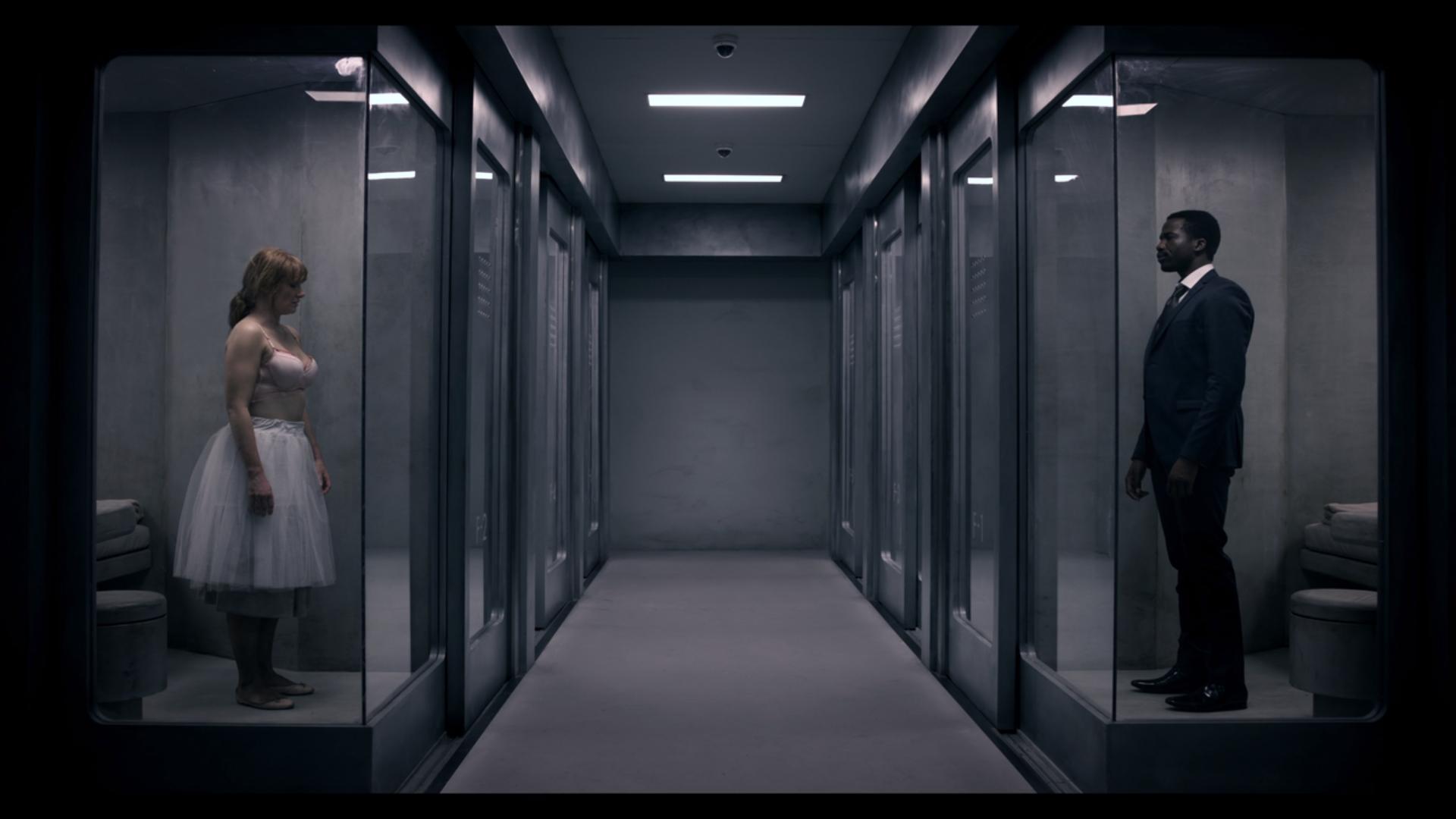
A few things the episode leaves implicit that are worth making explicit. The implant removal in the jail cell is not just a metaphor for detox. In the logic of the world the episode built, the implant is also the mechanism by which you see other people’s scores in real time, overlaid on their faces. Removing it means you can no longer see the number. You just see the person. The episode wants you to read that as liberation, and it is, but it is also worth noting that Lacie does not choose the removal, it happens to her as a consequence of incarceration. The freedom is involuntary, at first. What she does with it, the raw screaming match she gets into with the man in the adjacent cell, trading genuine insults with genuine laughter, is the first unscored human interaction she has had in the entire runtime. The episode ends there, on that specific image, two people being completely horrible to each other and loving every second of it.
There are two competing reads on where Lacie actually lands by the end, and they are not as far apart as they look.
The first read says she is genuinely free. The implant is gone, the score is gone, the apartment is gone, the wedding is gone, all the scaffolding of her anxiety has been stripped away by force and what is left is a woman who just discovered she is capable of genuine feeling, even if the first genuine feeling she expresses is rage at a stranger. The swearing match is supposed to play as release, and it does, and maybe that release is real.
The second read says she has simply hit bottom and does not yet understand it. That if Naomi walked in right now and handed her a conditional reinstatement, she would take it. That the compulsion is structural, not personal, and removing the implant does not remove the society that built the need in the first place. She will walk out of that cell into a world that is still running the same algorithm, and she will need to eat, and find housing, and work, and every single one of those systems still runs on her score.
Mike’s read is the second one, and here is why. The episode gives Lacie exactly one moment of genuine unfiltered human connection, in a jail cell, with no stakes, with a stranger she will never see again. That is a controlled environment. The real test is what happens when she has to re-enter the economy. The truck driver Susan got out and built a life outside the system, but the episode is also careful to show that Susan is alone, driving empty highways, with no one left who shares her frequency. The exit is real. The cost of the exit is also real. Lacie has not chosen the exit. The exit happened to her. Those are different things, and the episode knows it, even if Lacie does not yet.
The genuinely brutal thing about Nosedive, the thing that puts it above most Black Mirror episodes in the catalog, is that it was already a documentary when it aired. Not metaphorically. The infrastructure it describes, weighted social scoring, algorithmic status stratification, the compulsive performance of contentment on platforms that monetize your anxiety, was already running. Schur and Jones did not invent a warning. They labeled something that was already happening and dressed it in pastels so you would keep watching long enough to see the ending. The factories that make content designed to keep you chasing engagement metrics were not going to greenlight a version of this story that made you want to put your phone down. The fact that this version existed at all, sharp enough to actually cut, is the thing worth noting.
That is what a good episode does when it survives the process intact. It tells you the truth with enough charm that you do not realize until it is over that you have been watching yourself the whole time.