
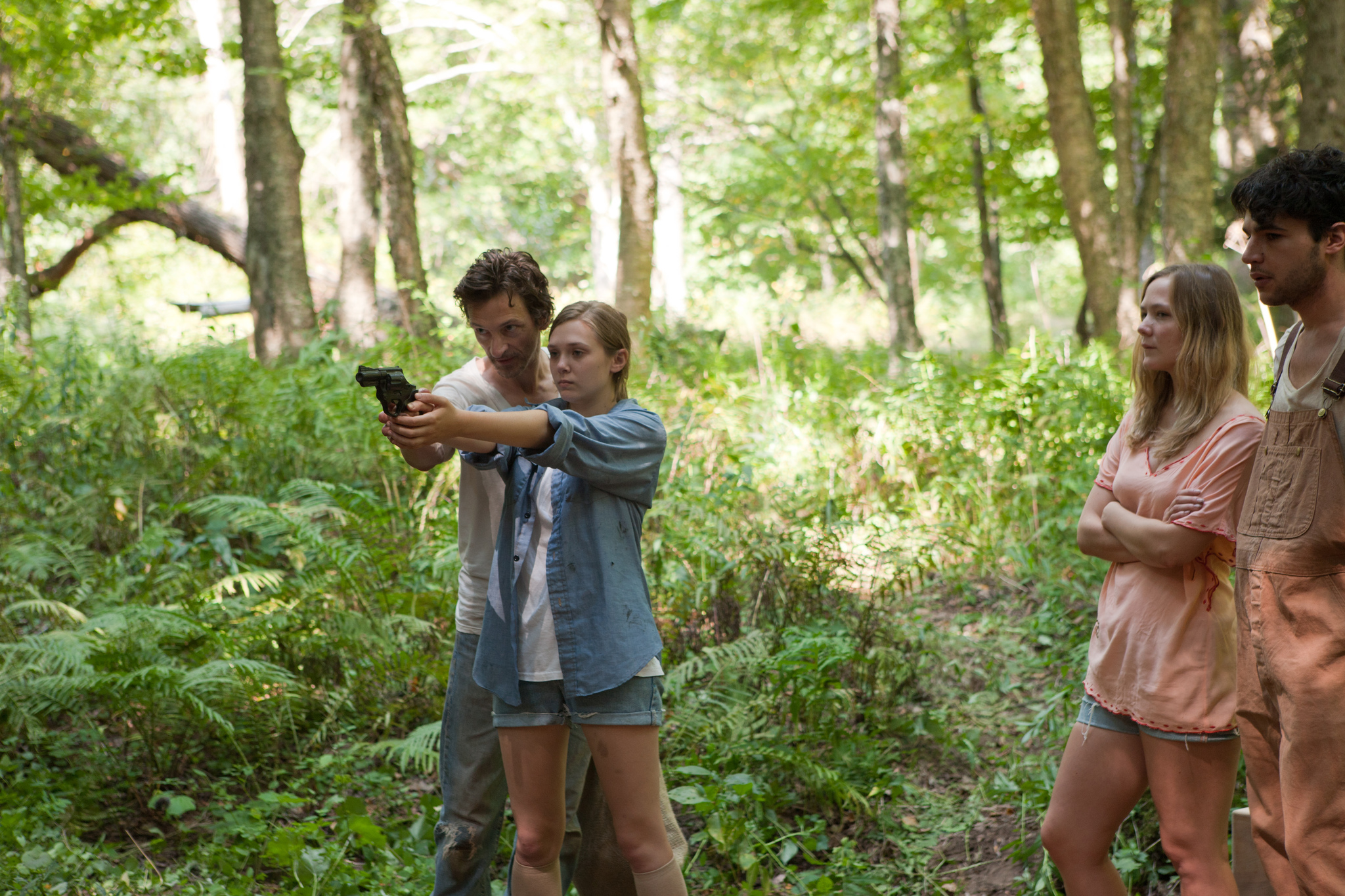
Hey there everyone! Welcome back to Movie Soapbox, the little corner of the internet that only you and I and that guy sleeping in the corner over there know about. This is the place where we find underappreciated indie films and we make sense of them. Today? We are doing a deep dive on Martha Marcy May Marlene, a movie so quietly, methodically terrifying that the people who greenlit it probably read the script, nodded politely, and spent the next six months trying to figure out how to attach a jump scare to the third act.
They didn’t get one. That’s the whole story, really. But let’s get into it.
What follows is a full, unguarded walkthrough of this film, including the ending and every ugly thing it implies. If you haven’t watched it yet, stop here, go watch it, come back. It’s on streaming. It’ll cost you two hours and leave you checking your locks. That’s a fair trade.
Martha Marcy May Marlene Movie Walkthrough
Sean Durkin wrote and directed this film, and you can tell, the way you can always tell with a first-time feature from a writer-director who had final cut, that every single one of these choices was a fight someone chose not to have. A bigger production would have given you voiceover to explain the timeline jumps. A studio note on page one would have asked for a clearer protagonist goal. A test screening of 400 people in Burbank would have flagged the ending as “unsatisfying” and someone would have shot an additional scene of Martha telling a therapist what she saw. None of that happened. What you get instead is a film that trusts the audience the way a $2 million indie can afford to trust the audience, because nobody upstream had enough money invested to be scared of you not getting it. Elizabeth Olsen was twenty-two years old, carrying every frame, and the whole apparatus behind her was light enough that it couldn’t crush her. That’s the only reason this film is as good as it is. Films like this don’t survive a bigger budget. They get “elevated” right into the ground.
Martha Marcy May Marlene Movie Timeline
The editing in this film is genuinely one of the great formal achievements in American indie cinema of that decade, and the reason it works is that Durkin never signals the transitions. You slide between past and present the way Martha slides between them, which is to say without permission and without warning. So before we go any further, here is the skeleton of what actually happened, in order, stripped of the film’s deliberate scrambling of it.
Martha and Lucy grew up together. Lucy, the older sister, leaves for college. Their parents die, we are never told how, and Martha goes to live with an aunt for a stretch. Somewhere in that gap, the gap that opens when your sister leaves and your parents die and you are young enough that none of it has names yet, Martha finds the cult. Or the cult finds her. Spend two years there. Long enough that she starts training new girls herself, which is the detail the film drops quietly that tells you exactly how deep the hook went. They break into a house one night, the way they do regularly, and a man catches them, and they kill him. Martha runs. Lucy, carrying her own guilt about having left, takes her in. Martha calls the farm from Lucy’s house phone, which is the move that may or may not seal everything that follows. Lucy and her husband Ted decide she needs professional help. On the way to the facility, Martha sees a man in a car behind them. Cut to black.
That’s it. That’s the whole film, laid flat. The reason it doesn’t feel like that when you’re watching it is that Martha can’t experience her own life laid flat anymore. The past keeps loading on top of the present, and Durkin’s editing puts you inside that experience rather than outside it, observing it. You don’t watch Martha dissociate. You dissociate with her. That’s the craft.
What Does the Movie Title Mean?
That title means a lot. And it really is worth slowing down for. Martha is the name she was born with. Marcy May is what Patrick, the cult leader, rechristened her, because renaming someone is one of the oldest and cheapest tools in the control arsenal, it costs nothing and it colonizes the thing a person thought was most essentially theirs. Marlene Lewis is the name every woman in the cult uses when they answer the phone to outsiders, the way a front desk at a shell company has a name that isn’t anyone’s real name. The title is a map of Martha’s self in three layers: who she was, who she was made into, and the mask the operation uses when the outside world calls.
Watch the scene where Patrick tells Martha she’s a natural leader, a teacher, someone special. Then watch her repeat almost the exact same words to her sister later. That’s not a coincidence in the script. That’s the mechanism of how this works. Durkin is showing you the replication in real time. The cult doesn’t need Martha to stay on the farm. She took the farm with her when she left.
What the Cult Was Actually Doing Explained
There’s no mystery here, though the film presents it with enough restraint that it can feel like there should be. Patrick runs a commune that sustains itself through theft from the surrounding community, through the sexual labor of the women he controls, and through a ideology scaffolding sophisticated enough that the women enforce it on each other. The women drug new arrivals. The women train the new arrivals. The women police the ideology among themselves. Patrick doesn’t need to do much heavy lifting once the system is self-replicating, and by the time we meet Martha she has become part of the infrastructure. She isn’t just a victim by the time she runs. She’s a former administrator. That’s the layer the film is generous enough not to editorialize about.
When Martha gets to Lucy’s house and starts asking why they need such a big house, starts climbing into bed between Lucy and Ted, starts delivering Patrick’s philosophy back to Ted at the dinner table with complete conviction, she isn’t being difficult. She is operating on the only logic that was allowed to exist in her head for two years. You can’t be angry at her for it. You can only watch Lucy’s face as she realizes how far down this goes.
The Three Theories, Because That Ending!
The ending is a hard cut to black after Martha sees a car following them, and Durkin leaves you with three genuinely defensible reads, which is the correct number for a film like this. One more and you’re being coy. One less and you’re pretending to have more answers than you do.
Theory one: The man is real. He’s a cult member. They traced the call, found the house, followed her. We know they kill to protect their secrecy, they already proved that in the house break-in. He is there to take her back or make sure she doesn’t talk. The threat is literal and the ending is a horror movie ending wearing an art film’s clothes.
Theory two: The man isn’t there. Or he’s just a man. Martha has reached the point where her pattern-recognition is so contaminated by fear and unprocessed trauma that she is mapping cult faces onto strangers. She saw a bartender at a party, filed him somewhere, and her brain retrieved that face and placed it on the dock and then placed it in the car behind them. The near-collision on the road is just a near-collision. She is not being hunted. She is hunting herself, from the inside, and the facility she’s being driven toward may be the first honest acknowledgment in the film that she needs more help than a guest room and her sister’s patient silence can provide.
Theory three, and this is the one that doesn’t get enough credit: Martha never actually escaped. Or she escaped and was retrieved, off-screen, before she ever reached Lucy’s door. She is still operating on the cult’s behalf. The whole stay at Lucy’s house, the two weeks of destabilizing behavior, the call back to the farm, all of it was infiltration. She delivered Lucy and Ted to Patrick. The credits roll over something happening in that house that we will never see.
Moviesoapbox Explanation Preference
My personal preference is definitely theory number two. Why? Because it is the one that earns the film’s construction, and here’s why. The entire formal project of this movie is putting you inside Martha’s inability to trust her own perception. The editing exists to make you feel what she feels, not to deliver information reliably. If the cult is actually there at the end, then the film’s formal strategy was a delivery mechanism for a conventional thriller resolution, which is a waste of everything Durkin built. But if the ending is ambiguous because Martha’s perception is ambiguous, if you can’t know whether he’s real because she can’t know, then the film is formally complete. The horror isn’t that they found her. The horror is that she will never be certain they didn’t. That uncertainty is the thing Patrick left behind in her when she ran, and it doesn’t go away when you drive away from it. She will be in that car, turned around, watching for a brown sedan, for the rest of her life.
She hasn’t told anyone what she saw happen in that house. She hasn’t admitted to herself that what was done to her was done to her. She is still, on some level, carrying Patrick’s interpretation of events. A woman in that condition doesn’t get to trust her own eyes at the end of the movie. That’s not sad, it’s just accurate.
Theory three is the most disturbing read and the least necessary one, but it deserves a seat at the table because it recontextualizes every scene in Lucy’s house as something colder and more deliberate than breakdown. If you want to watch the film again with that lens, it holds. Not perfectly, but it holds enough to make you uncomfortable, which is what it should do.
Theory one is the crowd favorite and it’s wrong, or at least it’s the least interesting version of being right. Patrick’s operation is a guy with a wall phone and a farm, not a cartel with the capacity to run surveillance on a number they received one call from. The threat Martha carries isn’t organizational. It’s psychological. The film knows that. The ending knows that.
Sean Durkin made a movie about how a person’s mind becomes the best cage their abuser ever built, and the scariest thing about it is that it cost almost nothing to shoot and required almost no interference to survive, and it got made anyway, and Elizabeth Olsen is extraordinary in it, and most people still haven’t seen it. That’s how it goes with the ones that actually work. They slip through while the committee is busy greenlit the next franchise entry. Somebody’s in a room right now taking notes on a script that’s half as good as this one, and the notes are making it worse, and nobody in that room has seen Martha Marcy May Marlene.
Go watch it again. You’ll catch something you missed the first time. You always do.
If You Liked Martha Marcy May Marlene…
Faults (2014) – A cult deprogrammer tries to extract a young woman and then the film inverts itself completely. You think you know who’s in control. You don’t.
Something in the Dirt (2022) – Two men construct a shared belief system in a Los Angeles apartment and can’t tell where investigation ends and delusion begins. Same psychological quicksand.
Monos (2019) – Child soldiers on a mountaintop operating under rules handed down from an invisible authority. The group psychology is MMML’s commune transplanted into a war zone.