
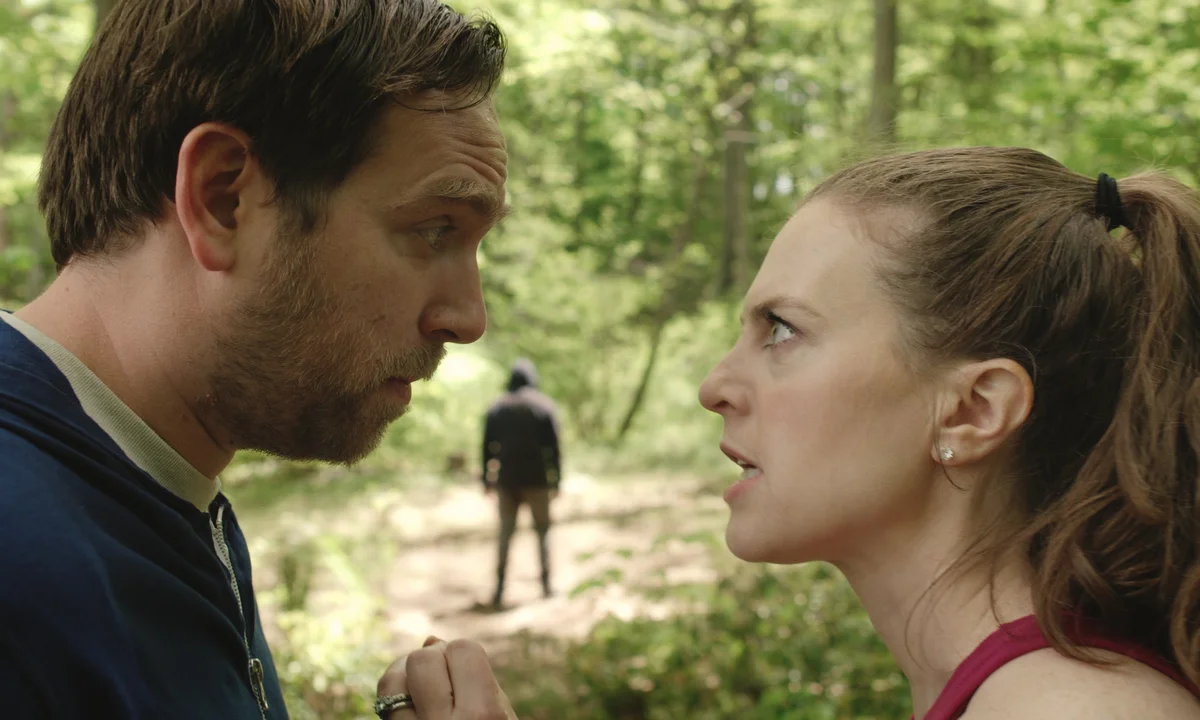
Hey there everyone! Welcome back to Movie Soapbox, the little corner of the internet that only you and I and that guy sleeping in the corner over there know about. This is the place where we find underappreciated indie films and we make sense of them. Today? We are doing a deep dive on Brightwood, a movie so quietly, efficiently, brutally weird that it makes you realize every single dollar a studio has ever spent on a time-loop premise was wasted, and then some.
Before we go any further, a word from Mike: this movie has blood. Real blood, the kind that arrives without a score cue telling you how to feel about it, the kind that lands on the ground and just stays there. If you have not watched Brightwood yet, the rest of this post will gut the experience for you completely and irreparably. Go watch it. Come back. I will be here, judging you gently for whatever you chose to watch in the meantime.
What you need to understand, before we get into the mechanics of the loop or the competing theories about what any of it means, is what it took to put this thing on a screen. Director Dane Elcar made Brightwood for somewhere in the neighborhood of ten to twenty thousand dollars. One lake. Two actors. Sound design carrying weight that a lesser film would have handed to a visual effects budget. And here is the thing that nobody who hasn’t spent time around low-budget production ever thinks about: when your location is an exterior body of water, you cannot shoot whenever you feel like it. The light has to match. Every single shooting day is constrained to the same window of hours, the same angle of sun, or your cuts don’t cut and your loop doesn’t loop and the whole illusion collapses. The logistical complexity of making Brightwood feel seamless is not smaller than the complexity of making a studio time-loop film. In some respects it is larger, because there is no money to fix in post what you didn’t get in camera. What you see on screen is what they actually pulled off, in real time, in a real place, with two people and a microphone. That reshoot-scar tension you feel watching big-budget loop films, where something feels stitched and airless? Absent here, completely. Whatever Elcar got, he got it right the first time.
Brightwood Movie Walkthrough
Jen, played by Dana Berger, and Dan, played by Max Woertendyke, are a married couple out for a morning run. The marriage is not going well. The night before, Dan apparently spent a party behaving in whatever way men who have stopped paying attention to their marriages behave at parties. Jen knows. Dan knows she knows. Dan doesn’t quite understand why this is the level of problem Jen is treating it as. You have seen this couple. You may have been this couple. The run is supposed to be Jen getting space. Dan, slower, falls behind, and Jen decides to circle the pond loop while he walks. A small, completely reasonable decision. The kind of decision that, in a normal morning, means nothing.
This is not a normal morning.
The path out of the loop is gone. Not blocked. Not obstructed. Gone, as though it was never there, while the lake and the trail and the trees are all exactly where they should be. The no-swimming sign is where it always was. The exit is not. They look for it the way people look for their keys before they accept they are actually lost, systematically at first, then with the specific panic of people who cannot yet admit to themselves that panic is warranted. And while they are looking, they start seeing things. A jogger who is there and then isn’t. A figure on the path that disappears. Until the moment they see themselves, across the clearing. Literally. Another Dan and another Jen, standing right there, looking back.
The film does not pause to explain this to you. It does not cut to a character saying the word “loop.” It presents the situation and moves forward, because the situation is not the point, the behavior is.
Because here is what happens next: a figure in a hood turns and murders Jen, violently, in front of Dan. And Dan runs. Not toward her. Away. He makes it halfway around the lake before the math of what he just did catches up with him. He turns back. But the moment is gone, and the debt is already on the books.
That is the engine of Brightwood. Every iteration of this couple, cycling through this loop, making the same calculus in their worst moments. Do you help, or do you survive? And the film’s brutal, patient argument is that these two particular people, in this particular marriage, keep choosing survival. Keep choosing themselves. Not because they are monsters by nature but because the marriage has already done the work of turning them into the versions of themselves that make that choice automatically. The loop does not create who they are. It just removes every social and logistical reason to pretend otherwise.
The violence escalates through the iterations. Dan-whatever-number-we’re-on clubs another Dan. Jen finishes him. They find a tent near the lake with a decomposed version of Dan inside it. They process this information for approximately as long as people who have been in a death-loop long enough process anything. And then two of the longest-surviving versions of the couple sit down together and eat. Each other. The other them. The film does not linger on this as transgression. It presents it as adaptation, which is somehow worse.
Brightwood Movie Theories
Theory One: Groundhog Day with the lesson stripped out
The loop in Groundhog Day is a moral machine. It runs until Phil Connors becomes a person worth releasing. Brightwood posits the same machine, the loop as a moral forcing function, but with a couple who are constitutionally incapable of passing the test it’s running. Every iteration they have the same choices Phil had. Be kinder. Be braver. Choose the other person. They keep choosing wrong. The loop doesn’t end because the loop can’t end, not for these two, because the thing the loop is waiting for is a change these people do not have in them. The trap is not the lake. The trap is who they already were when they arrived.
Theory Two: None of this is literal
The lake, the loop, the multiplication of selves, all of it is an externalized rendering of what it feels like to be inside a bad marriage in a bad moment. You have been in a fight with someone you love, or loved, where the same argument is the same argument is the same argument, where you can see yourself from the outside and you do not like what you see, where the other person becomes a stranger you are somehow also trapped with. The film puts that internal experience on a physical landscape and lets it breathe. No one is literally dead. The decomposed Dan in the tent is just the version of Dan the marriage killed years ago. The violence is just the argument. The cannibalism is just the late stage of a relationship that has been feeding on itself for a long time.
Theory Three: This is actually the happy ending
Stay with this one, because it is weirder and more interesting than it sounds at first. Every strong bond has a forge. Adversity, shared and survived, is one of the oldest binding agents there is. The two people who sit down together at the end of Brightwood have been through something no couple in the history of couples has been through. They have killed, together. They have watched themselves die, together. They have hit a floor so far below anything they imagined that the ceiling is no longer visible. And they are still there, together, feeding each other. Whatever comes out of that lake, if anything comes out, will be indestructible. The film might be less about entropy and more about the one crucible hot enough to burn away everything these two people were carrying. Whether you want to live next door to whatever walks out is your problem.
Moviesoapbox’s Take On the Movie Brightwood
I’m extremely partial to theory One. And I think that theory two is the subtext that resides underneath it. The literal mechanics of the loop are real within the film’s world, I don’t think Elcar is asking you to dismiss the physicality of what you’re watching. But the reason the loop exists, the engine underneath it, is the moral one. These two people are trapped because they are the kind of people who run when their partner is being killed, and they will keep being trapped until they are not that anymore. The film’s real argument is that some people never stop being that. The loop has no exit for them because they would need to fundamentally become different people to find it, and the film is not optimistic about that possibility. The cannibalism isn’t a twist. It’s a conclusion.
What Dane Elcar made here, with one location and two actors and whatever was left of twenty thousand dollars after the lake permit cleared, is a film that a studio would have destroyed in the note process. You can practically read the hypothetical development document. “The threat needs to be externalized.” “We need to understand the loop’s origin.” “The ending needs to offer the audience somewhere to go.” Every note would have been aimed at the thing that makes Brightwood what it is, the refusal to explain, the refusal to resolve, the willingness to let the couple be as bad as they actually are. He didn’t have to fight any of those notes. He made the film too small and too fast for those notes to reach him. That’s not a happy accident. That’s the only way a film like this survives.
Thanks for spending some time here at Movie Soapbox. We’ll see you next time in the corner.
If You Liked Brightwood…
Black Hollow Cage (2017) – A girl in an isolated house discovers a device that loops time, and every reset makes the situation worse. Same domestic horror fused with temporal mechanics.
Resolution (2012) – Two friends trapped in a cabin where something unseen keeps feeding them narrative loops. The meta-horror underneath is the same engine driving Brightwood’s lake.
Parallel (2018) – Friends discover a mirror that leads to parallel versions of their lives and immediately start exploiting it. The moral decay accelerates exactly the way Brightwood’s relationship does.