
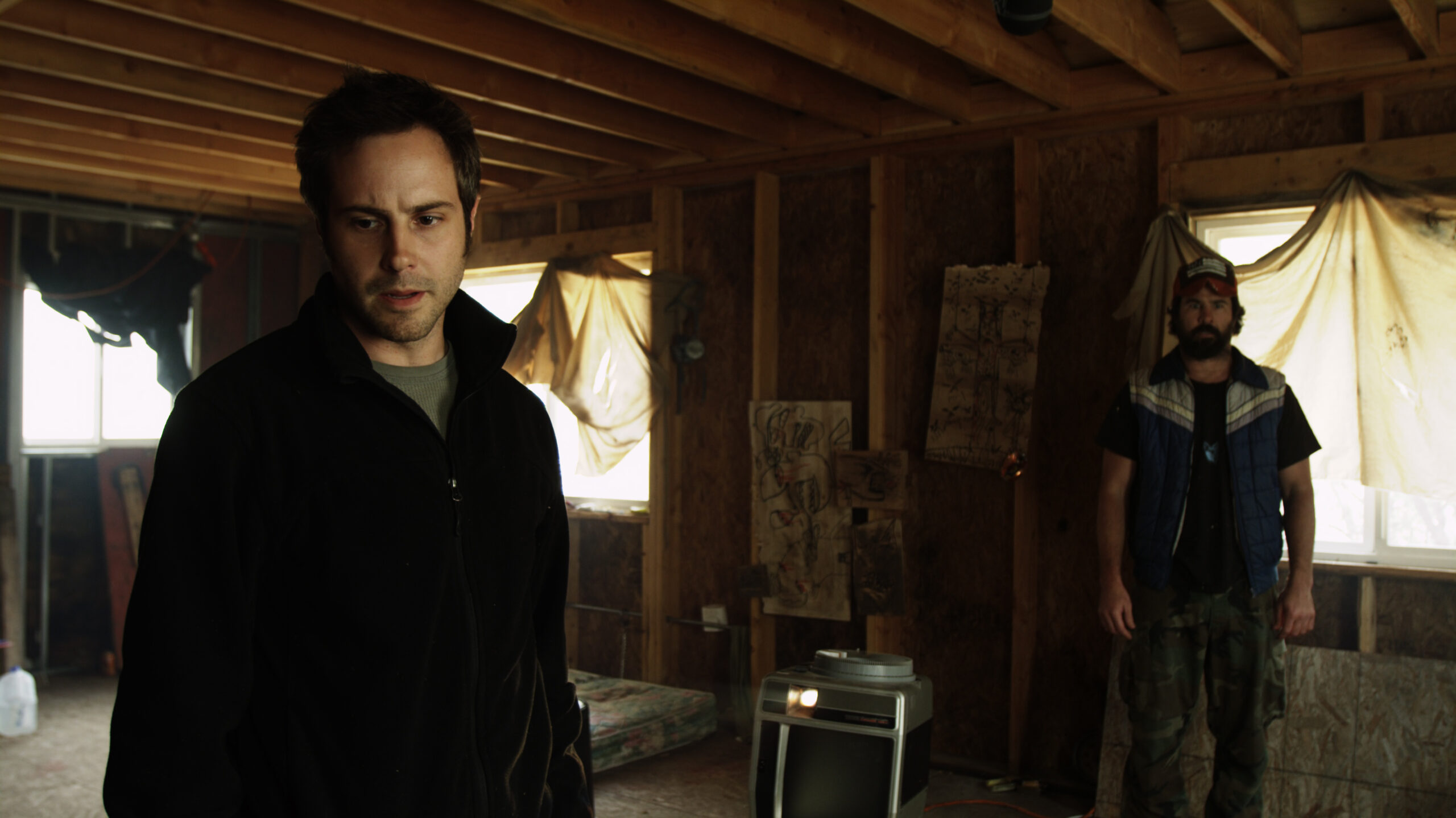
Hey there everyone! Welcome back to Movie Soapbox, the little corner of the internet that only you and I and that guy in the back who hasn’t looked up from his phone in forty minutes know about. This is the place where we find the films that got buried, mismarketed, dumped on a Wednesday in twelve theaters, or quietly uploaded to a streaming platform between two Adam Sandler originals with no fanfare whatsoever, and we make sense of them. Today? We are doing a deep dive on Resolution, a movie so quietly, stubbornly strange that it refuses to resolve itself even after the credits roll, which, depending on your tolerance for that kind of thing, is either the most frustrating thing a filmmaker can do to you or the most honest.
Before we go any further, here is the trailer. Watch it, or don’t, but know that almost nothing in the trailer prepares you for where this thing actually goes.
Alright. Past this point we are in full spoiler territory and I am not going to slow down for you. If you haven’t seen Resolution and you want to walk in clean, go watch it, come back, and we’ll be right here waiting. For everyone else, strap in, because this movie has more competing explanations than it has answers, and that is entirely by design, which is either a brave choice or a convenient excuse depending on which theory you land on by the end.
The movie Resolution Walk Through
So here is the setup, and it is genuinely simple on the surface: Michael’s best friend Chris is destroying himself on drugs out at a remote cabin on land he has no right to be squatting on, and Michael, rather than stage a conventional intervention, drives out there, tasers Chris, and handcuffs him to a pipe in the wall. That is the movie’s premise. Two guys in a shack. One trying to get clean, one trying to make him. And for about the first third of Resolution, that is exactly what you get, a low-key, almost claustrophobic character study about friendship and obligation and the limits of what you can force another person to want for themselves.
And then the movie decides that’s not what it wants to be.
Photos appear on Michael’s chest while he sleeps. Video cassettes turn up that contain footage of events no camera crew could have captured. A slide projector clicks on by itself and shows Michael and Chris in coffins. There are druggies who want payment. There are Native landowners who want them gone. There is a French researcher who has been living feral in the surrounding woods for two decades after his two colleagues died under circumstances that are, to put it gently, not fully accounted for. There is a UFO cult that wanders through a scene like a fever dream someone accidentally left in the edit. The movie stacks all of this onto what started as a two-man bottle film, and it does so without ever fully committing to an explanation for any of it.
The Movie Resolution’s is Indie Brilliance
Now, before we get into the theories, I want to talk about something the original conversation around this film almost never addresses, and it is the thing that tells you the most about what you are actually watching.
A film like Resolution, shot on this kind of budget, with this cast tier, distributed this quietly, almost always comes out the other end of development as something flatter and more legible than what Justin Benson and Aaron Moorhead actually made. You can read the pressure points in films like this if you know where to look. The multi-faction plot, the druggies, the landowners, the French researcher, the cult, all of that reads like a collection of ideas that, in a different production context, would have been note-campaigned into a single clean antagonist by the time you got to picture lock. Someone in a conference room would have said “we need to know who the villain IS” and the film would have obliged. The fact that Resolution does not oblige, that it holds all of these factions as equally valid and equally irrelevant red herrings, tells you that nobody with that kind of power got close enough to this film to demand the clean answer. That is what genuine creative control looks like at the micro-budget level. It looks like a film that is allowed to be inconclusive on purpose. That is rare. Most films that start this strange get sanded down before you ever see them.
The Ending of the Movie Resolution Detailed Out
So. The ending. Michael releases Chris. The slide projector clicks on and shows them dead. The laptop shows them their deaths at the hands of the druggies. But instead of being paralyzed by this, Michael and Chris use the foreknowledge to dodge each event as it arrives. The druggies and the Indian landowners end up killing each other in the cabin, or the other way around, the point is the immediate threat resolves itself without Michael and Chris being killed. The cabin burns. And as Chris and Michael stand outside watching it, there is something above them. Something neither the camera nor the screenplay will identify for you. Chris tells Michael he doesn’t want to die, that he’ll go to rehab right now, just get him out of there. And Michael looks up at whatever is above them and says, “I’m so sorry. Can we try it another way?” And that is the end of the film. He is not talking to Chris.
The Theories to Explain the Movie Resolution
Theory One: Michael Is the Unstable One
This is Chris’s theory, stated early in the film, and it is the only genuinely grounded explanation the movie offers: Michael has multiple personality disorder, he is planting the items and pre-recording the footage himself, he is his own unreliable narrator, and what we are watching is not a supernatural horror film but a psychological portrait of a man whose grip on reality is looser than he presents. It is the cleanest real-world read and the one that requires the fewest impossible things to be true simultaneously. The problem is the film gives you nothing to confirm it. Not a blackout. Not a memory gap. Not a single behavioral tell in Michael’s performance that would let you lock in this interpretation over any other. Good filmmakers who want you to consider this possibility leave breadcrumbs. Benson and Moorhead either forgot to or decided not to, and at this budget level, with this director, I am going to assume it was a decision.
Theory Two: The French Researcher Did It
He has motive, proximity, a demonstrated willingness to let people die around him, and twenty years alone in the woods to develop whatever elaborate psychological game he might want to run on two trespassers. He told Michael the other researchers “went looking for monsters and found them in themselves,” which is either a genuine observation or a man explaining exactly what he did to them and enjoying the telling of it. He could, conceivably, have been recording and planting the materials. The problem is he couldn’t have. Not all of them. Not the footage of Michael tazing Chris that existed before Michael arrived. Not the slide projector running itself. The French researcher is a compelling character who fits the profile of the kind of person who does terrible things in isolated places, but he cannot be the engine of everything this film asks you to accept as happening.
Theory Three: The UFO Cult, The Indians, The Asylum Patient, Take Your Pick
The screenplay hands you enough factions to construct almost any genre film you want out of the raw material. You want a land-curse narrative, the burial ground is right there. You want a cult horror film, the celestial messiah people are right there. You want an escaped mental patient thriller, there is one of those too. None of them hold up as the actual answer because the film never gives any of them enough weight to carry the ending. They are texture, not explanation.
Theory Four: The Loop
This is where the film stops being a bottle thriller and starts being something more uncomfortable. The theory is that Michael and Chris are trapped in a recursive loop, that something, some external force or some consequence of their own choices, is holding them inside this story and forcing them back to the beginning each time they approach an ending. This reading is supported by the film’s own internal logic more than any other theory, because the strange materials that keep appearing, the cassettes, the slides, the footage, are all pushing Michael and Chris toward specific endings, and when they dodge those endings, the loop presumably resets and tries again. Michael’s final line, “Can we try it another way,” is addressed upward, to whatever is running the loop, asking for a different version of the story to play out. The film’s weakness here is that it never gives us a clear sin or wound that the loop is punishing, the way a film like Triangle does. Chris is an addict. Michael is controlling in the way people who love addicts often are. But neither of those is the kind of defined transgression that loop-horror usually hangs itself on.
Theory Five: The Meta Read, The Film About Making the Film
This is the one I keep coming back to. The force above them at the end is the filmmaker. Specifically it is the screenplay itself, or the authorial will behind it, looking down at its characters and being unable to find an ending it is satisfied with. The materials that keep appearing, the slides, the cassettes, the laptop video, are not a supernatural entity’s method of torment. They are a writer’s drafts. They are versions of the ending that didn’t work, being shown to the characters so the characters can reject them and push back toward a conclusion the author can actually stand behind. When Michael looks up and says “Can we try it another way?” he is not speaking to a monster. He is speaking for the director. He is the character recognizing the hand of his creator and asking, on behalf of both of them, for one more pass at getting this right. The film is, at its deepest level, a story about the impossibility of ending a story you care about, and the cruelty of forcing an ending anyway.
The reason I believe this one over the others is that it is the only theory that accounts for ALL of the film’s strange materials simultaneously, the only one that explains why Michael is addressed by the ending instead of ambushed by it, and the only one that makes “Can we try it another way?” land as something other than resignation. It lands as collaboration. A character and his creator, stuck at the same problem, agreeing to go back in.
And look. Resolution as a standalone is not a complete film. It is the first chapter of something that The Endless eventually makes more sense of, and even then not entirely. But what Benson and Moorhead got onto the screen here, on the budget they had, with the creative latitude they somehow retained, is a film that is still having arguments about itself a decade after release. Most films that come out of the micro-budget horror pipeline are forgotten in the time it takes the festival circuit to move on to the next one. This one is still being argued about in comment sections at two in the morning, and that does not happen by accident. That happens because someone protected something worth arguing about from the people who would have explained it for you.
Most films this strange get their strangeness edited out before you see them. This one didn’t. That is worth something. Go watch The Endless immediately after, and then come back here, because we have a lot more to talk about.
🎬 If You Liked This…
- Spring — Benson and Moorhead doing what only they do, something ancient and inexplicable in an isolated setting, the horror almost incidental to the relationship at the center of it
- Something in the Dirt — the same two-guys-in-a-location formula, the same meta-awareness of being inside a story that something else is authoring, Benson and Moorhead at their most self-referential
- Hallow Road — the same dread built through found evidence rather than jump scares, something leaving artifacts of itself behind, an isolated location that won’t let its occupants leave until the story is finished