
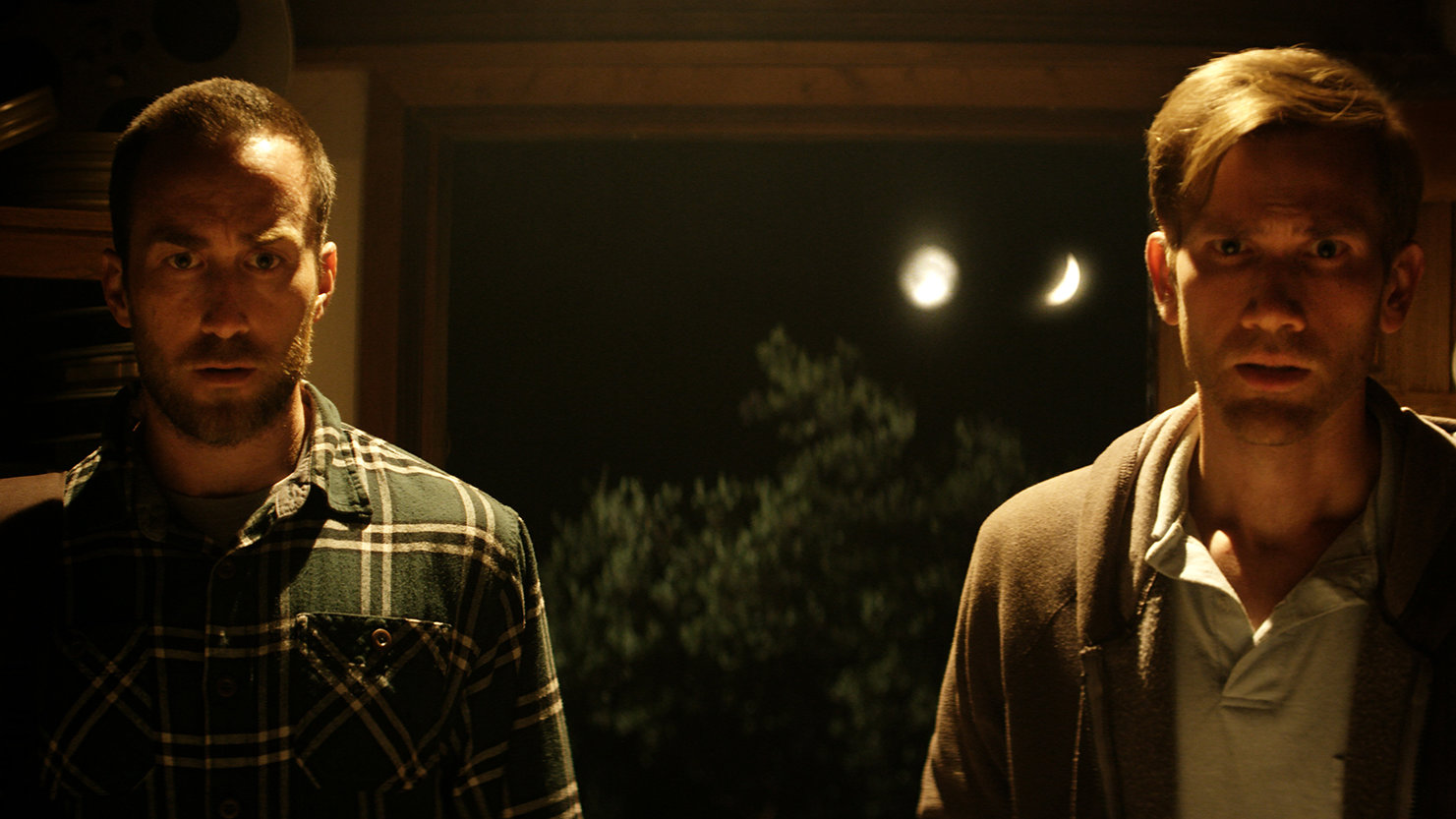
Hey there everyone! Welcome back to Movie Soapbox, the little corner of the internet that only you and I and that guy sleeping in the corner over there know about. This is the place where we find underappreciated indie films and we make sense of them. Today? We are doing a deep dive on The Endless, a movie so quietly, methodically brutal in the way it constructs its mythology that even the people who greenlit it probably thought they were getting a simple cult horror picture and then sat in the screening going very, very quiet.
Before we go anywhere, you need to watch the trailer. Not because it tells you much, it doesn’t, these guys are too smart for that, but because you need to calibrate what kind of movie we are talking about before I start explaining the machinery underneath it.
Alright. Listen carefully now, because I am going to tell you something important before I warn you about spoilers. Go watch Resolution first. Watch it before you come back here. The Endless is technically a standalone film, technically, but it is also a sequel, a companion piece, and a retroactive correction to every theory you thought you had about Resolution the moment after it ended. These two films together run about 220 minutes of combined runtime and they are one movie. The fact that they were released separately, years apart, made by a two-man team on a budget that a mid-tier studio would spend on craft services in a single week, is the whole story of what this film is. Watch Resolution. Then come back.
You have been warned. Everything from here on out is a spoiler, and if you keep reading without having seen both films, that is on you, and I will not feel bad about it even a little.
The Endless Movie Making Of
Justin Benson and Aaron Moorhead wrote, directed, produced, and starred in this film. Two guys. The budget was somewhere in the range of what a studio would spend reshooting a single scene because a test audience in Burbank found the original ending “unresolved.” And I want you to sit with that for a second, because the irony is almost too perfect, the entire architecture of The Endless is built around the horror of being forced to resolve things over and over forever, and yet this film exists precisely because no studio was involved to demand that kind of resolution. At this budget tier and with no pre-existing IP, no franchise hook, no name above the title that a VP could point to in a greenlight meeting, the director retains creative control almost by default, because nobody else wants the liability. That sounds like a backhanded compliment. It is not. It is exactly how films like this survive. The machine ignores them long enough for them to exist.
Now. Let me walk you through what actually happens.
What The Endless Is Actually About
The film picks up with two brothers, Justin and Aaron, who escaped a UFO cult in rural California about ten years before the story begins. Their mother is dead. Their lives outside the cult have been grinding, lonely, and unglamorous. Aaron wants to go back for a visit, just to get some closure. Justin, who has been telling anyone who would listen that the cult castrated its members and was dangerous, agrees reluctantly.
The camp is strange in the specific way that something deeply wrong is strange when it is wearing the costume of something welcoming. Nobody has aged. A man storms through the grounds acknowledging no one. Another man smiles without stopping. The cult leader, Hal, is warm and forgiving about their exit. Aaron starts to settle in. Justin starts to feel the ground shifting under him.
When Justin goes for a run, he hits a stretch of trail near volcanic stone formations and the world does something it should not do. The sky dims wrong. A trailer jumps. A tree falls with no wind behind it. Dust comes from nothing. And then there is a tent, with a clock inside repeating every five seconds, and a man running and screaming inside on a continuous loop. The man’s screen credit reads “Early 1900s Man.” That is the movie telling you, in the quietest possible voice, exactly how long this has been going on.
Justin finds a crying woman named Jennifer Danube. If that name means nothing to you, go watch Resolution right now and come back. Michael Danube was the protagonist of the first film. His wife came looking for him after he disappeared, and Hal told her it would take some time. She says, “It’s been a few. It’s been a few.” She does not finish the sentence. She does not need to.
Hal tells Justin to swim out to the buoy in the lake and bring up what he finds. Justin and Aaron do it. They pull up a cassette tape of themselves, from years earlier, proselytizing for the cult. The recording should not exist. Then they find Carl, a man who has been refusing to acknowledge their presence since they arrived, and Carl is ranting about looping time prisons, and there is a hanged version of himself nearby, and Carl draws Justin a map. The map shows the time pods. Carl tells Justin to find the “gun nut tweaker,” which is the first movie’s Chris, still handcuffed to a wall in a trailer, still inside the loop he was trapped in at the end of Resolution, still running the same intervention scene over and over with Michael.
Chris tells Justin never to give in to the monster. Not once. The moment you capitulate, it owns you. Michael goes and gets gasoline and walks back into the burning house. The loop resets.
Justin goes to find Aaron. Aaron, exhausted by years of Justin treating him as an afterthought, tells him he would rather loop forever in a place that feels like home than go back to the life Justin has been dragging him through. This is the moral engine of the entire film if you missed it. The monster does not just trap people with physics. It finds the version of you that wants to stay.
They give the gun to Carl. Carl shoots himself. Carl comes back. The cult members vanish. A locked cabin opens and inside are thousands of recordings, Super 8 reels, cassettes, VHS tapes, CDs, spanning decades, all of the same two brothers, returning to the camp across an uncountable number of loops. The creature has been watching them. Has always been watching them.
Justin, sitting at the campfire with Aaron, tells him he would feel guilty the rest of his life if he left him there. Aaron, finally feeling like he matters to his brother, agrees to leave. The creature wakes up. The car will not start. They jump it, gun it toward the camp exit, and the last two volcanic shibboleths are waiting to close the loop around them. They make it through. Cut to the cross where their mother died, the same cross that opened the film, and for one terrible second you think the movie has looped them back to the beginning. Their car blasts past it. They are out. The cult members stand at the camp boundary and watch them go.
The Endless Movie Mechanism: What The Shibboleths Are
Carl’s rant is where the rules get spelled out, and it is worth going through them clearly because this film expects you to keep up.
The volcanic stone formations, the shibboleths, mark the boundaries of individual time loop prisons. Each one is its own contained pod. The pods are not visible to the people trapped inside them as walls, there is no glass to press your hands against. You just find yourself running out of space, running out of time, finding the same paths looping back on themselves, and eventually you understand what you are inside.
The longer you have been in a pod, the shorter your loop becomes. The man in the tent, Early 1900s Man, is on a five-second loop. He has been there since at least the early twentieth century. Carl is on a loop long enough to hold a conversation but short enough that he cannot leave the area where Justin encounters him. Chris and Michael are on the same day-length loop they were trapped in during Resolution. The cult members have a larger pod, the entire camp, because they chose to stay, and choosing is a different mechanism than being caught.
Suicide does not free you from the pod. It restarts the loop. Carl shoots himself and Carl comes back. The loop does not care about what you do to the body. It cares about the boundary.
The creature, whatever it is, has more sensory capacity than a human being, the film uses the image of a being with far more color receptors in its eyes than we have, seeing a spectrum we cannot perceive. The recordings in the cabin are its archive. It has been watching everyone in its pods across every loop, collecting the footage the way a researcher collects data, or the way a predator learns the patterns of what it has already caught.
The pods we can confirm in the film: Jennifer Danube, alone at the house, cycling through the same grief. Michael and Chris, still in the intervention loop from Resolution. Early 1900s Man, on his five-second cycle of terror. Carl, in his running circuit of the outer trail. The cult, in the large central pod of the camp. Byron, the French researcher from Resolution, left a note saying he went to find his colleagues. He is not shown in a pod. Whether he escaped or whether the film just could not get the actor back is a question the film wisely does not answer.
The Six Theories, Graded Against What We Now Know
Theory One: Michael is the insane one. The original theory from Resolution was that Michael, the intervening friend, was the unreliable narrator, planting the videos himself through some dissociative episode, that the supernatural element was just a projection of his deteriorating mental state. After The Endless? This theory is completely dead. There is no version of Michael-is-insane that survives Jennifer Danube sitting on those steps saying “it’s been a few.” The mechanism is real. The pods are real. Michael’s psychology is not the engine of either film.
Theory Two: It’s the French researcher, Byron. Byron, in Resolution, is the man who has been living in the area for years, harvesting the red drug, implying that the location requires stories with beginnings, middles, and ends. The theory was that Byron was the architect of the weirdness, engineering the footage and the encounters. Byron’s absence from The Endless deflates this without resolving it. He left a note. He went looking for his colleagues. If he had been the source of the phenomena, he would not have needed to go looking for anything. He is a man who understood the creature’s appetite and found a way to coexist with it. That is not the same as being the creature.
Theory Three: The cult or indigenous burial grounds. A catch-all theory from a first watch of Resolution, grasping at the stray threads of a film that had too many. The answer is no to both. The cult did not create the pods. The cult is inside one of the pods. They chose it, which is a different horror, but they did not build the prison.
Theory Four: Generic looping theory. The closest original theory to the truth. The idea that some external force was imposing a Sisyphean cycle on the characters as a consequence of something, sin, choice, proximity. This holds up in broad structure. The pods are looping prisons run by an entity that demands stories, complete narratives with resolutions, from the people it captures. The closer you got to this idea in your first reading of Resolution, the better off you are now.
Theory Five: The muse theory. This was the most formally elegant theory from the first film, the idea that the creature is a stand-in for the creative process itself, that Justin Benson the filmmaker is the demigod, that the characters are looking up off the page at their author asking if what they did was good enough. It is a beautiful reading. It does not survive The Endless because The Endless is too specific, too committed to its own internal logic, too interested in the actual rules of the pods to sustain a purely meta-textual interpretation. The muse theory was a way of making sense of something that felt like it had a real mechanism hiding behind it. Now we have the mechanism.
Theory Six: The Time Pod Theory. The creature is a real entity. It is not a metaphor, not a hallucination, not a filmmaker’s self-portrait. It is something that predates the twentieth century, something that perceives more of the universe than we do, something that traps people in bounded loops of time and watches them run out their loops because that is what it does. The volcanic shibboleths are its fencing. The recordings are its library. The drug that Byron was harvesting is something that grew out of the creature’s presence in the land. The cult worships it because it offered them permanence, a version of immortality that turns out to be a cage they walked into with their eyes open. This is the theory that holds. This is the one Benson and Moorhead built both films around.
Moviesoapbox’s Preferred Theory Explained
The Time Pod Theory is the film. I do not think there is serious debate here, not after watching both movies back to back. What makes The Endless extraordinary is that it commits completely to its mythology while keeping the emotional weight of the film on the relationship between two brothers, one of whom has been managing his trauma by becoming controlling and dishonest, and one of whom has been managing his trauma by desperately wanting to go back to the last place that felt like home. The creature’s power is not just temporal. It finds the version of you that is willing to stay. Aaron was almost the creature’s easiest catch precisely because Justin had been such a bad brother for so long. The horror and the character study are the same thing. That is not something a committee produces. That is a writer who knew exactly what he was doing.
Two guys made this. Two guys wrote it, directed it, starred in it, and got it out into the world on a budget that most studio films would spend on a week of pickups. Every film like this one that makes it through is proof that the machine is not airtight, that something can still slip past the VP notes and the test screenings and the IP-first greenlight logic and land in front of you with its mythology intact and its emotional core uncompromised. Most films like this do not make it. The Endless did. Go watch it, then go watch Resolution, then come back and sit with what these two films are when you hold them together. We will be here.
🎬 If You Liked This…
- Resolution — the direct companion film, sharing characters and the same location, something ancient that wants the story finished before anyone is allowed to leave
- Something in the Dirt — Benson and Moorhead at their most self-aware, two guys in a location with something inexplicable, the same cosmic dread and the same meta-awareness of being trapped inside a story someone else is writing
- Spring — the same micro-budget, the same ancient thing that shouldn’t exist in a contained location, the same refusal to let genre mechanics override the human relationship at the center of it