
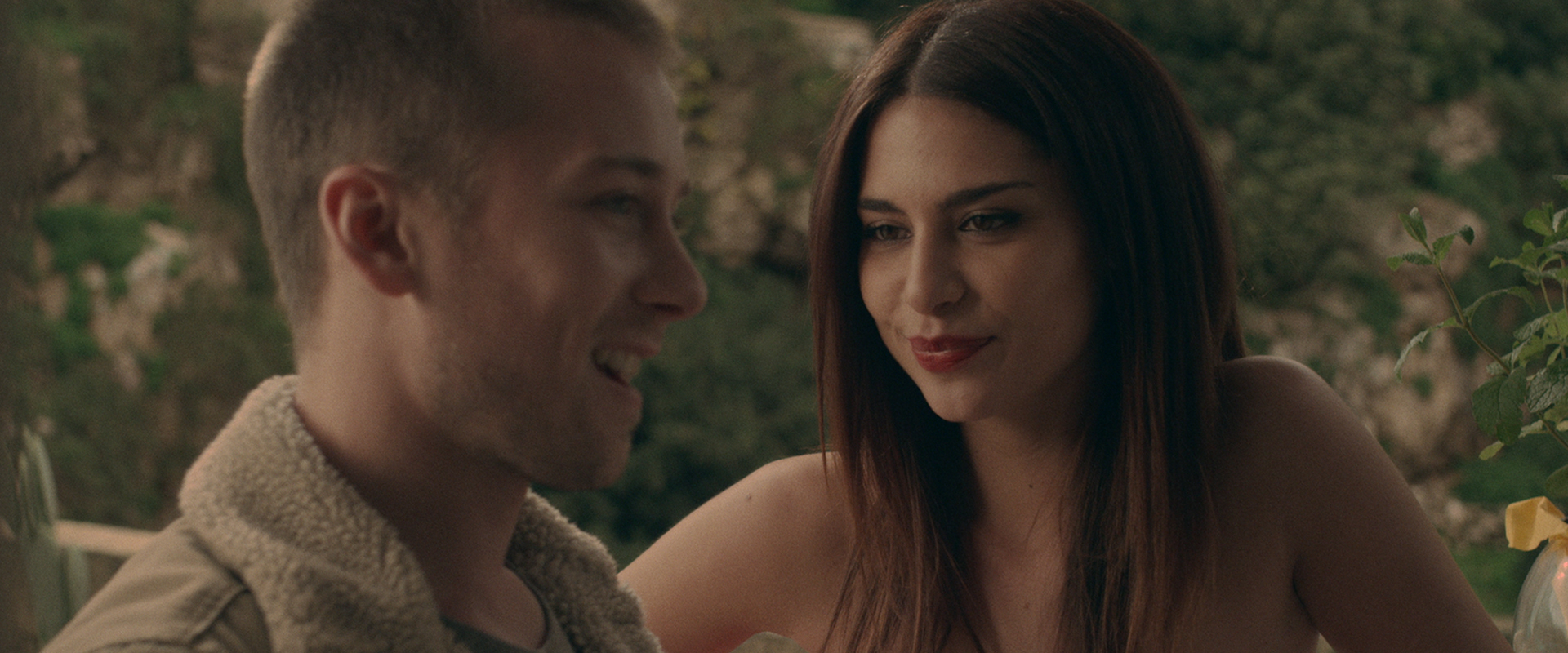
Hey there everyone! Welcome back to Movie Soapbox, the little corner of the internet that only you and I and that guy sleeping in the corner over there know about. This is the place where we find underappreciated indie films and we make sense of them. Today we are doing a deep dive on Spring, a movie so quietly, stubbornly strange that it probably confused every single person at whatever small distributor acquired it, and yet somehow it exists, intact, exactly as Benson and Moorhead intended it, which in this industry is basically a miracle that deserves a small candle lit in its honor.
Alright, fair warning, we are going deep into this film, every beat, every slimy morphing revelation, every lingering Apulian sunset. If you have not watched Spring yet, close this tab, find it, watch it, come back. You’ll thank yourself. If you have watched it and you are standing in your kitchen at midnight still trying to figure out what you just saw, then you are exactly where you need to be. We go full spoilers from here.
Before we get into the walkthrough, let’s talk about what this film is operating as, structurally, because if you miss this you will spend the whole movie waiting for a horror film that never quite arrives and miss the one that does. Justin Benson and Aaron Moorhead are directors who work in a specific mode, they use genre as load-bearing architecture, the monster, the cult, the loop, and then they fill the inside of that architecture with something much older and messier, which is two people trying to figure out whether to stay or go. Spring is a romance, a genuine one, in the vein of Linklater’s Before Sunrise, except Richard Linklater never had to convince a financier that his lead actress needed a prosthetics budget for octopus appendages. The fact that this film works as both things, as a creature feature and as a love story that actually earns its ending, is the accomplishment. At a budget level where most directors are fighting to keep their third act intact and getting notes from someone who saw Twilight and thought that was the benchmark for monster romance, Benson and Moorhead held the line. You can feel it in every scene where the film refuses to accelerate when a studio note would have demanded it. The pacing is unhurried. The conversations are allowed to finish. Nobody flinched on their behalf in the edit bay, and that is rarer than it should be.
Spring Movie Detailed Deep Dive Walkthrough
So. The film. Evan (Lou Taylor Pucci) opens in freefall. His mother is dying and he has come home from wherever college sent him to watch it happen, which is the kind of thing that restructures a person whether they want it to or not. She dies. He gets into a bar fight, the kind that happens when grief has nowhere organized to go, and the police start asking questions he doesn’t want to answer. And so he does what a certain kind of young American man does when the walls close in, he buys a one-way ticket somewhere far away and calls it a fresh start. He lands in Italy, specifically the coastal pocket of Apulia, which is the kind of place that makes even mediocre cinematography look considered. Benson and Moorhead are not mediocre cinematographers. The location work here is exceptional, the kind of light and coastline that makes you understand immediately why someone might decide to just stay, which is of course the whole point.
He picks up farm work from a local, an older man tending a fruit orchard, and starts walking around the town the way Americans do when they are pretending not to be lost. And then he meets Louise (Nadia Hilker). She offers, almost immediately, to sleep with him. He declines and asks for coffee instead, which is a character beat that reads as mildly eccentric in the moment and becomes retroactively loaded once you understand what Louise is and why she approached him the way she did. She is mid-cycle. She needs what he can provide. She has done this before, many times, across centuries, and she does not normally encounter resistance at the first ask. Evan’s coffee counter-offer is, from her perspective, a genuinely new variable.
They begin spending time together, the film giving this room to breathe in ways genre films almost never allow, long walks, arguments about theology and evolution, the kind of conversations that feel written by someone who actually reads, which Benson demonstrably does. But underneath the pastoral romance there are ruptures. Louise morphs, partially, in moments of biological stress, and the film keeps showing you glimpses, a texture wrong under skin, an eye that holds light wrong, and then pulling back before full revelation. It is building toward something, and it is in no hurry to get there.
The turn comes when Louise, having killed a loud American tourist during an involuntary transformation she could not suppress, decides the only responsible move is to end things with Evan. She tells him it’s over. He comes back anyway, because he is the kind of stubborn, slightly reckless person the film needs him to be, and he finds her on the floor mid-transformation, tentacled and morphed and genuinely horrifying, one of the more practically effective creature designs in recent low-budget horror, a thing that looks genuinely wrong in a way that CGI rarely achieves. He sees the syringe. He puts the available evidence together into the only theory that fits and he injects her with it. She stabilizes. She returns.
And here is where the film makes its real bet. Evan does not run. Conventional wisdom, and every survival instinct evolution has spent millions of years installing, says you run. The film knows you know this. It lets Evan’s decision to stay sit there in the room without explaining it away too quickly, because the film is not interested in explaining it, it is interested in whether you believe it, whether you feel the thing that would make a person make that choice. This is the romance. This is the Before Sunrise part. If the prior hour of conversation and coastline and stolen time did its job, you believe Evan. If it didn’t, you think he’s an idiot. The film is betting it did its job.
Now, what is Louise, mechanically, because the film does explain this even if it explains it fast enough that you might miss the scaffolding. Evan eventually works it out and recites it back to her in a piece of dialogue that is doing a lot of load-bearing work quickly. She is, functionally, an immortal organism that renews itself through a biological cycle requiring genetic material from a mate. She uses the embryonic cells generated by that process to repair and regenerate, which is what keeps her alive across what appears to be several thousand years of recorded history, she has, as she reveals, been documented in various forms across multiple historical eras. The morphing, the creature transformations, are a side effect of the cycle, her biology expressing its evolutionary deep structure while the regeneration is active. The syringe contains a compound she synthesizes herself that suppresses the transformation, keeps her surface-level human during the process. The older man at the fruit orchard is a previous mate, someone from a prior cycle who remained in her orbit, which the film leaves deliberately ambiguous in terms of what that relationship still is or means to him.
Why did she jump Evan so directly at first meeting? Cycle timing. She was at the point where she needed to initiate the process and she did what she had apparently always done, she found a suitable candidate and moved efficiently. What she had not calculated for was a candidate who wanted coffee first, and then conversation, and then more conversation, and then to actually know her, and what that would do to a person who has been renewing herself for long enough that genuine connection had stopped being something she planned for.
The Various Theories To Explain the Movie Spring
Spring Theory #1 – The competing reads on the ending are worth laying out because they lead somewhere different. The first read is the romantic one, the one the film most openly invites: Louise chooses to use her adult cells rather than the regenerative embryonic ones, which means she will age and die on a human timeline, and she makes this choice because Evan represents something worth trading immortality for.
Spring Theory #2 – The second read is harder and probably more honest about what Benson is actually writing: Louise doesn’t know what she’s choosing, she knows what she wants right now, and the film ends before we can see whether she holds to it, which is the same uncertainty that ends every love story worth telling. The sunset shot in the final frames is not resolution. It is the moment just before resolution, which is where all the weight actually lives.
Spring Theory #3 – The third read, which I think is wrong but worth naming, is that nothing has been decided, that Louise has been here before in some form, has felt versions of this pull before, and that the cycle will reassert itself regardless of what she intends, making the ending not hopeful but quietly tragic. I don’t think Benson writes it that way. The film has been too genuinely on Evan’s side for that reading to hold. But you can feel the gravity of it.
Moviesoapbox read of the Movie Spring: she stays. She chooses the version of herself that ends. And the film earns that because it spent ninety minutes making you understand why someone who has seen centuries might decide that one true thing, even a finite one, is worth more than endless renewal. That is not a monster movie ending. That is a love story ending. Benson and Moorhead made a love story with a practical creature budget and Italian coastal light and they got it to the screen without anyone sanding it down into something easier to market. That almost never happens. The films that try this and don’t have two directors stubborn enough to hold the tone usually come out the other end as something else entirely, something that hedges, something that can’t decide what it is. Spring knows exactly what it is. Watch it again and notice how early it knows.
🎬 If You Liked This…
- Lamb — a couple who accept something fundamentally wrong into their life and love it anyway, the same refusal to let genre mechanics override the emotional reality of what the characters are actually feeling
- Columbus — a grieving person in a strange place who forms an unexpected connection that changes what they thought they wanted from their life, same emotional register without the creature mythology
- A Dark Song — grief as the engine that drives someone toward something genuinely supernatural, the same willingness to take the horror seriously as an emotional experience rather than just a genre mechanism