
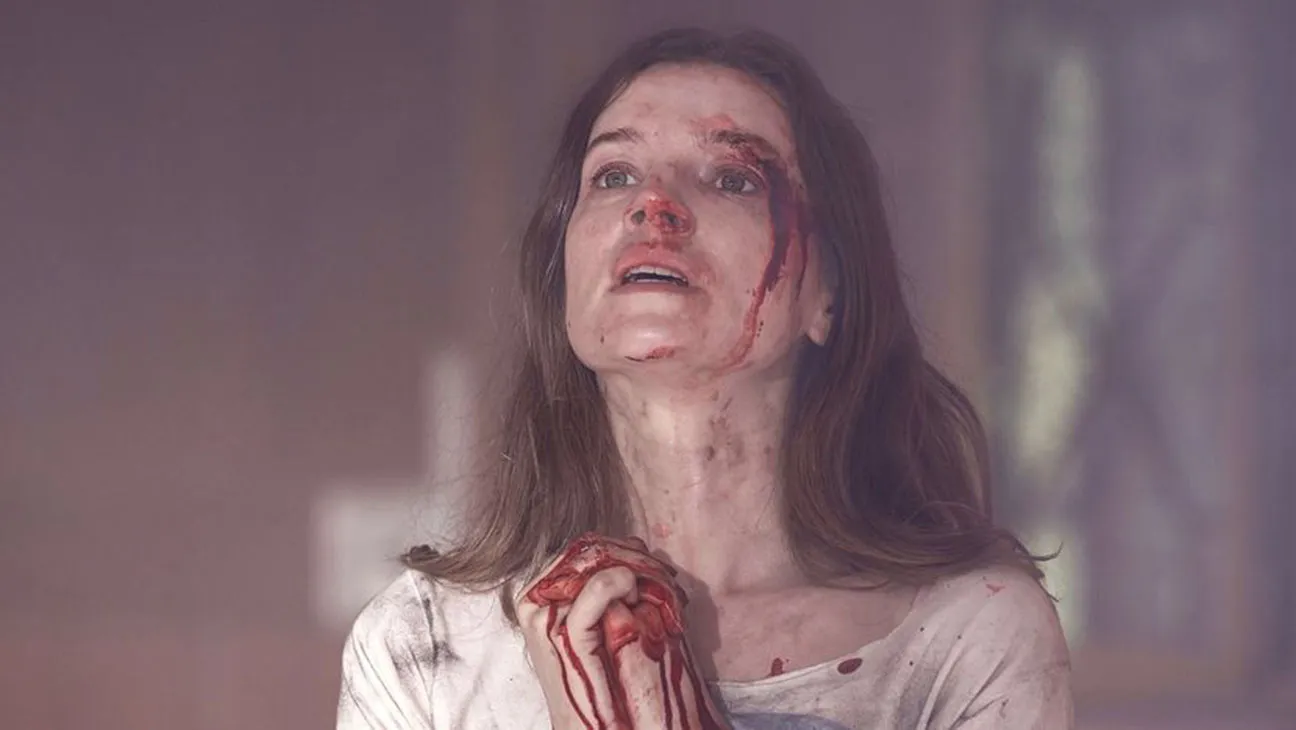
Hey there everyone! Welcome back to Movie Soapbox, the little corner of the internet that only you and I and that guy sleeping in the corner over there know about. This is the place where we find underappreciated indie films and we make sense of them. Today? We are doing a deep dive on A Dark Song, a movie so cosmologically unhinged, so ritually committed to its own internal logic, that the suits who greenlit it almost certainly had no idea what they were actually looking at until it was too late to ruin it.
Before we go any further, here is the trailer. Watch it only if you need to be convinced this is worth your evening. If you already know you’re in, skip it, because the film earns its dread the slow way and the trailer burns too much of it.
Full spoilers from here forward, all of them, every single one, the ending included. If you haven’t watched this film yet, close this tab, find it, watch it, come back. I’ll be here. Because oh how I loved this movie … let me count the ways.
The Darksong Movie Complete Walkthrough
A grieving mother named Sophia pays an occultist named Joseph Solomon roughly one hundred thousand dollars American to seal them both inside a rented Welsh countryside house for up to six months and perform a sustained, exhausting, Abramelin-derived ritual designed to summon her Holy Guardian Angel, which she intends to use as a delivery mechanism for vengeance against the men who murdered her son. That is the entire premise. A woman so consumed by grief that she is willing to walk into the machinery of the spiritual universe and grab the levers herself.
Now, before we walk the film beat by beat, here is the thing you need to understand about the specific layer of miracle it represents that this film exists in the form it does. A movie this ritually austere, this committed to the long-form texture of grief and occult procedure, this thoroughly uninterested in a jump scare or a commercial third-act escalation, at a budget level that almost certainly kept the whole production under two million pounds, at that tier the director’s leverage over his own cut is genuinely precarious. You can tell when a distributor has panicked in post. The rhythm goes wrong. You get inserted reaction shots. You get a score that over-explains every beat of dread instead of letting the silence do the work. A Dark Song has none of those scars. Whatever Liam Gavin had to fight for in the edit, he won. The film feels uninterfered with from the inside out, which at this budget and with material this uncommercial is less common than it should be and more fragile than it looks.
The film opens with Sophia meeting Joseph to negotiate the job. She tells him she wants this for love. He declines, because he is not an idiot, and he has seen what that particular lie looks like before. When she finally admits the truth, that her son was murdered and she wants the men responsible destroyed, he agrees. This exchange establishes the film’s entire moral architecture in about four minutes of screen time. Joseph is not a holy man. He is a detoxing alcoholic whose entire interest in the occult is epistemological, he wants to know how the machine works, he wants the levers. Sophia is not a supplicant. She is a weapon looking for a trigger mechanism. These are not good people attempting a good thing through a dark method. These are two damaged people attempting a dark thing through a thorough method, and the movie is honest about that from the first scene.
Before they seal the house, Sophia has a confrontation with her sister Victoria at a grocery store. Victoria is a Christian. She asks the only question the film actually cares about: is it Godly? And that question hangs over everything that follows, because the ritual framework Joseph is operating from is an absolute grab bag. Kabbalah, Gnosticism, Numerology, invocations of Orpheus, Horus, Baal, Christ. All of it is present. None of it is clearly dominant. Joseph speaks the way a man speaks who has read everything and synthesized it into his own private system, and Sophia speaks the way a woman speaks who does not care about the system, only the outcome. The film never resolves this tension into a clean answer, and that is exactly correct.
The ritual begins. Birds fly into windows. Flowers bloom in wrong places. Noises move through the house like something is learning the floor plan. And then the film does what almost no horror movie is willing to do: it slows down. It makes you sit in the waiting. It makes you feel the six months as duration, not as a montage.
The first real rupture comes when one of the ritual’s requirements is that Sophia forgive. Sophia, who is here specifically to incinerate the men who killed her child, refuses. Joseph engineers an end-around, a ritual that involves drowning her in a bathtub and resuscitating her, death standing in for the forgiveness she won’t perform. They have technically satisfied the requirement through procedural substitution. Whether the universe is fooled by this is a question the film saves for later.
Then Sophia stabs Joseph. Accidentally, during a struggle, but the wound is real and they cannot leave. The house is sealed. The seal was the whole point. So Joseph sits with a steak knife wound in a house that cannot be unlocked, and the infection spreads the way infections spread when there is no hospital, slowly and then all at once. He dies. And when he dies, something in the ritual machinery crosses the wires. The demonic entities that have been circling begin to run free. They present themselves to Sophia in the shape of her dead son, speaking in his voice, using his face. She recognizes them for what they are. She runs. A demon catches her and takes her fingers. She keeps running.
And then she reaches a door. And at that door she says she is sorry. She means it. And light comes. So. What actually happened in those final four minutes?
The Dark Room Movie Explanation Theories
Theory One: That was a demon
The film shows you its demons before the ending, and they are dark, physical, violent, terrifying things with fingers and intent. The being that arrives in the final scene is radiant, still, enormous in its implication. These are not the same category of entity. A demon taking Luciferian drag to trick Sophia into wasting her favor on forgiveness is a reading that requires the film to be far more cynical than everything that preceded it earns. Possible, but the evidence is thin.
Theory Two: That was Satan
This one is actually more theologically coherent than it sounds. The Adversary is described in Second Corinthians as capable of presenting as an angel of light. The word Lucifer itself, from the Hebrew hêylêl, carries the meaning of light-bringer, morning star, the planet Venus. A being of terrible radiance who encourages Sophia toward forgiveness rather than away from it, though, does not behave like the entity whose documented operational preference is theft, destruction, and the wasting of human potential on grief. If that is Satan, he is very bad at his job in this particular scene.
Theory Three: That was an angel
Specifically, the Holy Guardian Angel the ritual was designed to summon. Not summoned by the ritual correctly, because the ritual was compromised by substitution and by blood and by death before completion. But present anyway. The theological pattern here is not that Sophia earned a summons. The pattern is that Sophia, finally, genuinely, asked for the thing she actually needed. Every ritual requirement she bypassed or corrupted or bled through was a step toward a different door. And when she reached the actual door and asked not for vengeance but for the ability to forgive, something real showed up to give it to her. Not because she performed the correct sequence. Because she finally stopped lying about what she needed. Director Liam Gavin has confirmed in interviews this was the intended read.
Theory Four: It’s a metaphor
The entire film is Sophia’s grief process externalized as occult procedural, and the angel is the psychological breakthrough of a woman who walked through six months of ritual self-punishment and came out the other side capable of releasing her hatred. This works. The film supports it. But a metaphor reading requires you to decide that none of the spiritual machinery was real, and the film is far too committed to the reality of that machinery to earn that exit. The metaphor and the literal reading are not mutually exclusive. That is the actual answer. Both things are true simultaneously and the film is smart enough to hold them without blinking.
A Dark Song Movie Soapbox Mike’s Read
Theory Three, with Theory Four running underneath it the whole time like a second score. What Sophia summoned was not what the ritual promised her. The ritual promised her a weapon. What arrived was a response to the one genuine thing she did in six months of procedural manipulation, which was stand at a door and mean it when she said she was sorry. The spiritual universe in this film is not a machine you can game with the right sequence of inputs. Joseph thought it was. That is why he died in a house he could not leave, with a wound he could not treat, in service of a process that was never going to deliver what he wanted from it. Sophia survived because at the end she stopped trying to operate the levers and just said the true thing out loud. The angel did not come because she summoned it correctly. The angel came because she finally, after everything, asked for the right thing. That is the film’s entire argument… beginning, middle, and end.
A Dark Song is a movie about a woman who wanted to use the most powerful forces in the universe as a revenge delivery system, and who discovered, the long terrible way, that those forces have their own ideas about what she actually needed. It should have been flattened by a distributor who wanted the demon to win and the third act to deliver on the violence the setup implied. It wasn’t. It got through intact. That almost never happens at this budget, with this material, in this genre, and you should watch it knowing that, because surviving the machine is not a given, and this one did.
We’ll see you next time at Movie Soapbox, the only corner of the internet where the lights are still on for films like this one.
If You Liked A Dark Song…
Lamb (2021) – Grief warps into something supernatural and nobody in the film acknowledges how insane it all is. Same slow, ritualistic dread that A Dark Song builds so well.
Starfish (2018) – A woman alone in a dead world, processing loss through something that might be real or might be her grief given teeth. Atmospheric, strange, and deeply felt.
Hallow Road (2022) – Isolation, voices that shouldn’t be there, and a ritual that demands more than you planned to give. If A Dark Song’s house consumed you, this road will too.