
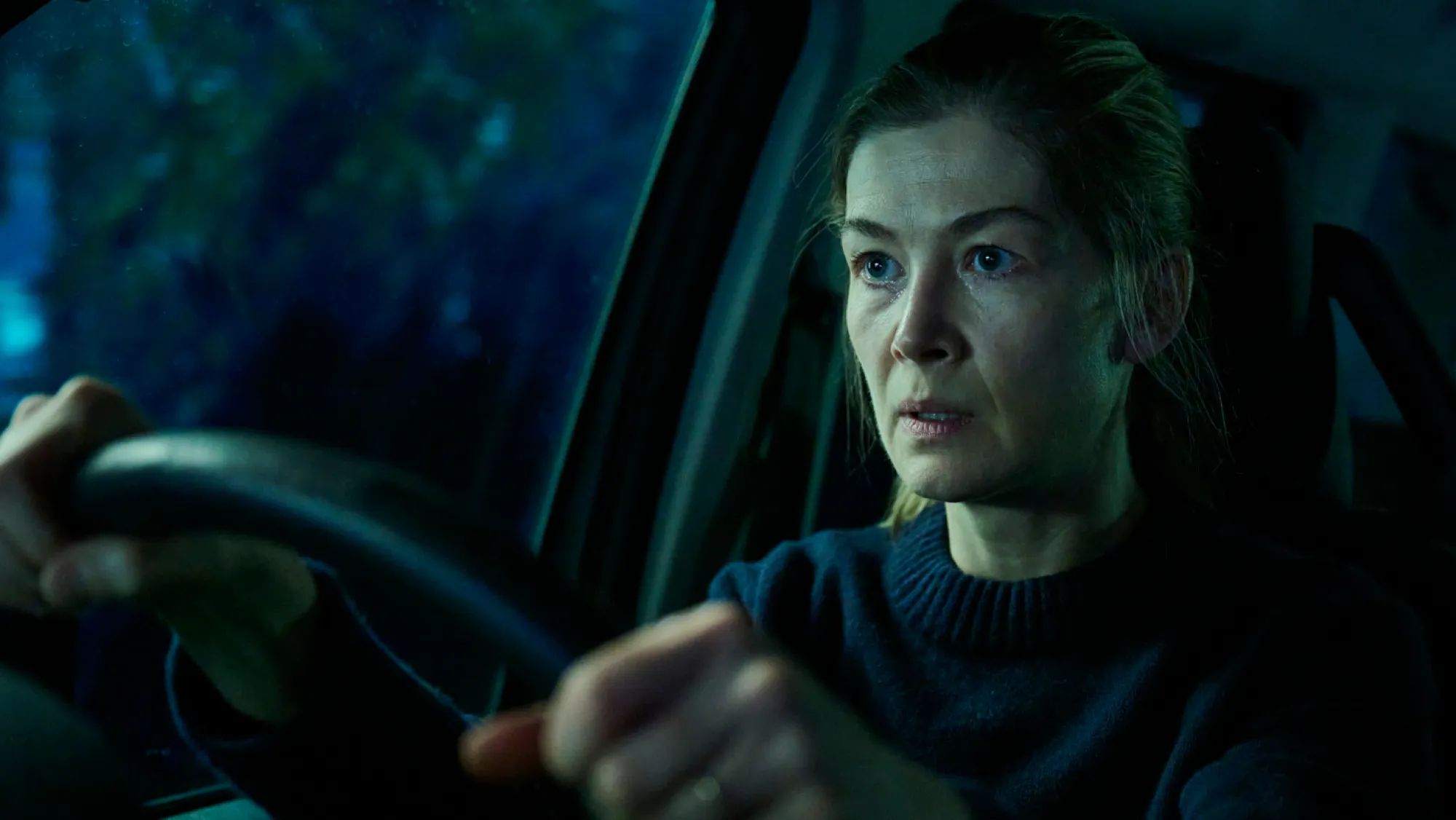
Hey there everyone! Welcome back to Movie Soapbox, the little corner of the internet that only you and I and that guy sleeping in the corner over there know about. This is the place where we find underappreciated indie films and we make sense of them. Today? We are doing a deep dive on Hallow Road, a movie so quietly devastating that it will sit behind your eyes for three days and you will not be able to explain to anyone why you can’t stop thinking about a film where almost nothing happens except two people driving in the dark and slowly realizing they are completely, irreversibly out of time.
Before we go any further, you need to know: everything from this point forward is a spoiler. Not a gentle “oh there’s a twist” spoiler. A “I am going to describe the ending in surgical detail and then tell you what I think it means” spoiler. If you have not watched Hallow Road yet, go find it, watch it, then come back. I will be here.
Hallow Road Movie Setup, Which Is Deceptively Simple
Late at night, a family already fraying at the edges, broken glass on a table, a dinner nobody touched, a daughter who has stormed out after an argument that was bad enough that she got in her car and drove into the dark. Alice, eighteen years old and newly, secretly pregnant, has hit someone on a road called Hallow Road, and now she is on the phone with her parents, Maddie and Frank, who are forty minutes away in their own car, hurtling toward her through the dark, doing the only thing available to people who are too far away to help: talking.
That is the whole film. Two people in a car. A phone call. A daughter getting further and further from safety with every passing minute. Babak Anvari, who directed this, and debut writer William Gillies, who wrote it, are doing something very specific here, something in the tradition of Locke and Calibre and The Guilty, which is to say: they are building a pressure chamber, sealing you inside it with the characters, and then turning the heat up so slowly you do not notice how much you are sweating until you cannot breathe.
What Maddie and Frank learn on the drive: Alice was high on MDMA. Alice never called an ambulance. The person Alice hit may or may not be dead in the undergrowth. And then, because the script is not done with you yet, a stranger arrives on that road. A woman, her voice pitched just slightly too helpful, too warm, too present, and from the moment she opens her mouth the film shifts registers in a way your nervous system registers before your brain does.
What a Film Like This Usually Survives
A movie this stripped-down, this reliant on two actors in a car and a voice on a phone, with no action set pieces, no visual spectacle, and an ending that refuses to resolve, gets strangled in development the vast majority of the time. You can read the script note practically word for word: the third act needs more clarity for the audience, can we confirm what is real please? That note, in some form, lands on almost every film that operates in this register. What you are watching when you watch Hallow Road is a movie that somehow kept its ambiguity intact through the whole process, and at the budget and cast tier this film is working at, with Rosamund Pike and Matthew Rhys, that is genuinely not a given. Talent at that level attracts attention, and attention from the wrong people in post-production tends to flatten exactly the kind of open ending that makes a film like this worth discussing. The fact that you are sitting here unsure of what you just watched means someone held the line. That matters.
The Escalation
The woman on Hallow Road does not leave when Alice asks her to leave. She and her husband, who appears, claim the girl Alice hit is alive and in their care, and then the language shifts, the way language shifts in folklore before anything physically horrible happens, that particular register of calm menace that is worse than shouting. They have, they say, taken in girls before. They have corrected many girls. And now Alice is theirs.
Maddie is on the phone through all of this. Frank is driving. They hear everything. Maddie tries to intervene and cannot. And then Alice reports that the dead girl’s face is changing, and the movie steps cleanly off the edge of realism and does not look back.
When Maddie and Frank finally reach Hallow Road, they find Alice’s car abandoned and a body in the undergrowth that looks like their daughter. Frank says it is Alice. Maddie refuses. Then Alice picks up the phone again, from somewhere else, in someone else’s hands, and the woman tells her parents calmly that Alice belongs to them now. The next morning, detectives walk through the scene and tell Maddie and Frank that their daughter died in a hit-and-run and that the calls they received afterward were grief. Hallucinations. Nothing more.
The Three Ways to Read the Movie Hallow Road
Hallow Road Theory Number One
The first reading, and the one the detectives hand you explicitly, is that Alice died on impact, or close to it, and every phone call after that point was Maddie and Frank’s shattered minds building a story they could survive. The police find no second vehicle, no suspicious couple, no evidence of anything except a dead girl and two parents who cannot accept it. In this reading, the mysterious woman and her husband are a projection, Maddie’s paramedic guilt and Frank’s helplessness and their shared failure around Alice’s pregnancy all folding together into a hallucination with a plot and a logic, the way trauma dreams do.
Hallow Road Theory Number Two
The second reading pushes back on the detectives hard. Both Maddie and Frank hear the woman on the phone, not just one of them in a dissociative moment, both of them, simultaneously, which is a problem for the pure hallucination theory. The woman knows about Alice’s pregnancy, and there is no clean explanation for how a random stranger on a dark road would know that. Alice continues to respond to her parents after the supposed discovery of her body. The detectives’ explanation is tidy in the way that dismissals always are when the people doing the dismissing do not want to look too hard. In this reading, the couple is real, predatory, and Alice is gone in a way that is worse than an accident because it was deliberate.
Hallow Road Theory Number Three
The third reading came from people who caught something the first two readings miss, which is the name of the road itself and what that name implies. Hallow Road is a liminal space in the old sense, a threshold, a place where the categories of living and dead and human and not-human do not hold the same way they do everywhere else. The woman and her husband, in this frame, are not cult members or serial killers but something older, fae or shapeshifters or whatever word the tradition you are drawing from uses for entities that move along the edges of ordinary life, feeding on grief and confusion, luring travelers, mimicking the familiar to deepen the trap. Their claim to have corrected many girls before is not a boast, it is a taxonomy. Their calm is the calm of things that have been doing this for longer than any individual human lifetime.
The Casting Detail That Does Most of the Work
Wait for it. Just hold on one dang second. Did you notice… did you see as the credits were rolling that both Rosamund Pike and Matthew Rhys, (who play Maddie and Frank for the less observant among us), also voice the mysterious woman and her husband? These are the voices Alice hears in person on that road, the voices her parents can only hear through the phone. Did you catch that? Because if you did… that should change everything for you as to how you are reading this movie. This is not a trivial footnote. This is the film’s structural argument, delivered quietly, trusting you to catch it.
If you are in the first reading, the casting confirms it completely. Maddie and Frank are not talking to their daughter. They are talking to themselves! This is their own voices looping back to them through the architecture of their grief, externalizing everything they cannot face, assigning it a villain shape so it has somewhere to go. The casting is the film showing you the mechanism of that projection in the most direct way available to it.
If you are in the second reading, the doubling works as something more unsettling than confirmation, a surrealist choice that places the danger in the parents’ own register, their own frequencies. The killers wear Maddie and Frank’s voices the way a wound wears the shape of whatever caused it. The threat to Alice, in this reading, radiates outward from her family’s failures, and the film literalizes that by putting those failures in the mouths of the people who took her.
If you are in the third reading, the casting is the oldest trick in the fae playbook. These entities do not have voices of their own the way humans do, they borrow what they need, they wear the familiar to get close, and what could be more disarming to a frightened girl on a dark road than the sound of something that resonates with the voices she grew up hearing. The mimicry is the predation. Pike and Rhys voicing both sets of characters is the film showing you exactly how that works.
Where Moviesoapbox Plants Their Flag on Hallow Road
I have decided that land on the first reading, and I have been since the credits rolled. The film’s entire architecture is built around two people in a car who cannot reach their daughter, and the horror of that architecture is not that something supernatural intervened, it is that nothing intervened. Alice was already gone before her parents were even in the car, and everything Maddie and Frank experienced on that drive was the sound of their own minds trying to stay functional in the face of something they could not fix. The casting choice is the tell. When the villains speak in the voices of the grieving parents, the film is not doing a stylistic flourish, it is describing the mechanism. Maddie and Frank built those voices. They built the whole thing. Because the alternative, that their daughter died randomly on a dark road because of an argument about a pregnancy, is the kind of loss that the human brain will work very hard to transform into something with a monster in it, something that can be blamed, something that makes the randomness feel like it had an intention. That is what Hallow Road is about. The stories we tell to survive the ones we cannot.
What Gillies wrote and what Anvari filmed is a movie about how guilt compounds inside a closed space, and the car is that space, and the family is that space, and the grief is that space, and by the end all three have collapsed into each other. That is a hard thing to get onto a screen. That is a harder thing to keep intact through distribution and post and all the people who will tell you the audience needs to know what happened. Somebody kept it intact. That is the film you watched. It deserved to survive, and it did. Good.