
Hey there everyone! Welcome back to Movie Soapbox, the little corner of the internet that only you and I and that guy sleeping in the corner over there know about. This is the place where we find underappreciated films, foreign films, the ones that slipped through the cracks or nearly got strangled in them, and we make sense of them. Today? We are doing a deep dive on Lamb, a movie so quietly, patiently, elementally strange that even people who loved it are still sitting with their hands in their laps three days later trying to figure out what they watched.
Before we go any further, you need to have already watched this one, because I’m going to walk through every beat of it and I will not be apologizing for that. If you haven’t seen Lamb yet, go find it, watch it in a dark room ideally with no one asking you questions, and come back. You’ll want to have experienced that ending cold. You owe yourself that. Everyone else? Buckle in, because we have a lot to get through.
The Lamb Full Movie Walkthrough
Let me tell you something about what a movie like this costs to exist in the current landscape. Lamb is an Icelandic debut feature from a first-time director, Valdimar Jóhannsson, built around a premise that you could not pitch in a room without watching every development executive in a fifteen-foot radius reach for their phone. A grieving couple on a remote sheep farm. A half-human, half-lamb baby. A Ram-Man who comes for what is his. No genre scaffolding to hide behind, no franchise IP to justify the budget, no sequel hook to promise the suits their money back. The kind of film that gets greenlit, if it gets greenlit at all, because someone with enough clout decided to put their name on it, and even then it gets distributed in America because A24 has built a brand specific enough that their audience will follow them into exactly this kind of beautiful, unnerving nowhere. You want to know why films like Lamb are rare? Because ninety-nine out of a hundred times, someone in the room says “but what does the creature want, can we make that clearer in act two,” and the director either caves or the film never gets made. Jóhannsson didn’t cave. The film exists. That’s already an achievement worth noting before we say a single word about what’s actually in it.
The film opens in near-silence, moving through mist, through horses scattering, something heavy and breathing and large passing through the frame at the edge of your vision. You don’t see it. You feel the weight of it, the physical mass of whatever this is, and the horses know before you do that something fundamental is happening. My first instinct watching that sequence was: this thing is enormous, this thing is deliberate, and this thing is not visiting randomly. I wrote down “demigod” in my notes and I wasn’t wrong, I just didn’t have the full picture yet. Put that aside. We’ll come back to it.
Maria and Ingvar are sheep farmers in a part of Iceland so remote it seems like the world decided to stop there, just gave up and said, fine, here’s where we end. They move through their days with a kind of practiced quiet, the silence of people who have already had the conversation they most needed to have and found no resolution in it. In the first ten minutes there is almost no dialog at all. Then when they do speak, Ingvar talks about time travel, specifically about traveling into the past, and Maria says of course you’d be able to go back, if you can go forward, and that right there is the whole wound of this film laid out in a single exchange. Something happened to these people. Something they would go back and change if the laws of physics were more cooperative. We don’t know what yet, but we know the shape of it, the weight of it, and we carry that forward.
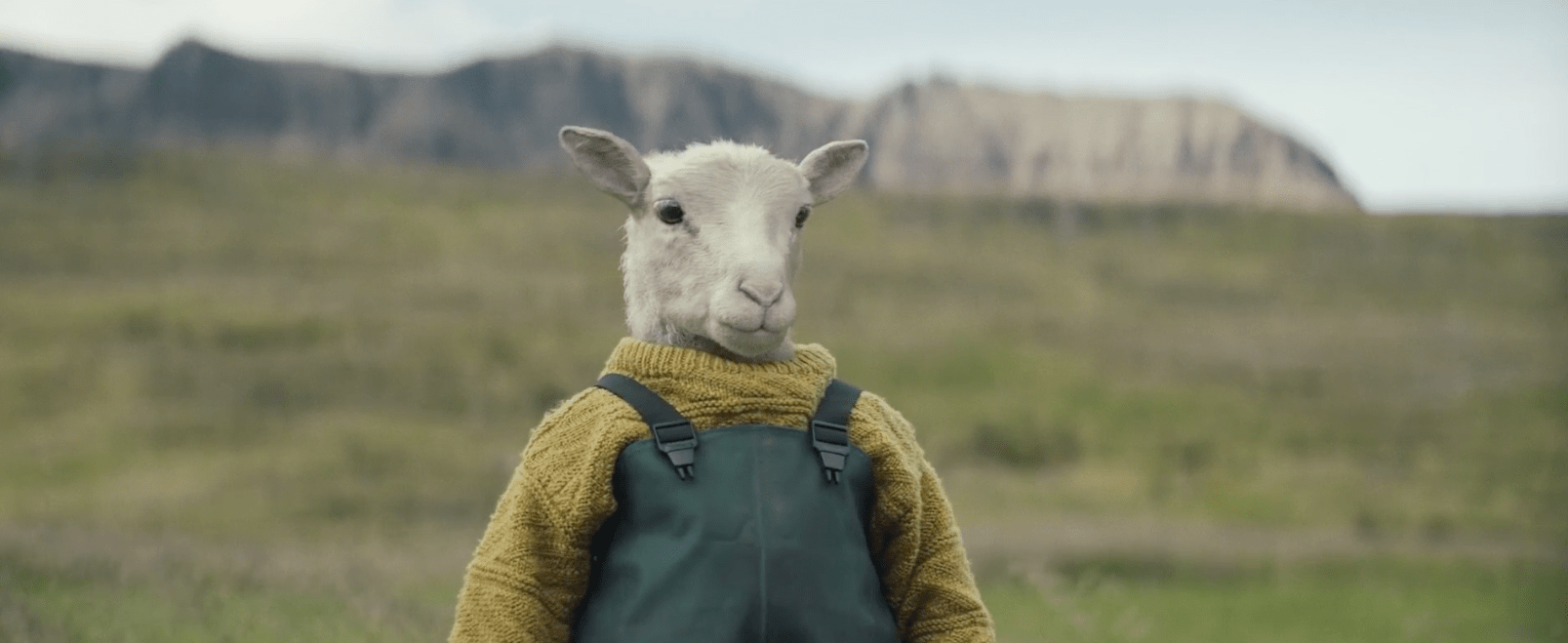
Then the lamb is born. Half lamb, half human. A child’s arm where a foreleg should be, a child’s face, a lamb’s wool body. And Maria and Ingvar take her in without flinching. Name her Ada. Move on. The film doesn’t editorialize. It doesn’t underline the strangeness. It just lets the new family unit exist, quietly, in that remote Icelandic field, and dares you to find a reason why they shouldn’t have her.
What you’re watching in those middle sections, before Pétur arrives and before the ending detonates, is a film about grief doing what grief does when it finds a vessel, it fills it completely, without asking permission and without checking whether the vessel belongs to you. Maria and Ingvar lost a daughter named Ada, we learn this from the cross in the small family cemetery on the property, Ada Ingvarsdóttir, Ingvar’s daughter. That loss is recent enough that it still shapes every silence between them. And when this creature arrives, this half-lamb child, Maria doesn’t see an abomination or a miracle or a question. She sees the thing that was taken from her. She takes it back. Simple as that.
Pétur arrives, drunk, ejected from some other life, the way he apparently does with some regularity, and he is the first character to say out loud what the audience has been thinking. He looks at Ada and says what the hell is this. And Ingvar says, happiness. And the film doesn’t argue with that answer. Pétur is also the character who makes the Maria/Ingvar marriage complicated in a way the film refuses to fully resolve, there’s history between Maria and Pétur, something that clearly went further than it should have, and the film leaves that thread alive and vibrating without tying it off. Did Maria have an affair with Ingvar’s brother? Almost certainly. Is Ada1, the dead child, possibly Pétur’s? The film plants the question and walks away from it. Hold that.
Maria has a nightmare about a sheep, an evil sheep that stalks her. She wakes and goes to the field and finds Ada’s biological mother, the ewe that carried her, and shoots her. Buries her in the field. This is the act the entire film pivots on, and I want to be precise about why. Because Maria’s sin here has nothing to do with Pétur, nothing to do with infidelity or desire. She murders a mother for wanting her child back. That’s the transgression. That’s the bill that eventually comes due.
Pétur’s arc swings back and forth, threatening Ada, then tenderly sleeping beside her, then being paid off and put on a bus by Maria, who at this point is managing everyone around her with a kind of steely competence that reads like virtue but is actually control. She’s holding the shape of the life she wants together by sheer force of will and the strategic deployment of cash.
Then the Ram-Man returns. Ingvar and Ada are out near the fields, looking for the dog that’s already dead, and Ingvar takes a rifle round in the neck. He turns and sees him, the Ram-Man, the father, standing there with a gun. He shoots Ingvar again. He takes Ada’s hand. And they walk back into the mountains together.
Maria comes back from the bus station. Finds Ingvar in the field. He dies. And the film ends with Maria sitting in the wreckage of everything she built, the mountains behind her, the sun going down, and something that might be resolve on her face, or might be the absence of anything left to lose.
Now let me unpack the questions this film is actually asking, because there are several and they don’t all have clean answers, which is the point.
Who is Ada?
Both of them. Ada1 was Maria and Ingvar’s daughter, buried in the family cemetery, Ingvarsdóttir confirming the parentage through Icelandic naming convention. She died within the last two or three years based on the scraps of dialog that suggest each year has been incrementally more bearable than the last. Whether Ada1 was Pétur’s biologically is a question the film raises through implication and then declines to answer, and I think that ambiguity is load-bearing. Because if she was Pétur’s daughter, then Maria’s grief has a second layer of guilt in it, the grief of a secret, and the new Ada becomes even more specifically a replacement for something Maria has never been able to fully mourn out in the open. The film doesn’t confirm it because it doesn’t need to. The weight of the possibility is what matters.
Ada2, the creature, is literally the biological offspring of a Ram-Man, a mythological being of some kind, and a ewe on the farm. The film treats this as real. We are not in metaphor territory here. Pétur’s reaction confirms it: he is a real-world person confronting something that should not exist, and he is clearly disturbed by it even as he eventually adapts to it the way humans adapt to most things they can’t explain. The creature is real. The Ram-Man is real. This is the world of the film.
What is the Ram-Man and what does he want?
The film gives you the behavior and asks you to derive the logic, which is a very specific and very deliberate choice. What we know: he created Ada intentionally. He has been watching the farm. He killed the dog. He killed Ingvar. He took Ada back. The pattern is not random, it’s paternal. He came for his child. The obstacle he removed was the man standing between him and that child. Which means the equation the film is running is a dark mirror of Maria’s own: she took something that wasn’t hers, a child that belonged to another mother. The Ram-Man took something back that was his, and removed the husband who was raising his offspring. The symmetry is brutal and the film is absolutely aware of it.
Has Maria sinned, and is the ending a punishment?
Yes, and the murder of the ewe is the sin, not the affair with Pétur. Maria killing Ada’s biological mother is the moment that sets the Ram-Man’s reckoning in motion. She didn’t just take his child, she eliminated the child’s mother to secure her claim. In most ancient moral frameworks, that act doesn’t go unanswered. The film is drawing on something older than Christianity here, older than Norse mythology, something closer to the bone: nature’s accounting. You took from something that owned what you took. It will take back.
What’s interesting is the exchange rate. Ingvar dies, not Maria. And the argument for why goes back to how ancient cultures assigned moral responsibility within a family unit, the husband was held accountable for what happened under his roof and in his fields. Ingvar knew Ada wasn’t a natural child and chose not to question it. He participated in the taking, even if Maria was the architect of it. So Ingvar pays. Maria is left alive. Whether what she’s left with constitutes punishment or merely consequence is a question the film hands you at the end and does not take back.
The Christmas conception and what it means
The Ram-Man visits on Christmas Day and impregnates the ewe. Ada is born five months later. The film is clearly in conversation with the nativity, an unusual birth, a creature not entirely of this world, arriving among the animals. But the film isn’t making a Christ allegory, it’s inverting one. The lamb in Judeo-Christian tradition is the sacrificial animal, the one that takes on sin and pays for it. Here, the lamb-child arrives to be received with joy, and the sin is in the receiving, in the taking of something divine and pressing it into the service of human grief. The Christmas framing is there to make you feel the weight of what Maria is doing when she accepts Ada: she is taking a blessing she did not earn, offered by a power she does not understand, and she will be billed for it later at a rate she didn’t negotiate.
The Lamb Movie theories
There are two main camps on what this film is doing and they’re not mutually exclusive.
The first is the naturalistic-mythological read: this is simply a world where these creatures exist, the Ram-Man is a real entity in this reality, and the film is a folk tale about the consequences of taking from nature what nature did not offer you. Maria stole a child, killed a mother, and nature sent the father to collect. Full stop. The emotional resonance of grief is there to make you sympathize with Maria, not to excuse her, and the ending is just. This is the read I find most satisfying and most earned by the film’s internal logic.
The second is the grief-as-psychosis read: Maria and Ingvar are so consumed by the loss of Ada1 that they have collectively agreed to a delusion, and Ada2 is a lamb they are raising as a human child, with the film rendering their subjective experience literally. Under this read, the Ram-Man is something that exists in the mythological layer of the film’s reality, possibly the manifestation of the natural world’s reclamation of what was always a lamb and never a child, and Ingvar’s death is literal while everything surrounding it is filtered through Maria’s fracturing psychology. This read is coherent but I find it less interesting because it defangs the moral stakes. If Ada was always just a lamb, Maria’s sin is madness, not murder, and the film becomes a tragedy of illness rather than a reckoning for a choice.
The third read, which gets less play but is worth naming, is the pure Icelandic folk tale mode: this is a parable about the old compact between humans and the land, the animals, the forces that predate human civilization, and what happens when that compact is broken. Iceland is one of the few places in the world where that kind of storytelling still has cultural roots deep enough to support a film like this without feeling affected. Jóhannsson grew up on a sheep farm. He’s not performing rurality. He’s drawing from it.
I’m planting my flag in the first read with elements of the third. This is a real world with real mythological forces operating in it, Maria made a real choice with real moral weight, and the ending is the bill coming due. The Ram-Man was always going to come back. The only question was when and what he would take. And the film answers that with one rifle shot to the neck and then silence.
What gets me about Lamb, what’s stayed with me since I watched it, is that Jóhannsson never once blinks. A lesser version of this film winks at the audience. Lets you in on the joke. Acknowledges the absurdity. This one just stares at you with its flat Icelandic light and its wide empty fields and its breathing, and it trusts you to meet it where it is. That’s a film that got made by someone with a specific, complete vision and enough runway to execute it without someone calling for a test screening in Burbank to figure out if the ending needed more closure. Films like this exist in the spaces the machine doesn’t bother to colonize because there’s no franchise in it, no sequel, no four-quadrant upside. The machine looked at Lamb and moved on. That’s the only reason it exists the way it does. And it’s damn near perfect.
Hey, thanks for hanging out here at Movie Soapbox, this little corner of the internet where we take the films that almost didn’t make it and give them the conversation they deserved from the start. If Lamb wrecked you a little, good. It was supposed to. We’ll be back with another one soon.
If You Liked Lamb…
Apples (2020) – A Greek film where people lose their memories and rebuild identities from scratch. Same quiet surrealism, same grief hiding underneath everything.
Godland (2022) – An Icelandic landscape that swallows a man whole. If Lamb’s valley felt alive, Godland’s terrain is actively hostile and twice as beautiful.
The Bothersome Man (2006) – A Scandinavian film where something is deeply wrong and nobody will acknowledge it. Same uncanny domesticity that Lamb builds its entire world on.