
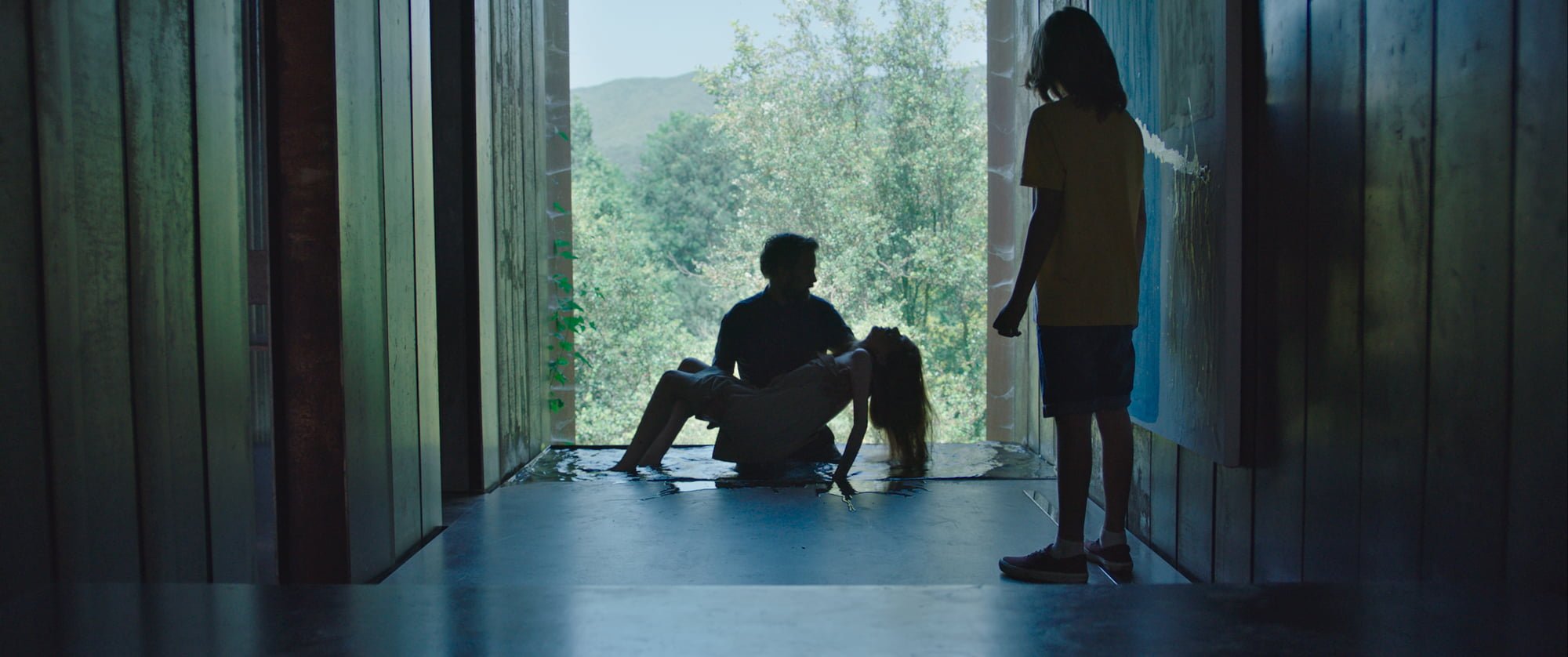
Hey there everyone! Welcome back to Movie Soapbox, the little corner of the internet that only you and I and that guy sleeping in the corner over there know about. This is the place where we find underappreciated indie films and we make sense of them. Today? We are doing a deep dive on Black Hollow Cage, a movie so deliberately, aggressively opaque that it will make you feel like a fool for the first hour and a prophet for the second, assuming you survive the crossing.
Okay, stop right here. If you have not seen Black Hollow Cage yet, close this tab, go find it, and come back. I mean it. This is the kind of film that gets exactly one chance to wreck you, and I am not going to be the reason you wasted yours. The rest of this post is a full demolition of the movie, front to back, no apologies. You have been warned, in Mike’s voice, which is all the warning you are getting.
Before we get into the mechanics of what this film is actually doing, let me tell you something about what kind of film this is at the industry level, because it matters. Black Hollow Cage is a first feature from a Spanish writer-director, Sadrac González-Perellón, shot in English, with a small international cast, almost certainly on a budget that a mid-tier studio spends on craft services for one week of a franchise sequel. At that budget tier, a director either gets what he came for or he doesn’t, there is no middle negotiation, no second-unit cavalry, no reshoots funded by a nervous distributor trying to sand down the edges. What you see on screen is what the director fought to put there, full stop. The fact that the film is this controlled, this committed to its own internal logic without once stopping to explain itself to you, is the tell. A committee never would have let this stay this strange. Someone with final cut held the line, or got lucky, or both. The Jury’s Choice win at Bucheon 2017 did not come from a film that flinched.
Black Hollow Cage Movie Walkthrough
The film opens mid-motion, which should tell you everything. Adam (Julian Nicholson) is carrying a food tray down the hallway of a strikingly modern home, all glass and clean lines and the kind of architectural silence that in real life costs money and in film language always signals a character who has built a fortress around himself and called it living. He senses something behind him. A man in a ski mask. The masked man clubs him and we cut away, no explanation, no anchor in time. Are we watching the beginning? The end? A loop already in progress? The movie does not care that you don’t know. It is already moving.
We land on Alice (Lowena McDonell), Adam’s daughter, being fitted for a mechanical prosthetic arm. Her right arm below the elbow is gone. She has serious, barely-contained anger about pretty much everything in her vicinity. And her companion through the woods surrounding this fortress-home is a dog named Mother, a white wolfhound with a voice-enabled collar that lets the dog speak. If that sentence made you uncomfortable, good. The film means it to. Mother is not an affectation, Mother is information, and you will understand what kind of information only once you’ve seen the whole thing.
In the woods, Alice and Mother find a large metal cube. Solid, featureless, responsive to Alice’s touch. The cube produces a note, written in Alice’s own handwriting: “They are not to be trusted.” Alice’s response is not panic. Her response is something closer to recognition, and that is your first enormous clue, though the film buries it quietly and moves on.
That same day, Adam finds two strangers in the woods. Erika (Haydée Lysander), face badly beaten, and Paul, who is mute. Erika says the man who did it was her boyfriend, David. She talks Adam out of calling the police, telling him it always goes wrong when he calls the police. That line will mean something specific later. Adam puts them up in the house like any reasonable person would not do, because inside grief-logic, control and proximity feel like safety.
The household dynamics that follow are wound extremely tight. Alice is furious when Adam makes an advance toward Erika in front of Mother. Adam tells Alice that Mother is not her mother. Alice says she transformed her. Adam says no, he killed her. And here, if you are watching carefully, the film has just handed you the whole thesis in a single exchange, wrapped in enough ambiguity that you will likely not realize it yet.
Alice returns to the cube and this time it gives her an audio file, in her own voice, with instructions. Go tell Adam that David is outside. Keep him from calling the police. Go to the kitchen, find Paul. Kill Paul. Kill Erika. The audio tells her that if she does not, something terrible will happen. Alice cannot do it. Paul and Erika then kill Mother and slit Adam’s throat while he follows Erika outside, and the ski mask figure from the opening is there to deliver the blow. Erika, Paul, and the masked figure leave together.
This is the end of the first loop. And here is where the film earns everything it asks of you.
Morning. Alice finds Adam and Mother dead. She goes back to the cube. This time it opens wide enough to enter, and she does, without hesitation, and that lack of hesitation is the film screaming at you from the margins. Inside the cube, we reset. We are at the beginning again, but now we are following Alice2, identifiable by a lighter blue blouse than Alice1’s darker one. Alice2 has already been through this. She records David beating Erika in the woods on her phone. She sends Mother’s voice collar the message “Come help,” drawing Alice1 toward her. She goes to the kitchen and stabs Paul in the neck. Erika walks in laughing and stabs Alice2 in the gut. Adam enters, horrified. Alice1 arrives and shows Adam the phone video of Erika’s beating in the woods. They go to the cube together.
The next permutation. Adam1 walks a hallway and Adam2, ski-masked, follows and kills him and takes his place. Adam2 is now running the household. David arrives, not as a threat but as a grieving son, delivering a monologue about his parents, the people Adam killed in the car wreck, describing their favorite foods and colors and actors and the love his mother taught him, because he needs someone in this house to know that they were real people and not just damage. And then Alice3, dark blue shirt, walks up behind him and stabs him. She sits down with Adam2 and says her father’s name is Adam, her mother’s name is Beatrice, and they need to use the cube to go back seven months and twelve days to stop Adam from taking his car keys from the drawer, because that is the morning he drove Beatrice and Alice somewhere and lost control and killed David’s parents and his own wife and took Alice’s arm and built this whole black hollow cage around himself out of the rubble.
Black Hollow Cage Details Explained
The car accident is the fixed point. Adam was driving. Beatrice died. A man named David and a woman named Elizabeth, parents of young David, died in the other car. Alice lost her arm. The dog named Mother is Alice’s psychological stand-in for the mother she lost, the voice collar its own kind of grief logic made literal. The cube is not a real object. The cube is Adam’s guilt given physical form inside a psychological collapse so total that it has bent his interior world into something that looks, from inside his own mind, like physics.
This is the theory the film is actually arguing. Not the only reading on the table, but the one with the most structural support.
Black Hollow Cage Theory Number 1 – The competing reads worth knowing: one school says the cube is real, alien or future-origin, that this is a genuine time-loop story in the Timecrimes tradition and the trauma reading is just thematic color. Proponents of this read point to the specificity of the loop mechanics, the numbered versions of Alice and Adam, the video that crosses loop boundaries, the way the film treats the cube’s physical properties with technical seriousness. The loops are too internally consistent, this argument goes, to be purely psychological.
Black Hollow Cage Theory Number 2 – Another read splits the difference: the cube is real but was built by a future Alice, the daughter reaching back across time to give herself the tools to undo her father’s mistake, and the “grief metaphor” framing is the film’s emotional layer rather than its literal answer.
Both of those readings are defensible. The film does not close the door on them. That is intentional. González-Perellón is not being sloppy, he is being precise about exactly how much ambiguity to leave standing.
Moviesoapbox’s Personal Opinion on the Movie Black Hollow Cage
Here is where I plant my flag. The cube is the trauma. Literally and architecturally. Look at Alice’s reaction the first time she touches it, recognition, not discovery. Look at what the cube asks of her, kill the strangers who are going to kill her family, which is exactly the impossible moral bargain that survivors of catastrophic loss make with themselves in the dark for years afterward. What if I had done something different. What if I had been faster. What if I had just not let it happen. The cube is that bargain made spatial. The loops are the recursive hell of replaying the event, finding new angles, inserting yourself into the sequence at a different point, arriving always at the same wreckage. Adam built this box out of sheer psychic desperation and he and Alice are both living inside it. The title is not a reference to the device. The title is a description of Adam. He is the black hollow cage. He has been since the accident. Everything else in this film is what that looks like from inside.
That is also why this film deserved to stay exactly as strange as it is, and why the fact that it did stay that strange is the thing most worth respecting about it. A studio note on a script like this would have asked for clarity, for a definitive answer about whether the cube is real, for a third act that tells the audience where to land. The film we have refuses that. It trusts you to sit with the ambiguity the way a real person sits with real grief, which does not resolve, which loops, which sends you notes in your own handwriting that tell you to do things you cannot do. If this film had gone through five more rounds of notes from twelve VPs who have never lost anything they could not replace, it would be a time-travel thriller with a twist ending and a licensed indie-folk song over the credits. Instead it is this. Be glad someone held the line.
If you want more films that live in this same psychological-mechanic overlap, Timecrimes is the obvious mechanical cousin. Starfish is the emotional one. The grief-as-architecture space is underbuilt in cinema and Black Hollow Cage is one of the few films willing to live there without a map.
Go watch it again. And this time, watch Alice’s face when she first touches the cube. She already knows what it is. She has always known what it is. That is the whole movie in one moment, and González-Perellón put it in the first twenty minutes and trusted you to find it on the way back through. That is what filmmaking looks like when nobody made the director explain himself.
🎬 If You Liked This…
- Hallow Road — an isolated setting, something that shouldn’t exist rewriting what happened, a protagonist trying to hold onto a version of events that keeps slipping away from her
- Aporia — a device that manipulates time built by ordinary people, and the family destruction that follows when you start pulling threads the universe didn’t intend to be pulled
- Time Trap — a location that distorts time in ways the characters only slowly understand, the same patient reveal structure and the same sense of something ancient and indifferent at the center of it