
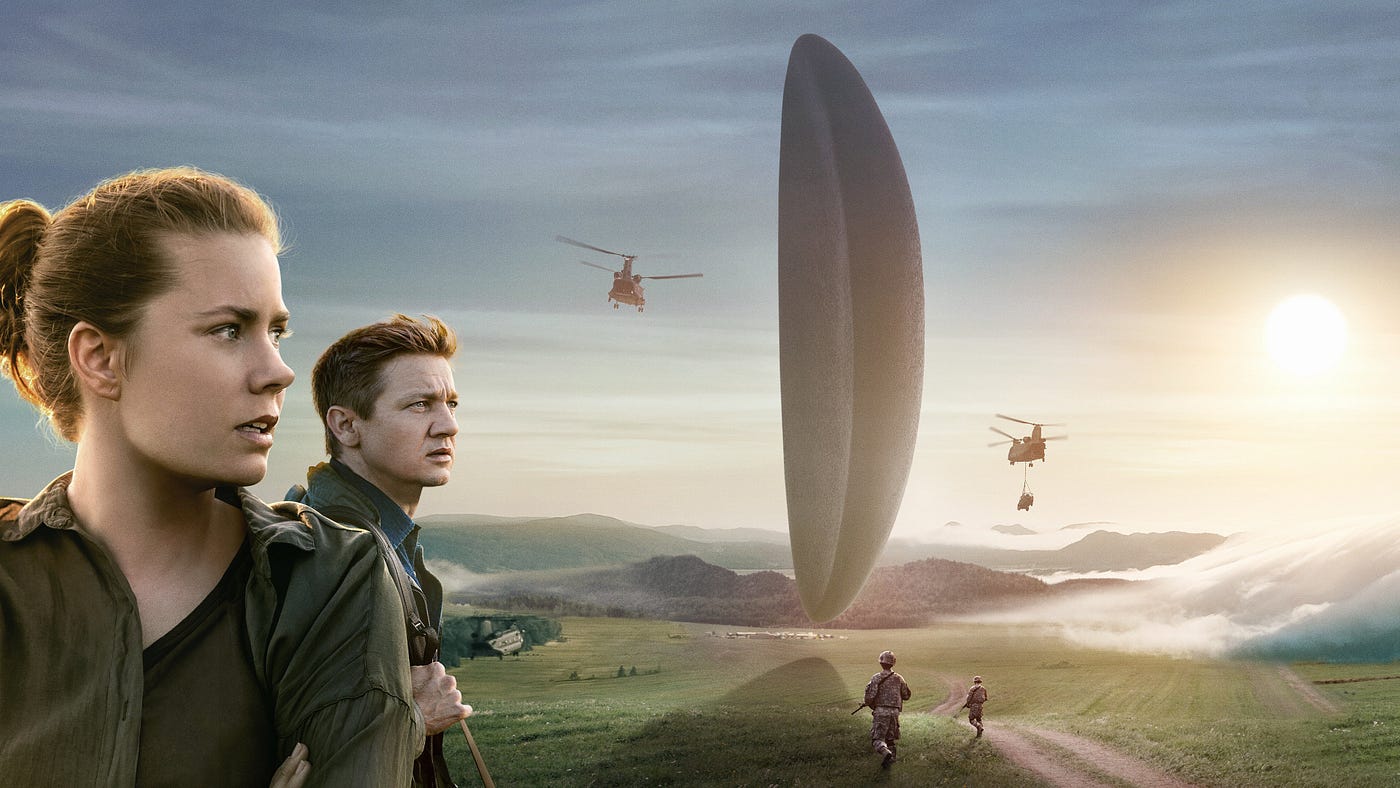
Hey there everyone! Welcome back to Movie Soapbox, the little corner of the internet that only you and I and that guy in the back who keeps rewinding the last twenty minutes of Arrival know about. This is the place where we take films that broke something in your brain and we actually fix it, or at least explain why it was worth breaking. Today we are doing a full deep dive on Arrival, Denis Villeneuve’s 2016 science fiction film so architecturally strange, so quietly devastating, that you probably sat in the parking lot afterward trying to figure out if you were sad or just confused or both, and the answer is both, and that was completely intentional.
Alright, listen. Everything from this point forward is going to spoil the entire film in granular detail, the whole mechanism, the timeline trick, the Shang phone call, the daughter, all of it. If you have not seen Arrival yet, close this tab, go watch it, come back when your face is still a little wet and you have no idea why. That is when this post will do you the most good.
Still here? Good. Let’s get into it.
The Movie Screenplay For Arrival
Before we walk through what actually happens in this movie, you need to understand what Eric Heisserer was actually handed when he was assigned to adapt Ted Chiang’s short story Story of Your Life. Chiang’s original is fifty pages, non-linear in conception, and built on a linguistic philosophy so abstract that the emotional payload of it lands almost entirely in the reader’s head rather than on the page. That is a nightmare to adapt. You cannot shoot a concept. You cannot cast a philosophical premise. What Heisserer had to do, and what you can see the scar tissue of if you know where to look, was find the human container for an idea that resists being embodied. The version of the script that made the rounds before production included a different alien gift entirely, an interstellar spacecraft, each nation receiving one-twelfth of the schematics, which forced geopolitical cooperation as a structural element. That is a clean, filmable concept. Then Interstellar came out. You can feel the emergency in the pivot, a production already deep into designing the logograms suddenly needing to reconceive what the aliens are actually offering humanity, and landing on the answer that the language itself is the gift. That is the kind of creative problem that either breaks a script or elevates it into something stranger and better than the original plan. In this case it elevated it. But that does not happen without a writer who understood why the pivot had to happen and what it had to become.
The Movie Arrival Walkthrough
The film opens on Louise Banks, linguist, and the first thing it shows you is a daughter. Birth, childhood, illness, death. It frames these as memories, as grief, as the emotional backstory that explains why Louise moves through the university campus like someone who recently survived something. Her mother calls. She brushes her off. We read it as a woman still underwater after losing a child. This is the con. This is Villeneuve and Heisserer setting you up to misread every piece of emotional information the film gives you for the next ninety minutes, and you fall for it completely, because grief looks exactly the same whether it is remembered or anticipated. Louise is not sad because she lost her daughter. She is sad because she has begun to see her daughter, a daughter who does not exist yet, and the image keeps arriving without context or explanation, the way a word in a language you do not speak yet lands in your ear as pure sound with no meaning attached.
The inciting event is the arrival of twelve extraterrestrial vessels, distributed across the globe with no apparent pattern or communication. The military pulls Louise in to lead the translation effort, pairing her with Ian Donnelly, a physicist, because the logic is that language needs math nearby in case language alone is not enough. What follows is weeks of slow, painstaking contact with the heptopods, Abbott and Costello as Louise names them, creatures who communicate not in linear spoken language but in circular, simultaneity-based logograms that carry meaning in their shape and their entirety rather than in any sequence of units. This matters enormously and we will come back to it.
Parallel to the contact, the other eleven sites are descending into paranoia. The problem is translation, specifically the way that partial translation of a non-linear language creates catastrophic misunderstanding. When one site translates a heptopod communication as “use weapon,” and the correct reading is closer to “tool” in a context-dependent sense that requires the full language to parse, you get a cascade of countries going dark, cutting off communication, moving toward military response. The world starts ending the way it usually ends in reality, not through malice but through incomplete information and the specific panic of people who have decided that the other side is operating in bad faith.
The bomb that a group of soldiers plants inside the vessel kills Abbott and triggers the event that resolves everything and breaks Louise’s brain open simultaneously. Before Abbott dies, the heptopods do something. They push everything. Every logogram, the entire vocabulary of their language, the complete non-linear grammar of how they perceive time, floods Louise at once. This is the gift. Not a ship. Not a weapon. A cognitive architecture that allows the recipient to experience time the way the heptopods do, without before and after, as a simultaneous whole.
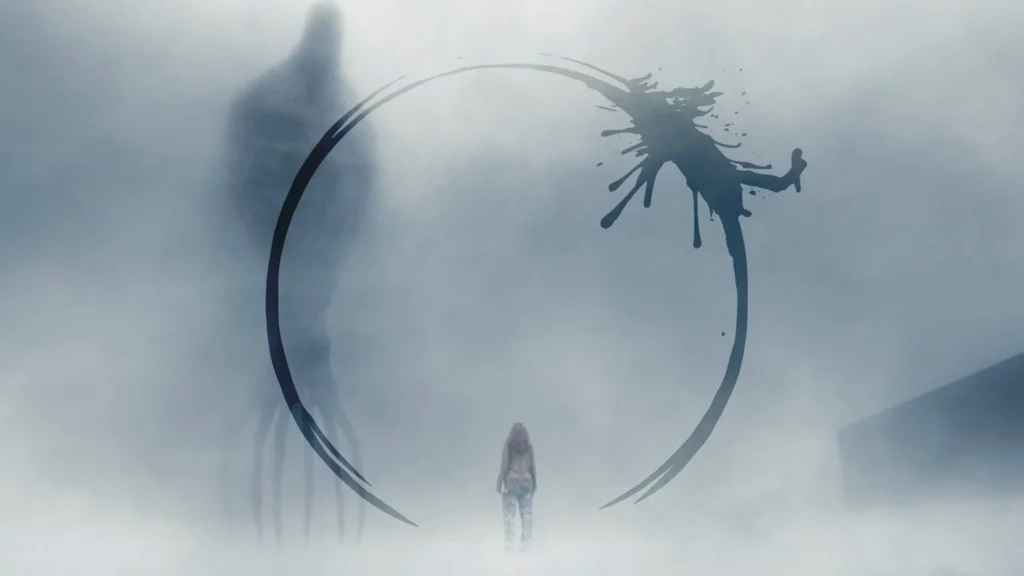
And here is the mechanism you need to hold onto: Louise, now partially immersed in this language, begins to see the future the way the logograms work, not as a linear sequence but as a field. The visions of her daughter are not memories. They are future-events arriving out of order in a mind that is only now learning how to receive them. She does not know the girl’s name. She does not know who the father is. She does not know anything, because she has not lived it yet. She is watching her own future the way you watch a trailer for a film that has not been released, recognizing faces without having the plot.
The Shang sequence is where the film shows you this mechanism at full operation. During the evacuation, Louise sees a future moment: a gala, General Shang, the Chinese military commander whose country is closest to launching an attack on the vessels, approaching her to thank her for the phone call that stopped the war. He shows her his private number on his phone. He tells her what she said to him. He whispers his dying wife’s final words, words that Louise told him over the phone, words that Louise is only learning for the first time in this future-vision because Shang is whispering them to her right now. She snaps back to the present with the number she needs, the thing she needs to say, and the knowledge that it will work, because she has already seen it work. She makes the call. She says the words she learned from the future in order to create the future in which she learned them. Shang stands down. The crisis ends.
The line, for those who could not make it out under the Chinese, is: “In war there are no winners, only widows.” Heisserer wrote the scene as a planted device, leaving the specific words blank in early drafts, then worked to earn something worthy of the moment. At the premiere the subtitles were not there and the line was functionally lost to most audiences, which is either a distribution failure or the most accidental piece of perfect ambiguity in recent cinema history, depending on your generosity.
The Theories to Explain the Movie Arrival
Now let’s deal with the theories, because there are a few legitimate ways to read what Louise’s gift actually means for her life going forward.
Theory one: the language is deterministic. Louise can see the future, which means the future is fixed, which means her choice to have Hannah with Ian knowing Hannah will die young is not a choice at all, it is an inevitability she is watching in slow motion. This reading tracks with the way Chiang’s original story handled the aliens, as a deterministic species trying to learn from humans how to choose differently. Under this reading, Louise is tragic in the classical sense, a woman who sees the shape of her life and lives it anyway because she has no alternative.
Theory two: choice remains on the table. This is Heisserer’s stated deviation from Chiang, and the logograms support it visually, they pulse and shift slightly on close inspection, suggesting the future is mutable rather than fixed. Under this reading, Louise sees Hannah coming, knows the cost, and chooses her anyway. That is not tragedy. That is the most profound expression of love the film is capable of depicting: a mother who chose her daughter with full knowledge of the price, because the years of Hannah’s life are worth more to her than the grief that follows them.
Theory three: the gift is incomplete. Louise has partial access to the language, a human mind running heptopod software it was not built for, and what she perceives as future-certainty may be closer to future-probability. She sees the most likely version of her life, not the only version. Her vision of Hannah dying may be the highest-probability future given the choices she makes, but other paths exist she simply cannot perceive yet.
Moviesoapbox’s Personal Perspective on the Movie Arrival
The one I believe is theory two, and here is why. The film’s emotional logic demands it. If Louise has no choice, then the movie is about endurance, about suffering gracefully. If Louise chooses, the movie is about love as a fully informed act, as the thing humans do that even a species capable of seeing the future cannot fully account for or replicate. That is the film Villeneuve made. The final shot of Louise and Ian and the silence between them, the weight of what she knows and has not told him yet, only makes sense if what she did was choose. Determinism would let Ian off the hook. Free will means she made this, deliberately, knowing everything.
Ian leaves eventually. We get it in a single line. He found out she knew about Hannah and went ahead anyway. He could not hold that. A lot of people cannot hold the idea that someone they love looked at their grief in advance and still said yes. That is his failure, not hers, and the film does not editorialize about it, just presents it as the cost of seeing further than the people around you.
What Arrival survived to exist in this form is worth naming. You had a fifty-page story with no traditional three-act structure, a screenplay adaptation that had to be rebuilt mid-production after a comparable film consumed its central concept, a studio that greenlit a Denis Villeneuve science fiction film with no action set-pieces and a linguistic philosophy as its primary plot engine, and a cast anchored by an Amy Adams performance so interior and so precise that any interference from a note-writing committee would have destroyed it. The test screening notes on a movie like this must have been a document of pure anxiety. Films that look like this one, quiet, grief-forward, structurally strange, get their third acts flattened into clean resolutions and their ambiguities explained out loud by supporting characters inserted in post. Arrival does not do that. Someone held the line.
Go watch it again if it has been a while. The second viewing hits harder than the first. You will see Louise seeing Hannah in the very first scene and you will understand that she does not know who that girl is yet, and you will feel the weight of every moment that follows differently. That is a film doing exactly what it was built to do. That is rare. Remember it.