
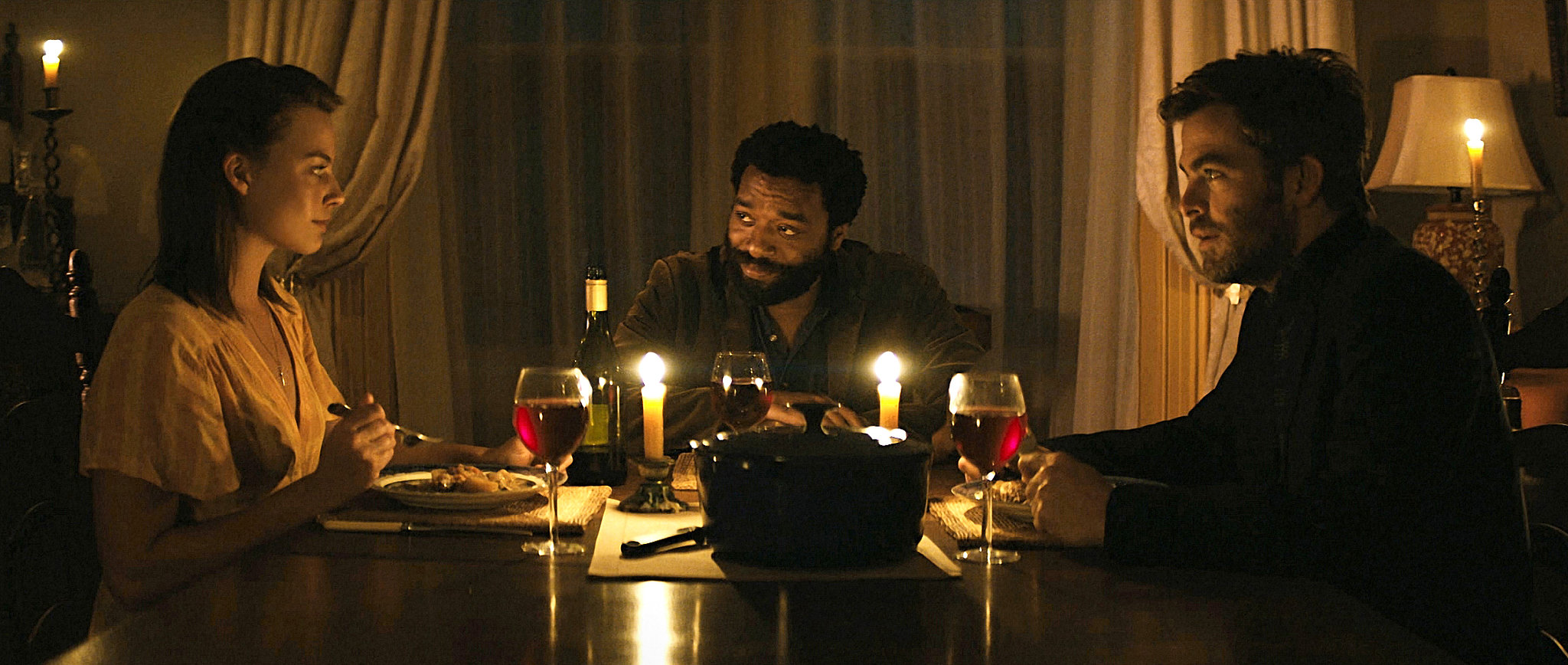
Hey there everyone! Welcome back to Movie Soapbox, the little corner of the internet that only you and I and that guy sleeping in the corner over there know about. This is the place where we find underappreciated indie films and we make sense of them. Today? We are doing a deep dive on Z for Zachariah, a movie so quietly, deliberately suffocating that the 57% of general audiences who bounced off it on Netflix probably did so somewhere around the third meaningful pause and the second lingering close-up of a woman doing farm chores while two men watch her from different windows.
And those people missed something real. That’s what we’re here to fix.
Before we go any further, understand that everything from this point forward is a spoiler. The ending, the theories, the mechanism of what Loomis did and how Ann knows it, all of it is on the table. If you haven’t seen the film yet, go watch it and come back. It’s on streaming, it takes ninety-some minutes, and it earns every one of them. I’ll be here.
Still with me? Good. Let’s get into it.
Z for Zachariah The Movie Setup
The world ended. Some kind of radiation event, some kind of atmospheric toxicity, and almost everyone is dead. Except in one valley, sheltered by the particular geography of what feels like the southern Appalachians, where a pocket of clean air and clean water has survived. And Ann Burden (Margot Robbie) has been living in it alone, farming, praying, keeping the livestock alive, watching the calendar for a family that stopped coming back a long time ago.
Then a man walks into the valley in a radiation suit, strips it off, and starts bathing in contaminated water because he doesn’t know any better. Ann saves his life. She nurses Mr. Loomis (Chiwetel Ejiofor) through radiation sickness. He recovers. And now there are two of them, a deeply religious young woman and an older scientist who survived because he happened to be the one who built the suit, which is a detail worth holding onto, because only one person can wear that suit at a time, and possession of it means everything in a world where the outside air will kill you.
The subtext running under every scene from this point forward is not subtle, but it is unspoken. Ann understands what her biology means at the end of the world. Loomis understands it too. And neither of them says a word about it out loud, because the script is too smart for that. The whole film runs on what isn’t said, on the weight of looks and pauses and the very specific way two people can be excruciatingly polite to each other when the actual conversation would be unbearable.
Then Caleb shows up. Chris Pine, younger, white, also a believer, also a southerner. And something cracks open in Ann that Loomis had been carefully, patiently watching for.
Z for Zachariah Movie and The Industry Context
A three-character chamber piece with no action sequences, no third-act confrontation, no score telling you how to feel, and an ending that refuses to hand you the answer, that film gets made because someone in financing looked at Margot Robbie and Chiwetel Ejiofor and Chris Pine and decided the cast could carry the risk. And it almost certainly could have been killed at any point in development by a note that said some version of “we need to see what Loomis actually does.” You can feel the ghost of that note in the final cut, that slight pressure where the film leans almost far enough toward explicit confirmation and then pulls back, which is either the director holding his nerve or the last trace of a conversation about how much ambiguity the audience could stomach. Craig Zobel had made Compliance before this, a film that also runs on dread and implication and behavioral inevitability, and you can see the same DNA here. A director who knows that the thing you almost show is more corrosive than the thing you show. Films like this don’t get a second chance if the first cut doesn’t test well. The fact that this one exists in the form it’s in means somebody kept the suits out of the editing room long enough to matter.
Z for Zachariah – The Book Is a Completely Different Animal
Robert C. O’Brien’s source novel is a YA thriller, and Loomis in that version is a genuine villain, the kind you’re not supposed to miss. He shot a colleague who wanted to borrow the radiation suit to check on his family. He starts controlling Ann’s farm work the moment he recovers. He attempts to rape her. He shoots her in the ankle when she tries to leave. Ann eventually steals the suit and walks out into the radiation rather than stay with him, and the curtain comes down on her walking toward possible death and certain freedom.
Screenwriter Nissar Modi took that book and removed its villain without removing its violence. The violence just went underground. There are two Loomis characters in the film, technically, the Loomis of the book split across Caleb and the Loomis of the movie, and the question the film never directly answers is which version of the original character each man inherited.
The Three Theories, Laid Out Clean
Theory One: Caleb is Loomis’ shadow self. Since the book only has two characters and the film has three, you could read Caleb as the externalized dark half of the Loomis-character, a Dr. Jekyll and Hyde split where all the book’s transgression gets relocated onto the younger man. Caleb sleeps with Ann. Caleb takes what he needs and leaves. But this falls apart almost immediately when you look at whose agency is actually driving the plot, because Ann initiates the relationship with Caleb, and it is Loomis who engineers Caleb’s departure, not the other way around. The shadow belongs to the wrong body if you’re trying to make this reading stick.
Theory Two: Complete creative divergence. Modi simply left the book’s darkness on the shelf and wrote a contemporary love triangle, using the natural dramatic pressure of two men and one woman in an enclosed space as his engine instead of any inherited villainy. This is the cleanest reading and the most boring one, and the film doesn’t quite support it, because there is too much gathering darkness in Loomis’ eyes in the final twenty minutes for a story that resolved itself as a simple romantic triangle. Something is built in those close-ups. Modi didn’t put it there by accident.
Theory Three: The book is the sequel. Caleb’s presence and disappearance is the prologue to everything that happens in O’Brien’s novel. Ann, at the end of the film, is sitting in the kitchen absorbing the first act of a story that doesn’t end well for her, because she’s been here before, because everyone leaves or gets taken, because Loomis has now demonstrated exactly what he’s capable of, and she knows the storm that’s coming even if she can’t prove what just caused it.
Z For Zachariah – What Actually Happened to Caleb
Watch the end of the film again with this in your head and tell me I’m wrong.
Caleb does not say goodbye to Ann. He just leaves. A man who has spent the entire film being warm toward her, a man who slept with her, a man who shares her faith and her dialect and her understanding of what survival actually costs, that man walks out of the valley without a word to the woman he’s been building something with. The only explanation that makes behavioral sense is that the goodbye was taken from him, that he did not choose the terms of his own departure.
Loomis buries him in the suit. That’s why the suit is still there. Caleb is dead, and the wagon is gone because Loomis cleaned up. Ann pushes the glass off the table and it’s not grief about a man who left, it’s grief about a man she knows is in the ground, without being able to say so, without being able to do anything about it, because Loomis controls the only piece of equipment that means anything in a world where the air outside the valley will kill you.
She checks the freezer to see if the power is still on. And it is. Loomis is still running things. He is still in the house. He is still in control. And she is still there, because what choice does she have.
Look at the pattern of her losses. Her father took the community and left. Her brother likely died at the perimeter, which the film implies Loomis knows something about and doesn’t say. And now Caleb, the one person who arrived in the valley and oriented toward her as a full human being rather than a reproductive resource or a farm asset, is gone. Loomis reads her perfectly. He knows that another betrayal doesn’t break Ann, it just bends her further toward whoever’s left. That is his calculation from the beginning, and the film is patient enough to let you watch him make it without ever announcing it.
Any wonder her name is Ann Burden.
Moviesoapbox – The One Reading I’m Putting My Name On
Loomis killed Caleb at the waterwheel. The “accident” is the film’s only real act of violence, displaced offscreen and rendered entirely in aftermath, which is the most honest way to shoot something that would be cheap if you showed it. The church argument earlier in the film, where Loomis argues against tearing it down for lumber, is him playing a long game, building credibility as a reasonable man, a spiritual man even, buying goodwill he planned to spend. The suit stays because Loomis needs Ann to believe Caleb chose to leave, and a man who chose to leave would take the suit. So he buries Caleb without it and invents a version of the story where Caleb made a decision. And Ann, who has been reading people’s eyes since she was alone in this valley, knows exactly what that story is worth.
The film ends on her face knowing it and not being able to do a damn thing about it. That’s the movie. That’s what it was always going to be.
One Last Thing Before You Go
This film had everything working against it at every stage of its commercial life. A three-character structure that reads as stagey to multiplex audiences. An ending that refuses catharsis. A 79% critical score that the general audience immediately punished down to 57% because the film made them feel things without explaining the feelings. It deserved better and got a small, loyal audience instead, which is the best-case outcome for a film like this and also the saddest one. Zobel made it anyway. Robbie and Ejiofor and Pine made it anyway. And it exists in the form it was meant to exist in, unflattened, unresolved, genuinely uncomfortable all the way to the credits. That’s rarer than you think. Appreciate it when you find it.
🎬 If You Liked This…
- The Survivalist — same post-apocalyptic resource scarcity, same dynamic of a lone survivor whose isolation is disrupted by strangers whose intentions cannot be fully trusted, same slow burn of deciding who gets to stay
- Settlers — the same three-person power dynamic in an isolated outpost where resources are finite and trust is the one thing nobody can afford to extend too freely
- Die Wand — a woman alone in an isolated landscape cut off from everything, survival as the entire frame of existence, the same meditative register and the same refusal to explain or resolve what the isolation means