
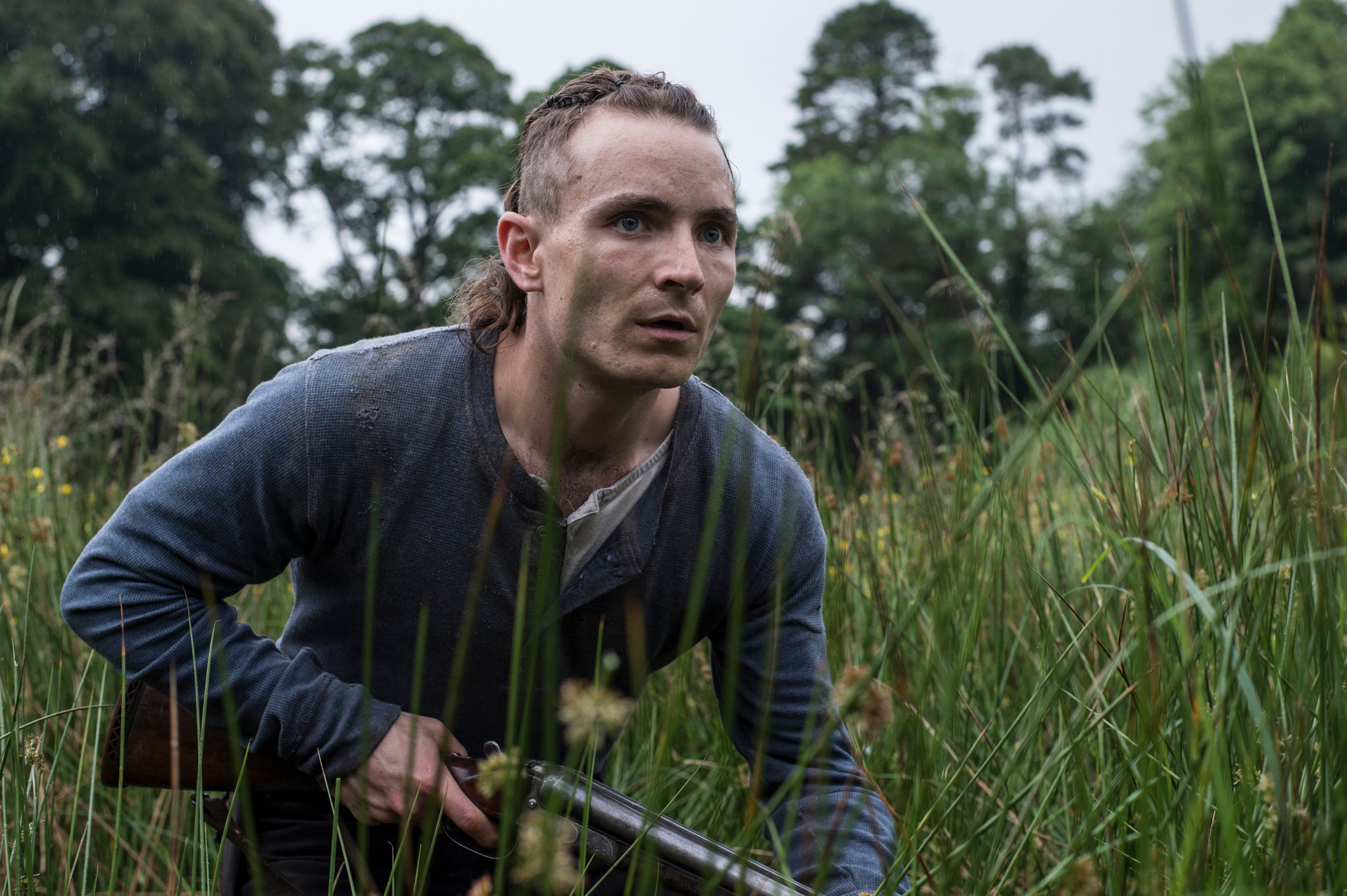
Hey there everyone! Welcome back to Movie Soapbox, the little corner of the internet that only you and I and that guy sleeping in the corner over there know about. This is the place where we find underappreciated indie films and we make sense of them. Today? We are doing a deep dive on The Survivalist, a movie so relentlessly, unapologetically bleak that even the people who love it come out the other side needing a few minutes in a bright room with a warm beverage before they can talk about it.
Before we get into it, here is the trailer. Watch it. Then come back, because we are going into full spoiler territory and I am not going to slow down for anyone.
Alright. If you have not seen this film and you keep reading anyway, that is entirely on you. I am going into every dark corner of this thing. You have been warned, and I mean that with more genuine urgency than the standard disclaimer deserves, because this movie is built on a series of gut-punch reveals that land a lot harder if you do not see them coming.
The Making of The Survivalist
A movie made for roughly a million pounds sterling, shot in the forests of Northern Ireland, directed by Stephen Fingleton on his feature debut, starring Martin McCann in a role with almost no dialogue and nowhere to hide. That is the situation. And the reason I want you to hold that budget figure in your head for the entire time we are talking about this film is that a million pounds is the kind of number that, in the current studio system, does not even cover the craft services budget on a mid-tier superhero reshoot, and yet what Fingleton got onto the screen for that figure is more texturally dense, more emotionally suffocating, and more formally disciplined than most things that cost fifty times as much. What a movie at this budget tier usually means, in practical terms, is that the director had final cut because there was no one else in the room to take it from him. No VP of creative affairs flying in with a notepad full of notes about the third act being too downbeat. No test-screening audience in Burbank asking why they should care about a protagonist who never smiles. Fingleton made the film he wanted to make, because the economics of the thing left no one powerful enough to stop him, and the result is a piece of work that feels like it was made by someone who had exactly one shot and knew it.
The Survivalist Movie Walkthrough
Now let me walk you through what actually happens in this film, beat by beat, because the plot is spare but the implications stack up in ways that are easy to miss on a first watch when you are too busy being oppressed by the atmosphere to track the logic.
The film opens on a man, unnamed in the credits and in the film, living alone in a shed on a tiny farm he has scratched out of the forest floor. The opening title card tells you everything you need to know about this world in graph form: as global population rose, oil production rose with it, and when oil peaked and collapsed, the population collapsed right behind it. That is the entire expository framework. The rest is silence and dread. The Survivalist, and we will call him that because that is all he is, tends his crops with the hypervigilance of a man who has learned that relaxing for even a moment is how you die. He jumps at wind. He sleeps with a weapon. He has flashbacks of running through darkness with another man, and we file that away.
Then two women arrive. Kathryn, older, sharp-eyed, clearly the strategist of the pair. Milja, younger, quieter, the one being offered forward as a bargaining chip, though the film is too smart to announce that directly. They want food. He does not want them there. What follows is a negotiation conducted almost entirely in looks and physical positioning, because this is a film that understands how much human beings communicate without words when the stakes are survival-level. He eventually lets them stay, sleeps with Milja, and a fragile, deeply suspicious cohabitation begins.
And here is where the film starts doing the thing that makes it worth two hours of your life. Every single character in this story is running a calculation at every single moment. Kathryn clocks the farm’s size and determines it cannot feed three people through winter. So she and Milja make a plan to steal the Survivalist’s two shotgun shells, which is his only real leverage in this world, and then decide whether to kill him or leave. He survives that round. Then he saves Milja from a man who hauls her off into the forest, takes a bullet doing it, stabs the attacker in the throat, and collapses. Now the women have to decide whether to let him die or nurse him back, because a dead Survivalist means no one defending the farm. They nurse him back. Six armed men then arrive and strip the farm of most of its food, and the math gets worse, and Kathryn’s conclusion becomes simpler: the Survivalist has to die. She and Milja agree to poison him with foraged mushrooms. Milja, in the film’s pivotal turn, poisons Kathryn instead. The Survivalist, understanding what has happened, kills Kathryn for her. And then the masked men come back for a final reckoning, and the Survivalist does the one heroic thing he seems capable of: he sacrifices himself to give Milja time to run.
Milja runs. Milja makes it to a militarized camp. Milja is pregnant. Roll credits.
The Questions Left Outstanding From The Survivalist
Now let me address the questions this film leaves sitting on the table, because there are a few that matter and the film is deliberately quiet about answering them.
The Survivalist – Question Number 1 – Are Kathryn and Milja related?
The film never says. The read that Kathryn is Milja’s mother, using her own daughter as a bargaining chip for survival, is supported by the power dynamic between them and by Kathryn’s ferocity in protecting Milja even while using her. The read that they are simply two women who found each other and built a survival unit out of mutual necessity is equally supported. Personally? The mother-daughter reading makes the film’s moral universe slightly tidier than it deserves to be. These are two women who have done what they needed to do to survive, and the biological relationship is almost beside the point. The transaction is the same either way.
The Survivalist – Question Number 2 – what’s with that flashback?
The Survivalist running through darkness with another man, Augustus, who attempted to assault a woman, and whom the Survivalist killed to prevent them both from being caught and presumably tortured by whoever was pursuing them. This is the film’s explanation for the Survivalist’s paranoia, and it is also the film’s quiet statement about what kind of man he is. He is not a good man. He killed his own brother. He is a man who has survived by making brutal calculations and then living inside the wreckage of those calculations forever. The flashback is not meant to excuse him. It is meant to explain why he flinches at shadows.
The Survivalist – Question Number 3 – are we supposed to be rooting for him?
The answer the film gives you, if you are paying attention, is no. Or at least, not exactly. You root for him the way you root for a wounded animal you are watching from a distance, because he is the thing the camera is following and because in this world the alternative to him is worse. But the actual hero of this film is Milja. She is the one who makes the active moral choice, the choice that the film’s entire second half turns on. She is the one carrying whatever comes next. The Survivalist is the world this film is set in. Milja is the only argument the film makes that there might be something worth surviving for.
The Survivalist – Question Number 4 – What are we supposed to do with that finals shot of the film?
The theory that gets tossed around in every forum thread about this movie is that the final shot, Milja at the camp, pregnant, is meant to be read as optimistic, a new beginning, the cycle continues. I understand why people land there. But, I personally do not buy it. Fingleton has been too unsparing for ninety minutes to pivot to consolation in the final thirty seconds. The more honest read is that Milja has made it to a militarized camp, which means she has traded one set of power dynamics for another, and the pregnancy means she is carrying the Survivalist’s child into a world that will treat that child exactly the way this world treated everyone else we watched. The film ends where it ends because that is where stories like this end. Not with resolution. With continuation.
That is Moviesoapbox’s read of the movie The Survivalist and I am not moving from it: Milja is not rescued. She has survived into the next problem. The film is not pessimistic about human nature in the way that nihilistic genre films are pessimistic, where everyone is simply bad and that is the joke. It is pessimistic in the way that history is pessimistic, which is to say it understands that people do what the conditions require of them, and that what makes Milja the film’s moral center is not that she is good in some abstract sense but that she chose, once, under maximum pressure, to protect someone at cost to herself. That choice is the entire argument. One choice. In a hundred and four minutes of a world that offers no good options. That is what Fingleton spent his million pounds to say, and he said it clearly enough that a dozen studio notes could not have improved it, though god knows they would have tried.
The film exists because no one with enough money to ruin it was paying attention. That is not always how good films get made. But it is how this one did.
🎬 If You Liked This…
- Z for Zachariah — same post-apocalyptic isolated farm, same dynamic of a lone survivor whose fragile equilibrium is disrupted by arrivals whose intentions cannot be fully trusted, same slow burn of deciding who gets to stay
- Settlers — the same sparse survival setting and three-person power dynamic where resources are finite and trust is the one thing nobody can extend too freely without paying for it
- Die Wand — a person completely alone in an isolated landscape where survival is the entire frame of existence, the same meditative bleakness and the same refusal to offer explanation or comfort for what the isolation means