
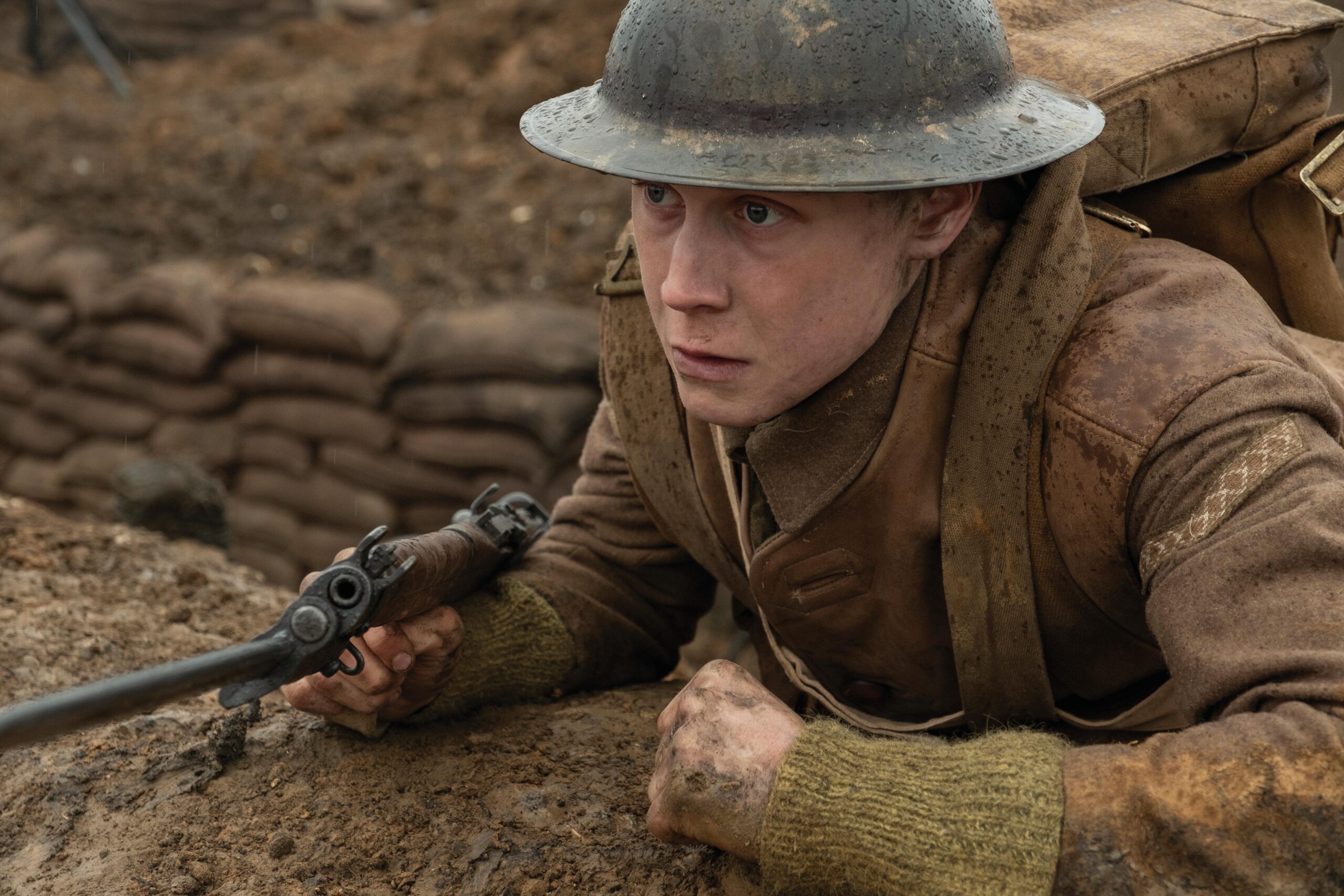
Hey there everyone! Welcome back to Movie Soapbox, the little corner of the internet that only you and I and that guy sleeping in the corner over there know about. This is the place where we find under-appreciated, under-discussed films and we make sense of them. Today? We are doing a deep dive on 1917, a movie so quietly devastating, so committed to a single formal idea, that even the studio suits who eventually slapped their names on it probably couldn’t tell you what the ending is actually about.
Fair warning: everything from this point forward is a full spoiler walkthrough. Every death, every reveal, every beat of that ending you’ve been arguing about in your head since the credits rolled. If you haven’t seen 1917 yet, go watch it, come back, and we’ll talk. It’s streaming. You have no excuse. For the rest of you, here we go.
The Making of the Movie 1917
Before we get into the walkthrough, you need to understand something about what kind of film 1917 is, and more importantly, what kind of film it was never supposed to be allowed to become. Sam Mendes came to this with a single-take formal conceit, a personal story sourced from his grandfather’s memoir, and a cast assembled with enough weight, Colin Firth, Benedict Cumberbatch, Andrew Scott, to drag the thing past the greenlight committee. That cast isn’t decorative. Talent at that level attached to a project is a negotiating instrument. It’s how a director buys himself the right to make a WWI film with no traditional act structure, no villain with a face, and an ending that refuses to give the audience the catharsis they paid for. You take that cast away, you replace it with two unknowns and its 100 million dollar budget, and this movie either never gets made or it gets made with a reshoot-corrected third act that ends on a medal ceremony. The cameos aren’t cameos. They’re the cost of admission to do this thing the right way.
The setup is almost painfully simple, and that simplicity is the whole point. It’s April 1917. The Western Front is locked. Two British lance corporals, Blake and Schofield, played by Dean-Charles Chapman and George MacKay, are pulled out of a rest and handed what sounds, on paper, like a clerical task. Deliver a message. Call off an attack. The 2nd Battalion of the Devonshire Regiment is about to charge into what the Germans have engineered as a slaughter. The German retreat everyone’s been celebrating is a feint, a strategic withdrawal to a stronger defensive position, and the 1,600 men of the Devonshire don’t know that yet. Blake and Schofield have until dawn to reach them. Blake has additional motivation in his back pocket: his brother is in that regiment, in the first wave.
The film then does the thing it promised in every piece of marketing and does not stop doing it for two hours. It moves. The single-take construction, and yes, it’s a constructed single take, assembled from long continuous shots that were edited at moments of darkness or motion blur to hide the cuts, it puts you on the ground with these two men in a way that conventional coverage simply cannot. (Side note – if you’re a fan of oners as they are called in the industry, please check out Birdman obviously, but better yet is a movie called Victoria – which I have not gotten to review here yet, but trust me, I will). You are not watching a war movie. You are walking through one, at their pace, with their information, with their fear. When Schofield says “let’s stop and think about this,” you feel the full weight of that line because you’ve been on your feet the whole time too.
The two cross into no man’s land, reach the abandoned German lines, and the emptiness of those trenches is its own kind of horror. Everything is booby-trapped. A rat trips a wire, the tunnel collapses, Schofield gets buried. Blake digs him out. This is the only moment in the first act where the film pauses long enough to let you see who these two men are to each other, and it does it without dialogue, just one man clawing through dirt to find another. They push on.
At the farmhouse, the film’s central wound gets inflicted. A German plane goes down nearby, the two pull the pilot from the wreckage because they are, in fact, decent men, and while Schofield goes to get water for the injured pilot, the pilot stabs Blake. The move is economical and precise and lands like a gut punch exactly because the film has made you comfortable with the rhythm of two people moving together. Now there’s one. Schofield kills the German thirty seconds too late, sits with Blake as he dies, takes his valuables and his promise to write to Blake’s mother, and then he’s alone for the rest of the movie.
British soldiers give Schofield a lift on a convoy, drop him at the outskirts of Écoust-Saint-Mein, and then the film shifts into something closer to nightmare. The town is a ruin. Schofield gets pinned by a German sniper in a sequence that ranks among the best-constructed action setpieces of that year, a man alone in a burning city, moving through fire and shadows, the long take now feeling less like a formal choice and more like a trap you can’t cut away from. He kills the sniper, takes a ricochet, goes down.
He wakes in a cellar. A French woman is there, caring for an infant that isn’t hers. The baby was abandoned, she took it in, because what else do you do. This is the film’s thesis in miniature: in the face of industrialized death at a scale that makes individual acts of mercy statistically meaningless, you still do the thing in front of you. You still get the water. You still dig out your friend. You still run the message. Schofield has to leave. He does. The escape through the city and into the white-water river is where the film earns its action credentials without ever feeling like it’s doing action-movie things. There’s no score pumping you up. There’s no slow-motion. There’s just a man in a river at night trying not to drown.
Schofield washes ashore behind British lines. He hears singing. Finds a regiment resting in a wood, a soldier performing for the others, and the film holds there for longer than you expect, long enough for Schofield, long enough for you. Then he runs. And this is where 1917 does the thing that confused half the audience and that I want you to understand fully.
He reaches the 2nd Battalion. The attack has already started. He runs across an active battlefield, men going over the top around him, and he looks completely insane, a lone figure sprinting in the wrong direction through the smoke, and it is the most purely cinematic image in the film. He reaches Colonel Mackenzie, played by Cumberbatch in about four minutes of screen time, and delivers the order. Mackenzie reads it. Calls it off. And then tells Schofield, in so many words, to get out of his sight.
No handshake. No commendation. No moment where the brass acknowledges what this man just did. Schofield wanders through the aftermath, finds Blake’s brother, tells him, gives him the dead man’s things. Then he sits down against a tree, pulls out a photograph, and the film ends where it began, a man sitting alone, staring at something you can’t quite see.
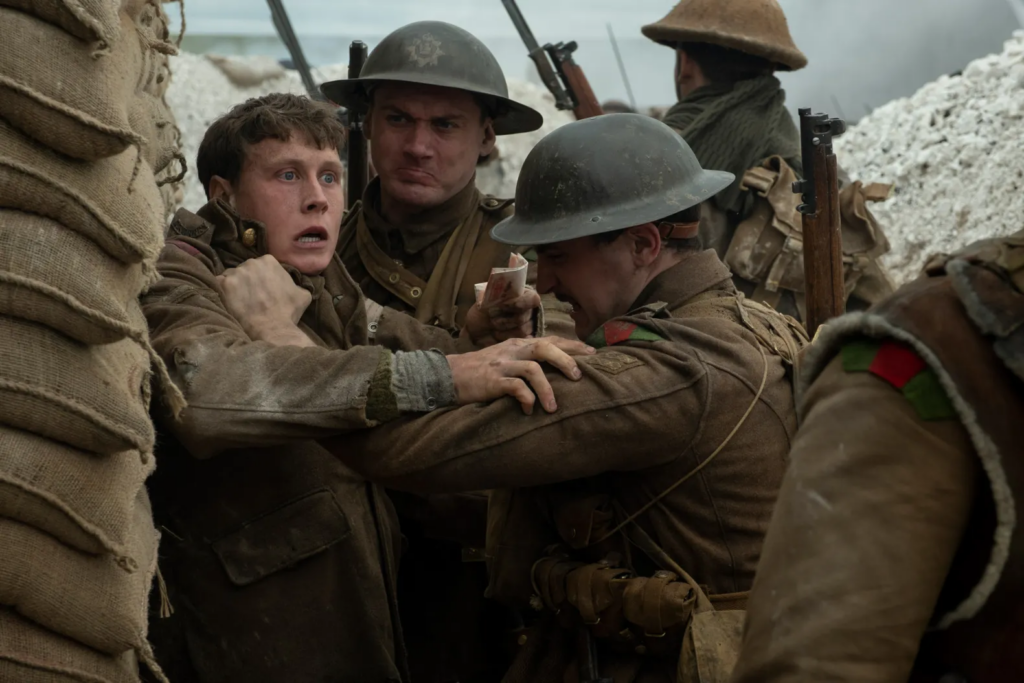
The Ending of 1917 Explained
The ending baffles people because they’ve been conditioned to expect the mission’s completion to mean something ceremonially. It doesn’t. And the film is precise about why. WWI is not a war that generates legible heroes because it isn’t a war with legible moral architecture. World War II has been narrativized into clarity, good and evil, liberation and atrocity, a story with a shape. WWI has none of that. It started because a network of interlocking alliances turned a political assassination into a global mobilization, and by the time anyone stopped to ask what the war was actually for, nine million soldiers were dead. The “Great War” is what they called it before they had to number the sequels.
Mackenzie’s bitterness at the ceasefire order isn’t villainy. It’s the war’s logic made human. His read is that no single act of intervention changes anything, that the math of attrition will grind on regardless, that calling off one attack on one morning just means those 1,600 men die slightly later in a slightly different field. He’s not wrong. He’s also not right. The film doesn’t resolve that tension. It just sits in it, the way Schofield sits against that tree.
The Historicity of the Movie 1917
Now, how much of this actually happened. The honest answer is: the emotional architecture is true, the specific events are invented, and the distance between those two things is where the film lives. Sam Mendes sourced the story from his grandfather Alfred Mendes’ memoir, Autobiography of Alfred H Mendes 1897-1991. In that account, Alfred’s commanding officer tasked him with locating scattered survivors after a failed assault on Poelcappelle, during which 158 of the 484 men in Alfred’s battalion were killed. Alfred, having completed a signaling course that had almost nothing to do with the actual task, volunteered anyway, moved through active sniper and shellfire, found his men, and made it back without a scratch. He was awarded the Military Medal for it. The film’s Blake and Schofield are composites, their specific mission is invented, and the 1,600 men and the called-off attack are dramatic constructs.
The broader historical context, though, is precise. The German withdrawal Schofield is threading through is Operation Alberich, a deliberate strategic repositioning to the Hindenburg Line that shortened the German front by 25 miles and freed 13 divisions for reassignment. The Germans didn’t just leave. They systematically destroyed everything behind them: roads, bridges, water pipes, telegraph lines, entire villages. The Allied advance moved through a lunar landscape of deliberate obliteration. The film’s empty trenches, the booby traps, the civilians left behind, all of that is documented reality. The 125,000 civilians of working age were evacuated to France and Belgium. The elderly, the children, they were left. German General Ludendorff, in his own account, described this as a calculated decision: don’t give the enemy useful labor, but make them feed as many mouths as possible. The French woman in the cellar with the abandoned infant is not a sentimental invention. She is the operational residue of that policy.
The battle Schofield is racing toward is a prelude to Passchendaele, the Third Battle of Ypres, which would wound or kill over half a million combatants across its duration for a net territorial gain that was, in any meaningful strategic sense, zero. The 1,600 men Schofield saves are, in the arithmetic of that campaign, a rounding error. The film knows this. Schofield knows this. The tree at the end knows this. The point was never the number.
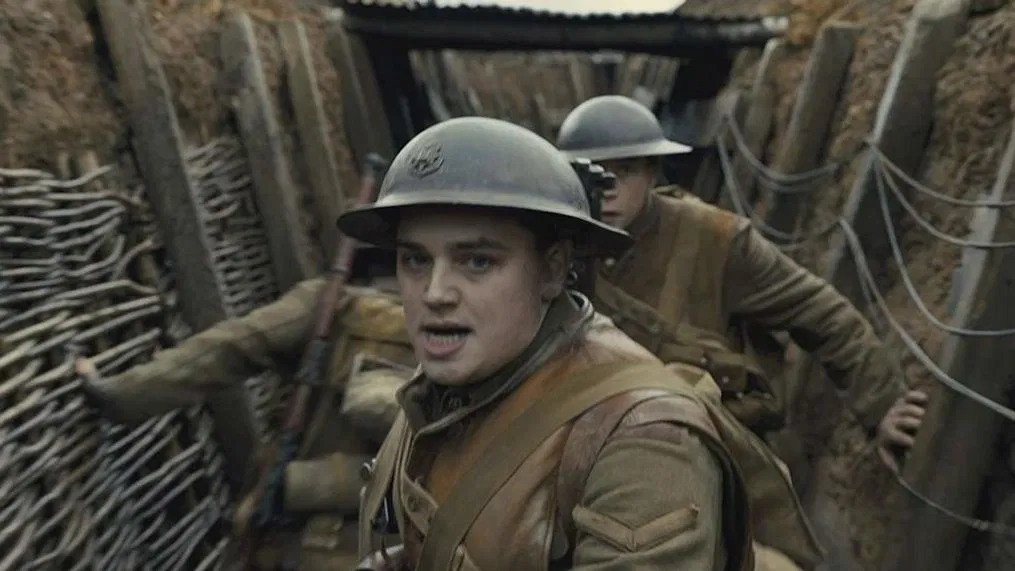
But What Do We Make of the Ending of 1917?
The interpretation question that splits audiences is essentially this: is the ending a tragedy or a benediction. The tragedy read says Schofield has accomplished nothing permanent, that the war will consume those 1,600 men eventually, that his friend is still dead, that Mackenzie was right. The benediction read says the film is not making a claim about the war’s outcome but about the nature of the act itself, that Schofield ran because Blake asked him to, because there was a brother in the first wave, because a French woman fed a stranger’s baby in a bombed-out cellar, and that these acts are what humans do when the institutions around them have completely failed.
Both reads are in the film. They coexist without resolution. That’s the formal argument the one-take structure is making: you can’t cut away from it. You have to stay in it to the end, the way the men did. World War II is the natural choice as far as war movies go – there is an easy demon to attribute your anger to. World War I is just political ambition wrapped in collapsed treaties and neighborhood and HOA level anger.
Moviesoapbox’s Perspective on the Movie 1917
My read is the benediction, but with the tragedy inside it, not instead of it. Schofield sitting against that tree is not a broken man and he is not a triumphant one. He is a man who did the thing that was in front of him, at the cost of the only person he was doing it with, in a war that will be indifferent to both the doing and the cost. The medal he traded away early in the film, for a bottle of milk, is the film’s first and most efficient piece of symbolism. The currency of heroism in this war is worth exactly what it can be exchanged for. One bottle of milk. A few hours of food. Something that keeps a person going until the next thing tries to kill them.
As an aside… I just finished the novel Angel Down – possibly one of the best books I’ve read in a long while. I believe the New York Times classified it as a modern classic, and it is. It is horrible and perfect. It’s filled with man’s inhumanity to man, and it has an interposed layer of spiritual ambiguity laid on top of the proceedings. A metaphor? A spiritual morality tale? Angel Down takes the quagmire of WWI and gives it a moral compass that clarifies. 1917 is harder to hold on to… to determine whether I am cheering or crying at the end.
What Mendes made here is the rare film that earns its formal ambition. The one-take construction isn’t a stunt, it’s the argument. It’s the reason the ending works, because you’ve been denied the psychological escape hatch of a cut for two hours, and so when Schofield sits down against that tree, you sit down with him. There’s no dissolve to the memorial. No title card about the Armistice. Just a man in a field, alone, alive, which is more than most of them got.
Films like this don’t get made by accident. They get made because someone spent years building the credibility and the relationships to drag a formally risky, commercially non-obvious project past every checkpoint that exists to sand those edges down. The WWI film has been an orphan genre since Paths of Glory because the war resists the narrative satisfactions that make studio math work. No clean villain. No liberation. No moment where the good guys win in a way that feels like winning. 1917 didn’t solve that problem. It made it the whole point. And then it got made anyway. That’s worth something.
🎬 If You Liked This…
- The 12th Man — same WWII survival against impossible odds, a single soldier trying to reach safety while everything tries to stop him, based on a true story that is almost too extreme to be believed
- Der Hauptmann — the same WW2 landscape where the rules have collapsed entirely, a man moving through a wartime world that has lost its moral framework, the horror of what people become when the institutional guardrails are gone