
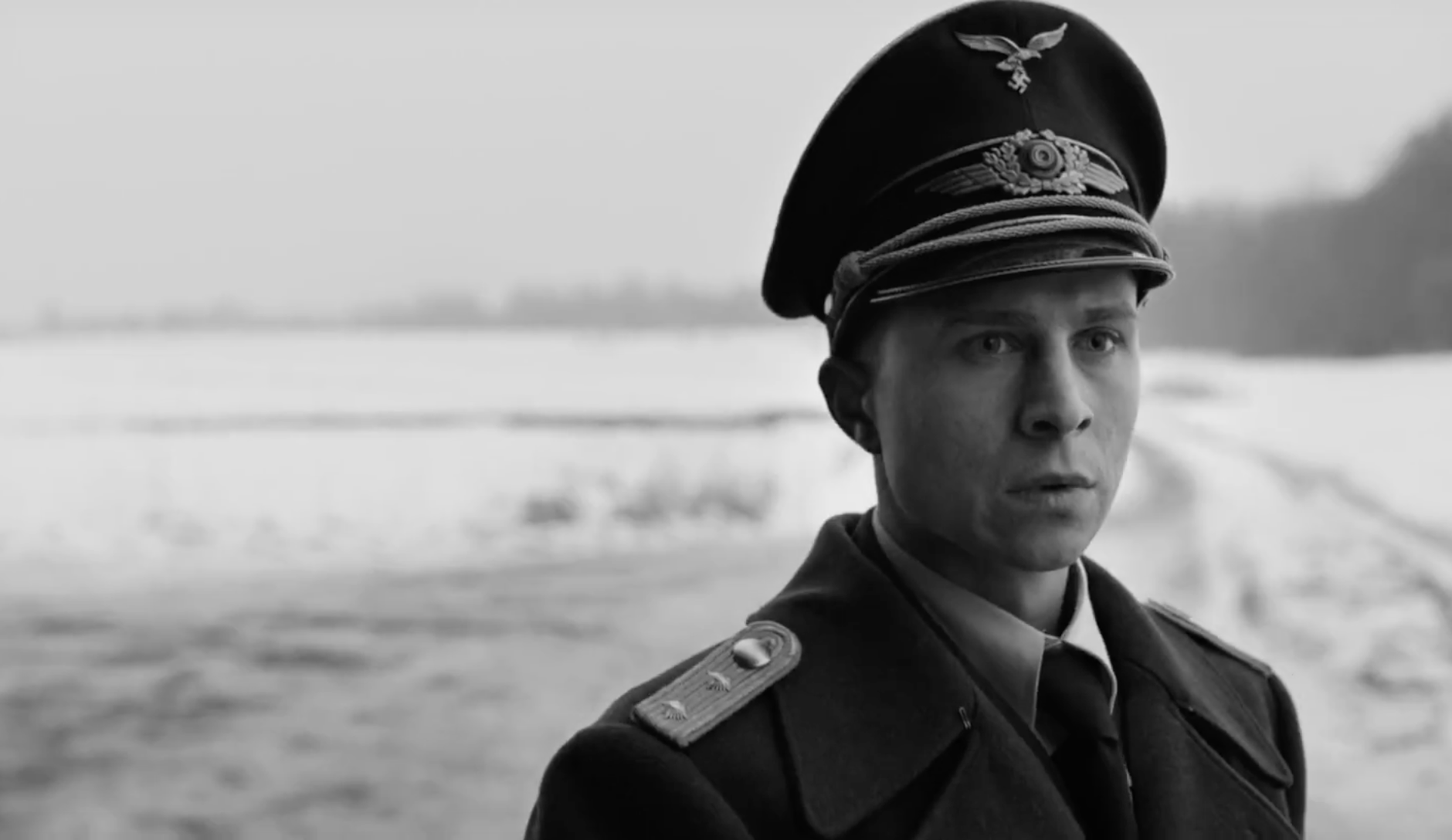
Hey there everyone! Welcome back to Movie Soapbox, the little corner of the internet that only you and I and that guy sleeping in the corner over there know about. This is the place where we find underappreciated films and we make sense of them, the ones that got buried, the ones that got weird distribution, the ones that absolutely nobody at a major studio wanted to touch with a ten-foot pole. Today? We are doing a deep dive on Der Hauptmann, known in English as The Captain, a German film so quietly, relentlessly brutal that by the time the credits roll you are not angry at the movie, you are angry at the entire twentieth century.
Fair warning before we go any further: everything that follows is a full spoiler walkthrough of this film and the true history behind it. We are going scene by scene, we are going fact by fact, we are going deep. If you haven’t seen it yet and you want to stay clean, go watch it, come back, and we’ll still be here. For everyone else, buckle in.
Before we walk through what actually happens in the film, let me tell you something about the kind of movie this is in terms of where it sits in the ecosystem, because that context matters. Der Hauptmann was written and directed by Robert Schwentke, a German director who had spent years working inside the Hollywood machine on things like R.I.P.D. and the Divergent sequels, the kind of credits that get you meetings but not final cut. This film is him coming back. Shooting in black and white, in German, on what was clearly a shoestring budget relative to anything he’d touched in the studio years, refusing every formal convention that would have made the material easier to digest. You can feel throughout this movie the specific discipline of a filmmaker who has spent time in rooms where fourteen people with titles gave him notes on how to make a thing more palatable, and who has decided, on this particular project, that palatable is the enemy. Films like this one don’t make it through the system intact. This one made it because it was never really inside the system to begin with.
Movie Deep Dive Walkthrough
So. April 1945. The Third Reich has maybe six weeks left to exist, though nobody has confirmed this to the men still fighting inside it. Willi Herold is twenty-one years old, a German paratrooper, and he is running across a frozen field being chased by a German military police unit because he has abandoned his post. Not defected to the Allies, not done anything dramatic, just walked away from a situation that was going to get him killed in a war everyone with a functioning brain could see was already over. He survives the chase. And then, in a ditch near a road, he finds an abandoned car. In that car is the full dress uniform of a Luftwaffe captain, medals and insignia included.
He puts it on.
What happens next is one of the most disturbing psychological case studies the war produced, and the film understands this completely. Herold doesn’t become a monster because of the uniform. The uniform just removes the friction between what he already was and what he was willing to do. The first soldiers he encounters after he puts it on snap to attention and ask for orders. He gives them. They obey. That is the entire mechanism. A system so rigidly structured around rank and performance that it cannot distinguish between a real captain and a teenage deserter wearing a dead man’s coat, and Herold, consciously or not, understands this about the system faster than the system understands it about itself.
He names his improvised unit Kampfgruppe Herold and escalates the lie with each kilometer, eventually claiming he is on a special mission from Hitler himself to assess morale inside Germany’s collapsing borders. The detail that matters here is not the audacity of the lie, it is that people need the lie. The stragglers who fall in behind him are desperate for someone to tell them the chaos has a structure. The camp commanders who let him walk in and take over are relieved to have anyone with apparent authority show up and make a decision. The German military bureaucracy in its death throes is so hungry for the performance of order that it will feed a 21-year-old fraud whatever he needs to keep the performance going.
The camp Herold takes over is the Aschendorfermoor, holding German deserters and other prisoners. He orders executions almost immediately. The film does not look away from these. The sequence where thirty men are marched into a trench and an anti-aircraft gun is turned on them is one of the most horrifying things you will sit through in a modern war film, not because of gore craft but because of the administrative calm with which it proceeds. Herold’s driver Freytag, the film’s closest thing to a moral witness, is sent into the trench afterward to find the one man still alive and finish him. Freytag does it. That detail is the film’s real argument, not that monsters exist, but that systems manufacture compliance from people who are not monsters.
It is also Freytag who eventually figures out the truth about Herold. A tailor has taken in the legs of Herold’s stolen uniform pants, the kind of small practical alteration a man makes when something doesn’t fit, and Freytag sees it and knows. He does nothing immediately useful with this knowledge. That is also the film’s argument.
After an Allied bombing destroys the camp, Herold takes his remaining men into the nearby city of Aurich. They commandeer the best hotel. Herold orders the murder of a local civilian essentially on arrival. Later he orders the killing of one of his own men, Kipinski, for touching a woman Herold had decided was his. By this point the film has made clear that the uniform was never really about survival. Herold has found something in the performance of authority that he does not want to give back.
The German MPs eventually catch him. He is brought before a court. His defense is that he was doing his best to serve the German people. The judge and his counsel decide he is a good German soldier who acted in good faith in chaotic circumstances. Before they can settle on a formal disposition, Herold goes out a window. He is later sent back to the front. The film closes by informing you that he was eventually captured by Allied forces and executed for war crimes. He was twenty years old when they shot him.
What Really Happened to Der Hauptmann The Captain
Now let’s talk about how close that is to what actually happened, because the real story in several respects is worse.
Willi Herold was called up at nineteen in September 1943. He served in Italy, including at Monte Cassino, and he was not a coward by any conventional measure, he destroyed two British tanks at Salerno and earned the Iron Cross. The film implies deserter from the jump and the real record is murkier, the separation from his unit appears to have happened in the general chaos of the Wehrmacht’s collapse rather than through any clear-cut abandonment. That distinction matters only in the sense that it complicates the easy reading of him as a coward who then compensated through cruelty. The arc from decorated combat soldier to the man who ran the Aschendorfermoor is, if anything, more disturbing without the desertion backstory because it removes the obvious psychological scaffolding.
The real death toll at the camps under his command was 172 people. The film captures the anti-aircraft trench sequence but the real version was even more calculated. Herold told the prisoners that anyone who wanted to be returned to active duty at the front should step forward. Everyone stepped forward, because of course they did. He marched them around the yard. He stopped them by the pits. Then the guns opened up from behind bushes. When the gun jammed, Herold threw a grenade into the pit and ordered his men to shoot the survivors individually. He personally killed a man who had just completed twenty squats with water buckets on the promise of release. He shot him in the head while he was lying on the ground. He had a farmer in Leer hanged for flying a white flag. He had five Dutch civilians executed for supposed espionage.
The film’s courtroom sequence is not invented. He genuinely was arrested, confessed, was tried by a Kriegsmarine court in Norden, and was then accidentally released in the chaos of the final days. The Allies captured him shortly after, caught him in lies during interrogation, extracted enough admissions to constitute a war crimes case, and executed him along with six members of his unit. He was twenty.
There are a few competing ways to read what this film is actually about, so let’s lay them out plainly.
Movie Explanation Number 1 – The first reading is the one the film most overtly invites, the situationist argument. Herold is what the German system produced. The uniform didn’t create the evil, it revealed what the system had always been capable of making. Every officer who saluted him, every bureaucrat who processed his orders, every soldier who pulled a trigger because he told them to, they are all Herold. The individual monster is just the concentrated version of distributed institutional rot.
Movie Explanation Number 2 – The second reading pushes back on that a little. Freytag knows. Several people around Herold know, or strongly suspect. They choose compliance not because the system forces their hand at every moment but because compliance is easier, safer, and in some cases profitable. This reading puts more weight on individual moral failure than the first one does. The system is the context, the choices are still choices.
Movie Explanation Number 3 – The third reading, and the one I think the black-and-white photography and the film’s strange, almost detached formalism are pointing toward, is that Herold is a mirror being held up to something specific about performance and identity. He is not performing captaincy badly. He is performing it well enough that the performance becomes indistinguishable from the real thing, which means the real thing was always mostly performance. What the film is asking you to sit with is not just that this particular man did these particular things, but that the entire apparatus he was impersonating was already a costume, ideology dressed up as order, cruelty dressed up as duty, and Willi Herold in his stolen pants just happened to be the most honest version of it.
I’ll tell you where I land. The third reading is right, and the film earns it, but the second reading is the one that keeps me up at night. Because the systemic argument, as true as it is, has a way of dissolving individual agency into historical inevitability, and Freytag is there to stop you from doing that. He knows. He sees the pants. He does the math. And he keeps driving. That is not the system acting through him, that is a man making a choice, and the film is honest enough to show you that and still not tell you what to do with it.
Der Hauptmann is the kind of film that gets made once every several years when a filmmaker has something true to say and enough stubbornness to say it in the least commercially viable form available to him. It did not get wide distribution. It did not get the American remake treatment, at least not yet. It exists in the corner of the catalog where films go when nobody could figure out how to market them to a Friday-night audience, which is usually where the ones worth your time are hiding. Go find it.