
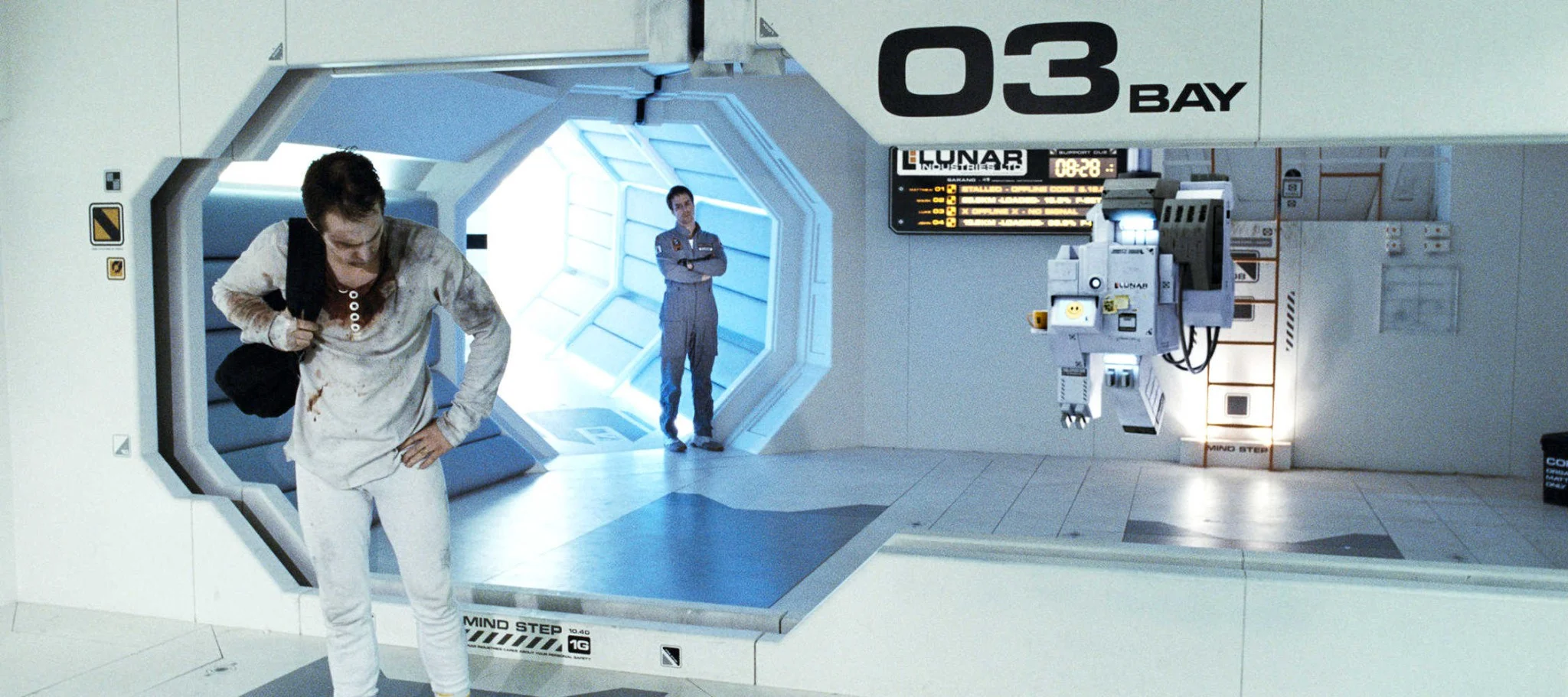
Hey there everyone! Welcome back to Movie Soapbox, the little corner of the internet that only you and I and that guy in the back who keeps rewinding the same twelve minutes of a Duncan Jones film know about. This is the place where we find underappreciated indie films and we make sense of them. Today? We are doing a deep dive on Moon, a movie so quietly, methodically furious about the way corporations treat human beings that it had to disguise itself as a science fiction film just to get anyone to greenlight it.
Fair warning before we go any further: everything past this paragraph is a spoiler. Not a soft spoiler, not a “you’ll see it coming anyway” spoiler. The full mechanism, laid bare, all the way to the credits. If you have not seen Moon, and you own a streaming subscription to anything, go fix that first and come back. Sam Rockwell spent the whole film doing what most actors can’t do with a full cast and you owe him the unspoiled version at least once.
Still here? Good. Let’s get into it.
The Movie Moon Setup Explained
The setup is almost insultingly simple, the kind of logline that sounds like a fake pitch but lands like a gut punch once you’re inside it: one man, one station, one AI companion, three years of lunar mining, two weeks left on his contract. Sam Bell is finishing his rotation for Lunar Industries on the far side of the moon, harvesting helium-3 from the lunar soil, keeping the automated harvesters running, and slowly going sideways in his own skull from the isolation. His only company is GERTY, an AI voiced, in the film’s original cut, by Kevin Spacey, all smooth solicitude and smiley-face emoticons, which lands somewhere between comfort and menace and never quite settles.
Now here is the thing you need to understand before we go one step further into the plot, and this is the part of the film that most breakdowns skim past because they’re too busy marveling at Sam Rockwell: the decision to shoot this film with almost no locations, almost no supporting cast, and a budget that wouldn’t cover catering on a Marvel production was not a limitation, it was the thesis. You can feel, in the production design of that station, in the recycled air and the dying plants and the pre-recorded video messages playing on a loop, exactly what this corporation thinks of Sam Bell. He is equipment. Expensive enough to maintain, cheap enough to warehouse. The station isn’t sparse because they ran out of money. It’s sparse because Lunar Industries didn’t spend a dime more than they had to on the man inside it.
A film at this budget tier, with a cast anchored by a single actor playing opposite a CGI robot, at a studio with no franchise upside to protect, almost never gets made without someone making a serious, serious sacrifice somewhere in the creative control column. The fact that what landed on screen feels authored, specific, uncompromised, the fact that every shot decision reads like a directorial choice and not a committee hedge, tells you something about how hard Duncan Jones must have fought for this film to stay exactly what it was. You can usually tell when a distributor got nervous in post and started requesting coverage shots, wider angles, more cutaways, the visual equivalent of hedging your bets. Moon has almost none of that. It sits in the claustrophobia. It holds. That’s a small miracle in the film’s production tier and you should know it going in.
The Moon Movie Walkthrough
So. Sam crashes his lunar rover after a hallucination, and wakes up in the infirmary with no memory of how he got there. And then he finds the other Sam. Same face. Same voice. Same implanted memories of a wife named Tess and a daughter named Eve and a life on earth that feels completely, achingly real. GERTY has activated a new clone, Sam6 in the shorthand the film implies and that I’ll use throughout, and told him he just arrived. Fresh contract. Three years ahead of him. All a lie, delivered by a machine with a smiley face. The Sam who crashed in the rover, who has two weeks left and is quietly dying, is Sam5. And somewhere in the back of the station, in a tank, Sam7 is waiting in the dark.
The two Sams find each other and start pulling threads. There’s a jamming station blocking all real-time communication with earth. There’s a room full of clone-tanks, dozens of Sam Bells in cryogenic suspension, an industrial supply of men who will never be told what they are. And there’s a “rescue team” on its way that both Sams correctly identify, once the scales fall from their eyes, as a cleanup crew. A Wolf, if you’ve seen Pulp Fiction. They’re coming to sanitize the station, incinerate what needs incinerating, spin up the next unit, and keep the quarterly numbers clean.
Sam5 drives out past the jammer and makes contact with earth. He’s trying to reach Tess. He gets Eve instead, who is fifteen years old, which is how you can reverse-engineer the whole naming convention: three-year rotations, five rotations, fifteen years. Tess has been dead for years. The wife he loves, that he has been aching to return to for three years, has been dead for the duration of the entire operation. The memories are real inside him, the grief is real inside him, and the woman is gone. That’s the film’s cruelest move and it happens in a single phone call.
Meanwhile Sam6 is going through the mission logs and learning that every previous Sam started breaking down at the three-year mark, biologically, because Lunar Industries engineered an expiration date into the clone template. The body fails when the contract ends. No loose ends. No retirement packages. No Sams wandering around Earth asking uncomfortable questions.
The endgame is fast and clean: Sam6 talks GERTY into waking Sam7. Sam5, knowing he’s dying, chooses to go back into the crashed rover and let it end there rather than spend his last weeks being managed. Sam6 programs a harvester to take out one of the jamming stations, grabs a canister of helium-3 to fund his return, and launches for Earth. GERTY wipes his own logs before the cleanup crew arrives, and presents them with a freshly-woken Sam7 who knows nothing. The crew finds no evidence. The operation continues. Except it doesn’t, because Sam6 lands and starts talking. The credits roll over news audio of his testimony, of Lunar Industries’ stock collapsing, of investigations beginning. One Sam survived. One Sam was enough.
The Theories Explaining the Movie Moon
Now let’s talk about what this film is actually arguing, because there are three serious reads and I want to give each of them its fair weight before I tell you which one I think is doing the most work.
Moon Movie Explanation Theory #1
The first read is the Mary Shelley read. Frankenstein, specifically, the full subtitle of which is “The Modern Prometheus,” a story about a man who creates life without asking whether he has the right to, and then runs from the consequences. Sam Bell the original, Sam0 if you want to extend the numbering back to the source, gave his DNA and his memories and his face to a corporation, and whatever deal he made or was coerced into, the thing he created is now awake and alone and suffering and asking questions nobody prepared an answer for. The technology is real in this world, and nobody thought past the quarterly return. That’s Shelley in a boilersuit.
Moon Movie Explanation Theory #2
The second read is the identity read, and it’s the one that gets the most forum mileage because it’s genuinely unanswerable. Duncan Jones went on to make Mute, which exists in the same universe, and which contains background news footage of the Sam Bell legal aftermath: 156 clones released from their containers, lawyers arguing over rights and personhood, one Sam on the prosecution side and one Sam on the defense. The question the film keeps asking, and refusing to answer, is what makes a person legitimate. Sam6 wakes up with love in him, with grief, with personality, with the specific texture of a human life, none of which he earned through experience and all of which is completely, functionally real. Does it matter how the love got there if it operates like love? Does the clone of a soul have a soul? The film doesn’t tell you. It just makes you feel the wrongness of the alternative, which is to say no.
Moon Movie Explanation Theory #3
The third read is the one that gets dismissed as too on-the-nose but is actually the sharpest: this is a film about labor. About what rich corporations do to expendable workers when they get the smell of money in their nose and the law isn’t watching. Lunar Industries isn’t a science fiction villain, it’s an Amazon warehouse with a longer supply chain and fewer OSHA inspectors. The logic is exactly the same: find the cheapest possible unit of human productivity, extract everything from it, and replace it the moment it becomes a liability. The only thing stopping that from being the operational model for any number of real companies today is the available technology, and the film knows this, and it’s furious about it in that quiet, devastating way that only really angry films can be quiet and devastating.
Moviesoapbox’s Preferred Moon Theory
Not to cop out our anything – but my read is that all three of these readings are simultaneously true, and the film earns that, which almost no films do. Most films that try to carry three themes collapse under the weight and you end up with a movie that’s about nothing. Moon stays coherent because Jones understood that the Shelley horror, the identity question, and the labor brutality aren’t separate arguments. They’re the same argument at three different levels of abstraction. The Shelley horror is what happens when you create life carelessly. The identity question is what you owe that life once it exists. The labor read is the economic motive that drove the carelessness in the first place. Pull any one of them out and the other two collapse. Together they’re a machine, and the machine works.
What Sam6 gets, in the end, is three years. Three years on Earth, dying, with a canister of helium-3 and a testimony that blows the whole operation open. He doesn’t get justice. He doesn’t get his wife back. He doesn’t get to not be dying. He gets three years and the chance to make it mean something. The film treats that as enough. Barely enough. Achingly barely enough. And the fact that you feel it as a victory anyway is the measure of how completely Sam Rockwell made you believe in a man who, by the film’s own internal logic, technically did not exist.
A film like this almost never survives contact with the studio system. It’s too slow, too interior, too morally uncomfortable in ways that can’t be softened with a third-act action sequence. The fact that Duncan Jones got it made, got it made intact, and got Sam Rockwell the space to do what he did in it, is itself a small act of resistance against every instinct the industry has when it sees a story this specific and this angry. Remember that when you watch it. Not all films like this make it through.
That’s Moon. See you next time.