
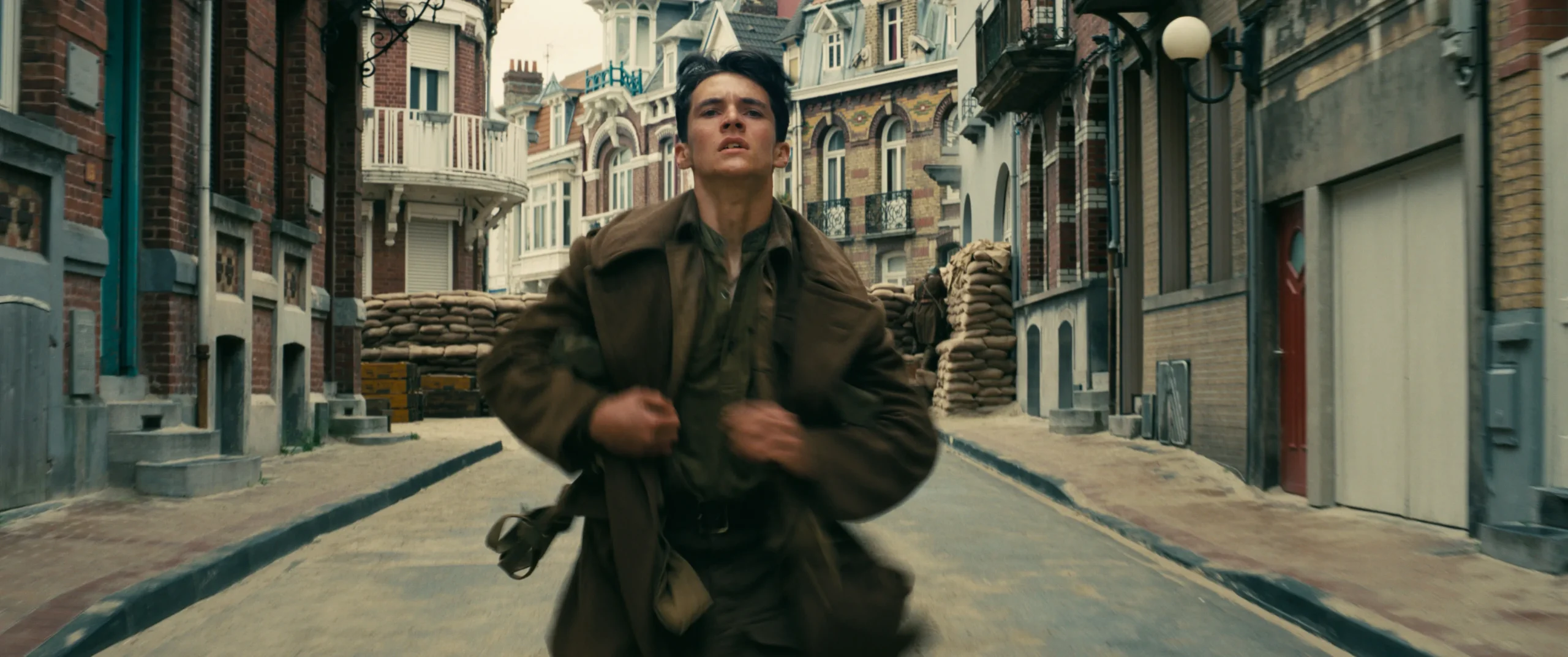
Hey there everyone! Welcome back to Movie Soapbox, the little corner of the internet that only you and I and that guy sleeping in the corner over there know about. This is the place where we find underseen, underappreciated, and genuinely difficult films and we make sense of them. Today? We are doing a full deep dive on Dunkirk, a movie so aggressively, almost violently non-linear that a significant portion of its opening-weekend audience walked out of the theater genuinely unsure what order events had happened in, and honestly, that is not a failure on their part.
Before we go any further, a word: everything from this point on is a full spoiler walkthrough of Dunkirk from the first frame to the last. If you have not seen this movie yet, close this tab, go watch it, and come back. I am not going to be coy about what happens, I am not going to tiptoe around the structure, and I am not going to pretend I do not know how it ends. You have been warned, and I mean it, and I will not apologize when you scroll down anyway.
What Nolan Actually Did Here, and Why It’s So Abnormal
So a 106-minute war movie with almost no dialogue, three interlocking timelines running at completely different speeds, no traditional protagonist arc, no villain with a face, and a climax that depends entirely on the audience understanding a non-linear time structure they were never explicitly taught. On a $150 million budget. Released wide by a major studio in the middle of summer franchise season.
You have to understand what that sentence means on a practical level, because this is the part nobody talks about. At that budget tier, at that release window, with that studio infrastructure around it, a film like this does not normally survive its own test screenings. Films in the $100M-plus range get notes. They get a lot of notes. And the note that kills movies like Dunkirk is always the same one, always delivered the same way, always by someone who has never read a novel in the last decade and is genuinely concerned about four-quadrant accessibility: audiences found the timeline confusing. That note, in most rooms, is a death sentence for the structure. You see the reshoot scar on a hundred films that started out bold and came out flat, that one additional scene early in act one where a character turns to another character and explains, out loud, using words, what is happening and when. Nolan did not add that scene. That, right there, is the whole story of why this film matters as an artifact of what commercial cinema can still occasionally be.
The Three Timelines, Actually Explained
The film gives you three threads, and it names them at the start. The Mole. The Sea. The Air. What it does not tell you, and what tripped up a lot of first-time viewers, is that these three threads are not running concurrently. They are running at completely different lengths of time, braided together and cut as though they were simultaneous.
The Mole thread, which follows Tommy, the young British soldier scrabbling for any way off the beach, spans roughly one week. He is on that beach for days. Days of failed attempts, of boats sinking, of climbing into ship hulls and nearly drowning, of watching the line shuffle forward and then watching the line get blown apart. One week.
The Sea thread, which follows Mr. Dawson and his son Peter and the young deckhand George as they pilot their private sailing vessel across the channel, spans roughly one day. They leave England, they cross, they arrive in the chaos. One day.
The Air thread, which follows Farrier in his Spitfire, spans roughly one hour. He launches, he fights, he runs out of fuel, he lands. One hour.
Nolan and editor Lee Smith are cutting between all three of these as if they are happening at the same moment, because emotionally they are, and because structurally the film needs you to feel the compression and the extension simultaneously, the war both grinding and sudden, the rescue both immediate and agonizingly slow. When it becomes night in the film, you have not moved forward in time. You have gone backward, to earlier in the week of the Mole timeline, where the events that preceded everything you just watched are now being shown to you. The visual cue is day versus night. That is the only signpost Nolan gives you, and it is enough, once you know to look for it.
The Moment That Broke Everyone in the Theater
The scene that made people turn to their companions with genuine alarm is the Cillian Murphy scene. You are watching the shivering soldier, the man Dawson’s boat pulls out of the water from a sinking destroyer, and he is panicked, barely functional, in full shock. He fights going back to Dunkirk so hard he accidentally knocks young George down the stairs of the boat, and George, we learn, dies from that. This is the Sea thread. One day out from England.
And then later in the film you see that same shivering soldier commanding a vessel, telling other men they cannot board, that they are fine, that they should swim to shore. He seems harder, more decisive, more terrible in a recognizable way. That is the Mole thread. That scene is earlier in the week, days before Dawson pulls him out of the water. The man commanding that smaller vessel with his cold arithmetic about who gets to live is the same man as the shivering wreck on Dawson’s boat, and the film gives you both ends of what the beach did to him and trusts you to close the gap yourself.
That is not a gimmick. That is a structural choice that completely reframes how you understand trauma in a war film. You do not watch him break. You watch him already broken, and then you watch, later, the before, and you fill in the breaking yourself.
The Farrier Thread and Why It Hits Differently on a Second Watch
Tom Hardy in a cockpit for an hour, face mostly covered by an oxygen mask, communicating almost entirely through eye movement and the physical language of a man managing a broken aircraft. The fuel gauge is damaged early. From that point forward you are watching a man fly every sortie knowing he almost certainly cannot make it home, and the film does not announce this, it just shows you the gauge and lets you do the math.
The dogfighting in this film is shot in a way that took genuine nerve, because Hoyte van Hoytema and Nolan committed to keeping the camera inside that cockpit, locked to Farrier’s perspective, and to refusing the traditional grammar of the aerial combat sequence, the God-view wide shot, the CG exterior, the sense of grand spatial overview. You know approximately as much about what is happening outside that cockpit as Farrier does, which is not much, and what you know you piece together from the flicker of other aircraft at the edge of frame and the sounds coming through the fuselage. By the time Farrier glides his dead aircraft down onto the beach at Dunkirk and climbs out and burns it, knowing he is walking into German captivity, the film has made you work for that moment. You earned it at the same pace he did.
What the Minimal Dialogue Is Actually Doing
The screenplay for this film is famously short. Stripped down to a degree that is genuinely unusual for a major studio release. And there is a case to be made that this was a strategic decision on Nolan’s part, not just an aesthetic one. A film that relied on dialogue to explain its timeline would have to stop moving to do the explaining. The Zimmer score, built around a Shepard tone that creates the psychoacoustic illusion of sound that perpetually rises without ever actually arriving at a higher pitch, is doing the work that exposition would normally do. It tells you where you are emotionally. It keeps you in the blender even when the image in front of you is, temporarily, calm. The absence of dialogue is not a limitation, it is the mechanism that allows the editing to work at all. If characters were talking at the pace the film is cutting, you would feel the whiplash. The silence absorbs it.
The Competing Reads
There is a version of the critical conversation around Dunkirk that says the non-linear structure is pure technique, that Nolan made a film about the formal possibilities of editing and used the evacuation of Dunkirk as the material rather than the subject, that the film is ultimately more interested in what cinema can do than in the men on the beach. This read has some honesty to it. The soldiers in the Mole thread are deliberately, almost programmatically anonymous. You do not learn Tommy’s last name. You do not get backstory scenes. You do not get a letter-home moment or a photograph-in-a-pocket moment. They are, by design, everyman placeholders in a structural mechanism.
The counter-read, which I find more interesting, is that the anonymity is the point, and the non-linear structure is what generates the emotional argument the film is making. By showing you these men after they have already been through hell, by withholding the linear backstory, Nolan is asserting that you cannot fully see someone’s survival in real time, that the weight of what they have already endured is invisible to the observer, that the man standing in line on the beach carries a week’s worth of near-death inside him and you will never know it from looking at him. The structure IS the thesis. The confusion you feel in the first forty minutes is calibrated, it is asking you to experience, on a tiny and safe scale, the disorientation of men who have been in survival mode so long they have lost the thread of their own story.
Movie Mike’s Read
The second one. Fully, without reservation. The formal complexity in Dunkirk is not Nolan showing off, it is Nolan doing the one thing that war films almost never manage: refusing to let you watch suffering from a comfortable narrative distance. The traditional war film structure, here is the man, here is what he loves, here is what he fears, now watch him go through war, requires you to stay oriented, requires you to always know where you are in the story, requires the film to keep handing you the map. Dunkirk takes the map away. And for a film about men so overwhelmed by events that their individual experience became nearly impossible to narrate, that theft of orientation is the most honest formal choice available. The structure is the respect. Everything else follows from that.
It took a director with enough leverage to keep twelve VPs out of the editing room to make this film the way it exists. Most films that start here end up somewhere else, somewhere flatter, somewhere the audience can follow without leaning forward. Dunkirk makes you lean forward for two hours. That is not an accident of craft, it is craft at full extension, and it is rarer than it should be.
Thanks for being here. We will see you next time at Movie Soapbox, the little corner of the internet where we take these things seriously, because someone has to.