
Hey there everyone! Welcome back to Movie Soapbox, the little corner of the internet that only you and I and that guy in the back who hasn’t looked up from his phone once know about. This is the place where we find the films that slipped through the cracks, usually because the cracks were widened on purpose, and we make sense of them. Today we are doing a full deep dive on 2067, an Australian indie time travel film so quietly confident and so genuinely good at what it does that the studio system’s complete ignorance of it is less a mystery than a confession.
From this point forward, everything below is a spoiler. The whole film. The ending, the twist, the dead body in the hallway, all of it. If you haven’t seen 2067 yet, the correct move is to stop reading, go watch it, and come back. I’ll still be here, equally annoyed about the same things.
2067 Movie Premise
The premise is this: it is 2067, every plant on earth is dead, the atmosphere is collapsing, a corporation called Chronicorp is selling bottled oxygen to a dying population, and a scientist named Dr. Richard Whyte has figured out how to punch radio waves into the future. The first signal they get back says three words: Send Ethan Whyte. Ethan is Richard’s kid. From there the film does something that most Hollywood time travel pictures are too scared to do, which is trust the audience to sit with the implications of a closed loop without immediately papering over them with exposition and a charismatic secondary character who exists only to explain things at the camera.
Now, before we get into the beat-by-beat, let me tell you something about what a film like this actually is, structurally, inside the industry, because it matters for how you watch it.
A film at this budget tier, produced outside the American studio system, with a cast that has real names attached (Kodi Smit-McPhee, Ryan Kwanten), gets made one of two ways. Either the director retains genuine creative control because the numbers are too small for anyone powerful enough to meddle to care, or the numbers are just large enough that someone in a distribution deal starts sending notes around the time the third act gets locked. You can usually tell which happened by watching the ending. When a film’s first two acts build with real patience and internal logic and then the finale makes a tonal pivot toward warmth and resolution that the rest of the film’s DNA wasn’t asking for, that is a reshoot scar, or the shadow of one, a place where someone decided the film needed to feel okay. 2067 has that shape. The ending works harder than it has to, and it works in the direction of comfort, which tells you something about the conversation that probably happened between picture lock and release. The miracle is that everything before that ending is largely intact and genuinely good.
The Movie 2067 Walkthrough
Ethan Whyte, as an adult, is a maintenance worker keeping Chronicorp’s city nuclear reactor from melting down on a daily basis, alongside his surrogate brother and mentor Jude. His girlfriend Xanthe is already symptomatic with O2 Rejection Syndrome, which is the film’s name for what happens to a human body when the atmosphere it is breathing has been failing for decades. She is coughing blood. Ethan’s entire plan for saving her is to work more shifts and buy better oxygen masks, which is not a plan, it is the coping mechanism of a man who cannot afford to look at the actual scale of the problem.
Chronicorp calls him in and tells him about the message. Send Ethan Whyte. The signal came from the future. His father sent it, presumably, before disappearing years ago. Ethan is resistant, because of Xanthe, because of the specific shape of the grief you carry when everyone who was supposed to protect you either died or left. But Jude pushes him to go. Xanthe pushes him to go. The world needs him. So he goes.
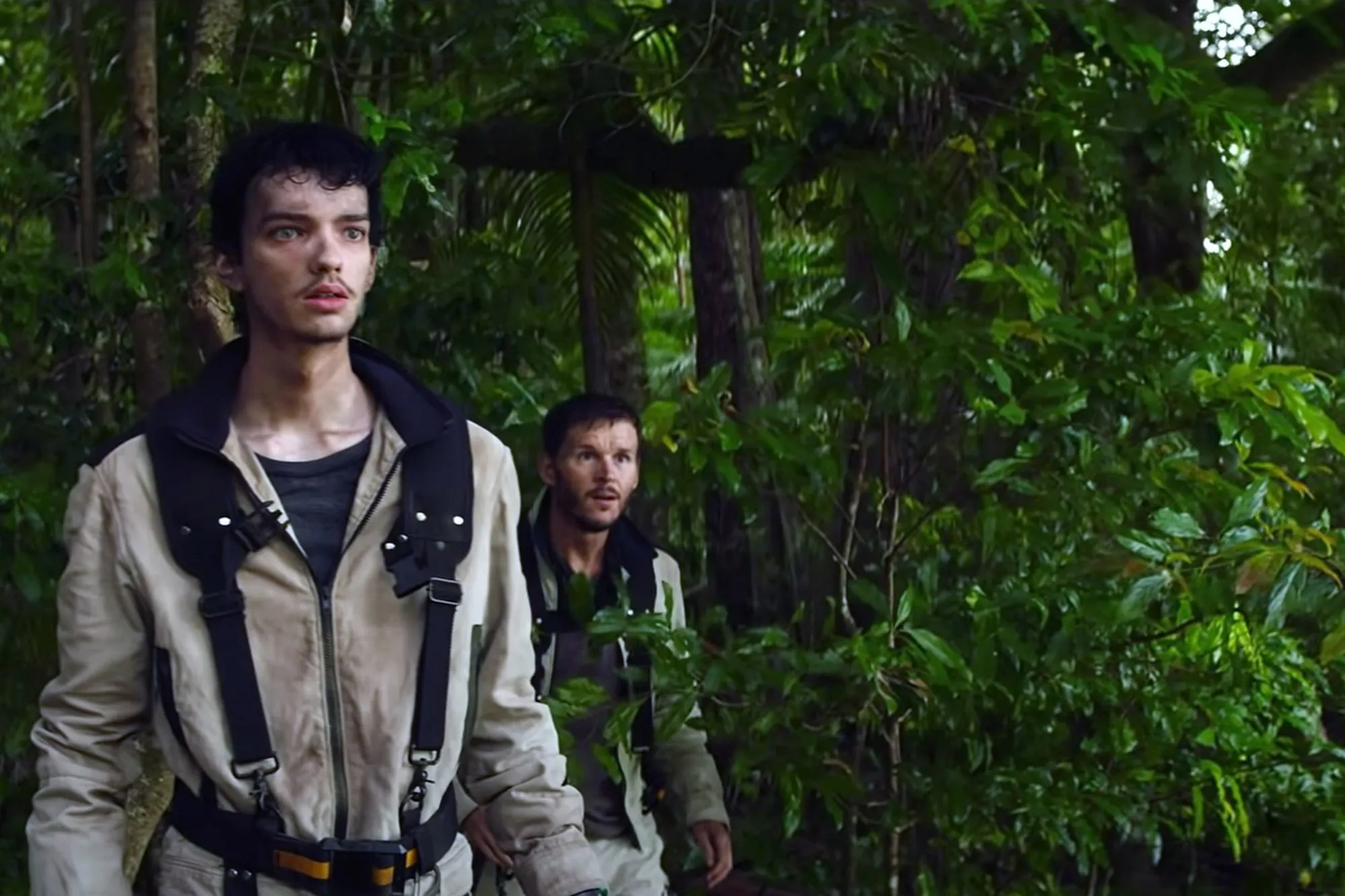
The transit is not gentle. He is fired into the future over the city in a ball of fire and lands in what should be a dead urban ruin but is instead dense, mature forest, trees and undergrowth reclaiming every structure. The planet healed. Humanity, apparently, is not present to take credit for it.
The first significant thing Ethan finds is himself. His own body, in the space suit he is currently wearing, shot once in the head, left to decompose in the entrance of a facility called the Chronicle. The dead Ethan’s wristband is green. Ethan’s is currently red. The dead Ethan’s handheld device, his Archie unit, has been modified in ways that Ethan’s has not. When Ethan replicates the modifications, his Archie starts pulling in sensor data from the surrounding area.
Then he eats a berry and nearly dies. I am not going to defend this plot point. The film commits to it and we move on. Jude arrives from the past, saves him, and together they find the Chronicle bunker. The bunker’s first act is to scan Ethan’s DNA via the bracelet his father installed on his wrist when he was eight years old. This is the answer to the question the whole first act was building toward: why specifically Ethan? Because Richard Whyte built a system that only his son’s DNA could unlock, and the bracelet was how that son’s identity got encoded into the door. No other human on the planet can open the Chronicle. That is why the message said what it said.
So we now understand the loop’s architecture. Richard Whyte opens a channel to the future. The future sends back a message telling them who to send. Richard places the bracelet on his son. Chronicorp, who wants control of the one person who can eventually operate their escape hatch, has Richard killed and Ethan’s mother killed, and installs Jude as Ethan’s guardian and trainer, making sure Ethan learns exactly the skills he will need, reactor repair, systems maintenance, without ever knowing why he is learning them. Ethan grows up thinking he has a brother. He has a handler.
This is the film’s sharpest move, the reveal that the entire texture of Ethan’s adult life, the bond with Jude, the sense of purpose at the reactor, the skills he is proud of, was engineered by a corporation that murdered his parents to produce a specific outcome. Every moment of warmth in Ethan’s past has a Chronicorp signature on the back of it.
In the future, Ethan and Jude reach the power center and discover why the future needed someone from 2067 specifically. The Chronicle station has a massive power failure, and the only people who know how to fix it are the two men who have spent their adult lives keeping 2067’s reactor from going critical. The future called for Ethan because the future needed a man shaped by a past Chronicorp deliberately designed. The closed loop isn’t just temporal. It is corporate.
2067 Movie’s Dual Timeline
Timeline one, the original: Chronicorp receives the signal, manipulates Ethan into going, Ethan and Jude fix the power, they return to 2067, Regina and the Chronicorp board are standing there with a line of selected humans ready to evacuate into the future, Ethan is shot in the head and left in the hallway, humanity abandons a dying planet and tries to survive as a remnant in the healed future. This is the ending that was always going to happen if no one made a different choice. This is the body Ethan found in the doorway. That Ethan came back, got shot, and the evacuation proceeded without him having changed anything at all.
Timeline two, the one the film earns: Ethan, standing in the Chronicle knowing what he knows about the body in the hallway, about Xanthe’s skeleton in her classroom, about what Chronicorp did to his parents, decides he is not going back. Instead he takes every seed, every cultivated plant in the Chronicle’s greenhouse archive, and ships them back to 2067. Not a cure. Not a pill. The actual mechanism. Give the past the capacity to heal itself and don’t go back to watch it fail again.
The Two Competing Timelines of the Film 2067
Theory The first: Ethan’s gesture is genuinely redemptive, the closed loop is broken, the plants change the trajectory of 2067 enough that the original timeline’s collapse never fully happens, Xanthe lives, the planet recovers, and the forest Ethan landed in is the result of his own intervention. This is the optimistic read. The film is pretty clearly asking you to land here.
Theory the second: nothing changes. The loop is closed in a different direction but it is still closed. Chronicorp still exists. The profit motive that killed every plant the first time still exists. Sending seeds back to a civilization that already demonstrated it would strip-mine its own atmosphere for quarterly returns is not a solution, it is a delay. The Xanthe who lives in the revised timeline is still living inside the same system that killed the first one. The forest in the future exists because humans are gone, not because humans changed.
Moviesoapbox’s Preferred Reading of the Film 2067
Mike’s read is the second one, with one concession to the first. The film knows the second read is true. The matte painting of the recovered earth is too beautiful, the resolution too warm, for a film that spent its entire second act showing you exactly what Chronicorp is and what it does to people it finds useful. That gap between what the film knows and what it allows itself to conclude is the reshoot scar I mentioned earlier. The film’s logic supports the darker reading. The film’s ending reaches past its own logic toward comfort. You can feel the seam.
What makes 2067 worth your time anyway is that the seam is the only structural failure in a film that otherwise handles its closed loop with more discipline than most American productions three times its budget. The bracelet, the dead body, the DNA door, Jude’s function as a shaped tool, all of it holds. The performances hold. Smit-McPhee carries the specific weight of a man who has been managed his entire life without knowing it, and when that recognition hits him in Xanthe’s classroom it lands because he has been playing that undercurrent the whole film, not just in the scene where it pays off.
This is what surviving the system looks like when you actually survive it. An Australian writer-director got a genuinely strange, genuinely committed science fiction film with a real cast and real effects across the finish line with its internal logic mostly intact. The ending flinches. The film doesn’t. Watch it, then come back and argue with me about the seeds.
We’ll be here. This is the corner of the internet we built for exactly that argument.