

Hey there everyone. Welcome back to Movie Soapbox, the little corner of the internet that only you and I and that guy sleeping in the corner over there know about. This is the place where we find underappreciated indie films and we make sense of them. Today we are doing a deep dive on Coherence, a movie so quietly, patiently, devastatingly complicated that by the time you realize what it’s doing to you, it’s already done it, twice, in a house you haven’t visited yet.
Alright. If you have not seen Coherence, close this tab, go watch it, come back. I’m only going to say this once – this is a beaut of an indie film. The amazing result, phenomenal improvisation, glorious twists. And you don’t want to have any of that spoiled. And you know what, the rest of this write up will be the full wreckage, laid out piece by piece.
Coherence Movie the Making of this Movie
Still here? You’ve seen it? Good. Let’s get into it.
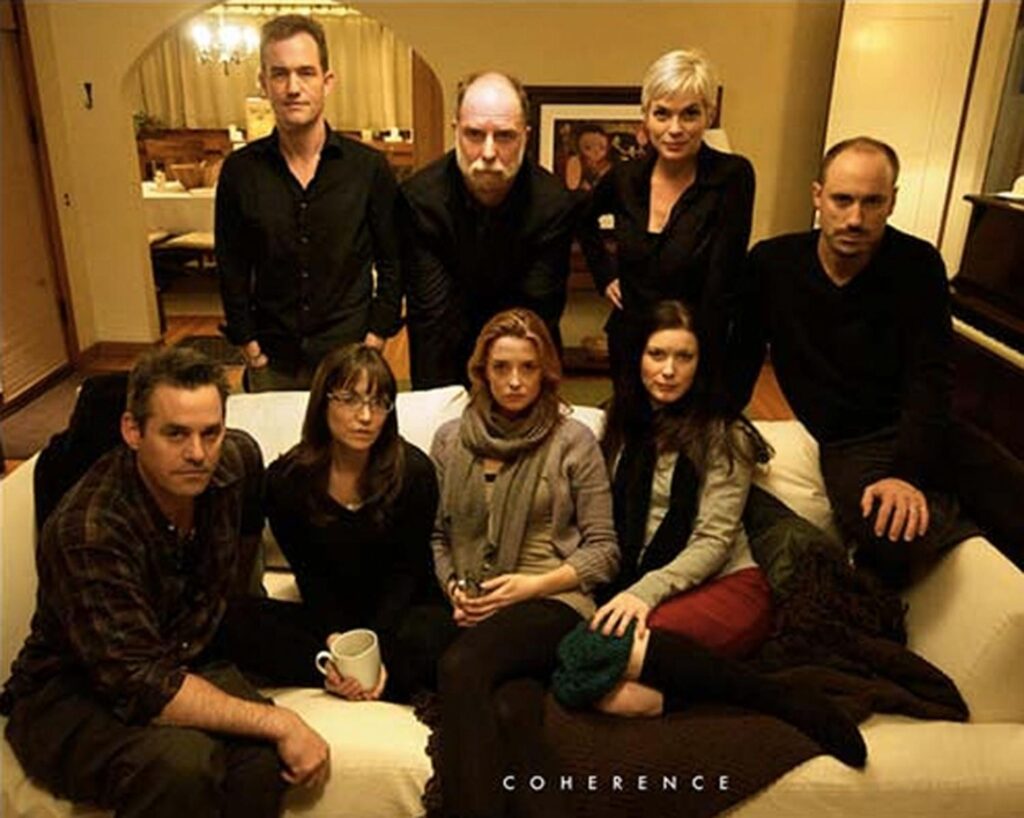
What you need to understand before we touch a single scene is what this film actually is, structurally, as a production, because the mechanics of how it got made are inseparable from why it works the way it does. James Ward Byrkit shot Coherence with no script, a cast of friends, a rented house, and a set of index cards with scene directions that the actors received night by night, sometimes scene by scene, without knowing what was on anyone else’s card. There was no rehearsal in the traditional sense because there was no text to rehearse. You know what kind of note a film like this gets from a development executive? You know what note it gets? It doesn’t. Because it never goes near a development executive. It can’t. The entire structural logic of this movie, the raw improvised panic in those performances, the way the dread seeps in at the edges instead of arriving on cue, all of that is possible only because nobody with a greenlight budget and a VP title ever got their hands on it. You can feel the absence of interference the way you feel a room where something was just almost ruined and then wasn’t. A film at this budget tier, with this cast, at a distributor like Lionsgate Premiere, usually means one of two things: a genre director proving a calling card, or a filmmaker who ran out of money mid-compromise. Byrkit ran out of neither. What survived was entirely intentional, which in this industry is genuinely rare. Now. Let’s get to the movie deep dive.
Movie Coherence Setup Deep Dive
Coherence opens like a dinner party movie, the kind of slow social drama where the drama is all subtext and wine and passive aggression between people who know each other too well, and for about fifteen minutes it lets you believe that’s what it is… you know, something like The Party, or Beatriz at Dinner. Just a tight dialogue driven flick. Eight friends, one house, a comet passing overhead. But then power goes out. Someone checks the generator. This is where most people’s brains are still in dinner-party mode, and that is exactly the trap.
At the 19th minute, Hugh and Amir leave the house. They come back. And something happened while they were gone that the film does not explain, does not announce, does not italicize for you. It just happened. And you don’t even realize that you are already in it.
What happened is this: the comet overhead has created a zone of quantum decoherence around their neighborhood. Multiple parallel versions of their house, their party, their lives, are now physically adjacent to one another in the dark between the streetlights. Hugh and Amir walked out the door of one version and came back into another. They brought a box. Hugh has a cut on his head. The ping pong paddle in that box is the first hard object proof that something is wrong, because the people in this house chose a different item.
Byrkit’s instruction, when asked how to watch this film, was to follow Em. Watch the magician’s left hand. Don’t let the ensemble distract you from the one character whose continuity is the spine of the whole movie. And the second instruction was to watch the fades to black, which are not just editing choices, they are events, each one a signal that the film’s reality has shifted in some way, that someone has crossed and the roulette wheel has landed somewhere new. The fades get shorter as Em gets deeper into the maze. Then, at the 1:06:32 mark, they get long again. Make of that what you will – but I will definitely be giving you my own opinion as we get deeper into it.
Coherence Movie Scene-by-Scene Walkthrough
Let me map the houses the way this film actually demands, because the version in your memory is not clean enough to hold what I’m about to tell you.
We start at House 1. This is our anchor. Em1, Kevin1, Amir1, Hugh1, Laurie1, Mike1, Lee1, Beth1. Eight people, one party, one house, our baseline. The comet passes. The power dies. Hugh1 and Amir1 walk out at the 19th minute. They never come back.
What comes back is Hugh2 and Amir2, walking in from a different house entirely, carrying a box, Hugh with a fresh cut on his head. The cut matters. In their house, something happened that didn’t happen here. The ping pong paddle in the box is their house’s identifier. This house’s identifier, we’ll learn later, is something else.
At the 32nd minute, Em1 leaves for the first time, along with Kevin, Laurie, and Mike. This is the moment the film’s POV anchor shifts, and from here on Em’s perspective is our window, unreliable because she is moving between houses the same way everyone else is, but we don’t know that yet.
Unbeknownst to us at the time, our vantage is now House 2, the blue glow stick box is also open. Mike looks through the window and sees Lee in the dining room, asleep. They entered House 2 with blue glow sticks. Hugh and Amir here are holding red ones. The identifiers are already multiplying and the film gives you maybe two seconds to register each one before moving on.
Mike1, once he understands enough about how the comet works, leaves to blackmail himself. He has information only he would know. He’s going to leave a note for another version of himself and use it as leverage. The film presents this as a joke and it is also completely insane and completely logical, which is basically the film’s whole register.
At this point, the only two characters who have been present without confirmed replacement since the start of the walkthrough are Em1 and Laurie1. Everyone else has been swapped at least once. The numbers on the back of the key cards confirm this: Kevin3’s card reads 6, which matches what Kevin1 had back at House 1. He’s the ping pong paddle Kevin. Em, doing the math out loud, tells Mike that Beth and Lee are originals of this house because they never left, and Mike and Em are visitors, which means Mike3 started as Mike1 and ended up back here by chance.
Hugh and Amir’s numbers come from a third house entirely. Neither House 1 nor House 2. There are at least five Amirs and four Hughs moving through these houses by this point, and the film never stops to let you catch your breath and count.
Then the Green Mike breaks in and attacks Mike3, which is when Em leaves. Not toward safety. Toward something specific. She is looking for something, and what she is looking for is the thing the movie has been building to since that phone call at the beginning.
She passes through House 3 (identifier: Monkey), keeps going, arrives at House 4, where someone already smashed the car window outside. Someone in a different house broke the window because in their timeline the book was in the car. In this one it wasn’t. Em doesn’t stop to think about that for long. She is on a mission.
Coherence Movie and What Em Is Actually Looking For
Here is where most readings of this movie go wrong, mine included on first watch. The natural assumption is that Em is looking for Kevin1. Her Kevin. The Kevin she’s been fighting with. The Kevin she owes a conversation to. The comet scattered them and she is trying to get back to her own house and her own life. And I do not believe that that is what is happening.
Go back to the beginning of the film. Em and Kevin are on the phone. He asks her to make a decision, she asks for more time. Then, twenty minutes in, he says it directly: eventually, indecision becomes a no. Em holds her ground. She is not ready. He moves on, at least partially. That moment, that specific failure of commitment, is the engine of the entire ending.
Em is not looking for Kevin1. She is looking for KevinX, a Kevin from a parallel house where Em said yes. A Kevin where she made the other choice. She is using the decoherence, consciously, to find the version of her life she didn’t take.
When she finds the house where Em-Prime and KevinX are laughing together on the couch, relaxed, at peace, committed, she knows she has found it. Em-Prime said yes. Em-Prime is going to Paris. Em-Prime is everything Em1 couldn’t make herself be, and Em1 is going to take her place.
What follows is not a horror sequence in the traditional sense, but it functions like one. Em1 drugs Em-Prime in the car. Em-Prime wakes up and fights back hard. Em1 hammers her with a toilet lid, shoves her in the tub. Em-Prime’s ring falls to the floor, Em1 takes it. She puts on Em-Prime’s life like a coat. Morning comes. The decoherence has passed. Em1 wakes up on the couch and doesn’t know where she’s landed. She finds KevinX outside. He asks if she’s okay. She is trying to read him, to figure out if it worked, if she is now inside the life she wanted.
Then KevinX checks his voicemail. Em-Prime called before the decoherence closed. She left a message. And on that message she tells Kevin exactly what happened. Em1 is standing in front of him while Em-Prime’s voice explains what Em1 did. And that is where the film ends.
Coherence Movie Rules, or: How the Houses Actually Work
The mechanism behind the movement is cleaner than it feels in the chaos of watching it. When someone leaves one of the houses and enters the dark zone created by the comet, they don’t walk to a specific house. They are routed randomly across the available parallel houses, like a roulette wheel where the slots are infinite and the wheel never stops. When a person leaves House 1, somewhere a person also leaves House 2, and they do not necessarily swap cleanly. The comet does not operate on symmetry.
The book Hugh reads from is the film’s only expository tool, and Byrkit uses it precisely once, letting the film’s logic explain itself rather than stopping to diagram it: two states continue to exist, separate and decoherent from each other, each creating a new branch of reality based on the two outcomes, and quantum decoherence ensures those outcomes have no interaction with each other. Except that during the comet’s passage, they do. The decoherence fails. The branches touch.
The unique item system, the ping pong paddle, the stapler, the oven mitt, the monkey, exists because the characters invented it mid-crisis to track which house they were in. It is a workaround, not a rule. The comet doesn’t care about their inventory system. People still get scrambled. Numbers on the backs of index cards still don’t match. The system helps them think; it doesn’t help them survive.
Coherence Movie the Fade to Black Question
Byrkit said the fades to black were debated extensively, down to the number of frames, the audio tail, the structural rules. They are not decorative. They are not just pacing. Watch them in sequence and you notice that they are long at the start, when the film is still pretending to be a dinner party movie, and they shorten as the comet’s effect deepens, as the probability space expands and the cuts between states become faster, more compressed, less breath between them. Then at 1:06:32, as Em is fully down in the labyrinth and has begun to understand the scale of what she’s in, the fade goes long again.
Moviesoapbox’s read is that the long fades at the start are the film’s normal breathing rhythm, the pace of an ordinary night. The shortening fades are the comet tightening its grip, the intervals between branch-points shrinking as the decoherence deepens. The long fade at 1:06:32 is the moment Em stops being a passenger and becomes an agent, the moment she chooses to use the system rather than just survive it, and the film pauses to let that register.
The Competing Coherence Movie Theories
Coherence Movie Theory Possibility #1
The first reading says Em’s arc is tragedy. She set out to steal a better life and got caught. The system corrected for her interference. The voicemail is the universe’s veto.
Coherence Movie Theory Possibility #2
The second reading says it’s ambiguous whether the correction matters. If Em-Prime no longer exists in this branch, if the decoherence closed and took her with it, then the voicemail is a ghost, and KevinX has to decide what to do with information from a woman who may no longer be anywhere. Em1 could still build something from the wreckage.
Coherence Movie Theory Possibility #3
The third reading, and the one that takes the film most seriously as a character study, says the ending is about identity collapse. Em1 spent the whole night trying to become EmX?, and in doing so proved she was never going to be her. The woman who can drug her double and shove her in a tub to take her life is not the woman laughing on the couch with KevinX. She took the seat. She didn’t become the person who deserved it.
Where Moviesoapbox Lands on a Coherence Movie Explanation
The third reading is the correct one and I will not be taking questions on this. The whole film is about decoherence as a metaphor for the choices we don’t make and what they cost us, and Em’s arc proves the metaphor by destroying it. She finds the version of herself who made the right choice, and her response is to eliminate that version and take the reward without having made the choice. That’s not how it works. That has never been how it works. KevinX got a voicemail because Em-Prime, even in the middle of being shoved in a bathtub, understood something Em1 hasn’t figured out yet: you cannot inherit a life you didn’t earn by the choices that built it. The comet gave Em1 a window into the self she could have been. She looked through it and decided to break the glass.
The voicemail is not a twist. It’s a consequence. The film is heading to this moment from the beginning.
Coherence got made because Byrkit had a house and a cast and an idea and no studio between him and the screen. There are a hundred versions of this film where someone with development money and test-screening data got involved and smoothed the improvised panic into something cleaner and completely dead. This version survived because it never went near that process. This movie sits near the top of the indie mind blowing sci-fi films. If you loved Coherence, here are a few more movies you might enjoy as well.
🎬 If You Liked This…
- Primer — two people who thought they understood what they were building, discovering too late that the thing they built understood them better, same suffocating intimacy as Coherence and the same refusal to explain itself twice
- Another Earth — parallel versions of reality as an emotional proposition rather than a physics problem, the same question Coherence is really asking underneath all the comet business: who would you be if you made different choices
- Radius — two strangers bound together by a rule neither of them chose, the same micro-budget ingenuity and the same discovery that the real horror is what the situation reveals about the people inside it