
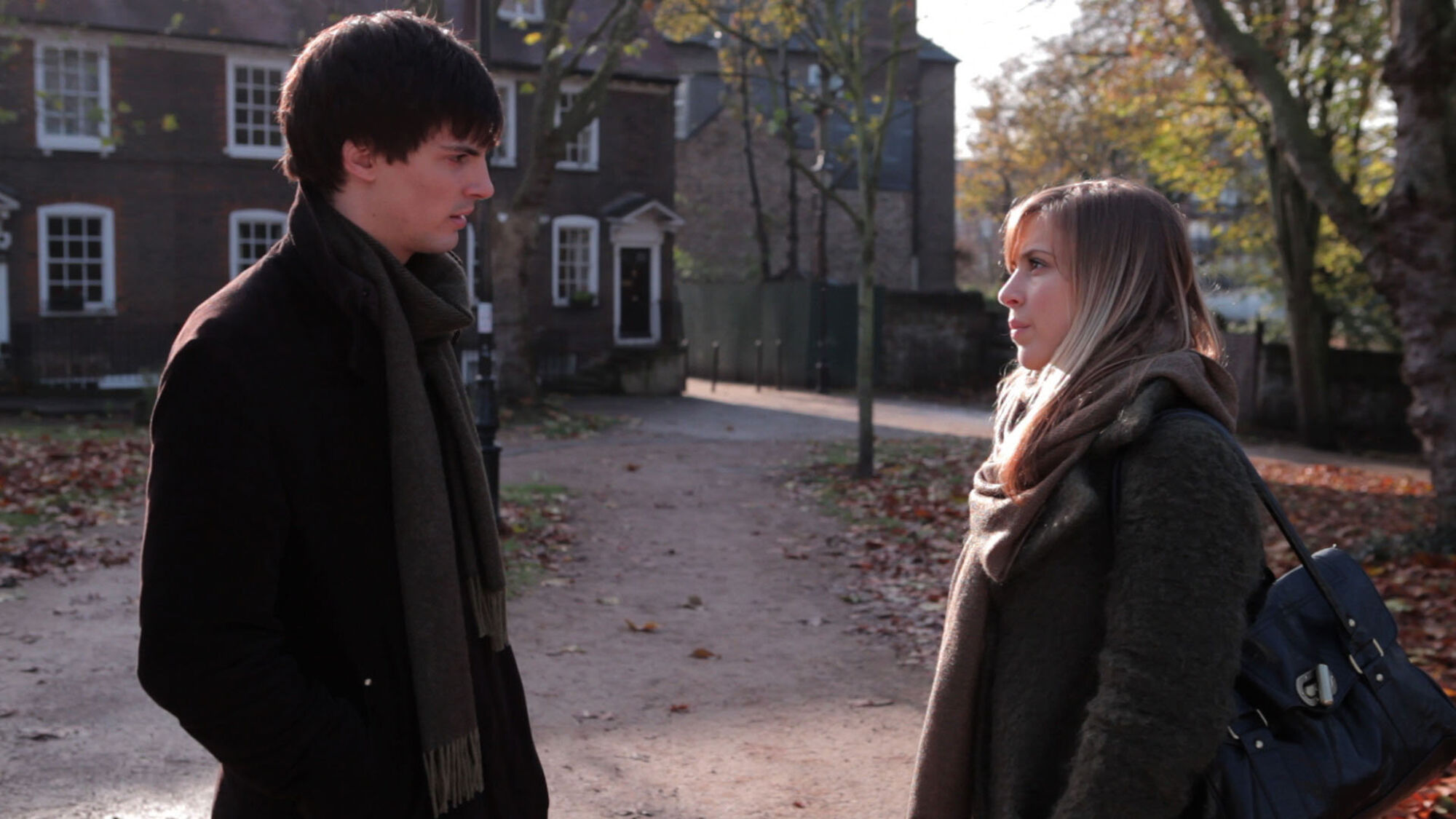
Hey there everyone! Welcome back to Movie Soapbox, the little corner of the internet that only you and I and that guy sleeping in the corner over there know about. This is the place where we find underappreciated indie films and we make sense of them. Today? We are doing a deep dive on Frequencies, a movie so quietly, stubbornly strange that the people who greenlit it probably couldn’t have told you what it was about when the deal closed, and honestly, that’s the only reason it got made the way it did.
Before we go any further, here’s the trailer. Watch it. If you’ve already seen the film, watch it again, because after we’re done here you’re going to notice things in it you didn’t catch the first time.
Alright. If you haven’t seen Frequencies yet, stop reading right now and go find it. Everything from this point forward assumes you’ve watched the whole thing, end to end, including the part where the movie quietly decides it was a time travel film the whole time without ever once announcing that. You’ve been warned. We’re going in.
So. Frequencies. A British sci-fi film from 2013, written and directed by Darren Paul Fisher, shot on what was almost certainly a budget that wouldn’t cover a single day of catering on a Marvel production. And here’s the thing you need to understand before we go a single step further into the mechanics of this film: a movie like this, with this level of conceptual ambition, at this budget tier, with a cast you don’t recognize, in a sub-genre that test audiences historically cannot follow, does not survive the development process at any studio that has a development process. The version of this film that gets made with actual money attached is the version where someone has added a love triangle in act two and the third act has been softened into something the VP of Acquisitions felt comfortable showing his wife. The Mobius loop ending gets replaced with a conversation on a park bench where the two leads agree that fate is complicated. You get a poster that looks like every other poster. What Fisher actually made, this precise, weird, philosophically serious little film, happens because there was no room for the committee to get its hands on it. That’s not an accident of budget. That’s the budget being the only reason the film survived intact.
Now let’s talk about what this film actually is.
The World of Frequencies: Basic Rules
The film drops you into a world that looks like ours except it runs on a different logic. Every person in this world has a measurable Frequency, sometimes called a Luckiness Quotient, and it determines how the universe treats you. High Frequency individuals move through life like the world is tilted in their favor, trains arrive, money appears, doors open. Low Frequency individuals get the opposite, the world actively resists them, not cruelly, just indifferently, the way a river doesn’t hate the rock it wears down.
Our two central figures are Zak, a very low frequency boy, and Marie, a very high frequency girl, and the film establishes early and clearly that these two cannot occupy the same physical space for more than roughly a minute without the universe beginning to correct for it. First a small disruption. Then a larger one. Then, if they push it, something genuinely catastrophic. The world has rules and the rules do not care about what Zak and Marie want.
Zak’s response to this is to go looking for a workaround, and he finds one in what the film calls The Technology, a set of specific words and phrases that function as frequency-balancing mechanisms. Random, contextless words, armadillo being the example the film leans on hardest, that when deployed in the right construction, smooth out the frequency disparity enough to buy more time. More time together. More presence. More possibility.
But The Technology turns out to have a side effect that is more alarming than the original problem. The words don’t just balance frequencies, they override will. Whoever hears the key word at the end of a sentence cannot resist completing the last instruction they were given. Tell someone they’ll love you and close it with the word, they will love you. Tell someone to slap you and close it with the word, they will slap you. The film is asking, carefully and a little uncomfortably, whether love manufactured through compulsion is still love, and it’s not really interested in giving you an easy answer.
Then the third act arrives and the film adds a second system entirely.
Theo, the Music, and the Part Where the Film Changes Shape
A significant number of reviews of Frequencies go positive through the first two acts and then balk at the Theo section, treating it as a tonal rupture, a different movie stapled onto the back of the one they were enjoying. Those reviews are, with respect, wrong, but they’re wrong in a way that tells you something real about how the film distributes its information. Fisher buries the structural logic of the third act in the first two, and if you were watching the Zak and Marie material as a love story rather than as a systems diagram, you missed the scaffolding.
What Theo discovers is that music, specific musical constructions first mapped by composers like Mozart, functions as a counterweight to The Technology. Where The Technology smooths frequency disparities and overrides present-tense will, the music does something stranger: it allows the user to perceive time non-linearly. Theo can see backward. And then, with practice, he can act on what he sees, redirecting outcomes before they happen, positioning himself perpetually ahead of every conversation, every confrontation, every variable. He becomes, functionally, a man playing chess on a board where he can already see the end of the game.
The film presents this as disturbing, and it is. Theo is not a villain exactly, but he is a warning about what happens when someone acquires perfect foresight without the wisdom to carry it carefully. He dismisses his own father mid-sentence because he has already run the conversation and knows how it ends. The intimacy has been removed from every interaction. He’s not present in any of them anymore.
Four Theories for What Frequencies Is Actually Doing
Four coherent readings of this film exist and they are not equally convincing, but they all deserve a fair hearing before we settle on one.
Theory One: Pure Literalism. Everything is coincidence. Zak found The Technology by accident. Theo found the Music by accident. They are two separate systems with no underlying connection, and the film is simply a story about two people who each happened to stumble onto something powerful and used it for their own ends. The ending is the ending. There’s no loop, no deeper architecture. The film is exactly as wide as its surface.
The problem with literalism is that it makes the Theo section narratively inert. If the two systems are unrelated, Theo’s entire arc is a detour. The film has spent ninety minutes building toward something and then, under literalism, it just stops. That’s not a satisfying accounting for what Fisher put on screen.
Theory Two: The Triptych. Three powers, baked into the foundation of the Frequency world from the beginning, each designed to check the other two. The Frequencies themselves give High Frequency individuals material dominance over the world around them. The Technology can counterbalance the Frequencies, smoothing disparities and overriding individual will. The Music can counterbalance The Technology, restoring some form of prior-state to a situation The Technology has manipulated. Each system contains and is contained by the others. Marie embodies the Frequency power. Zak embodies The Technology. Theo embodies the Music. The film is about these three forces cycling through each other in an eternal, unresolvable contest for control.
This theory is elegant and it handles the structure well. It doesn’t fully resolve the ending, but it gives the ending purpose.
Theory Three: Predeterminism. The world of the Frequencies is a fully deterministic system and the film is about its characters coming to terms with that fact. Marie’s High Frequency status means the world moves for her, she needs a train, the train is there, but she has no more free will than Zak does, she’s simply getting better outcomes from the same absence of choice. Zak’s discovery of The Technology is part of the system, not a break from it. The Music is part of the system. Theo’s seeming free will is the most elaborate illusion of all. Everything is running on rails that were laid before the film began.
The theological resonance here is hard to miss and clearly intentional. The film is in direct conversation with the free will versus determinism debate, the question of whether a universe that is fully known in advance by something can still contain genuine choice for the things moving through it. Fisher is not answering this question. He is refusing to answer it, which is different and more honest.
Theory Four: The Mobius Loop. This is the one that actually closes every open door in the film, and it’s the one that requires you to take the Theo section not as a detour but as the destination the whole film was driving toward.
In the Mobius reading, Frequencies is a closed loop narrative. The film begins at the end. Theo, having pushed his musical time-perception abilities as far as they will go, eventually acquires the reach to push influence backward far enough to touch the beginning of the story itself. The apple that rolls to Marie at the film’s opening, the inciting contact between her and Zak, is not a coincidence. Future Theo, working backward through time with the precision of a man who has already watched the entire film play out, engineers that moment. He causes his younger self to kick the apple. He starts the chain. The story is a loop and Theo is both inside it and responsible for it.
When this film’s producer, Owen Pugh, who played Theo, was asked directly whether Theo was the only character with genuine free will or whether that was itself an illusion, his answer was careful: Theo has discovered how to control it, and thus how to control people. Not that Theo has free will. That Theo has control. Those are different things, and Fisher knew what he was doing when he drew that line.
Asked whether some higher-up version of the system, someone with even deeper musical insight than Theo, might be controlling Theo in turn, Pugh said the script doesn’t suggest it but added: if it makes sense, why not? That’s not a deflection. That’s a writer and actor who built a film specifically designed to keep that question open.
Which Theory Is Right?
Moviesoapbox has a very real opinion on which theory is right – and we are 100% going all in on The Mobius Loop theory as the correct reading. And it’s correct for a specific structural reason, not just because it’s the most satisfying or the most clever. Without the loop, Theo’s arc does not connect back to the film’s opening. The apple roll sits there as an unexplained moment, a random event in a film that has established, clearly and early, that nothing in the Frequency world is random. The film’s own internal logic demands an explanation for the apple, and the only explanation that fits is the one where future Theo reaches back and provides it. Every other theory leaves that thread dangling.
And once you accept the loop, the predeterminism reading doesn’t collapse, it deepens. The world of the Frequencies may indeed be fully deterministic, and the reason it’s deterministic is precisely because Theo is in it, has always been in it, working backward from an end point the audience never gets to see. The loop is the mechanism by which the predeterminism operates. These aren’t competing theories at that point. The Mobius loop is the engine. Predeterminism is what it looks like from inside the engine.
Frequencies is a film that knew what it was, that got made because it was small enough to stay what it was, and that asks the questions it asks without flinching from the fact that it will not answer them. Fisher built a system and trusted you to map it. That’s a thing that almost never survives contact with the people who finance films. The fact that this one did, intact, weird, uncompromised, sitting on a budget that bought it total creative freedom in exchange for total obscurity, is the only miracle in a film that is ostensibly about miracles. Go back and watch it again. You’ll catch the apple differently this time.
🎬 If You Liked This…
- Coherence — another film that takes a single elegant rule change to the fabric of reality and follows it with complete logical commitment until everything the characters thought they knew about themselves falls apart
- Another Earth — the same romantic longing underneath the sci-fi premise, a person trying to reach across an impossible distance to someone they love, and the universe offering something that looks like a solution but isn’t
- The One I Love — a couple confronting alternate versions of their relationship, the same question Frequencies is really asking: if you could engineer the perfect conditions for love, would what you built still be love