
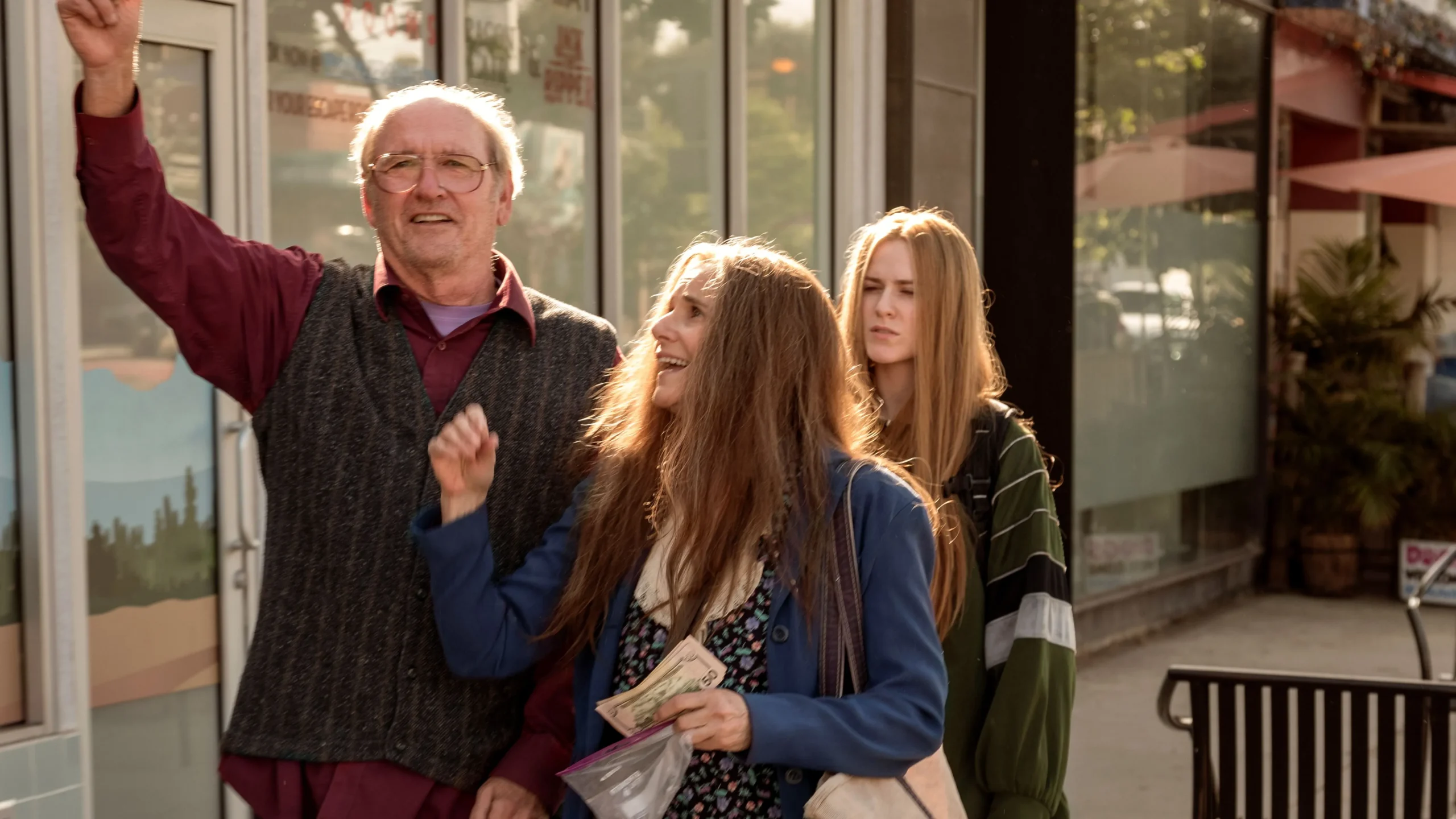
Hey there everyone! Welcome back to Movie Soapbox, the little corner of the internet that only you and I and that guy sleeping in the corner over there know about. This is the place where we find underappreciated indie films and we make sense of them. Today? We are doing a deep dive on Kajillionaire, a movie so quietly devastating, so perfectly engineered to dismantle you at the exact moment you think you’ve gotten away clean, that even describing the ending feels like a small act of cruelty toward anyone who hasn’t seen it yet. Go see it. Come back. We’ll be here.
Okay. If you’re still reading and you haven’t seen Kajillionaire, I want you to understand something: what happens at the end of this film is a precision instrument, and I am about to hand it to you fully assembled. That’s a spoiler warning. That’s what it is. Everything past this sentence is the movie with its clothes off, and Miranda July worked too hard for you to stumble into that underprepared.
Kajillionare Movie Walkthrough Explanation
The movie opens on three people in the middle of an extremely small crime, and the scale of that crime tells you everything you need to know about where they are in life. Robert (Richard Jenkins, who has been doing the best quiet work in American film for twenty years and still doesn’t get enough credit for it) and Teresa (Debra Winger) are grifters of the most pathetic, low-yield variety imaginable, the kind of people running mail-order fraud schemes that net forty dollars on a good day. And they have raised a daughter, Old Dolio (Evan Rachel Wood, doing something genuinely strange and true here), inside this same philosophy, which is less a philosophy than it is a wound that calcified into a lifestyle. They owe $1,500 in back rent on an apartment that gets flooded with industrial soap bubbles every single day from the factory upstairs, which, yes, that is the right visual metaphor for their entire existence.
Now, before we get too deep into the beat-by-beat, let me tell you what kind of film this actually was when it was sitting on a financing desk somewhere.
A Miranda July script about a family of petty grifters, no traditional narrative engine, no villain you can point to, the emotional climax hinging entirely on whether a grown woman will let herself be held, anchored by a lead performance built around deliberate blankness and a name that sounds like a joke, this is a film that gets murdered in development. You’ve seen what happens to films like it that don’t survive: they get a scene rewritten where Old Dolio discovers her parents have a secret heart of gold in act two, they get a third act that wraps the family conflict in a way that tests well with the 35-to-49 demo, they get a love interest who explains his feelings out loud. The fact that Kajillionaire exists in the shape it exists in tells you that July either had final cut or was fast enough to finish the film before anyone realized what she was actually making. You can feel the absence of interference in every scene. That absence is the movie’s best special effect.
Back to the film. On a flight home from a luggage scam in New York, they meet Melanie (Gina Rodriguez, doing the hardest thing an actor can do in a film like this, which is play the emotionally available person without making it feel like a function), a warm, quick, openly curious woman who gets excited about the idea of running cons with these weird people she just met on a plane. She is not there for the cons. You understand this before she does, maybe, or at least before Old Dolio does. She is there because Old Dolio is a person who has never been loved correctly and Melanie can see it the way you can see a building that’s been structurally compromised, you just know, from the outside, before you ever go in.
The con they run together, visiting lonely elderly people under the pretense of delivering glasses, sitting with them, keeping them company while they case the apartment for checkbooks and valuables, is where the film gets its teeth into you. There is one scene, one old man dying alone in his apartment, just wanting to hear the sounds of a normal household moving around him while he goes, and these three people trying to steal from him while providing that exact thing, the thing they are categorically incapable of providing in their own home, and the way July holds that scene without flinching is the moment you realize this isn’t a quirky indie about lovable small-time criminals. This is a film about what happens to a child raised inside a closed system that decided the world was a wound to be avoided rather than a thing to be lived in.
Old Dolio attended a positive parenting class earlier in the film (she needed twenty dollars, she took the job) and learned about the newborn stomach crawl, the way an infant placed on its mother’s belly will crawl up toward her on instinct, toward warmth, toward contact, toward the thing it needs. She found out, afterward, that her mother never did this with her. You already knew that. But now she knows you know, and the film knows you know, and it still costs something to hear it said plainly.
When the $1,575 check from the luggage scam comes in early, Old Dolio does what she’s been trained to do: she goes rigid, she bolts. Teresa, handed the chance to call her daughter “hon” in exchange for the money, cannot do it. Melanie can. Melanie says it, means it, and adds: “let’s go, and don’t look back.” So they do.
At Melanie’s apartment, Old Dolio gets the pancakes. She gets the stomach crawl, in a gas station bathroom so dark she thinks she’s dead, she thinks they’re both dead, and she says she’ll miss life, she’ll miss the sex and the dancing and the good food, but she was only ever skimming it, passing her hand over the surface of it on her way somewhere else, and the earthquake ending outside is matched by the thing happening inside her, which is the first real feeling she’s ever let herself have that wasn’t in service of a grift.
Robert and Teresa show back up. Eighteen gifts, one for every year they missed. Dinner. Robert gives a speech about fear and base responses and growth. It is a credible performance of a man who has changed. Old Dolio, who has been trained since birth by two of the most skilled grifters she will ever meet, believes it completely. And why wouldn’t she. She wants to. That’s what wanting something does to your read of the situation.
Then comes the mechanism July built the whole film to deliver.
Melanie stands near the hiding spot where the luggage scam money lives and says: if the money is gone, they are monsters and this whole night was a lie. Old Dolio’s answer: if it’s there, then everything is real, they’ve changed, this is something new. But there is a third option, the one Old Dolio floats almost under her breath: if it’s just her third in there, $525, then nothing can change. That’s what that number means. Not a settlement. A verdict.
They check. All the money is there. Option two. They’ve changed. Old Dolio goes to sleep in the warmth of that.
In the morning, she and Melanie walk out into the apartment and every single thing in it is gone. Robert and Teresa took everything that wasn’t in the bedroom. The furniture, the dishes, whatever wasn’t nailed down or sleeping. They left the cash because they left the cash, and then they cleaned out the rest. They didn’t take the $525. They took everything else instead. Because they are telling their daughter: we love you within the only system we know how to run, and the system does not include other people, and here is the $525 to prove that nothing can change.
The eighteen gifts come back. The refund total: $525. July doesn’t underline it. She doesn’t need to.
Kajillionaire Theories to Explain this Crazy Movie
Kajillionare Theory Number One –
Another read is that Old Dolio chose, actively and with full information, to leave a family that cannot change and walk toward a person who already proved she could show up, and that the film is less about rescue than about the first real decision Old Dolio has ever made for herself rather than for the system.
Kajillionare Theory Number two –
A third read, the colder one, is that Old Dolio is just running a new con now, the con of being a person who has feelings, that she’s been so thoroughly trained in performance that even her own emotional awakening is suspect, that we’re watching a grift so deep even the grifter doesn’t know she’s running it.
Kajillionare Theory Number three –
There are a few ways people read what happens next, when Old Dolio and Melanie walk away together at the end. One read is that this is a rescue story, that Melanie pulled Old Dolio out of a cult, because that’s what these tight family systems are, closed loops with their own internal logic and their own accounting of what the world is worth, and Old Dolio finally got out.
Moviesoapbox’s Take on the Movie Kajillionare –
I don’t buy the third one theory at all. I think July earns the ending honestly. Old Dolio smashing her own finger to apologize to Melanie for something real, the way she says “I’ll miss” the things in life before she thinks she’s dying in a gas station bathroom, the absolute terror in her face when she realizes she wants something, those are not the moves of someone running a play. Those are the moves of a person feeling things for the first time with no script and no fallback position.
My read: this is a film about the cost of being raised inside a system that decided the world owed it a retreat. Robert and Teresa got hurt once, badly enough, and they built a life specifically designed so that nothing could hurt them that way again, and the cost of that insurance policy was their daughter’s entire interior life. Old Dolio didn’t know she was being robbed. That’s the worst kind of theft. And Melanie is the first person who saw what was missing and offered something real to put in its place, not because she had a plan, but because she was paying attention.
Miranda July made a film that factory Hollywood would have sanded into a quirky coming-of-age crowd-pleaser in about four rounds of notes, and instead she delivered something that ends on a number, $525, that means more than any monologue could, and the fact that it exists in this shape, uncompromised, with that ending intact, is the whole argument for why indie film still matters. Most films like this one don’t make it out. This one did. Go find it.
🎬 If You Liked This…
- I Don’t Feel at Home in This World Anymore — another ordinary person so worn down by the world’s indifference that she ends up doing something completely unexpected about it, same deadpan register and same sense that the absurdity is just barely covering real pain
- We Have Always Lived in the Castle — a family that has constructed an entire alternative world to live inside rather than participate in the one outside their door, same claustrophobic family logic that feels completely normal from the inside
- Beatriz at Dinner — another outsider dropped into a social world with completely different values and watching the collision happen in real time, the same quietly devastating observation of how people actually treat each other