
Hey there everyone! Welcome back to Movie Soapbox, the little corner of the internet that only you and I and that guy sleeping in the corner over there know about. This is the place where we find underappreciated indie films and we make sense of them. Today we are doing a deep dive on Radius, a movie so quietly strange and so genuinely clever that the suits who might have greenlit a bigger version of it probably still don’t understand what they passed on.
Alright. From here, we are in full spoiler territory, and I mean all the way in, the deep end, no floaties. If you have not seen this film, close this tab, go find it, it is on the major platforms, and come back when you’re done. The rest of you, stay close.
Radius Movie Deepdive Walkthrough
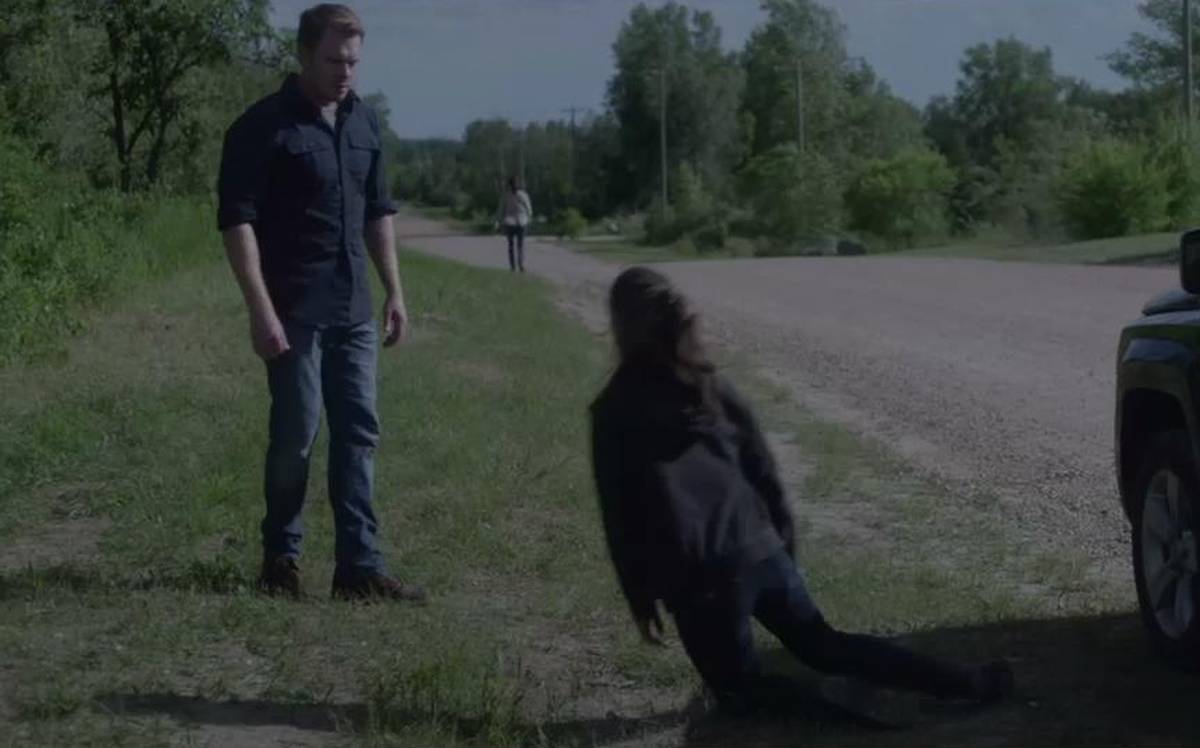
So here is what Radius actually is. A man wakes up from a car accident with no memory and immediately starts killing everything around him, not with a weapon, not with intent, just with proximity. A crow drops out of the sky. A dog goes stiff in a yard. The radius of death around him is roughly fifty feet, and he has no idea why, and neither does anyone else in the film for a good long while. That is the whole engine. A man who is a walking kill zone trying to figure out who he was before he became a weapon. And then a woman shows up who, for reasons the film takes its time earning, neutralizes him completely. Together they are inert. Apart, he is catastrophic.
That is a genuinely good idea. Small, contained, emotionally legible even when the logic gets complicated. The kind of idea that a writer has at two in the morning and writes down because they know it works before they know why.
Now pay attention to what that idea had to survive to reach you. Films at this budget tier, and Radius is a Canadian co-production that likely came in well under five million, live or die on whether the director gets to protect the central conceit through post. The note that kills movies like this always sounds reasonable: can we open it up a little, can we give the audience more to hold onto early, can we explain the mechanism sooner so people aren’t confused. Every one of those notes, if followed, would have gutted this film. The whole thing runs on the audience being as disoriented as Liam. You feel the rules being assembled in real time because you are assembling them in real time. A studio note that demands clarity in act one is a note that accidentally asks for a different, worse movie. The fact that Radius lands with its ambiguity intact tells you something about how Steeve Léonard and Caroline Labrèche held the line. Films like this don’t survive that process by accident.
The Mechanics of the Movie Radius
Liam’s death field is a sphere, roughly fifty feet in radius, and anything living that enters it dies. The film does not tell you this directly at first. You watch him walk and things fall. A crow. Some birds on a freeway overpass. A dog in someone’s front yard. He pieces it together before you do because he is the one who notices the pattern in real time, which is the correct dramatic move. The audience is always one beat behind Liam, and that creates a quiet, sustained dread that a more expository approach would have destroyed completely.
The rules as the film eventually establishes them: living things within the field die. The field is always on. Contact with Jane, our second amnesiac, suppresses the field entirely. When Jane is near him, he is harmless. When she leaves, even briefly, the field reactivates. This is the yin and yang dynamic the film is quietly constructing from the first scene where an animal is alive near him for the first time, because Jane is close enough.
Now, the questions the internal logic raises, because I watched this film with the kind of attention that ruins parties and I have notes.
The pigeons on the freeway underpass. Liam is below the overpass. He kills the birds roosting on the underpass structure. Fine. But why wasn’t he concerned about the people driving across the overpass above him? If his field extends fifty feet in every direction including upward, he should be flattening traffic above him. The film does not address this, and it is the kind of gap that the source-novel instinct in genre storytelling usually fills with a single line of dialogue. It didn’t here. You either decide the overpass structure itself creates some barrier the film never theorizes, or you give it a pass and move on. I chose to move on, but I made a note.
The rowboat scene. Beautiful scene, contemplative, Liam floating on a lake trying to remember who he is. And I want dead fish. I want them floating belly-up in his immediate radius like a crime scene on the water. The film doesn’t give them to us, probably for tonal reasons, because a lake full of floating fish turns the scene into dark comedy rather than melancholy. I understand the choice. I still want the fish. The fish are a honesty problem the film decided aesthetics outranked, and I think they were probably right, but it cost them a little internal credibility with anyone doing the math.
These are not fatal problems. They are the seams you find when you look closely at any film that built its rules fast and had limited time and resources to pressure-test every scenario. The remarkable thing is how few seams there are, not how many.
Radius Movie Walkthrough
Now, backstory. The film parcels it out through flashbacks, which is the correct structural call because you need to be as confused about who these people were as they are. What we learn: Liam was not a good man before the incident. The incident itself is a NASA-adjacent atmospheric event, some kind of energy discharge, the film keeps it deliberately vague in the way that smart low-budget science fiction always keeps the cosmic mechanism vague because the mechanism is never the point. The point is what the mechanism reveals about the people it hits.
What it reveals about Liam is this: he killed Jane’s sister. That’s the weight the whole second half is carrying. He is quite literally the man who destroyed her family, now bound to her by a curse that requires him to stay close enough to keep her alive. The film does not rush to this reveal. It lets you build genuine sympathy for Liam, watch him try to do right, watch him and Jane develop something real between them, and then it drops the information at the moment it will hurt the most. That is disciplined screenwriting from Léonard and Labrèche, the kind of structural patience that you genuinely cannot buy with a bigger budget, it either exists in the script or it doesn’t.
Sam, Jane’s husband, shows up and is almost aggressively underwritten. He functions as a plot mechanism more than a character, which is the one place where the seam between the film’s ambitions and its resources shows most clearly. You can feel that version of the story where Sam is a real complication, where the Liam-Jane dynamic has to contend with a man who actually matters. That film wasn’t made. The film that was made needed Sam to be thin enough that his death doesn’t register as tragedy, and it gets what it needs, but you notice.
The gas station gang reappearing in the climax is the film’s single most logistically baffling decision. This is the moment the original analysis called the most illogical leap in all of movie history, and that is hyperbolic but not entirely wrong. The film needed a catalyst for its ending and reached for a thread it had laid down earlier without quite making the mechanics of why that thread reactivates feel inevitable. It is a third act seam, and I would bet real money there was a cleaner version of this confrontation in an earlier draft that got simplified somewhere in production.
Radius Movie Explanation Theories
Theory Number One – A Mechanical Read
Radius, from this view, is a well-constructed sci-fi puzzle about two people bound by a supernatural condition, and the emotional content is in service of the puzzle. Liam is interesting because his power is interesting. Jane matters because she is the solution to the problem he represents. Under this read, the film succeeds as a tightly engineered genre exercise and doesn’t need to be more.
Theory Number Two – A Salvific View
Liam killed Jane’s sister. He is literally death to everything around him. Jane is literally the thing that neutralizes death. He cannot survive his own redemption because in movie grammar, and this is a real structural law of popular narrative, the man who sinned that severely and turns toward grace does not get to live in the new world he made possible. He clears the way and exits. The film knows this law and builds to it deliberately. Liam bringing Jane to the hospital and then removing himself from the equation is the only ending this story was ever going to have once you understood what he had done and what he had become to her. It is tidy to the point of being slightly schematic.
Theory Number Three – Pure Physics
The third read, which is the one that interests me most, is about what happens when two people are each other’s only viable option not by choice but by physics. The film is asking whether connection that is compelled by necessity can become connection that is chosen. Liam and Jane are not together because they want to be. They are together because the alternative is mass death. And yet something real develops between them in the space of that compulsion, something that looks, by the end, a lot like grief on Jane’s part and a lot like love on Liam’s. The film doesn’t sentimentalize this. It doesn’t let them have it. But it suggests it was real, and that suggestion is the most interesting thing the movie does.
Moviesoapbox’s Take on the Movie Radius
My read? The third one, with the second one providing the structural spine. The film is a salvific narrative wearing a sci-fi premise as a jacket, and underneath the jacket it is quietly asking whether the kind of damage Liam caused can ever be truly neutralized, or whether the best outcome is simply subtraction. He doesn’t heal anything. He removes himself. Jane gets to live without the field around her because Liam is no longer generating it. That’s not redemption in the full sense, it is the best approximation available given what he actually did. The film is honest enough to frame it that way rather than letting him walk into a sunset.
That honesty is what a bigger film would have bargained away. A studio version of Radius finds a way to keep Liam alive at the end because the lead actor has a three-picture deal and test audiences responded to him. The film we actually got lets the logic of what he did determine what happens to him, and that is a choice that required someone in that production to protect it through every conversation about accessibility and audience satisfaction and can we give them something to feel good about at the end.