
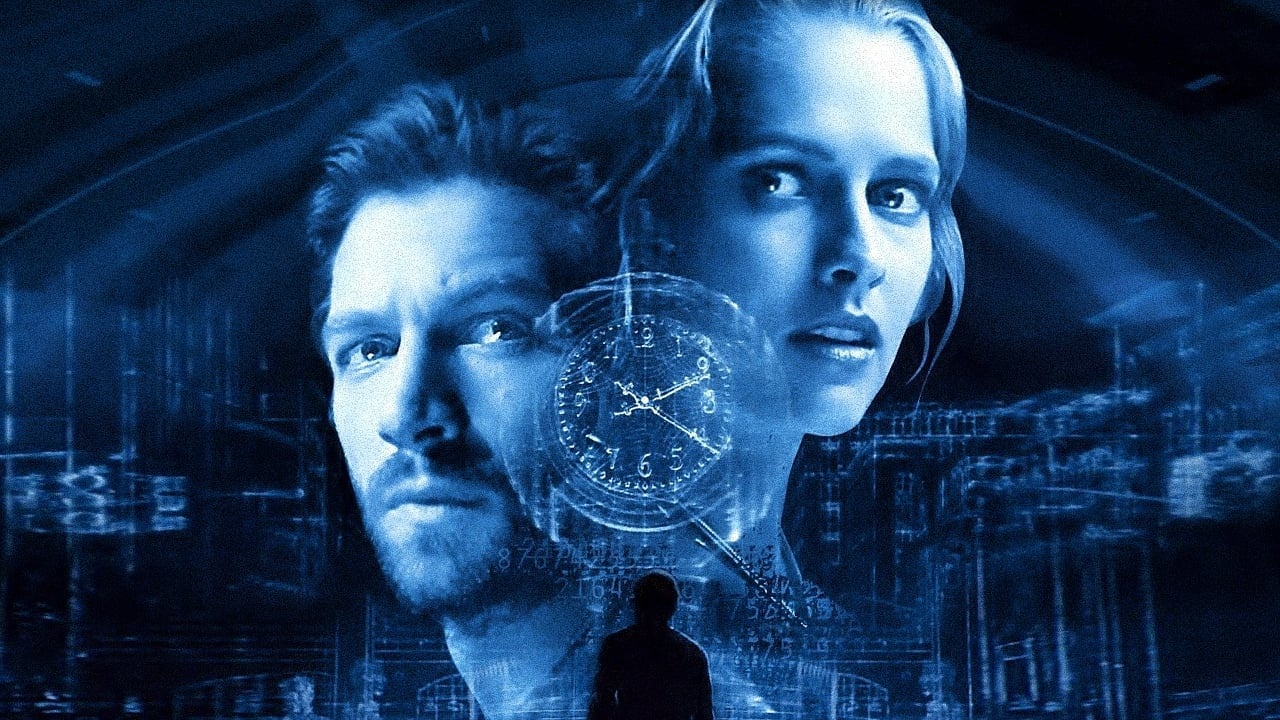
Hey there everyone! Welcome back to Movie Soapbox, the little corner of the internet that only you and I and that guy sleeping in the corner over there know about. This is the place where we find underappreciated indie films and we make sense of them. Today? We are doing a deep dive on 2:22, a movie so aggressively, almost admirably slick that it managed to construct a perfect trap and then forget to put anything inside it.
Before we get into the guts of this thing, here is the trailer. Watch it. Because the trailer, as it happens, is better at selling the movie than the movie is at being the movie.
Alright. Everything from this point forward is spoilers. Full walkthrough, full dissection, no exits. If you haven’t seen 2:22 yet and you want to stay clean, go watch it, come back, and we’ll be here. For everyone else, buckle in, because we’re going to figure out what this film was actually trying to do, and why it came so close and then just, didn’t.
Dylan is an air traffic controller in New York, played by Michiel Huisman, and if you’ve clocked him anywhere before it’s probably The Invitation, which is a genuinely good movie and no accident that he’s in both, because the man projects a specific flavor of controlled unraveling better than almost anyone working at his budget tier. His whole deal is pattern recognition, which is a hell of a skill to build a thriller around because pattern recognition is exactly what a good thriller does to an audience. The film is already setting up its own mirror. Dylan sees patterns in air traffic data that no one else catches in time, which is why he’s good at his job, until one day at Grand Central Station something scrambles him, and he nearly loses nine hundred people because he freezes instead of acts. Suspended. Unmoored. Starting to see patterns everywhere, not in the data but in the texture of his daily life.
And here is where I want to stop the walkthrough for a second, because there is something specific about how this film is constructed that you can only really see if you’ve watched a certain kind of project go sideways in post.
A film with this premise, a man who perceives temporal recurrence and must use that perception to break a decades-old murder loop, is a film that lives and dies on whether its third act mechanics have been stress-tested by one writer in one room, or committee-noted into a shape that feels logical on a beat sheet and falls apart the moment you apply thirty seconds of scrutiny. 2:22 has every marker of the second thing. The setup is meticulous. The visual language is meticulous. And then the resolution asks you to accept that Dylan’s master plan was to get shot while unarmed and trust that the police he’d been evading for the previous ten minutes would handle it. That is a third act that had notes applied to it. You can feel the original version underneath, the one where Dylan’s pattern knowledge actually functions as a weapon, and you can feel where someone decided that was too complicated and smoothed it down to this.
So Dylan meets Sarah, played by Teresa Palmer, who is one of those actors the industry persistently undersells, and they fall into the kind of relationship that exists in this film almost entirely as a structural necessity. She’s connected to Jonas, the artist, her ex, who is obsessed with Grand Central Station. Dylan is obsessed with Grand Central Station. The coincidences begin stacking up in Dylan’s loft, sketched on the windows, which is the movie’s single best image, this man papering his glass walls with the architecture of a pattern he can feel but can’t yet name.
Dylan finds letters. Two people, murdered in Grand Central Station, thirty years prior. Their story mirrors his. Man, woman, rival. Same geometry. Same location. And the inference the film is building toward is that this pattern recurs, that some loop of circumstance keeps pulling three people into that same collision at 2:22, and that unless the pattern is broken the same outcome will repeat. This is a genuinely good premise. A proper writer with a closed-room draft and nobody’s notes but their own could have made this devastating.
What actually happens is: Jonas buys a ticket, Dylan races across the city evading police in a sequence that the film treats as thrilling but which raises the question of why Dylan would make himself a fugitive thirty minutes before the moment he supposedly needs to navigate a crowded public space, and they all converge at Grand Central at 2:22. Jonas has a gun. Dylan does not. Jonas shoots Dylan. The cops who were chasing Dylan arrive and shoot Jonas. Dylan bleeds. The pattern is broken because nobody died in the same configuration the original trio did.
Now let’s untangle what the film seems to be going for, because it is going for something, even if it couldn’t quite land the plane.
2:22 Movie Logic Deep Dive
The loop logic, as best as it can be reconstructed, is this: the pattern isn’t just coincidental, it’s a kind of temporal scar. Something happened at that location at that time thirty years ago, and the residue of it keeps pulling similar configurations of people back into the same ending. The coincidences Dylan tracks, the dog barking, the jackhammer, the repeated micro-events, are the loop reasserting itself, the universe running the same program. Dylan’s gift for pattern recognition, the same gift that makes him good at his job, is what allows him to perceive the loop rather than simply live inside it.
The break condition is the interesting part, or would be if the film had committed to it. The original trio ended in a double murder, one man killing another man, woman watching. The loop perpetuates as long as that outcome repeats. Dylan’s solution, and here is the most generous read of the film’s ending, is to refuse to escalate. He doesn’t bring a gun. He doesn’t try to out-maneuver Jonas physically. He absorbs the violence and redirects the chain of consequences by ensuring that when Jonas fires, the only person who dies is Jonas himself, taken out by a third party, the police, who are not part of the original pattern geometry. The trio is broken. Nobody dies in the original configuration. Loop ends.
That reading holds water. It is actually a smart structural solution to the problem the film poses. The reason the ending feels like a failure is that the film never clearly establishes that Dylan has arrived at this solution consciously, rather than just getting lucky. There is a version of this scene where Dylan’s journey through the coincidences has been building toward this specific insight, where we watch him understand that non-escalation is the mechanism, and that version is earned. What we get instead is a man who just sort of shows up without a gun, which could be intention or could be he didn’t have time to get one, and the film never closes that gap.
The competing read is bleaker and in some ways more honest to the film’s visual logic: Dylan doesn’t break the loop through cleverness, he breaks it through sacrifice. He walks in knowing he is probably going to be the one who absorbs the violence this time, and he accepts that, because absorbing it himself is the only configuration that ends differently from the original. He is not outsmarting the loop. He is offering himself to it in a way that changes the outcome. This reading gives the ending more weight but requires the film to have been building toward Dylan’s willingness to die for Sarah in a way that its thin characterization work simply does not support.
A third read, which I think is the one the film half-intended and half-fumbled: Dylan uses his pattern knowledge tactically. He knows the cops will follow him. He deliberately makes himself a target, draws them into Grand Central, and engineers the situation so that when Jonas fires, the institutional violence of the police is already in the room and pointed the right direction. He is not the hero of the resolution. He is the catalyst. The film gestures at this possibility but never commits, which is the single most frustrating thing about it, because that version of the ending is actually clever, and the film had the architecture to support it.
Movie Mike’s Movie Soapbox Read
My read? The tactical one. Dylan spent half the movie watching patterns execute themselves without any intervention being possible, and the one thing his pattern-recognition brain figured out was that he couldn’t beat Jonas in the geometry the loop had already established. He needed to introduce a new variable. The cops were the variable. The no-gun was the tell, the deliberate removal of the element that made the original trio’s confrontation fatal, so that when Jonas fired, only Jonas would end up dead. It’s the only reading that makes Dylan’s gifts actually functional in the resolution rather than decorative, and it’s the only reading that makes the movie worth the build.
But the film didn’t earn it. It got close enough to feel the heat of a genuinely good thriller and then let the machinery run without an operator inside. What you’re left with is a movie that looks exactly like a film that worked, gorgeous loft, gorgeous station, two very beautiful people making very beautiful choices in very beautiful light, with a hollow space where the payoff was supposed to live. Some films fail because they had nothing. This one failed because it had almost everything, and almost, in the thriller genre, is the worst possible outcome. Almost means you can see the shape of what it should have been every time you look at what it is.
That’s the ones that stay with you. Not the bad ones. The almost ones.
Hey, thanks for hanging out at Movie Soapbox. We’ll be back with another one soon. You know where to find us, right here in this quiet little corner, turning the lights on in films that almost nobody else stopped to look at. See you next time.