
Hey there everyone! Welcome back to Movie Soapbox, the little corner of the internet that only you and I and that guy asleep in the back booth over there know about. This is where we find the films that got squeezed through the machine sideways, or snuck past it entirely, and we figure out what they actually are. Today we are doing a full deep dive on Columbus, a 2017 film so quiet and so precise and so completely unconcerned with giving you anything the algorithm wants that it feels almost like an act of defiance just sitting there on your screen.
One warning before we go any further, and I’m going to be direct with you: everything from this point forward assumes you have already watched Columbus. We are going into the whole film, every beat, every implication, the ending, the silences, the things the movie decides not to say out loud. If you haven’t watched it yet, close this tab, go find it, come back when you’re done. You will not regret it. Go. I’ll still be here.
Kogonada made his feature debut with this film. You want to know what a feature debut from a first-time director in the American indie space actually looks like in terms of creative control? It looks exactly like this, and that is genuinely rare. At the budget tier this film was almost certainly operating in, roughly the range where you’re shooting on location in a real small city because you cannot afford to build anything, the director typically gets final cut in name only. There is a financier somewhere, there are sales agents with opinions, and there is always, always, someone in a room suggesting that the film needs a stronger plot engine in the second act. You can watch Columbus and see a film where none of those people won. The pacing is Kogonada’s pacing. The silences are Kogonada’s silences. The choice to let a conversation end without resolution, to cut away from an emotional confrontation before it peaks, to frame two people separated by a chain-link fence and just leave them there, that is a director who retained the cut. The film that was lobbied for in those financing conversations, the one where Jin and Casey’s friendship resolves into something warmer and more legible for a general audience, that film does not exist. What exists instead is this one. That is worth noting before you watch a single frame of it.
Columbus Movie Deep Dive Walkthrough
The film opens on two threads running simultaneously. Eleanor, played by Parker Posey, is touring the architectural landmarks of Columbus, Indiana with the renowned Professor Jae Yong Lee, a scholar of modernist architecture, when Lee collapses. Across town, Casey, played by Haley Lu Richardson, is at the library with Gabriel, played by Rory Culkin, and they are reading the marginalia someone has left in a book. The marginal notes argue that the so-called crisis of attention in young people is a misdiagnosis. Adults say kids can’t focus, but those same kids will sit with a video game for six hours. The real crisis, the marginal writer argues, is a crisis of interest. We lose focus on the things that don’t engage us, not on the things that do.
Kogonada opens his film with a meditation on whether you will find it interesting. He is not doing this to flatter you. He is doing it as a quiet challenge, a warning that this film will ask you to be interested in things that do not announce themselves loudly, and that if you can manage that, it will reward you completely. That is an enormous risk. Most films do not open by questioning whether their audience can be bothered to pay attention. Kogonada does it in the first ten minutes, through someone else’s handwriting in the margin of a book, and then he just moves on.
Jin, Professor Lee’s son, arrives in Columbus after his father falls into a coma. He and his father have been estranged, the estrangement the film traces back to Lee’s total absorption in his work and his scholarship, the classic cost-of-brilliance-paid-by-the-people-around-you story that academia runs on. Jin is not grieving. He is stranded. There is a difference, and the film knows it, and it does not judge him for it. He has translation deadlines. He has a life in Seoul. He did not choose to be here, and he is watching his obligation to a man he loves and resents in equal measure hold him in place against his will while the days stack up.
Casey is stranded in the opposite direction. She graduated. She is smart enough that her coworkers know she is smart enough, her employer knows it, and everyone around her is waiting for her to leave for college. She is not leaving. Her mother, Maria, has a history that includes meth and a more chronic addiction to men who accelerate her worst impulses. Casey has appointed herself the stabilizing force in her mother’s life. She is roughly twenty years old and she is parenting her parent, which is one of the more quietly devastating things a family situation can produce in a person, because it generates a kind of competence and emotional intelligence that sits right next to a complete inability to prioritize yourself. Casey knows how to read people. She cannot, yet, read herself.
What Is Happening in the Movie Columbus
What Kogonada is building between these two characters is a study in mirror-image damage. Jin ran from his family and the distance hollowed him out. Casey stayed for hers and the staying hollowed her out. They are, as the film makes plain across a series of long walking conversations through the modernist landmarks of Columbus, two people who arrived at the same psychic wound from opposite directions. Both of them want something from a parent that the parent is constitutionally incapable of giving. Jin wanted a father who showed up. Casey wants a mother who stays clean and stays present. Neither of them is going to get what they want, and somewhere in the middle of the film they both understand that the other person understands this without having to have it explained.
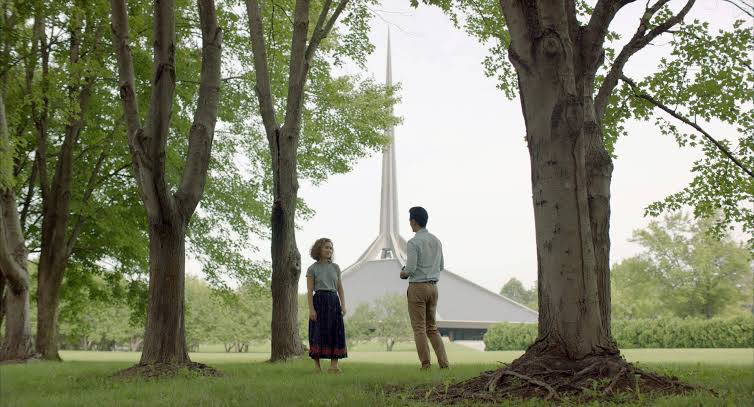
That is what the conversations are doing. The architecture is not incidental to this. Kogonada frames these two people against buildings that represent the modernist ideal: pure function, perfect geometry, no ornamentation, the belief that form and purpose can be made to match exactly. Columbus, Indiana holds more than sixty significant public buildings designed by I.M. Pei, Eero Saarinen, Cesar Pelli, and a roster of other architects who reshaped the twentieth century, all of them sitting inside a small Midwestern city of forty thousand people that otherwise looks like every other small Midwestern city of forty thousand people. The buildings are a false signal. They promise coherence. The lives happening in front of them are falling apart. Kogonada knows exactly what he is doing with that contrast and he never makes you feel like he is explaining it to you.
The Casting Decisions of Columbus
Eleanor, played by Parker Posey, is the film’s most interesting open question. She was with Professor Lee when he collapsed. She is clearly significant to him, a student, a mentored scholar, someone close enough to be his companion on a research visit. Jin admitted his love for her years ago, probably while she was still his father’s student, and she turned him away then. She turns him away now. The film does not explain why. What it does give you is Eleanor telling Jin, with some authority, that he needs to be there for his father. She says it like someone who knows what his father means and what Jin’s absence costs. Whether her closeness to the professor has ever been more than professional is something the film leaves in the air deliberately, and the ambiguity is the point. Jin is not just grieving a father. He is navigating a man whose life was so thoroughly his work that the people in it are hard to categorize.
Casey’s mother is running the same pattern in miniature. More and more across the second act, Maria stops answering Casey’s calls. Her coworker covers for her. One scene makes it plain that Maria is simply not at work when she is supposed to be. Casey knows what this means. We know what this means. The film doesn’t announce it. A man is involved. The fragile structure Casey has spent years maintaining is probably already compromised, and the question the film is quietly asking is whether Casey is going to keep paying the toll for her mother’s choices or finally let herself be the one who leaves.
Jin is the one who says it to her plainly. He sees what she is. He sees the potential she is banking on behalf of someone else. He doesn’t see an architect in her specifically, but he sees someone who should be doing something large with her life, and he petitions Eleanor on her behalf even after Eleanor has closed the door on him personally. Whether Eleanor connects Casey with Debra Berke, the architect who designed the bank building that Casey returns to again and again as a kind of emotional anchor, the film doesn’t confirm. What it confirms is that by the end, Casey is leaving. She gets on a bus. Jin drives out of Columbus. They separate, and the separation is not a loss, it is both of them finally moving instead of standing still.
The Movie Columbus Explained – The Theories
Columbus Theory Number 1 –
The first read is the straightforward one: this is a film about two people who unstick each other. Jin and Casey meet at the exact moment when each of them needs someone to reflect their situation back to them without flinching, and the friendship does that work, and then they both go. The architecture is thematic furniture, beautiful and precisely chosen, but the film is finally about human connection doing what human connection does when it is genuine.
Columbus Theory Number 2 –
The second read puts more weight on the architecture as a structural argument. Columbus, Indiana is a city that solved an aesthetic problem completely, these extraordinary buildings dropped into an ordinary place, and the film is suggesting that the human need for beauty and order is real and legitimate but the things we build to satisfy it cannot hold against actual life. Jin’s father built a monument of scholarship and left his son alone. Casey’s mother wants stability and keeps choosing chaos. The buildings stand. The lives tilt. The film is a long meditation on the gap between what we design and what we live.
Columbus Theory Number 3 –
The third read is the one that interests me most, and it comes through the marginalia scene at the beginning. Kogonada is making a film about people who are paying attention to the wrong things because no one has shown them how to be interested in the right things. Casey has been interested in her mother’s survival for so long that she has forgotten to be interested in her own life. Jin has been so comprehensively uninterested in his father that he has also become uninterested in himself. The film’s argument is that interest, genuine curiosity about another person’s inner life, is the mechanism by which people recover themselves. Casey and Jin are interesting to each other in a way that no one else in either of their lives has managed. That is what heals them. The crisis was never attention. It was always interest.
Moviesoapbox Take on Columbus –
My read is the third one. I think the marginalia scene is not a warm-up, it is the thesis, and everything that follows is Kogonada demonstrating it. Casey and Jin are the most attentive people in each other’s lives because they are genuinely, specifically, curiously interested in each other, not in what the other person represents or needs or can provide, but in what the other person actually thinks. That kind of attention is rare enough that when two people stumble into it they tend to anchor to it. The film earns its ending because it trusts that you understand why leaving is the right outcome for both of them. Being seen clearly by someone is not a reason to stay. Sometimes it is exactly the thing that gives you the courage to go.
A film like this does not happen often, and when it does, it usually does not survive the process intact. The version of Columbus that a more aggressive development process would have produced would have a third act that clarifies the Jin-Eleanor history, probably a more explicit resolution for Casey’s mother, almost certainly a scene that tells you what Casey decides rather than letting you watch her get on a bus. Kogonada held the line on all of it. The film you can watch is the film he made, and in 2017, in the American indie landscape, that is not nothing. That is, in fact, almost everything.
Watch Columbus. Then watch it again and pay attention to where Kogonada cuts.