
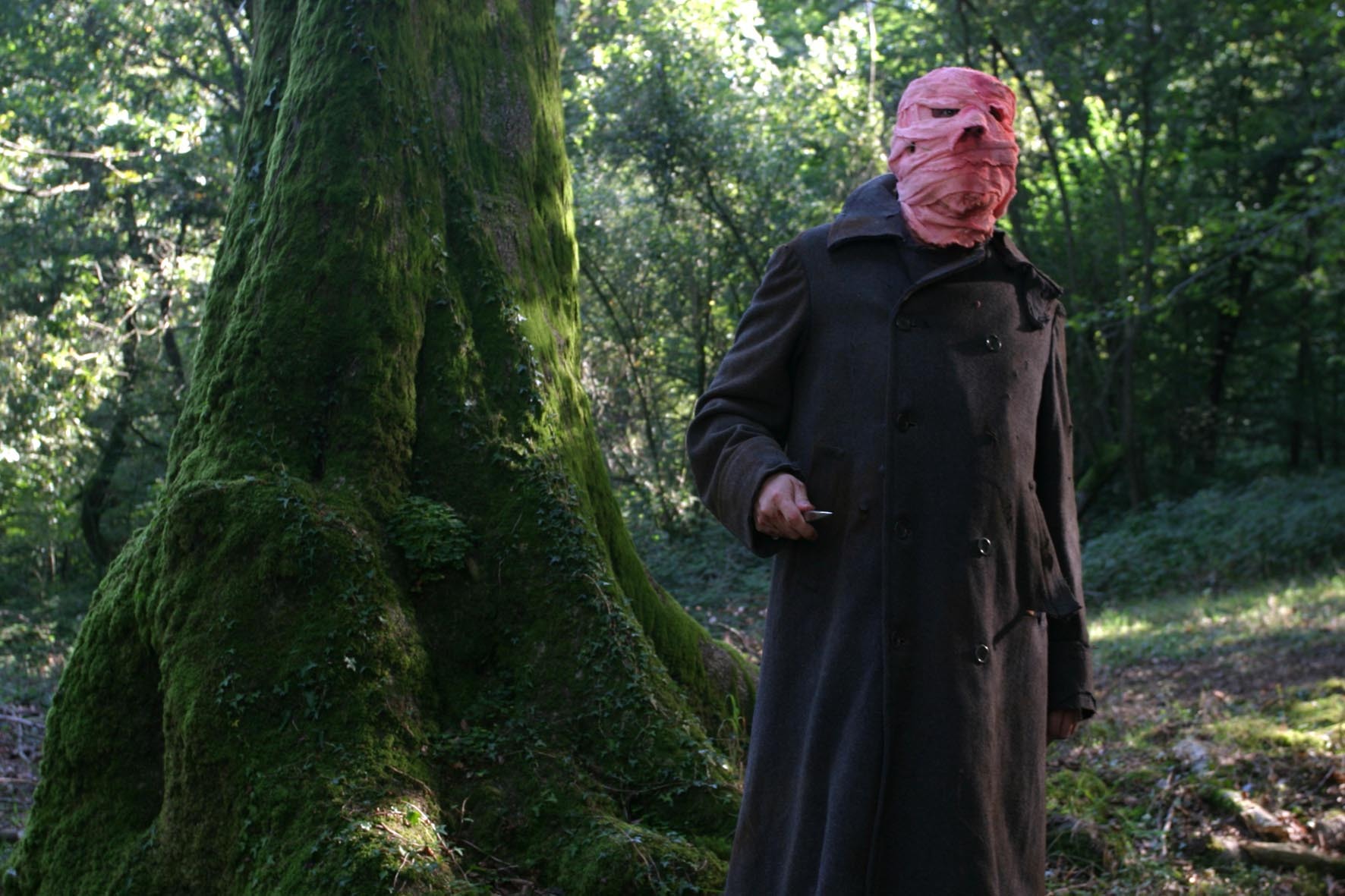
Hey there everyone! Welcome back to Movie Soapbox, the little corner of the internet that only you and I and that guy sleeping in the corner over there know about. This is the place where we find underappreciated indie films and we make sense of them. Today? We are doing a deep dive on Timecrimes, a Spanish time travel film so quietly, mechanically perfect that Dreamworks bought the rights to it, sat on them, bought them again when they expired, and still hasn’t managed to ruin it yet. Give them time. They always find a way.
Alright, before we go any further, you should know this entire post is a spoiler. Wall to wall. Timecrimes is a film that works precisely because you don’t know what’s coming the first time through, and I’m going to dismantle every single piece of it for you right now, so if you haven’t watched it, close this tab, find the film, come back in eighty-eight minutes. I’ll be here. The loop will still be running.
Nacho Vigalondo wrote and directed Timecrimes in 2007 for somewhere in the neighborhood of two million euros, with a cast of four people, two of whom are barely in it, and one of them is him. The film he made for that money is tighter, more formally rigorous, and more genuinely unsettling than anything a studio time travel project has produced in the decade since, and you need to understand that context before we go scene by scene, because films like this don’t just happen. They survive. A Spanish-language genre picture with no stars and a premise that requires the audience to hold three simultaneous versions of the same man in their heads doesn’t get made without someone being bloody-minded about it. The budget tier Vigalondo was working in is the tier where the director is also doing craft services and the script is whatever that guy can defend in a room alone. There are no twelve VPs here to sand the edges off. There’s no test-screening panel to tell Nacho that Hector 2 needs a redemption beat in act two. The locked-loop structure you’re about to read about exists because nobody had the leverage to demand he open it up. That’s what this film cost to be what it is. Remember that.
Timecrimes Movie Walkthrough in Detail
So. Timecrimes. Here is what actually happens, in the order the movie shows it to you, and then in the order it actually occurred, because those are two different things and the gap between them is the whole movie.
Hector, a middle-aged man remodeling a house with his wife, sees a woman in the woods through his binoculars. He goes to investigate. He finds her apparently unconscious at a rock. Before he can process what he’s looking at, a bandaged figure stabs him in the arm. Hector runs. He finds a scientific facility, meets a young technician, and when the bandaged man pursues them both, the technician suggests Hector hide inside a large machine nearby. Hector climbs in. The machine turns out to be a time machine. It sends him approximately one hour into the past. This is where the film stops being a thriller and becomes something closer to a formal proof.
Now there are two Hectors. The one who just emerged from the machine, disoriented, is Hector 2. The one still back at the house with his binoculars, about to walk into the woods, is Hector 1. Hector 2 has a wound on his arm. He has the technician’s car. He is trying to figure out what just happened to him. And the mechanism of the film, the thing Vigalondo built with that diagram he drew while writing the script, is already running whether Hector 2 understands it or not.
Hector 2’s arc, compressed: he drives out in the technician’s car, gets run off the road by a truck, wraps his head in bandages to stop the bleeding, and becomes the bandaged man. He finds the young woman. They fall down a hill together and she’s knocked unconscious. He enters his own house. He sees a woman fall from the roof and believes, devastated, that he has just killed his own wife. He contacts the technician in a panic and tells him to lure Hector 1 into the time machine. He plays the bandaged pursuer who drives Hector 1 into exactly the situation Hector 1 was already going to be in. He did not change anything. He performed everything.

Then the film does it again. Because Hector 2, after learning from the technician that there’s already a Hector 3 out there somewhere, decides he needs to go back one more time, forty seconds before Hector 2 emerged, to fix what he now thinks is his wife’s death. Hector 3 emerges. He has a golf cart. He gets a truck. He runs Hector 2 off the road, which is the moment that made Hector 2 into the bandaged man, which is the moment the whole loop required. He finds the young woman. He brings her into his house and disguises her as his wife to satisfy the police who’ve been called. His actual wife is fine. She was never in danger. The woman on the roof was the disguised girl, staged by Hector 3 to make Hector 2 believe the crisis was real and keep him moving toward the machine on schedule.
The loop closes. Everyone is where they were always going to be.
Timecrimes Movie Mechanics Explained
Now, the mechanical questions that trip people up on first watch, addressed directly.
How far back can the machine send you? Only as far back as the machine was first switched on. This is the same constraint Primer uses, and it’s the right constraint for a locked-loop story because it puts a hard wall on the chaos. You can’t go back far enough to stop any of this from starting. The machine’s operating window is the prison.
The young woman: did she die? No. She’s knocked unconscious when she and Hector 2 fall down the hill. The woman who falls from the roof of Hector’s house is also her, placed there and costumed by Hector 3, who is managing the situation he already knows the outcome of. She survives. She has been used, terrified, and instrumentalized by three versions of the same man across a single afternoon, none of whom meant her harm and all of whom caused it. That detail is not an accident in Vigalondo’s script. He is asking you to notice it.
Is any of this changeable? Vigalondo, when asked directly, said the question was more interesting than any answer he could give. Which is a writer’s answer, and a correct one, and also a dodge. What the film shows you is that every attempt to change things, Hector 2 trying to intervene, Hector 3 warning Hector 2 not to travel, produced exactly the events that needed to happen. Vigalondo’s stated favorite time travel film is 12 Monkeys, Terry Gilliam’s film, a film built entirely around the unchangeability of what’s already happened. His literary influences are Dick, Heinlein, Bester, all writers who understood fate as a structural condition, not a feeling. Take that for what it is.
Theories to Explain Timecrimes Movie in Detail
There are two theories worth laying out here for how you can read the film’s metaphysics.
Theory one: hard determinism, full stop. The loop is closed before the film begins. Hector was always going to enter the machine. Hector 2 was always going to become the bandaged man. Hector 3 was always going to run Hector 2 off the road. Every choice every Hector makes is the choice that was already made. The film is not showing you a man trapped by circumstance. It’s showing you a man discovering the shape of his own inevitability one hour at a time.
Theory two: soft determinism with a closed system. Hector theoretically could have chosen differently at several points, but every choice he made was the choice that preserved the loop, because the loop is the path of least resistance when you’re panicking and under-informed. He wasn’t fated. He was predictable. Same outcome, bleaker diagnosis.
Moviesoapbox’s Preferred Read on Timecrimes Movie
Movie Mike’s read is theory one, and here’s why it matters which one you pick. If it’s theory two, the film is a character study about a man who makes every wrong call under pressure and pays for it. That’s a good film. If it’s theory one, the film is something stranger, a film about a man who is both the agent and the object of everything that happens to him, who stabs himself with his own hand while fleeing himself, who constructs the trap he was already inside. Vigalondo drew a diagram to write the script. He put that diagram inside the film. He is telling you the diagram came first, and the man came after. That’s theory one.
Dreamworks has been cycling the rights on this film for years. There is reportedly a Steve Zaillian script sitting somewhere in a development drawer, and Zaillian is a serious writer, and it would almost certainly be a competent film, and it would almost certainly be missing the thing that makes this one matter, which is the sensation of watching a locked system run to completion with no one powerful enough to stop it. A studio version would find Hector a way out. It would have to. You cannot sell a wide release on a hero who discovers he was the mechanism all along. So the version of this film that survives without being rebuilt from the foundation is the one you already have, the one that cost almost nothing to make and that nobody important enough to damage it had any reason to touch.
That’s Timecrimes. Go watch it again, now that you know what you’re looking at. The loop was always going to run. It’s still running.