
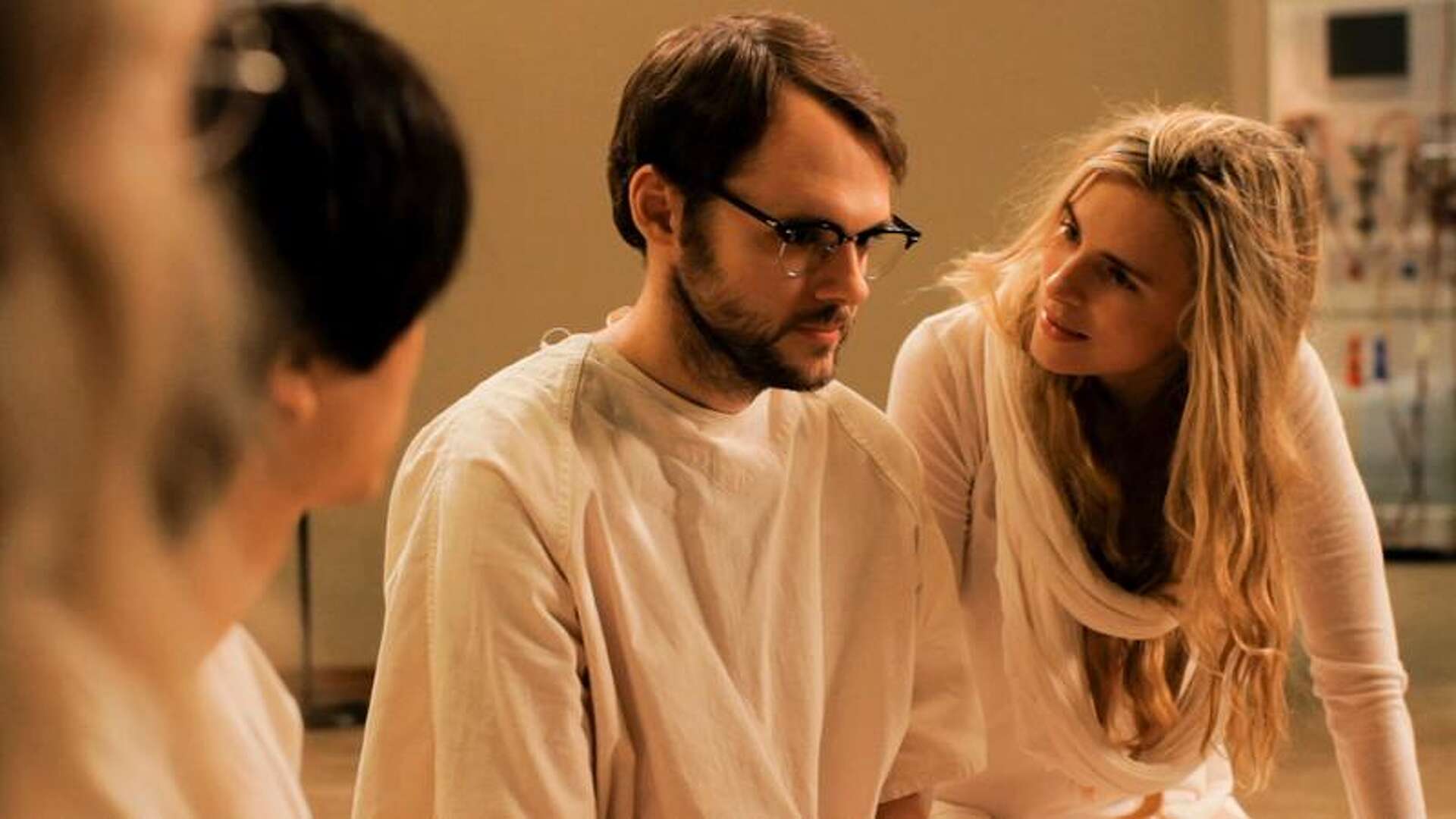
Hey there everyone! Welcome back to Movie Soapbox, the little corner of the internet that only you and I and that guy sleeping in the corner over there know about. This is the place where we find underappreciated indie films and we make sense of them. Today? We are doing a deep dive on Sound of My Voice, a movie so precisely, mercilessly balanced between two completely incompatible realities that watching it feels less like cinema and more like someone carefully placing a knife on its edge and daring you to breathe.
Alright. Before we go any further, you should know this post goes all the way in. Every scene. The ending. The handshake. The girl in the red hat. All of it. If you have not seen this film, close this tab, go find it, watch it in the dark with no distractions, and come back. I am serious about that. The movie earns its surprises and you will be annoyed at yourself if you let me ruin them. Everyone else, you are cleared. Let’s get into it.
What This Movie Had to Survive
Before the walkthrough, you need a piece of context the trailer won’t give you. Brit Marling and Zal Batmanglij wrote this script while they were simultaneously developing what would eventually become The OA, which tells you something important about the creative atmosphere this thing came out of, which was basically two writers sitting in a room together refusing to blink on any of their weirder instincts. The budget on a film like this, at this cast tier, in this distribution window, typically means the director retained a level of creative control that a larger production would have systematically dismantled by round three of studio notes. You can feel that in the film’s refusal to resolve. A more expensive version of Sound of My Voice, one with a real greenlight apparatus behind it, probably ends with a scene that tells you definitively whether Maggie is a fraud. That scene would have come from a VP who screened a test cut and wrote one note: audiences need closure. The film you actually got did not get that note, or it survived it, and that stubbornness is the whole ballgame. The ambiguity isn’t a stylistic flourish. It is the only honest answer to the question the movie is asking, and somebody had to be willing to defend it all the way through post.
The Walkthrough
The film drops you in at the fifth gear, no ramp-up, no orientation. Peter and Lorna are already in the middle of the initiation process, already blindfolded, already being shuttled through the procedural humiliations of joining a cult, the memorization, the cleansing rituals, the homework. The movie trusts you to catch up. When they finally meet Maggie, the big claim lands without ceremony: she is from the future. 2054. She woke up face down in a bathtub with no memory of how she got there, was taken in by people who eventually helped her piece together who she was, and now she is here, building a community of people she is preparing for a coming catastrophe.
Peter and Lorna are not true believers. They are documentary filmmakers who have infiltrated the cult specifically to expose it, recording whatever they can get on camera. But the film is smart enough to know that the most interesting thing about two people trying to debunk something is what happens when one of them starts to wobble. Peter wobbles. Lorna mostly doesn’t, but Peter wobbles hard.
Both of them carry their own damage into this situation, and Maggie, fraud or not, is perceptive enough to use it. Peter lost his mother at thirteen, was raised by grandparents, and there are strong implications of abuse he has never resolved. Lorna comes from wealth and disconnection, first hangover at thirteen, first intervention at sixteen. These are not incidental backstory details. They are the key. Maggie’s power, whatever its source, runs on exactly this kind of unprocessed wound, and the film is patient enough to let that dynamic develop before it starts pulling the rug.
The scene everyone remembers is the song. A cult member challenges Maggie to sing something from the future. She sings Dreams by the Cranberries. The member points out that is a song from the 1990s, he knows it. Maggie says she doesn’t know what the 1990s are, that she learned the song from a band called Benetton. The member gets expelled. His wife chooses to stay. In forty-five seconds, Batmanglij and Marling demonstrate exactly how the machine works, the social cost of skepticism inside a closed group, and they do it with a Cranberries song, which is either brilliant or deranged, probably both.

Then the other thread arrives. One of the children in Peter’s class keeps surfacing in the story, a girl named Abigail Pritchett. Maggie wants Peter to bring Abigail to her. Peter agrees to this. Lorna does not agree with Peter agreeing to this, and throws him out. Meanwhile the Justice Department, which has been investigating Maggie separately, pulls Lorna in as an inside source, and the plan becomes: bring Abigail, use that meeting as the moment to pull Maggie out into the open where the feds can take her.
The meeting happens. Maggie holds Abigail’s hand. Then the two of them begin performing the elaborate cult handshake, the one the group uses as their shared ritual greeting, the one that Peter and Lorna spent weeks learning to perform correctly. Abigail knows it. Knows every step. Nobody taught her. The feds swoop in and take Maggie away. Peter stands there having just watched a ten-year-old girl do a handshake that should not exist yet.
Untangling the Mechanics of The Sound of My Voice
The film is deliberately constructed to make both explanations load-bearing, so let’s lay out what each theory actually requires you to accept.
The fraud case: Maggie is a skilled manipulator, probably intelligent enough to research the family histories of her initiates, almost certainly capable of feeding information to people outside the circle who then feed it back in. The handshake is the hard problem here. To make the fraud case work, you have to believe Maggie had prior contact with Abigail, taught her the handshake outside of anything we see in the film, and engineered that meeting as a final psychological kill shot aimed specifically at Peter. That is a lot of moving parts for a woman who, at the moment the feds arrive, is getting arrested and does not appear to be in control of that outcome.
The time traveler case: Maggie came back from 2054, landed in 2012 with partial amnesia and severe physical trauma from the transit, which is why she requires the blood donations and the carefully controlled food. Abigail Pritchett is her mother, which means the handshake wasn’t taught, it was transmitted backward through time the way all family gestures are, a child learned it from her mother before her mother was born. That is the kind of sentence that sounds like gibberish until you watch the scene, and then it feels like the only sentence that fits.
Batmanglij described the film as designed like a calculus proof. Marling said every element was crafted to support multiple interpretations simultaneously. They were not being modest. This thing is engineered.
The Sound of My Voice Two Theories
Theory Number 1 –
Maggie is a charlatan running a sophisticated psychological operation on vulnerable people. Detective Carol Briggs at the Justice Department represents this read most clearly. Briggs sees a dangerous woman weaponizing broken people for purposes that have nothing to do with time travel. Every piece of apparent evidence for Maggie’s legitimacy has a rational explanation if you are willing to credit Maggie with enough intelligence and preparation. The handshake is the only moment where the fraud theory strains, but it does not break, if you are willing to work for it.
Theory Number 2 –
Maggie is exactly what she says she is. The amnesia, the physical weakness, the blood requirements, the food restrictions, the partial and then gradually returning memory, all of it is consistent with the physiological aftermath of time travel as the film describes it. Abigail knowing the handshake is not a trick. It is confirmation. The film’s final image, Maggie being taken away, is not an exposure. It is a complication in a story that was never going to have a clean ending.
Moviesoapbox’s Take on the Movie Sound of My Voice
Peter believes her. That is my read, stated flat. Not because the evidence is airtight on the time travel side, it isn’t, but because the film is Peter’s story and the film ends on his face after he watches that handshake, and his face is not the face of a man who has just confirmed his documentary thesis. His face is the face of a man whose entire frame for the last several months has just cracked down the middle.
You were not in that room when Maggie read him accurately enough to know things she had no documented route to knowing. You were not the one who watched a child perform a secret ritual greeting with a woman she had never met. Peter was. And the film earns that gap between your vantage point and his. Maggie’s last line to him is not a taunt or a manipulation, it is a release: it’s not my choice, it’s yours. A con artist doesn’t say that to the mark when the feds are already moving in. A person who knows she cannot control what you believe says that.
Peter believes her. And the film is wise enough to know that Peter believing her is not the same as the film confirming she’s real. Those are two different statements, and Sound of My Voice is one of the few films that actually understands the difference.
The Close
Zal Batmanglij and Brit Marling made this film for nothing, with people who trusted them, and they refused every instinct that would have made it easier to market and harder to dismiss. Factory Hollywood would have given you the answer. Factory Hollywood would have tested three endings and picked the one that scored highest with the 25-to-34 demo in Burbank. What you got instead is a movie that respects you enough to leave you exactly where Peter is standing at the end, knowing what you saw, uncertain what it means, unable to quite let go of it.
That’s what we do here at Movie Soapbox. We find the ones that survived, or the ones that didn’t quite, and we figure out what they were actually trying to say. We’ll see you next time.