
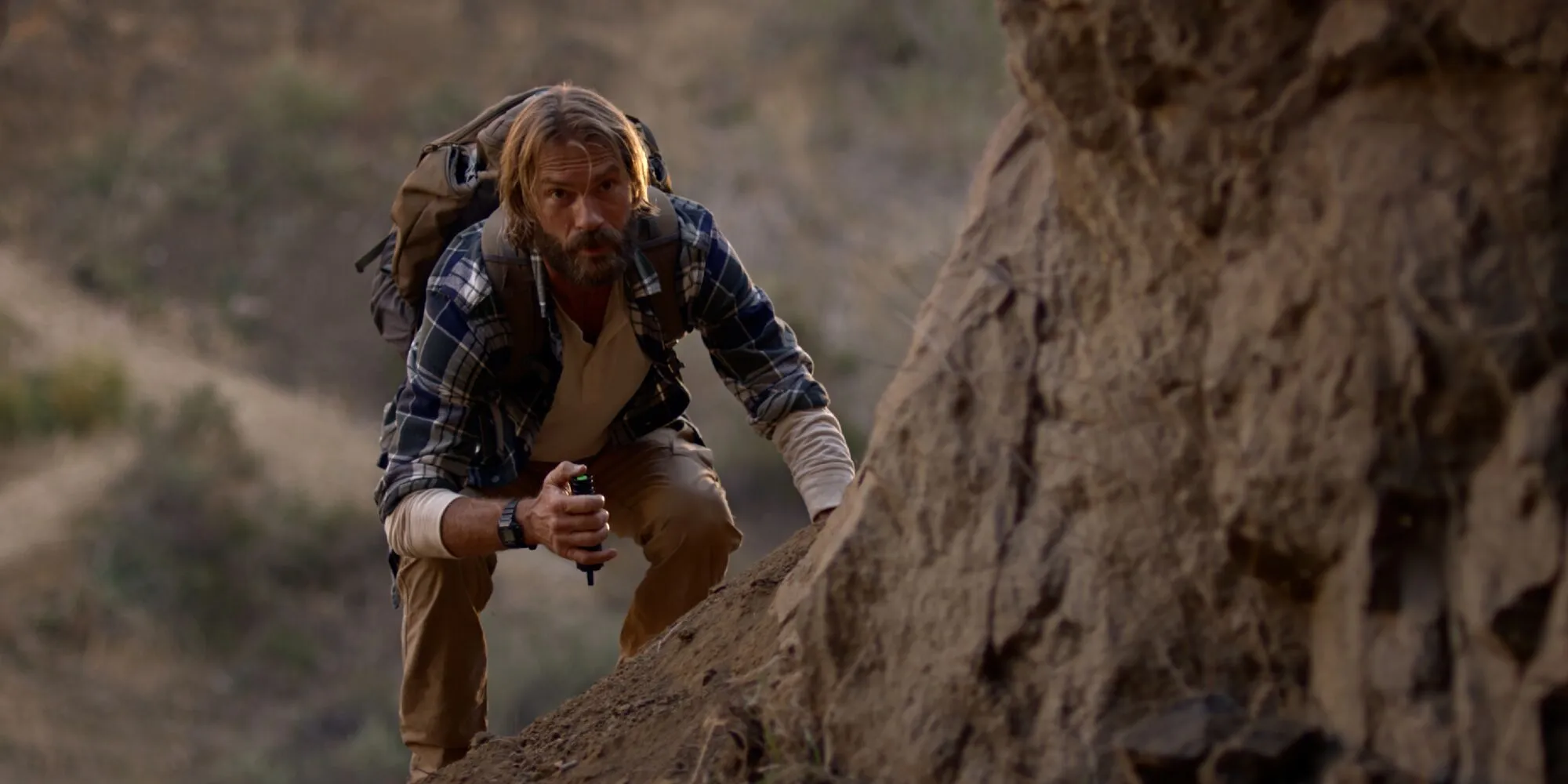
Hey there everyone! Welcome back to Movie Soapbox, the little corner of the internet that only you and I and that guy sleeping in the corner over there know about. This is the place where we find underappreciated indie films and we make sense of them. Today we are doing a deep dive on Time Trap, a movie so quietly deranged in its ambitions that it somehow convinced a skeleton crew with a shoestring budget to point a camera at some cave walls and ask you to care about the heat death of human civilization. And here is the thing: for about forty minutes of its runtime, it almost works.
Before we get into it, here is the trailer.
Alright. If you have not seen this film, stop here, go watch it, and come back. What follows is the full breakdown, scene by scene, beat by beat, and I am going to tell you exactly what happened, what it meant, and what the screenplay somehow forgot to address entirely. You have been warned.
Now, before we walk through the cave with these people, I need you to understand something about what a film like Time Trap actually is, at the industry level, because it changes how you read every creative decision in it. This is a micro-budget genre picture with a premise that a mid-tier studio would have spent four years and forty million dollars turning into something aggressively mediocre, a PG-13 adventure with a recognizable face in the lead and a third act that test-screened its way into a feel-good resolution where someone gets home in time for dinner. The fact that Time Trap ends on a spaceship circling a dead planet, with its characters essentially orphaned from the entire human timeline, tells you the notes process either never got that far, or the directors Ben Foster and Mark Dennis just didn’t answer those particular emails. Films at this budget level sometimes get that gift. The suits aren’t paying close enough attention to ruin them.
Time Trap Movie Detailed Walkthrough
So. Hopper, played by Andrew Wilson, is a professor-type, the kind of character indie sci-fi loves because he can deliver exposition without a scene partner and the audience accepts it as intellect rather than budget. He goes hunting for his missing family in some Texas hill country caves, finds an apparently frozen cowboy deep inside, pushes further in, and vanishes. His students, because apparently this man’s students care about him more than most people’s families do, mount a rescue. They find the caves. A young member of their group named Furby dies, and when they play back the GoPro footage on his body, they watch days compress into the few hours they have actually been underground. The cave is not running on the same clock as the surface. The sun outside is pulsing like a strobe light. What looks like a day-night cycle starts revealing itself, as they climb higher, as something much larger. Seasons. Then possibly millennia.
The Time Mechanics of Time Trap
Here is what the film is actually doing with its time mechanics, because the movie gestures at this elegantly and then trusts you to fill in the math yourself. Think of it as a transmission with gears, the surface of the earth running at full speed, and each layer of the cave representing a downshift. The deeper you go, the slower time moves relative to the surface. A membrane, visualized as a shimmering liquid boundary, acts as the clutch between each layer, keeping the different temporal speeds from colliding violently. What registers as an afternoon underground corresponds to years, then decades, then centuries on the surface. Hopper, who crossed that boundary first and went deepest, has been inside for what feels to him like a short period, while the world above has aged past recognition. The cowboy they found frozen early in the film has been trapped in the deepest layer, where time barely moves at all, for what the surface world would measure as over a hundred years. The frozen tableau of figures they find deeper in, that cosmic scrum of cavemen and cowboys locked in apparent combat, is a group of people from across centuries who all stumbled into this cave and downshifted so far that they are effectively paused. The fountain-of-youth water the film references isn’t granting immortality. It is healing wounds fast enough to keep bodies functional inside a time envelope so slow that death has trouble completing its paperwork.
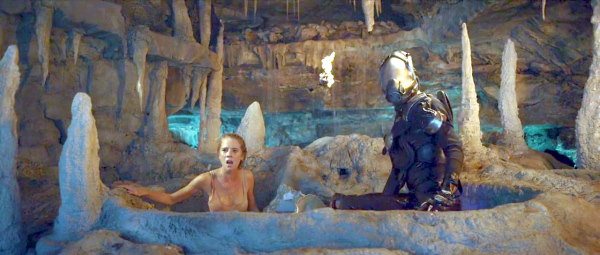
Eventually someone climbs high enough to breach the surface and finds the planet’s atmosphere in ruins, storms, dust, an extinction-event sky. And up there, orbiting, a spaceship. The group gets extracted. They wake up in orbit around a dead version of Earth, ready, we are meant to understand, to begin something new.
Now let’s talk about what the film believes its ending means, and then let’s talk about what it actually means if you think about it for thirty seconds.
The Movie Time Trap Explained in Detail
The movie presents the spaceship rescue as a resolution. Our people are alive, they are together, there is a future. Roll credits. But what you are actually watching is a group of college students and one professor absorbing the information that everyone they have ever loved is dead, that the entire civilization they were born into has collapsed, that the planet is uninhabitable, and they are responding to this with the emotional register of people who missed a connecting flight. The screenplay doesn’t give a single character a moment of genuine grief for the loss of the entire human world. No one mourns. No one sits with the fact that they are, in every meaningful sense, the last people, marooned in a future they have no context for, extracted by beings whose agenda they do not understand. The script treats escape from the cave as the victory condition, without ever asking escape to what.
And the cowboy problem deserves its own moment. You stumble into a cave with a pool of water that heals mortal wounds, and time outside is moving so fast that you are, for practical purposes, immortal. Sounds appealing until you realize your food supply ran out a week in and the healing water does not appear to address caloric intake. You are spending eternity in a cave, starving to death and healing, starving to death and healing, in an endless loop. That is not a fountain of youth. That is a specific kind of hell that the movie introduces as backstory color and then absolutely refuses to reckon with.
So what is the film actually arguing? Two readings have settled in around this one, and they are not as far apart as their proponents tend to think.
Time Trap Movie Theory Number 1
The first reading is optimistic and takes the spaceship at face value. The future is not dead, it has just changed ownership. Whatever civilization built and sent that ship has not only survived but advanced to the point of monitoring temporal anomalies on a planetary scale. Our characters are not abandoned, they are recruited. The film is a quiet argument that human continuity persists even past catastrophe, that someone always makes it.
Time Trap Movie Theory Number 2
The second reading is considerably darker and I think the more honest one given the evidence on screen. The spaceship is not there because it was looking for our characters. It is there because a dead planet with a major temporal anomaly in its cave system is worth cataloguing. These seven students and one professor are an archaeological curiosity, not a rescue. They have been extracted the way you would extract a sample. What awaits them aboard that ship is not a new life, it is observation. They are the cowboy now, just with better lighting and a view of the stars.
Moviesoapbox’s Reading of the Movie Time Trap
My read is the second one, and I will tell you why. The film’s entire mechanical logic is built around entrapment, every boundary in this story is something you cross without understanding and cannot easily uncross. The students go into the cave looking for Hopper. Hopper went in looking for his family. The cowboy went in looking for something none of them will ever know. The pattern is clear. The spaceship is just a larger cave. These people did not escape the loop. They stepped into a bigger one.
Is Time Trap a great film? No. The acting is thin in ways that a better-funded production would have addressed in casting, and the emotional screenplay vacuum in the final act is the kind of problem that a single sharp script note, from someone who had actually read the thing rather than just approved the logline, would have caught. But the mechanical imagination at the center of it, these layered time envelopes with their liquid clutches between them, is genuinely elegant for a film at this budget level. Someone thought hard about this. That matters. Most films that come out of committee rooms with ten times this budget don’t have a single idea in them this clean. That is what you are watching when you watch Time Trap, not a great film, but proof that one good idea, protected long enough to make it to screen, can carry a lot of weight. This film got that idea to screen. Barely. But it got there.
That’s all for today. We’ll see you in the next one.