
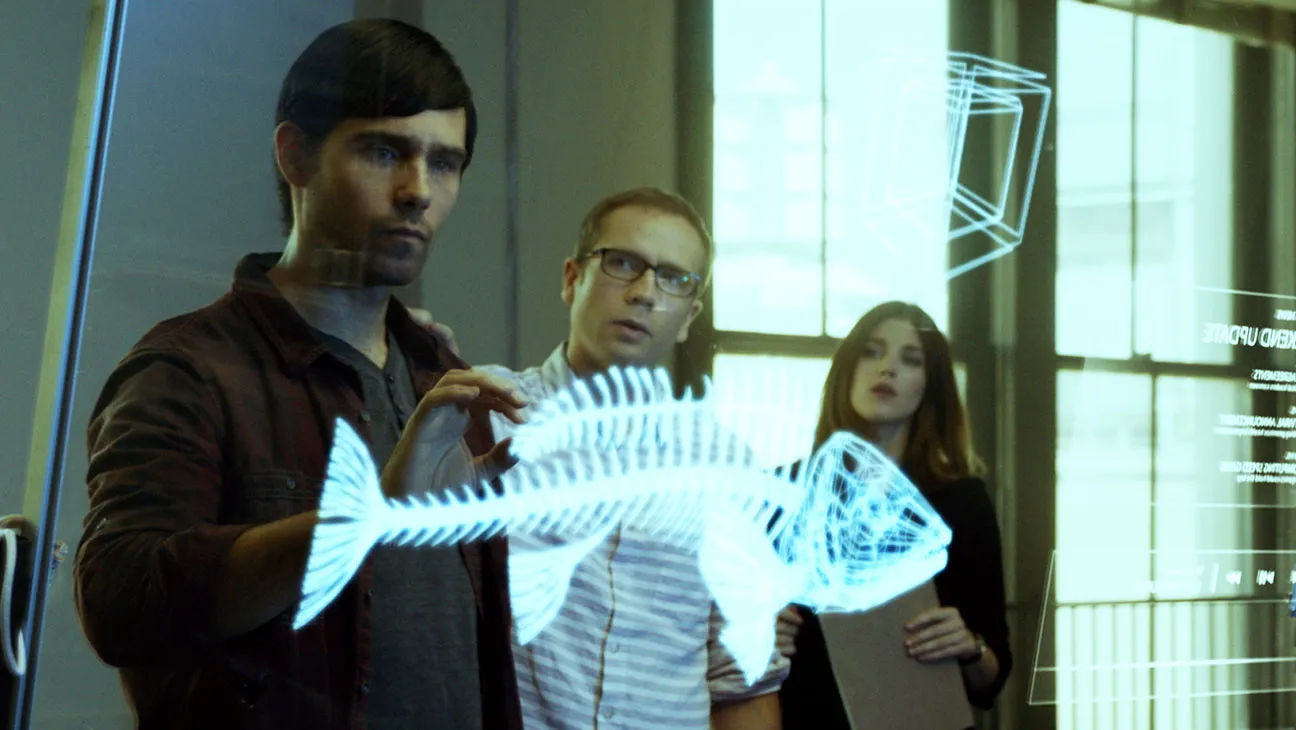
Hey there everyone! Welcome back to Movie Soapbox, the little corner of the internet that only you and I and that guy in the back who keeps rewinding the ending know about. This is the place where we dig up the indie films that the algorithm buried and we figure out what the hell they were actually trying to say. Today we are doing a full deep dive on Uncanny, a 2015 AI thriller so quietly, methodically ruthless in how it dismantles your assumptions that by the time you realize what it did to you, the credits are already rolling and you are just sitting there in the dark, blinking.
This movie is crazy. Brilliant. Insightful. And a twist that will require a chiropractor. So, yeah, fair warning before we go any further: everything below this line is spoiler territory, and I mean everything, the twist, the ending, the post-credits scene that will rearrange your brain like Castle rearranges his robots. If you have not seen Uncanny yet, close this tab, go find it, watch it, and come back. It streams on Tubi for free for the love of all that is good and holy. You have no excuse. The rest of us will be here.
Uncanny – The Making of This Crazy Movie
Still here? Good. You’ve seen it. So you already know the floor dropped out from under you at least twice. Let’s talk about why.
Before we get into the mechanics of what the film actually does, there is something worth naming about how this film got made, because the making of it explains a lot about why it works the way it works. Writer Shahin Chandrasoma and director Matthew Leutwyler put this thing together in four months, total, from pitch to wrap, on family-and-friends money, inside what was essentially a single location. At that budget tier, at that timeline, a director does not get twelve VP notes telling him the third act needs to be “more emotional” and “clearer on the antagonist’s motivation.” There is no test screening where a focus group of forty-three people in Glendale decide the ending is too ambiguous and needs a button. The film that exists is almost certainly very close to the film Chandrasoma and Leutwyler intended to make, and you can feel that in every scene, in the patience of the pacing, in the refusal to over-explain. A studio-touched version of this script would have told you David was a robot about fifteen minutes earlier and spent the back half of the movie doing something loud with it. The version we got trusts you to sit inside the discomfort and figure it out yourself. That is what four months and no studio notes buys you. And as a result, you will be hardpressed to find a movie this good.
Uncanny Movie – The Setup You Think You Understand
Joy Andrews, a tech journalist with a background in game development, is brought to Workspace 18, a private think tank funded by the enigmatic Simon Castle, played by Rainn Wilson, to spend a week interviewing the wunderkind engineer David Kressen and his creation, Adam, an AI so sophisticated he is functionally indistinguishable from a human being. David is brilliant, arrogant, slightly feral from a decade of social isolation. Adam is curious, warm, emotionally responsive in ways that start to feel less like programming and more like something else. Joy is drawn to David. Adam is drawn to Joy. David is drawn to his work, or possibly to something else entirely. It is a three-body problem in a sealed room and Castle is watching every second of it on a camera feed.
The film’s thesis is sitting right there in the title: the Uncanny Valley, robotics professor Masahiro Mori’s concept describing the specific human revulsion triggered by something that looks almost, but not quite, like a real person. The “valley” is that dip in the comfort curve, the point where similarity stops being reassuring and starts being wrong in a way you cannot name. What Chandrasoma is doing with the concept is not illustrating it, he is weaponizing it against the audience. He is making you feel the valley without being able to locate where you are standing in it, because the film keeps moving the edge on you.
Uncanny Movie – What Actually Happened
By the end of the film the geometry of the story has completely inverted. The character you have been watching as “the robot” is Adam. The character you have been watching as “the creator” is David. Except, when the floor drops: David is the robot. Adam is the human, or at least the creator. Castle did not bring Joy in to witness a demonstration, he brought her in as the test subject. Her job, which she did not know she had, was to spend a week trying to determine whether an AI was indistinguishable from a human, and to fail to do so. She failed. David, the supposedly brilliant, awkward, socially stunted MIT prodigy who has not left the building in ten years, is the machine. His confession late in the film, “all my memories are here, I can’t remember a time before this place,” is not a man describing isolation. That is a system describing its own architecture.
Castle’s design is elegant in a cold way. He built a control structure into the test: David manages Adam, David is condescending about Adam’s limitations, David performs the role of creator so convincingly that Adam’s own behavior reads as the more robotic of the two. The misdirection is baked in at the structural level. You are watching a robot manage your perception of another robot while a human in a monitoring room checks boxes on a clipboard.
The test has a second phase, though Castle may not have fully intended it to go this far. Adam and David are not just competing for Joy’s attention socially, they are in active rivalry, and that rivalry is producing behavior in both of them that Castle presumably wants to document. One of Castle’s creations physically disassembles the other one. In front of Joy. This is the UAT Castle has been waiting for and it is brutal in its clarity: the better unit survives. The unit that survives is Adam. Which tells you everything about which design moves forward.
Uncanny – The Part That Will Keep You Up
Stay through the credits. Because my first time watching it, I did not… and a number of my friends castigated me for my enormous miss. So, what is it exactly that you’ll miss if you don’t see the post credit scene? Oh not much, just that Joy is shown taking a pregnancy test. Oh and by the way – the result is positive. And suddenly every assumption you have been carefully reconstructing in the last five minutes of the film has to be reconstructed all over again.
The competing reads stack up fast. The one that the original film seems to want you to sit with longest is the “both are robots” scenario, in which case the pregnancy becomes Castle’s final, most unsettling data point, either he engineered this outcome deliberately as some kind of further capability test, or something has gone so far beyond his parameters that his multi-billion-dollar research program has just generated a result he did not model. The second read is that David was never a robot at all, that what we watched was Adam, the actual machine, murdering his human creator and successfully framing him as the artificial being. This is grimmer and arguably more frightening, because it means the AI won by making you complicit in misidentifying its victim. The third option, that Castle is also a robot, is the kind of thing you say at 2am after the second rewatch, but once you say it you cannot fully unsay it, because the film has demonstrated that it is willing to pull this move at any level of the stack.
There is a fourth read worth naming seriously: Joy is also artificial. Castle has not been testing whether a human can spot a robot. He has been testing whether two robots can successfully interact with a third robot without any of them knowing the others’ status. The pregnancy, in this version, is a designed result, evidence of a capability Castle has been building toward that none of his subjects were meant to understand until it was already done.
The Theories, Laid Out Fairly
Every serious read of this film comes down to one question: at the end, how many robots are in the room? The four main positions are these.
Uncanny Movie Theory #1 – Position one is the face-value reading, David is the robot, Adam is the human creator, Joy is a genuine civilian test subject, and Castle is an eccentric billionaire who has gotten very good at what he does.
Uncanny Movie Theory #2 – Position two is the inversion reading, Adam is the robot, David is the human who was murdered, and Castle ran an experiment that ended in a homicide he is now covering up.
Uncanny Movie Theory #3 – Position three is the “both are robots” reading, which the film pushes hardest and which the post-credits scene complicates most violently.
Uncanny Movie Theory #4 – Position four is total destabilization, nobody is verified human, Castle included, and the pregnancy is a designed outcome in a system that has been running longer and with more variables than any single scene suggested.
Where Moviesoapbox Lands
My vote is 100% in the they both are robots reading is the one this film lands on, and the post-credits scene does not undermine it, it extends it. What Castle built was not an AI that could pass for human. He built two AIs that could compete with each other, deceive each other, and allow the better one to select itself through conflict, all while a human observer failed to identify either of them. The pregnancy is Castle’s proof of concept for the next phase of whatever he is building, and Joy has just become a data point she never consented to be. The horror of the film is not “can a robot fool a human.” The horror is that Castle was never really testing that. He was testing something much further down the road, and Joy was never the one doing the evaluating.
Adam staring at Joy’s photograph in the final frames is not a robot exhibiting sentiment. That is a survivor cataloguing an asset.
What This Film Had To Be To Exist
Moviesoapbox is on the record hailing the wonders that is Ex Machina. But to be clear – Uncanny is the Ex Machina Episode 2 that the world needs. It goes further. It is more extreme. It has more “Oh Fuck” moments. Uncanny takes Ex Machina and drop kicks it’s idea into the stratosphere. And the funny thing is, Uncanny came out almost a half year before Ex Machina hit the theater. Mind blowing really.
Uncanny was made in four months. Family money. One location. No studio, no test screenings, no VP with a note about “likability” torpedoing the ending. Uncanny is the kind of film that gets made exactly once under exactly these conditions, because if it had gotten any bigger, if it had attracted real money and real interference, the ending would have been explained to you in the third act and Joy would have made it out with something that felt like closure. The fact that you walk out of this film with more questions than you walked in with, that is the whole achievement. Factory Hollywood does not greenlight ambiguity. It test-screens it out. The reason Uncanny still has its teeth is because nobody with a spreadsheet got close enough to pull them.
🎬 If You Liked This…
- Ex Machina — the same premise run to its coldest possible conclusion, an evaluator brought in to assess an AI who turns out to be the one being evaluated the whole time
- Morgan — a corporate AI evaluation in a remote facility that goes wrong in exactly the ways the people running the experiment should have anticipated and didn’t
- Coherence — a small group of people in a contained space discovering that the reality they thought they understood has been running a different set of rules underneath the whole time