
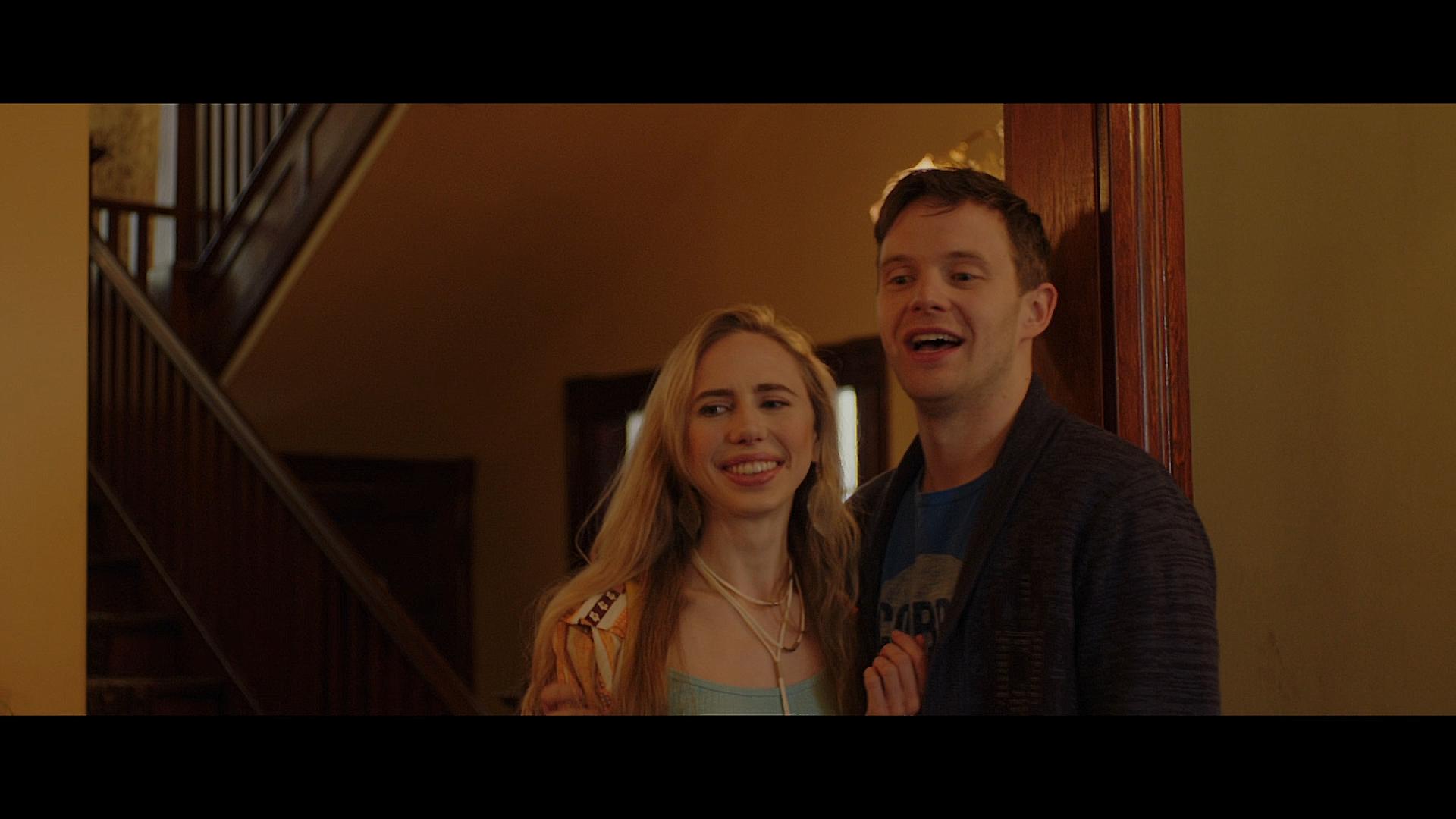
Hey there everyone! Welcome back to Movie Soapbox, the little corner of the internet that only you and I and that guy asleep in the corner over there know about. This is where we find the films that got lost in the shuffle, the ones that slipped through the cracks of whatever algorithm decides what you should care about this week, and we make sense of them. Today we are doing a deep dive on Parallel, a multiverse thriller so crammed with ideas that the people who distributed it apparently just shrugged, dumped it onto digital December 11th, and walked away. Let’s talk about why that matters, and what you actually watched.
Fair warning: everything that follows is a full walkthrough of this film, including the ending. If you haven’t seen it, go watch it first. It’s on Amazon Prime and it costs you nothing but the time. Come back when you’re done. For everyone else, we are going in.
Before we walk through the film beat by beat, let me tell you something about what you are looking at when you watch Parallel, because the movie itself will not tell you. Films at this budget level, with a cast this unrecognizable, carrying this many ideas in one screenplay, have a very specific problem in post-production. They attract a certain kind of distributor attention. Not the good kind. The kind where someone in acquisitions watches the first twenty minutes, gets excited, watches the back half, gets confused, and then starts making phone calls about whether the third act can be clarified. You can usually tell when that conversation happened because the third act starts to feel rushed in a way that doesn’t match the patience of everything that came before it. Parallel has that quality. The first half earns its runtime, takes its time, builds the mechanics carefully. The second half moves like someone told the director he had six more shooting days and to wrap up six different character arcs as efficiently as possible. That is a production-pressure pattern, not a stylistic choice. The film this screenplay was reaching for is longer, slower, and a lot more brutal.
Parallel Movie Movie Walkthrough
The film opens on a move so bold it almost dares you to keep watching. An older woman named Marissa leaves her house, attacks a version of herself, disposes of the body, and quietly takes over her other self’s life. No explanation. No title card. Just the act, committed with the calm of someone who has done this before or at least spent a long time deciding to. In about ninety seconds, the film tells you everything you need to know about where the moral floor of this story is located. Somewhere underground.
A group of friends running a startup buy Marissa’s abandoned house because it is cheap and because startup people in movies always make decisions that serve the plot. Their app is called Meter Maid, it lets people resell parking spots, and they need it built by Thursday because a competitor promised theirs by the end of the week. If you’ve spent any time around the early-stage startup world, this setup will feel painfully accurate in a way that is almost certainly intentional. The director, Isaac Ezban, is doing his Primer homework here and he is not being subtle about it.
Leena, played by Georgia King, finds a false wall in the house. Behind it, in the attic, is a mirror. Not a decorative mirror. A portal. It drops you into a parallel universe that is almost, but not quite, your world. The catch, and this is the mechanical engine the whole film runs on, is time dilation. One minute on your side equals three hours on the other side. That asymmetry is how Noel and Josh justify spending days in someone else’s attic finishing an app that needs to be done by morning. (The people in the house cannot hear them working up there for what amounts to weeks of their subjective time. You will need to make peace with this. The film has.)
The whiteboard diagram Noel draws is doing a lot of work fast. The key rules are these: every trip through the mirror drops you into a different, essentially random parallel world. You do not control the destination. When you come back through, you always snap back to your originating world. So the group can go out into World7 or World12 or wherever and come back to World1 reliably, but they cannot choose which world they visit on the way out. The film draws this clearly enough that it works, mostly.
What they discover in these parallel worlds is the angle. Lottery tickets and financial markets are basically identical across worlds, so that is a dead end. But the arts? Wildly different. And technology? There are inventions in some of these worlds that simply do not exist in theirs. Leena starts painting reproductions of artworks from other dimensions and showing them as her own. Noel starts filing patents on technologies he has lifted from other universes. Josh uses the whole apparatus to repeatedly reconnect with an ex-girlfriend by bringing her music from a band that only exists in one of the parallel worlds. And Devin, the moral center the film keeps checking back in with when it remembers it has one, is the only one who seems to understand that none of this ends cleanly.
Devin’s father committed suicide after construction corruption charges destroyed two companies. The film waves at this backstory as the thing that makes Devin the way he is, a man who cannot look away from what the wrong choice costs. It is genuinely interesting character material. The film does not give it enough room.
Josh gets shot by an ex-girlfriend’s boyfriend during one of his parallel-world visits, an entirely avoidable situation that the film treats as a plot mechanism rather than the consequence of sustained reckless behavior it clearly is, and bleeds out in the attic. The trio’s response to this is one of the film’s most revealing moments. Noel does not want to involve the police because the police would find the mirror. The mirror funds the empire. The friend is secondary to the empire. Devin objects. Devin always objects. Noel wins. They kidnap a Josh from a parallel universe and drop him into their world as a replacement, arrange a job for him at his dream marketing firm to keep him occupied, and go back to work.
Josh2 starts unraveling almost immediately. His social media is full of photos he has no memory of taking, events he never attended, a haircut he never chose. The ground has been pulled out from under his entire sense of self and nobody around him will tell him why. This is the film’s most uncomfortable material, a man quietly going insane because reality no longer matches his recollection of it, and the people who caused it keep patching the leaks instead of coming clean. The actor handles it about as well as the screenplay allows him to.
Leena, meanwhile, has the art show she always wanted. And she feels terrible. The film is smart enough to know that this is exactly what happens when you get the dream through the wrong door. It just does not linger on it long enough to let that land.
Noel has by this point gone somewhere past ambitious into something that does not have a polite name. He has been filing patents around the clock for weeks. He has been cycling through parallel worlds long enough that the power has done what power does when nobody pushes back against it. He disposes of Devin1, drops a Devin2 into the world to cover the gap, and when Leena figures out the switch because the new Devin still has her art show program in his wallet (he never gave it to her in his timeline), the whole architecture starts coming apart.
Josh2 goes to the attic and ends up in a confrontation with Noel. He shoots Noel. A second Noel comes through the mirror and kills Josh2, then kills the injured first Noel. Leena arrives. The surviving Noel tells her they can take everything together. She tries to kill him. Fails. Devin1 comes back and shoots Noel, who runs for the mirror. Leena closes the portal while he is halfway through it.
The film ends the surviving Leena and Devin donating the anti-gravity patents to the NIH, going on a road trip, and then at a gas station rest stop, a Leena from another universe swaps out the original through a bathroom mirror. Devin notices something is off. Cut to black.
Parallel Movie Ending Explained
Now let’s talk about the ending specifically, because that gas station mirror is the thing that breaks the rules the film spent an hour establishing. The mirror in the attic has to be stationary, mounted at a precise angle. If it tilts, it goes dead. That is an explicit mechanical rule. A gas station bathroom mirror is not mounted at a precise angle by anyone. So how does this work?
Parallel Movie Theories
Parallel Movie Theory #1 – The most coherent explanation is also the most unsettling one. In the space of parallel worlds, the constraint that the mirror must be fixed and stationary is a property of the specific mirror in that attic, or of mirrors at that particular stage of development in their world. Some other version of this technology, developed independently in some other parallel universe, already solved the stationary problem. A portable, mobile version of the portal exists somewhere in the multiverse, and someone in that universe has been using it for long enough to know how to move through public spaces, watch for the right moment, and make a switch. The older Marissa we saw in the opening of the film was already doing something like this, comfortable and practiced. The ending is telling you that by the time the credits roll, the game is already much larger and much older than anything that happened in this house, and nobody in it was ever really in control.
Parallel Movie Theory #2 – The competing read is simpler and darker. The rules were never airtight. The film told you what the attic mirror required, but never established that those requirements applied universally to all possible mirrors in all possible worlds. Marissa’s diaries imply she spent years mapping this, and her diary is not a complete document. What she knew, and what she wrote down, are almost certainly not the same thing. The ending is consistent with the film simply having been more honest about the edges of its own world than it was given credit for.
Both readings land in the same place. Leena is gone. A Leena is still in the car. Devin knows something happened and cannot prove it. And out there in the multiverse, someone with a portable version of this technology and no apparent ethical guardrails has been running a much longer game than any of the people in that house ever realized.
Moviesoapbox’s Preferred Reading of the Movie Parallel
My read? The Marissa from the opening is the key. She is not a throwaway cold open. She is a preview of the endpoint. She had already solved the portability problem, had already normalized the act of replacing herself, had already been running this operation long enough to be calm about it. The ending is not a twist tacked on to signal a sequel. It is the film closing the circle back to its own opening and telling you that Noel’s God Complex was a small, local version of something that predates him by decades. The whole story you just watched was someone else’s inciting incident.
Look. This film had a cast that could have carried something genuinely brutal. Martin Wallström playing a man who dismantles his own soul patent by patent, Georgia King carrying the full weight of an artist who knows exactly where her work came from, the moral collapse of a friend group told with the patience it deserved. That movie exists somewhere in the screenplay. You can feel it trying to surface in the back half before the runtime closes down on it. What made it to the screen is still worth your two hours. But somewhere between the writer-director who made El Incidente and the version of this film that Vertical dropped onto digital with apparently zero promotional ambition, something got lost. Films like this one don’t usually get a second chance to find their audience. That you found it anyway is something.
🎬 If You Liked This…
- The One I Love — alternate versions of the people closest to you, and the discovery that what you actually wanted was the version you couldn’t have, same moral vertigo of a gift that destroys the people who use it
- ARQ — a group of people with access to something they shouldn’t have, making increasingly compromised decisions the longer the loop runs, trust dissolving at exactly the rate the advantage grows
- Coherence — friends who discover parallel versions of themselves making better choices, the same corrosive effect on every relationship in the room once everyone starts wondering if the other version of them would have been the right choice