
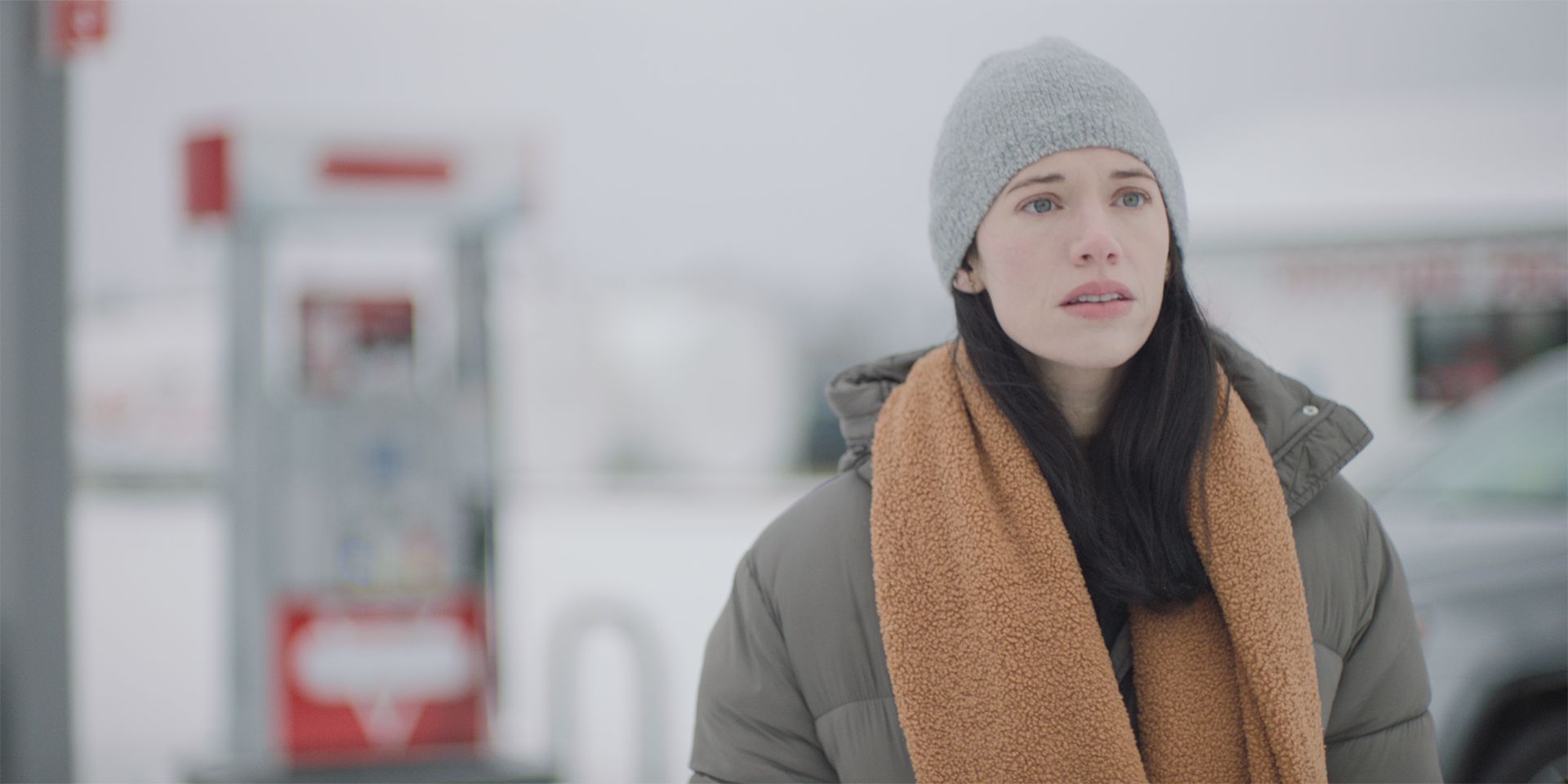
Hey there everyone! Welcome back to Movie Soapbox, the little corner of the internet that only you and I and that guy sleeping in the corner over there know about. This is the place where we find underappreciated indie films and we make sense of them. Today? We are doing a deep dive on Next Exit, a movie so quietly strange and genuinely felt that the studio notes it almost certainly survived would have turned it into something you’d skip past on a Tuesday night and feel nothing about either way.
Fair warning: everything from this point forward is a spoiler. The ending, the shade, Rose’s affair, Teddy’s father, all of it. If you haven’t seen the film and you want to go in clean, bookmark this, go watch it, come back. For the rest of you, the ones who just stared at that final sequence and typed something into a search bar, you’re exactly where you need to be.
Next Exit Movie Context
So. Mali Elfman, daughter of Danny Elfman (lead singer of Oingo Boingo and amazing movie composer), spent roughly ten years building this script, coming back to it during the hard stretches of her own life, adding to it, putting it down again. You can feel that in the seams of the thing, the way certain scenes have a weight that feels personally excavated rather than conceptually engineered. And then the pandemic hits and she shoots it anyway, across Missouri, Oklahoma, Texas, New Mexico, and Arizona, with a budget that you can measure in the production design choices she didn’t get to make. That’s not a complaint. That’s context.
Because here is what a movie like this looks like after five more rounds of studio notes: the sci-fi proof-of-afterlife premise gets foregrounded, the road trip becomes a genre chassis instead of the entire point, and somewhere around the third act, a producer who has never been afraid of anything in his life demands that the ending “earn it” by which he means resolve cleanly, hit a swell, give the audience the cry they paid for and send them home satisfied. What Elfman made instead is a movie where the emotional logic is messier than that, where the catharsis is partial and sideways, and where the genre scaffolding is basically a trick to get you into a story about guilt and moral debt before you realize that’s what you signed up for. Films at this budget tier, with this kind of cast, survive that vision maybe thirty percent of the time. This one did.
Next Exit Movie Walkthrough
The setup, briefly: a scientist has presented what the world has accepted as proof of life after death. People are dying by suicide in large numbers, believing they’re stepping through a verified door. Into this world we drop two strangers, Rose and Teddy, both headed to California to enroll in the study as voluntary subjects. They share a car. They do not share a reason. And the movie that follows is a road trip about two people being forced to actually look at the thing they’ve been outrunning long enough to outrun it all the way to a clinical IV drip on the West Coast.
Teddy’s story is the cleaner one. He was abandoned by his father at birth, spent his whole life trying to build something that would justify his existence to a man who never asked for the update. The father confrontation scene is where the film takes its one genuinely unexpected swing: Rose steps in and plays the hypothetical father, lets Teddy scream at her, gives him the proxy release he could never get from the real thing. He ends it with, “I didn’t need you then, and I don’t need you now.” And the movie knows, and Teddy knows, and you know, that this is a beautiful lie he is telling himself, because the entire trip exists precisely because he did need it and it wrecked him. But he says it and something loosens. That’s enough. Teddy is going to be okay.
Rose is harder. Her damage runs on a more complicated fuel. Her mother died. School failed. Debt accumulated. She moved in with her sister, accepted the charity of a smaller life inside someone else’s perfect house, and then slept with her sister’s husband. He treated it like it didn’t happen. That’s when the haunting started. Not when her mother died. After the affair. And that sequencing is the entire key to the ending, so keep it.
“And the darkness knows that I have a self-destruct button. And it’s irresistible. I can be happy for maybe a day, or a year. But eventually, I’m pushing that button.”
Now. The ending. Rose is in the chair, the IV is in, Teddy makes his last case for her staying, she declines. The procedure begins. She starts to cross over. And her first move on the other side is to go find the shade, the thing that has been following her in mirrors and TV screens across six states, the thing she has assumed, the thing the film has let you assume, is her dead mother.
The Ending of Next Exit Explained
It isn’t her mother. It’s herself. If you felt the floor drop out from under that reveal, good. That’s the move working. Now here’s why it logically follows from everything the film built.
The shade doesn’t appear when her mother dies. It appears after the affair. Rose wasn’t haunted by grief. She was haunted by what she did to her sister, by the specific flavor of self-destruction that comes from burning down someone else’s life because you were jealous of it and then watching the man you burned it for pretend it never happened. The shadow in the mirror is her own moral debt in corporeal form. Her own worst version of herself, trailing her, waiting.
When she crosses over and sees this, she also absorbs what her sister told her, that Rose’s whole pattern is focusing on everyone else’s disasters so she never has to face her own. Her sister’s “perfect life” was already quietly falling apart. Rose didn’t destroy anything that wasn’t already cracked. But she used it as confirmation of her own worthlessness rather than looking straight at the actual problem, which was always Rose’s relationship with Rose.
So in the afterlife, she sees herself. And she understands that wherever she’s headed if she stays dead, it is not peace. It is that shade, forever, because she hasn’t resolved it. She hasn’t even named it yet until this exact moment. So she pulls the IV. She snaps back. The film lets her live.
Is it the cleanest third-act turn Elfman could have written? No. The mechanics of “she wills herself back from death” are the one place where the film’s emotional logic outruns its narrative logic, and you can feel the seam. But the emotional case for why she comes back is airtight. She comes back because she finally saw the thing clearly, and because the version of the afterlife waiting for her was indistinguishable from the life she was already living. There was nothing to gain by crossing over. There is something to lose by staying dead. That’s enough.
The Open Questions of the Film Next Exit
The boy and his grandfather at the start: the film opens on video footage of a child interacting with what appears to be his deceased grandfather’s ghost, playing a game only the two of them knew the rules to. This is the scientific proof-of-afterlife event that broke the world. And yes, the evidential bar here is astonishingly low, a private game between a child and a ghost that no one else can verify. The film is not being careless with this. It is showing you how little it takes, when people are already looking for permission to stop, to give them what feels like permission. The proof isn’t rigorous. It doesn’t need to be. The world wanted to believe it, so it did.
Why did Teddy want to die: his father’s abandonment became the organizing principle of his entire life, the thing he was always performing for and never reaching. Once he said the true sentence out loud, once the proxy confrontation with Rose gave him that, the organizing principle collapsed. He didn’t need the study anymore. He had somewhere to go back to.
Why did Rose want to die: the affair with her brother-in-law was the latest and most precise version of a pattern she’d been running her whole life, the self-destruct button she named. The shade was that pattern. She had to see it directly before she could choose differently.
What the shade actually was: herself. Her failure and her guilt and her specific brand of moral devastation. Not supernatural. Not her mother. Her.
Moviesoapbox’s Next Exit Read: stated plainly, the film is about what happens when you offer people a sanctioned exit before they’ve finished looking at the thing that is actually wrong. The scientific proof-of-afterlife is a MacGuffin wrapped around a moral argument, that the urge toward self-destruction isn’t resolved by a better destination, it’s resolved by finally turning around and facing the thing that’s been following you. Rose faces hers. Teddy faced his on a highway shoulder while screaming at a woman pretending to be his father. The film earns its ending because it doesn’t pretend either of them is fixed. It just gets them to the moment where they stop running.
Mali Elfman built this over a decade, shot it during a pandemic, and got it across the finish line as the movie she intended to make. The version where the studio notes won would have given you a cleaner third act and an emptier one. What she made instead stays with you in the specific way that only slightly uncomfortable things do, the ones that got made before anyone could sand them down.
That’s all for this one. Find something true on screen this week, and we’ll see you back here next time.
🎬 If You Liked This…
- The Discovery — the same premise of scientific proof of the afterlife and what it does to people who were already looking for a reason to leave, the same moral seriousness about why people choose to stop
- Manchester by the Sea — a person for whom the reasons to keep going have become genuinely difficult to locate, grief making the future feel like somewhere they don’t have access to, same emotional register without the sci-fi premise