
Hey there everyone! Welcome back to Movie Soapbox, the little corner of the internet that only you and I and that guy sleeping in the corner over there know about. This is the place where we find underappreciated films and we make sense of them, the ones that got buried under the algorithm or misfiled as prestige bait when they were actually doing something weirder and more honest than that. Today? We are doing a full deep dive on The Discovery, a Netflix film so philosophically loaded and structurally strange that the marketing team clearly had no idea how to sell it, which is probably the most reliable sign you have stumbled onto something worth your time.
Alright. If you have not seen The Discovery yet, here is your one warning in plain language: everything from this point forward is a spoiler, not just a detail or a nudge, but the full mechanism, the ending, the loops, the reveal, all of it. This movie lives and dies on not knowing what you are walking into, so close this tab, go watch it, and come back. The rest of you, stay with me, because we have serious business to conduct.
The Discovery Series and the Making Of
Before we get into the walkthrough, something worth naming about where this film came from. Justin Lader and Charlie McDowell made The One I Love before this, a film that also did something structurally uncanny on what was clearly a budget that required everyone on set to be extremely clever with every single dollar. That movie found its audience by word of mouth, slowly, the way genuinely unsettling films tend to. When two filmmakers like that get a Netflix deal and a cast that includes Robert Redford, Jason Segel, Rooney Mara, and Jesse Plemons, you are looking at a window, a very specific, very narrow window, where the industry accidentally funds something strange. You can feel it in The Discovery, the film that was trying to get made here was always a small, ideas-first, character-interior piece about grief and guilt and whether the universe keeps your tab. What Netflix wanted was probably something that could be described in a sentence in a pitch deck. The version that exists is clearly the result of Lader and McDowell holding the line on the weird stuff while conceding enough surface-level genre shape to get the thing greenlit, and if that sounds exhausting, that is because it is, and you can see the seams in places, and the film is better for every seam the suits did not manage to smooth over.
The Discovery Walkthrough
The film opens mid-crisis, no easing in. A scientist named Thomas Harper, played by Redford, has proven definitively that something exists after death, some destination, some continuation. He has published the proof. And the result is not wonder or comfort, it is a global suicide epidemic. Four million people dead since the announcement. The movie drops you into a world where confirmed knowledge of an afterlife functions as a mass extinction event, which is, if you slow down enough to actually sit with it, one of the more genuinely disturbing premises any film has attempted in the last decade. An interviewer on live television tries to pin the body count on Thomas. He refuses the weight of it with the flat certainty of a man who has decided his methodology was the thing that mattered, not the consequences. And then one of the crew members pulls out a gun, says, “Thank you for my fresh start,” and shoots himself on camera. That is your opening scene. The movie has told you exactly what it is.
We cut to a ferry. Will, Thomas’s estranged son, played by Segel, meets a woman named Isla, played by Mara. The scene is quiet, a little off, two people talking the way people talk when they are each carrying something they have not named yet. They part ways. You file it.
Will arrives at his father’s compound, which is organized and staffed and color-coded in a way that maps almost exactly onto how a cult functions without ever using the word. People in jumpsuits with assigned roles. A leader who speaks in the register of someone who has decided that being wrong is no longer a category that applies to him. Thomas is being “rebooted” when Will arrives, meaning he is technically dead and will be resuscitated shortly, which his team delivers as straightforward operational information. Will looks around at all of this and his face does the work the film needs it to do, which is to show us a man recognizing something he already knew was true.
The Thomas-as-Doubting-Thomas naming is doing something real, by the way. A man named Thomas who has obliterated doubt, who has converted faith into data, who now operates from a position of total epistemic certainty and is surrounded by people who have given him their belief in exchange for structure. The film is using the name as a quiet inversion. The original Thomas doubted until he saw. This Thomas saw, and now doubt is the one thing he has contempt for. He says it directly when he dismisses a team member who appeals to his faith in her: “I have such contempt for that word.” The movie heard that line clearly.
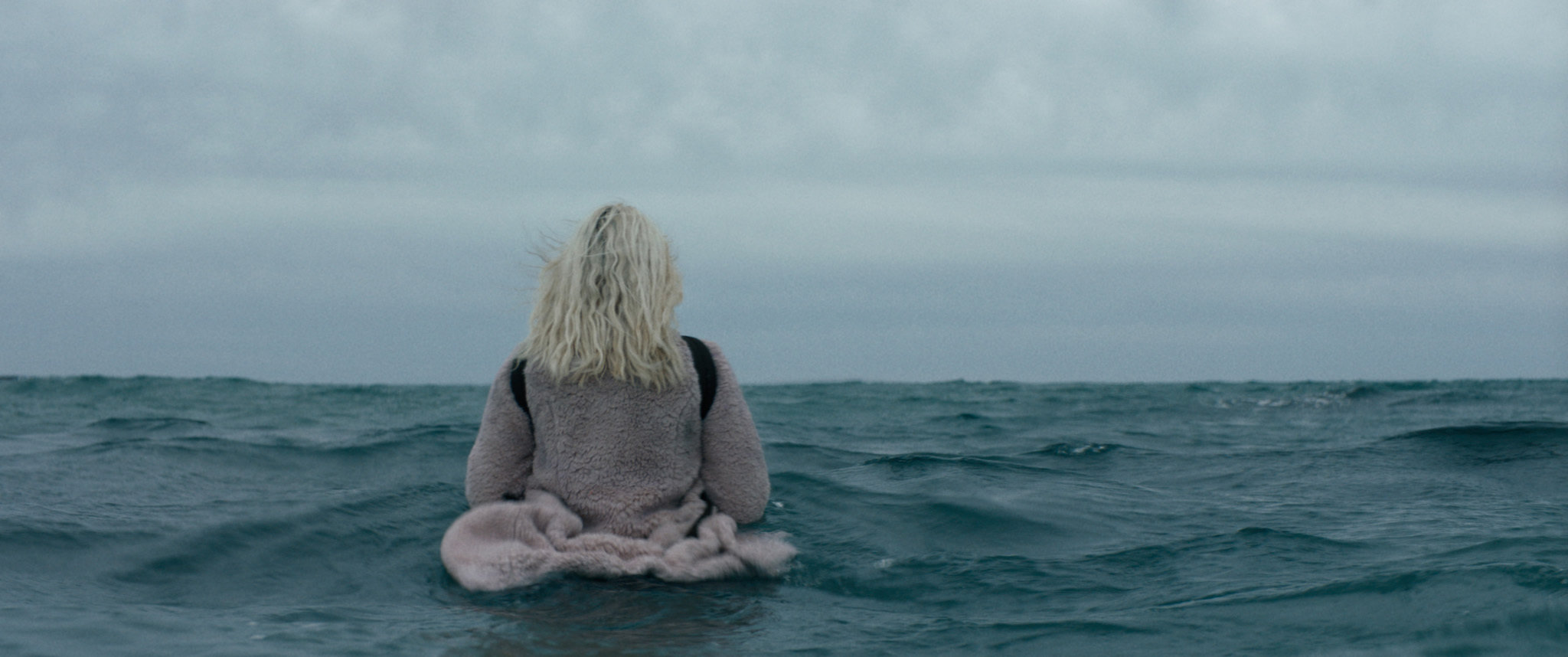
Will heads to the beach. He finds Isla there. She is strapping weight to her chest. She is going to drown herself. Will dives in and pulls her out, and this moment, this specific moment of Will choosing to save a stranger rather than let the logic of the world they are living in take her, is the axle the entire film rotates around. Everything that follows is downstream of that choice.
Isla is folded into the compound. We start learning about Will’s mother. She died because of Thomas, Will says, and the film is smart enough not to fully explain this for a while, letting the weight of it accumulate. Thomas invites Will and Isla to an inner-circle demonstration of where his research has gone next.
Thomas’s new thesis: he proved there is a somewhere-after, but he has not proven the somewhere is good. It could be a void. It could be worse than here. So he wants to study the content of the afterlife experience using a cadaver run through his machine, knowing the process would vegetize a living subject. Will sabotages the machine, then reassembles it, and what the machine produces is not abstract data. It is video footage of what looks like a specific location, a specific moment, a specific unresolved human failure. A hospital. A hallway that was remodeled. A man named Pat who did not go in to see his dying father.
The machine is not showing the afterlife as a place. It is showing a missed opportunity. A moment where a person failed someone and did not go back. The afterlife, in this film’s architecture, is not a destination, it is a second draft.
Thomas eventually puts himself into the machine and the footage shows him turning his wife around in her final moments, talking her back from the edge. His wife, Will’s mother, died by suicide. Thomas’s afterlife loop is the moment he almost saved her and did not. He has built an entire scientific apparatus, a compound, a movement, around the guilt of one moment he cannot stop replaying. You do not need the film to state this explicitly. The machine states it.
Then Lacey, the team member Thomas publicly humiliated and expelled, comes back and shoots Isla. “I didn’t kill her. I just relocated her.” And Will, instead of putting Isla into the machine, gets in himself. He dies deliberately. And wakes up on the ferry.
Now Isla is there with him. And she tells him something that reframes every scene you have watched.
“You’ve been coming here over and over again. Your first time you didn’t even leave the ferry.”
Will has been dead since before the film began. The ferry scene that opened the story was not a beginning, it was an iteration, one of many. He has been cycling through this loop, forgetting each time, slowly getting closer to understanding what he is supposed to fix. He saved Isla from drowning. That was not enough. He has to prevent the thing that broke her, the death of her son Oliver, the child she slept through losing on a beach.
Will asks if he will remember her. She says she hopes so. He dies in the real world, fully and finally this time, and he arrives at the beach where Oliver dies. He prevents it. And in the last frame, the glimmer in his eye is the film keeping its promise. He remembers.
The Discovery Series Explanation Theories
Now. The film gives you four possible ways to hold what you just watched, and they are worth laying out cleanly.
Theory One: Death is a constructed dream. Will has been dead from the opening frames and everything we watched is his consciousness generating a context in which to work out what he failed. The compound, Thomas, the machine, all of it is the architecture of Will’s own guilt given form. The machine is just the film’s way of externalizing an internal process. You cannot disprove this. It is internally consistent with every scene.
Theory Two: Recursive loops, literally structured. The afterlife in this film is a retry mechanic. You loop back to the moment of your greatest failure, you attempt to correct it, and if you succeed you advance to someone else’s failure, someone whose life you intersected with, whose wound you share responsibility for. Pat and the lighthouse tattoo is the proof of concept. Will and Oliver is the graduation. The loops are not punishment, they are curriculum.
Theory Three: Sisyphean punishment. The loops are not corrective, they are permanent. Will has done something we are never shown, possibly connected to his mother’s death, possibly something else, and the cycling is not mercy but sentence. Triangle runs on this logic. This reading makes the ending darker, because the glimmer in Will’s eye might not be resolution, it might be the last moment before he forgets again and the ferry appears.
Theory Four: Will arrived. The beach with Oliver is not another loop. It is the end of the recursion. He corrected the final thing. What we see in the last frame is not a man about to cycle again, it is a man who has finished, and the place he is finishing in is a moment of genuine repair. This is the film’s most hopeful read and also, structurally, the one the ending’s visual grammar supports most directly.
Moviesoapbox’s Read on the Netflix Series The Discovery
We are going all in on Theory Two with Theory Four as the terminal state, meaning the loops are real and the retry mechanic is genuinely corrective, and Will’s loop ends with Oliver on the beach because that was the last thing the system needed him to do. The reason I land here is the specificity of the Pat subplot. The film did not have to build out Pat’s missed visit, his sister, the tattoo versus the lighthouse, in that much detail unless it was trying to show you the system from the outside before making you experience it from the inside through Will. Pat’s loop is the instruction manual. Will’s loop is the exam. And the glimmer is the grade.
What Lader and McDowell actually pulled off here is a reincarnation story told as a grief mechanism, the idea that what we owe the universe is not perfection but repair, not a clean life but a corrected one, and that the machinery of the afterlife is less concerned with judgment than with making you go back and do the thing you flinched from. That is a genuinely unusual piece of moral architecture to put inside a Netflix genre film. The fact that it exists at all, in the form it exists, with the cast it has, is the kind of small industrial miracle that happens when the people making it care more about the idea than the IP potential. There is no Discovery 2. There is no franchise. There is just this strange, sad, structurally committed film about a man who had to die several times before he understood what living was for. That is enough. That is more than enough.
🎬 If You Liked This…
- Eternal Sunshine of the Spotless Mind — memory and identity as the same philosophical question The Discovery is asking, what remains of a person when the memories that made them are removed, grief as the thing that drives people toward choices they cannot undo
- After Yang — what constitutes a soul when memory is the only evidence you have that one existed, same quiet devastation and same question about whether the people we lose leave anything behind that persists
- Another Earth — grief and the unbearable question of whether a version of reality exists where the worst thing didn’t happen, same emotional engine as The Discovery dressed in different scientific clothing