
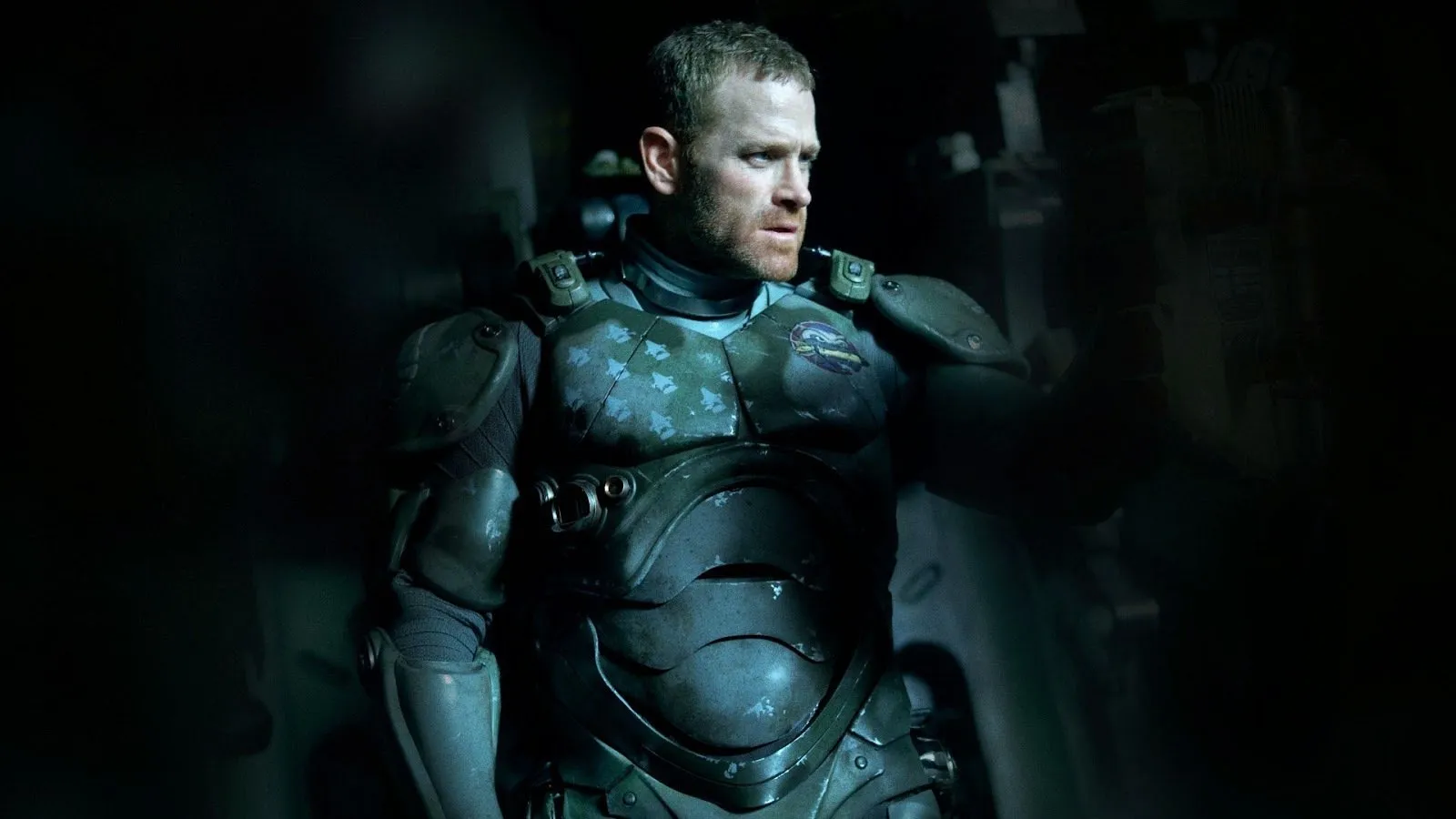
Hey there everyone! Welcome back to Movie Soapbox, the little corner of the internet that only you and I and that guy sleeping in the corner over there know about. This is the place where we find underappreciated films and make sense of them, the ones the algorithm buried, the ones the trades ignored, the ones that got quietly slid out a side door while the studio pretended it never happened. Today? We are doing a deep dive on Spectral, a movie so technically ambitious and narratively thin that Universal greenlit it at seventy million dollars, watched the rough cut, and then basically handed it to Netflix like a man leaving a restaurant before the check arrives.
Watch the trailer, then we go in.
Alright. From here on out the whole film is on the table, every beat, every ghost, every moment where our DARPA guy somehow reinvents quantum physics with a soldering iron and thirty minutes. If you haven’t seen Spectral yet, close this tab, go watch it on Netflix, it’s free and it’s ninety minutes, come back when you’re done. You’ve been warned.
What Universal Actually Paid For (And Then Didn’t Want)
Before we walk the film beat by beat, you need to understand the specific flavor of studio cowardice that shaped what you’re watching. Because Spectral carries it like a scar.
A seventy-million-dollar budget with WETA Workshop attached is not an indie production. That is a mid-tier studio tentpole, the kind of film that gets a November wide release, a tie-in toy deal, and a sequel greenlit before anyone’s seen act three. When a studio builds that infrastructure and then sells the finished product to a streaming platform for worldwide simultaneous release, that is a specific thing. That is a room full of executives watching a cut and collectively deciding that whatever this film IS, they do not want to be standing next to it when it opens. You can feel that decision in Spectral‘s bones, in the way it swings for enormous spectacle and then flinches at the character work that would have made the spectacle land. Films that go through that kind of late-stage abandonment tend to show up polished on the outside and hollowed out in the middle, because the notes that would have fixed the middle were never given, or were given and then ignored when the exit door opened. What you get instead is the WETA reel. And honestly? The WETA reel is extraordinary. But we’ll get there.
The Film, Beat by Beat
The movie drops you into a war zone. Moldova, or something close enough to Moldova to film there cheaply, a crumbling European city with the kind of architecture that makes every wide shot look like a painting someone set on fire. A soldier encounters something that should not exist. It moves through him. He dies. The army, as armies do, responds to the inexplicable by calling a scientist.
That scientist is Dr. Mark Clyne, DARPA researcher, inventor of the hyperspectral imaging goggles that are somehow the only technology on earth capable of seeing these things. General Orland pulls him into theater. CIA officer Fran Madison pulls him in a slightly different direction. Nobody is particularly surprised that a ghost war has started; they’re just annoyed it’s happening on their watch.
The apparitions, which the film calls spectrals because of course it does, are killing soldiers on contact. Touch one and you’re done. Utah Team goes dark trying to engage them. Delta goes in to pull out survivors and collect a sample, which is the kind of mission objective that tells you everything you need to know about how the military thinks about things it doesn’t understand. Clyne rides along with a truck-mounted version of his goggles, essentially a hyperspectral camera the size of a small car, because the handheld version isn’t sensitive enough to study them in the field.
The engagement goes badly. Multiple soldiers die. Both armored personnel carriers get destroyed by mines on the retreat. The surviving group takes cover in a factory where two girls have been hiding under the protection of their father, who figured out empirically, through the specific genius of a man with nothing left to lose, that iron shavings stop the spectrals from crossing a threshold. They can’t move through iron. They move through everything else, concrete, steel, human tissue, but not iron shavings scattered on the ground.
Clyne takes this information and does what the film needs him to do, which is use it to build weapons. Iron-laced grenades. Iron-laced IEDs. The group fights their way to an extraction point in an open quad, gets hit from every direction, loses most of what’s left of the team, and a handful of survivors make it onto a helicopter. They reach a civilian holdout managed by the Moldovan army, which is where Clyne finally has enough data and enough quiet to think.
His conclusion: Bose-Einstein Condensate. The spectrals are not ghosts. They are matter in a condensate state, cooled to near absolute zero, which in practice means they exist in a quantum superposition that lets them pass through conventional matter, kill through direct contact by disrupting biological systems at the cellular level, and explains the iron interaction, because iron’s ferromagnetic properties disrupt the wavefunction coherence that keeps the condensate stable. Clyne says all of this very fast while everyone around him stares. The film does not slow down to let you argue with it. Smart move.
The nearby power plant is the only facility in the region capable of generating the energy required to produce and maintain a condensate at that scale. The remaining soldiers raid it. Inside they find the lab. And inside the lab they find the thing that reframes the entire film: these are not weapons manufactured in a factory. These are people. Or they were. A process was developed to scan a human nervous system, 3D-print its neural architecture in condensate, and run the resulting spectral warrior as a living weapon, while keeping the original brain and nervous system alive in a storage unit, because the condensate version needs a biological anchor to remain coherent. The scientists built soldiers out of souls and stored the leftovers in jars.
Clyne shuts the system down. The biological components die. The spectrals collapse simultaneously. The war ends, or this part of it does. The city gets swept. And as Clyne is leaving, a Department of Defense team is quietly dismantling the lab equipment and loading it onto trucks. The film doesn’t comment on this. It just shows it to you and lets you sit with it.
The Bose-Einstein Problem (What’s Real, What’s Not)
Bose-Einstein Condensate is a real state of matter. Satyendra Nath Bose and Albert Einstein predicted it in 1924 and 1925, and it was experimentally confirmed in 1995, work that eventually earned a Nobel Prize. You achieve it by cooling a dilute gas of bosons, a specific category of subatomic particles, to temperatures near absolute zero, at which point quantum mechanical effects that normally average out at human scales become macroscopically visible. The particles stop behaving like individual objects and start behaving like a single coherent quantum entity. Wavefunction interference becomes observable. It is genuinely strange and genuinely real.
What is not real: using that state of matter to 3D-print a human soul into a ghost soldier. The film’s screenwriters, and you have to give them this, did not invent a fictional particle or a made-up field of physics. They found an actual phenomenon at the edge of what matter can do and then made a hard left turn into complete fantasy from there. The pivot point is somewhere around the phrase “scanning and printing a nervous system in condensate” and it does not survive any real scrutiny. But the iron interaction has a soft internal logic to it, ferromagnetism disrupting quantum coherence is at least in the neighborhood of real physics, and the film moves fast enough that you don’t have time to file a formal objection before the next action sequence starts.
Why Clyne Can Do Literally Anything
The film’s single biggest structural problem, and the source post names it correctly, is that Clyne has no ceiling. Every obstacle the film creates, he dismantles with improvised technology in roughly the time it takes to explain what he’s doing. Iron shavings in grenades. Reconfigured goggles as projectors. Field-built condensate detection arrays. The film needs him to be smart because the plot requires it, but it never asks him to pay a price for being smart, never lets him be wrong about something important, never puts him in a situation where his knowledge fails him and something human has to substitute. He is a solution-delivery mechanism wearing a person suit, and the film is too in love with each individual solution to notice that solutions without cost are just demonstrations.
This is the reshoot scar the film doesn’t have, which is almost worse. A second pass at Clyne’s arc, with a writer who understood that capability without vulnerability is not a character, would have been worth more to this movie than any single WETA sequence. The film never got that pass. Universal was already walking out the door.
Spectral Movie Discussed and Explained
Two readings compete here, and they are not mutually exclusive.
The first reading is straightforward genre filmmaking. Spectral is a military sci-fi action film that takes a real scientific concept, extrapolates it into impossible territory, and builds a competent three-act soldier movie around the result. On this reading the film mostly works. The action sequences are well-staged. The WETA effects are extraordinary. The European location work gives the whole thing a visual weight that most films at this budget level would kill for. The ending, with the DOD loading the equipment onto trucks, is genuinely unsettling if you let it land. This is a film that delivers what it promises.
The second reading is the one that stings a little. Spectral at seventy million dollars with WETA attached had the resources to be something more. The premise, condensate soldiers, brains in jars, a war fought against what turns out to be harvested human consciousness, carries genuine horror underneath it. A different film, a film that knew what it had, would have let Clyne reckon with what he finds in that lab in a way that costs him something, would have let the two girls in the factory be more than props for the iron-shavings revelation, would have made the DOD ending feel like a gut punch instead of a shrug. Instead the film uses its budget to look incredible and uses its runtime to move too fast to feel anything. The girls in that factory disappear from the film after they’ve served their plot function. Clyne’s final expression tells you nothing about what he thinks just happened. The DOD trucks roll away and nobody says a word.
What the film actually is, functionally, is a demonstration reel for what WETA can do in a modern war-zone environment with a science fiction brief. The weapons are extraordinary. The spectrals are extraordinary. Every piece of hardware Clyne builds or modifies looks like something real that might actually work, because WETA built it to look that way. If you wanted to show a studio what WETA is capable of outside of fantasy and period work, you would make this film. It does that job perfectly.
Moviesoapbox’s Read on the Movie Spectral
The second reading wins, but not in the way that indicts the film. Spectral is a genuinely enjoyable ninety minutes that happens to be wearing clothes it can’t quite fill. The bones of something stranger and more unsettling are visible in the premise, in the lab sequence, in that final image of the DOD trucks, and the film doesn’t pursue them because it was built for a different purpose and then abandoned before anyone could redirect it. What you’re watching is what happens when a mid-tier studio spectacle gets its parent pulled away and nobody in the room has the authority or the incentive to ask what this movie is actually about.
Watch it for the effects. Watch it for the European architecture burning around a competent genre premise. Watch it for the moment in the lab where the film almost becomes something genuinely disturbing and then flinches. And then go watch what a film with a tenth of this budget does when the director actually has a thesis. The distance between those two experiences tells you everything about what studio money costs the films it touches.
Spectral survived Universal abandoning it. It just didn’t survive Universal building it first.