
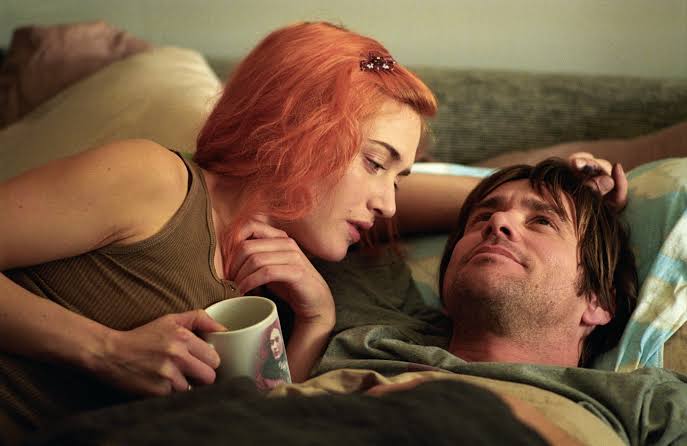
Hey there everyone! Welcome back to Movie Soapbox, the little corner of the internet that only you and I and that guy sleeping in the corner over there know about. This is the place where we find underappreciated films and we make sense of them, the ones that got through the machine a little bruised, the ones that almost didn’t get through at all. Today? We are doing a full deep dive on Eternal Sunshine of the Spotless Mind, a movie so structurally deranged, so committed to breaking every convention about how a love story is supposed to unspool, that the fact it exists in the form it does is borderline miraculous. And we are going all the way through it. Every beat. So strap in.
Before we go any further: everything from this point forward is a spoiler. The whole architecture of this film, the reason it hits the way it hits, lives in the reveals. If you haven’t watched it yet, close this tab, go watch it, come back. I’ll be here. For everyone else, good, let’s get into it.
Eternal Sunshine of the Spotless Mind Walkthrough
The first thing you need to know about Eternal Sunshine is that the film opens approximately two-thirds of the way through its own story and then proceeds to work backwards while simultaneously jumping forward, and Charlie Kaufman wrote that script knowing full well that most development executives in Los Angeles would have handed it back with a note reading something like, “Uh, can you possible assemble the puzzle before you hand it to audiences? “Can we make the first act clearer? Can we give the audience a map?” You can feel, watching the finished film, how many times that conversation almost happened. The reason the film is as disorienting as it is in the opening twenty minutes is because nobody with final cut authority over Kaufman’s draft forced a linear re-entry point into it. That is rarer than people understand. At Gondry and Kaufman’s budget tier, with a cast built around Jim Carrey coming off his dramatic-pivot period, there were absolutely rooms full of people with opinions about how a paying audience was supposed to be oriented. The film you are watching is the version where those people lost. Which is a huge win for the audience.
The Walkthrough, In the Order You Experience It
The film opens on Joel Barish, played by Jim Carrey, waking up looking like a man who has recently survived something without knowing what. Unshaven. Flat. He calls in sick, drives to Montauk on impulse, and meets a woman named Clementine on the beach. Kate Winslet. Blue hair. Zero filter between her brain and her mouth. They talk on a frozen river. They take the train back together. There is chemistry that reads as both brand-new and inexplicably familiar, and the film lets you sit in that sensation before it tells you why.
Then it cuts back. Further back. Joel waking up on a different morning, in a different emotional state, and we are now inside the real chronology, except the real chronology is itself nested inside a memory-erasure procedure that is already in progress. Joel Barish is lying in his apartment while two technicians, Stan (Mark Ruffalo) and Patrick (Elijah Wood), run equipment through his memories of Clementine and delete them one by one. The procedure works backwards from most recent memory toward emotional core. It is not painless. It is not clean. And Joel, somewhere in the sedated architecture of his own dissolving recall, realizes partway through that he does not want to be doing this, and begins trying to hide Clementine inside memories she was never part of.
Before we go further, the Valentine’s Day scene, because this is where the film’s central engine turns over for the first time on screen. Joel goes to find Clementine at the bookstore where she works, carrying a gift, and she looks at him with complete, undisturbed blankness. Doesn’t know him. Patrick is there, which means Patrick, who was the technician present for her erasure of Joel, used what he learned during that procedure to pursue her himself. He has her favorite phrases. He has Joel’s private gifts. He is running a relationship on stolen data, which the film frames as pathetic and a little predatory, and Elijah Wood plays it exactly that way, with a kind of low-grade sleaze that never tips into villain-mustache territory. Then Joel gets the card. Clementine erased him first. Or did she? Watch the way her name fades off the card. The film plants that ambiguity and does not pull it out.
What we learn across the middle of the film, as Joel’s memories are being stripped away in reverse order, is the full shape of the relationship. Clementine was not an easy person to love. She knew it. She told him. She is impulsive, combustible, capable of turning a compliment into a small wound before the sentence is finished. Joel is the opposite, passive to the point of paralysis, a man who journals feelings he never says out loud. They were, in the way of certain real couples you have known, catastrophically suited to each other. And the film respects that. It does not sand the edges down. It shows you a relationship that was worth having and also genuinely painful, and it asks you to hold both of those things, which is a demand most studio love stories refuse to make of their audience.
The architecture of the memory sequence is the film’s real formal achievement. As the deletion moves backward through time, deeper into the emotional history, the memories destabilize. Faces blur. Locations bleed together. Characters from later memories appear in earlier ones, wrong and jagged. Joel starts actively running, pulling Clementine into childhood memories, into places the technicians haven’t indexed, buying time. There is a sequence where they hide in a memory of Joel as a small child, and it is one of the stranger, more quietly devastating things Gondry ever put on film. The child Joel and Clementine in a kitchen that keeps collapsing at its edges. The whole middle act of this movie is essentially a man fighting, inside his own sedated brain, against a decision his waking self made in grief and spite. And losing.
Eternal Sunshine of the Spoteless Mind and the Stuff That Actually Needs Untangling
The timeline, which the film is not going to hand to you on a plate, works roughly like this. Joel and Clementine had a relationship. It ended badly. Clementine went to Lacuna Inc., the company run by Dr. Howard Mierzwiak (Tom Wilkinson), and had Joel erased from her memory. At some point after, Joel learned this, went to Lacuna himself, and initiated his own erasure of Clementine. The film begins during Joel’s procedure, cuts between the procedure unfolding and the present-tense aftermath, and gradually fills in the relationship itself through the memories being deleted. The Montauk beach sequence that opens the film happens after both erasures. They found each other again without knowing why.
Patrick, the technician, is worth a paragraph. He lifted personal details from Clementine’s erasure session and used them to start a relationship with her after she no longer remembered Joel. The film is damning about this but not theatrical about it. Stan, his supervisor, gives him a hard time about it because Stan knows it’s wrong. This is the same Stan who is, at that moment, allowing Mary (Kirsten Dunst), the receptionist he likes, to operate under the impression that her feelings for Dr. Mierzwiak are her own feelings, when in fact Mary has previously had a relationship with Mierzwiak that she then had erased at his request. Stan benefits from Mary’s reset memory because it meant she was suddenly available to him. The film does not underline this with a flashing sign. It just leaves it there, and if you are paying attention it makes every character in the Lacuna office structure slightly complicit in the same thing they are criticizing Patrick for.
Mary eventually figures it out. She finds the tapes, the intake records, realizes what was done to her, and mails every patient their documentation before walking out. That mailing is what delivers Joel and Clementine their own erasure records, the recordings of themselves explaining why they wanted the other person gone, which they listen to in the hallway of Clementine’s apartment building at the end of the film. It is an extraordinarily cruel scene in the best possible way. They know, now, what they were. They choose each other anyway. Or they start to.
The screenplay had an additional layer here that was cut from the final film. In the original draft, the framing device was an elderly Mary trying to publish a manuscript about Lacuna, and the closing image revealed an aged Clementine telling a stranger she recently met a man named Joel. She has had him erased, by the implication of the draft, at least fifteen times across a lifetime. The film lets you read that version in or out depending on your temperament. If they keep erasing and keep finding each other, that is either tragedy or proof of something. The film will not tell you which.
Eternal Sunshine of the Spotless Mind Explanation Theories
The Romantic Read: Joel and Clementine erase each other once. They find each other on the beach without any map to follow but something that functions like instinct. Love is more durable than the mechanisms built to erase it. The film ends with a beginning, imperfect and entirely chosen. This is the reading the film earns if you want it to earn it.
The Fatalist Read: The erasures are a loop. They have done this before. They will do it again. The tragedy is not the relationship, it is the pattern, the compulsion to destroy the record of pain rather than survive it. Lacuna is not a villain in this reading so much as a mirror. The machine that erases memory only exists because people keep asking it to.
The Unreliable Memory Read: When Joel tries to hide Clementine in memories she was never part of, he is not remembering her correctly. He is building a better version, a more patient version, a version softened by the act of losing her. The Clementine he is trying to save is already a construction. What he reconstructs after the erasure is not the woman who wrecked his car and turned his compliments into insults. It is a Clementine shaped by the grief of almost losing her. This reading makes the ending neither romantic nor tragic. It makes it a different kind of question entirely.
Moviesoapbox Read on Eternal Sunshine of the Spotless Mind
The fatalist read is the more honest one, and Kaufman’s original screenplay ending exists precisely to support it, but I do not think it is the film’s final position. The film cuts before it confirms the loop. That cut is a choice. Gondry and Kaufman are leaving the door open for the romantic reading, not because it is more comforting but because the whole architecture of the film is built on the idea that knowing something is going to be difficult, knowing you have already chosen it and regretted it, does not necessarily stop you from choosing it again, and that choosing it again anyway is not stupidity. It might be the only honest thing two people can do with what they know about each other. Joel and Clementine stand in that hallway, they hear themselves at their worst, they are looking at the full damage report, and Clementine says okay. That is the film’s thesis, it is not an accident that that word is the last one. She is not choosing despite knowing. She is choosing because of it. That is the reading I believe, and I will hold it.
Eternal Sunshine of the Spotless Mind Send-Off
Charlie Kaufman wrote a script that no normal development pipeline produces. A love story told entirely from inside the process of destroying it, with a nonlinear structure built to replicate the experience of a memory being dismantled, with a protagonist who spends the entire second act fighting the decision his own first act made. Focus Features put it out. Michel Gondry shot it the way it needed to be shot. Jim Carrey did the best work of his career in it, and the industry spent the next decade mostly not giving him opportunities like this again. The film exists. Go watch it. Some things get through.