
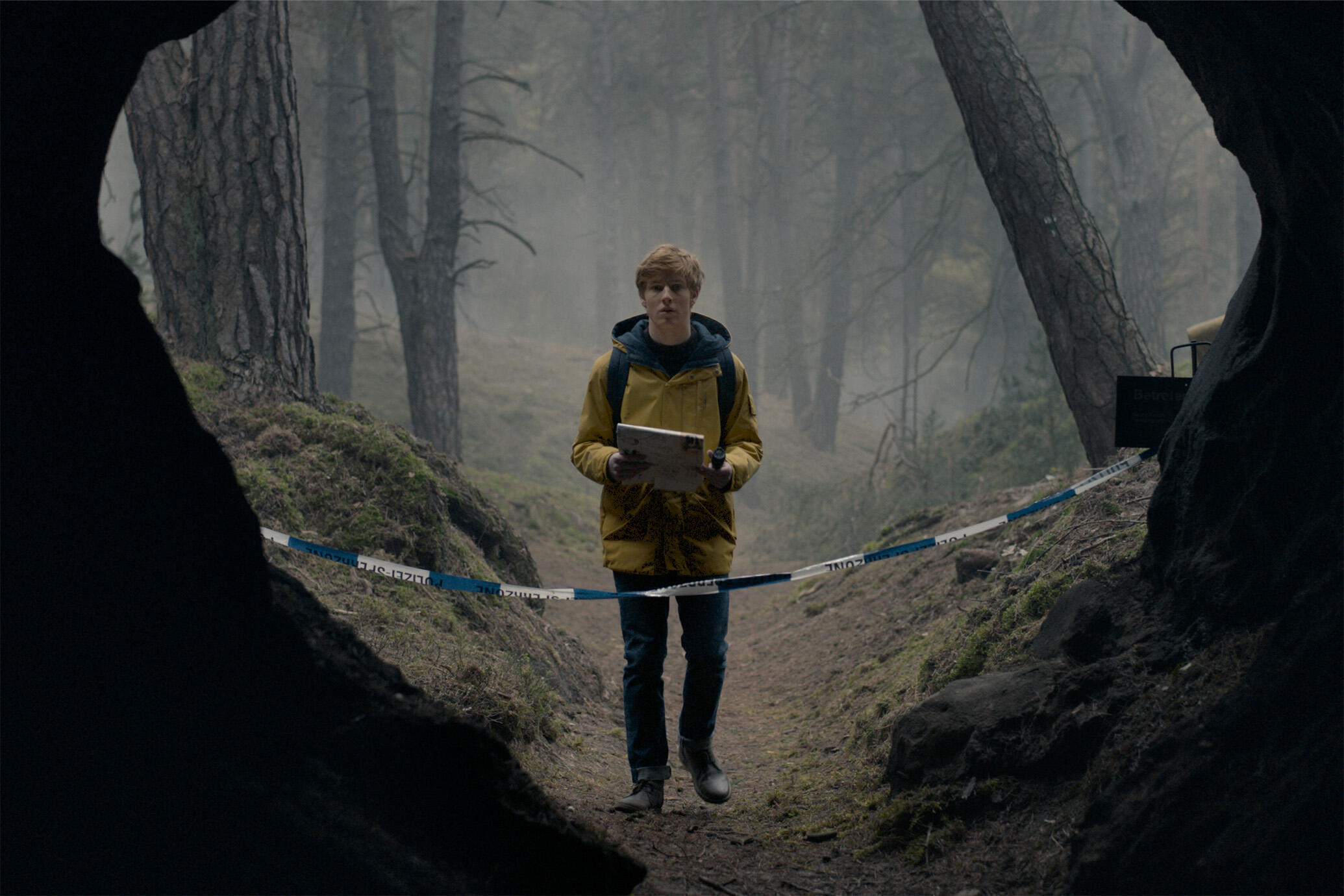
Hey there everyone! Welcome back to Movie Soapbox, the little corner of the internet that only you and I and that guy sleeping in the corner over there know about. This is the place where we find the films and shows that the algorithm buries under a avalanche of franchise product, and we make sense of them. Today? We are doing a full deep dive on Dark, the German Netflix show so structurally dense, so relentlessly committed to its own internal logic, that even the people who watched all ten episodes in a single weekend are still drawing diagrams on napkins and getting them wrong.
Alright. If you have not seen Dark Season 1 in its entirety, close this tab, go watch it, come back. Do NOT ruin the greatest series ever created by reading this page. Everything past this sentence is a spoiler. Not the soft kind where you learn a character’s name before you should. The hard kind, where you learn that the teenager you have been following for five episodes is the grandfather of the man hunting him. Moviesoapbox is not going to hold your hand through this. You were warned.
How Did Dark Get Made?!?
Before we get into the episode breakdown, let’s talk about what this show had to survive to exist, because that context matters. Dark is a foreign-language production that Netflix acquired and distributed globally, and it carries every hallmark of a creative team that knew, going in, that nobody in a Burbank development office was going to save them if they lost the thread. You can feel it in the structure, every episode functions less like a television hour and more like a chapter in a novel that assumes you are paying full attention and taking notes. The non-linear timeline is not a gimmick layered over a conventional story, it is load-bearing architecture. When you see that kind of structural commitment at this budget tier, in this format, it almost always means the writers locked the room from the inside and dared the platform to interfere. The show has no reshoot scar, no softened third act, none of the test-screening flinch you get when a distributor has panicked in post and asked for something more accessible. The ending of Season 1 is not audience-friendly. Jonas landing in a post-apocalyptic 2052 is a hard, unresolved gut-punch, and the fact that it survived to air is the argument for what prestige television can still be when the machine leaves it alone.
Dark Season 1 Episode 1: Winden, November 2019, and the Envelope Nobody Should Open
The show opens in 2019 with Michael Kahnwald walking into a room and hanging himself, and before his body is cold he has left behind an envelope with instructions not to open it until November 4th, after 10:13pm. His adoptive mother Ines takes the letter before anyone else can. Jonas, Michael’s son, returns to school from a psychiatric stay after his father’s suicide, discovers his best friend Bartosz is now dating Martha, the girl Jonas loves, and the town’s missing-child problem is already underway: Erik Obendorf vanished weeks earlier, and by the end of the episode Mikkel Nielsen disappears into the cave system outside Winden. The following morning a dead boy turns up, eyes burnt out, eardrums exploded, and he is not Erik. He is not Mikkel. He is wearing clothes from a different decade entirely.
Four time periods is the number you need to hold in your head: 1953, 1986, 2019, 2052. Everything that happens in this show happens inside that container, moving between those four points in 33-year increments, and the town of Winden is the pin that holds the whole structure to the map.
Dark Season 1 Episode 2: The Dead Boy in the Wrong Clothes
The coroner’s finding is the first concrete proof that something temporal is happening: the unidentified dead boy has been dead for sixteen hours, but he is dressed in 1980s clothing, carrying a Walkman, and the red dirt on him does not match any soil local to Winden. Mikkel, meanwhile, wakes up in the cave and runs to what he thinks is home, only to be told to get lost by a teenage Ulrich Nielsen, and the date is November 5th, 1986. Mikkel has traveled back thirty-three years. The cave is the mechanism. The door inside it is the hinge.
Dark Season 1 Episode 3: 1986 Winden, and the First Female Plant Director
Mikkel in 1986 tries every rational option available to a child who has landed in the wrong decade: his grandmother’s house, the high school where his mother works as a future principal, the police station where his father will eventually serve. None of it works, because none of those people exist yet in the form he knows them. Ines, who will become his adoptive mother, takes him in at the hospital. In parallel, Claudia Tiedemann becomes the first female director of the Winden nuclear plant and is shown a secret: the cave beneath the facility contains barrels of nuclear waste from a meltdown nobody reported. Dead birds. Dead sheep. The cave is leaking into the world in more ways than one.
Dark Season 1 Episode 4: Noah, the Watch, and the Cabin That Explains Everything
A man named Noah gives Charlotte’s deaf daughter Elisabeth a watch that belonged to Charlotte. The watch has not been lost. Charlotte is wearing it. This is the show’s first direct, impossible object loop, and it is placed in the fourth episode with no fanfare whatsoever, as though the writers fully expected you to be keeping up. Helge, operating in 1986, takes Yasin from 2019 back through the cave. The cabin near Helge’s family home, and the bomb shelter outbuilding attached to it, are where the chair is. The chair is where the children die. Everything hinges on that cabin.
Dark Season 1 Episode 5: Mikkel Is Michael, and the 33-Year Mechanism
The package Jonas receives from the Stranger contains the suicide note his father left. The note explains it: Mikkel traveled back to 1986, was stranded, grew up, changed his name to Michael, married Hannah, and had a son named Jonas. Jonas is his own grandfather’s contemporary. His father is his childhood friend’s little brother. The 33-year theory is stated explicitly by the Stranger: the cave wormhole aligns at 33-year intervals, and the universe only finds coherence within those multiples. This is not a twist. This is the operating manual for everything that follows.
Dark Season 1 Episode 6: Jonas Goes Back
Following the Geiger counter his father’s suicide note led him to, Jonas finds the cave door and walks through into 1986, where missing-child posters for Mads Nielsen cover every surface. In 2019, Ulrich is closing in on the truth about Mads through a tangle of misdirected accusations: Tronte’s affair with Claudia, Regina’s accusation against Ulrich, Hannah’s accusation against Ulrich, and a scar on the unidentified dead body’s chin that matches a scar Mads got in a childhood fight. It’s the same body. Mads went into the cave in 1986 and came out dead in 2019, thirty-three years displaced.
Dark Season 1 Episode 7: Helge and Noah, Confirmed
The final scene of the episode: young Helge in 1986, stepping out of the cellar, staring at Yasin’s body on the ground, and Noah in the cellar behind him, scrubbing the floor clean. The abductions are not random. Noah is running experiments on the children using the chair, attempting to crack the mechanism of time travel, and Helge is disposing of the failed results across time periods. Ulrich visits the elderly Helge in the nursing home and is physically removed. The splinter in his mind from Helge’s cryptic answer about the forest road does not leave him. Jonas, in 1986, is stopped by the Stranger from approaching Mikkel at the hospital, and the Stranger’s reasoning is cold and precise: any change to Mikkel’s timeline erases Jonas. The Stranger cannot let Jonas unmake himself.
Dark Season 1 Episode 8: 1953, Ulrich, and the Original Machine
Ulrich follows Helge through the cave door and exits in 1953, where he meets his own grandmother Agnes and his infant father Tronte simultaneously, where the nuclear facility is still under construction, and where Tannhaus is a young man who has not yet written the book Ulrich is holding. Ulrich beats Helge nearly to death in the woods, believing he can prevent the future abductions by removing Helge from the timeline before he becomes complicit in them. The Stranger, in 1986, brings the broken brass time machine to Tannhaus and asks him to repair it. Tannhaus pulls out the original device he built himself to help with the repairs, and the Stranger’s intention is stated: not to travel through time with the machine, but to destroy the wormhole entirely. Tannhaus finds the Stranger’s cell phone in his coat pocket and the scene holds on his face for a long beat. This is the moment the old clockmaker begins to understand what he has actually built.
Dark Season 1 Episode 9: Claudia, Aleksander, and the Architecture of the Light
Claudia delivers the plans for the copper time machine to Tannhaus in 1953, which means Claudia is the origin point of the device that Tannhaus builds, that the Stranger carries, that Jonas will eventually fire. The bootstrap loop is complete. Nobody designed the machine. It arrived from the future, complete, and Tannhaus built it from plans that came from the future version of a device he built from plans that came from the future. There is no first inventor. Claudia in 2019 finds Bartosz and introduces herself as his grandmother, the woman he thought was dead, and the boy is now positioned between two factions: Noah’s order of the shade, and Claudia’s order of the light. Aleksander, the man who appeared in the woods in 1986 to intercept Katharina attacking Regina, is carrying two passports and has a name that is not his own. He is still unexplained at the end of the season, and that is deliberate.
Dark Season 1 Episode 10: Jonas Is the Stranger, and the Wormhole Opens
Peter is in the cabin when Mads Nielsen’s body falls through a rift into 2019, thirty-three years after Mads disappeared. Claudia walks in and tells Peter and Tronte they have to move the body to where it will be found, because the timeline does not bend. Charlotte, investigating the 1953 abductions, finds a photograph of Ulrich as the prime suspect in a murder. Ulrich is in a 1953 prison cell insisting the boys should be alive now that he has killed Helge, not understanding that Helge is not dead, and that it was never Helge doing the killing anyway. Elder Helge travels back to 1986 to warn his younger self away from Noah. Younger Helge does not listen. Elder Helge drives his car into younger Helge’s car in an attempt to physically prevent the meeting. Younger Helge survives. Elder Helge does not. Jonas, trapped in the cellar of the cabin, has a conversation through a door with the Stranger, and the shape of it closes the loop: Jonas is the Stranger. The boy in 2019 and the man moving through the decades are the same person at different points in his own timeline. Jonas ignites the brass machine in the cave. The wormhole opens. Young Helge, still in 1953 recovering from Ulrich’s beating, sees Jonas through the portal, they touch hands, Helge is pushed forward to 1986, Jonas is pushed from 1986 forward to 2052. He walks out into a post-apocalyptic Winden. A truck arrives. Guns are raised. Welcome to the future.
Dark and The Mechanics: What Actually Happened and How
The closed loop is the whole show. Winden is a sealed system, and every attempt to change the timeline is itself part of the timeline. Ulrich did not prevent Helge from becoming Noah’s accomplice, he created the conditions for it: a traumatized boy beaten senseless by a man from the future, found by a priest who showed him kindness, bound by gratitude to that priest forever. Jonas did not destroy the wormhole. He created it. The Stranger spent decades moving through time to undo the thing that Jonas-as-boy was always going to do, because the Stranger is Jonas-as-boy, and the loop cannot be broken from inside the loop. Tannhaus did not design the machine. He assembled it from instructions that originated in the future of a machine he had not yet built. There is no prime cause. Every cause is also an effect.
The four time periods function as chambers: 1953, 1986, 2019, and 2052. The cave connects them. The door inscribed with Sic Mundus Creatus Est, thus the world was created, is the hinge. Travel through it moves you back or forward thirty-three years depending on direction. The chair is Noah’s failed prototype, running on caesium, killing children in the experiment chamber when their eardrums and eyes cannot survive the pressure of forced transit. The copper suitcase device is the refined version, portable, Claudia’s design delivered to Tannhaus as plans from a future she already lived through.
Dark Season 1 The Theories
Three main reads have circulated since the season landed, and all three are defensible against the text.
The first is the pure closed loop: the timeline is fixed, nothing changes, every attempt at intervention is itself already woven into the fabric of what happened, and the show is an elaborate demonstration of why free will cannot exist inside a causal loop. Ulrich beats Helge because Helge will become a killer. Ulrich beating Helge is why Helge becomes a killer. The loop is the point.
The second is the hidden branch theory: the show’s events are not a single closed loop but a loop that has been running and accumulating small deviations across iterations, and what we are watching is a late iteration, one with enough accumulated drift that the characters might finally be capable of breaking the cycle. The evidence for this is the emotional weight the show places on characters who seem to have knowledge they should not possess, Claudia in particular, whose understanding of the system seems to exceed what a first-pass participant would have.
The third is the Hermetic reading the show itself invites: the loop is not a mechanical prison but a moral one, a closed world that amplifies the flaws of its inhabitants rather than correcting them, and the question is not whether the loop can be broken by cleverness but whether any of these people can become different enough to deserve breaking free. The Ariadne monologue Martha performs is the clearest statement of this frame: the labyrinth is not just a structure, it is a test, and the thread you were given to find your way out was cut by someone you trusted.
Moviesoapbox’s Take on Dark Season 1
The closed loop is correct, and the hidden branch reading is how Season 2 will complicate it, and the Hermetic reading is what elevates both of those interpretations above puzzle-box mechanics into actual drama. But if you are asking which theory the first season earns on its own terms, the answer is that time in Dark does not bend. Ulrich cannot save Mads. Jonas cannot save Mikkel. The Stranger cannot destroy what Jonas will always create. Every action in this show is the cause of the condition it was trying to prevent, and the show commits to that with a conviction that most American genre television will not touch because test audiences find it depressing. Jonas walks out of that cave into 2052 because he was always going to walk out of that cave into 2052. The tragedy is not that he failed. The tragedy is that trying was always part of the loop.
This is what a show looks like when nobody flattened the third act. Nobody softened the closed loop into something more hopeful so the finale would land warmer in the room. The machine ate the children, Jonas became the Stranger, and the wormhole opened because the wormhole was always open. The suits who greenlit this show got something they almost certainly did not fully understand, and for once, that worked out. See you next time.