

Hey there everyone! Welcome back to Movie Soapbox, the little corner of the internet that only you and I and that guy quietly crying in the back row know about. This is the place where we find the films that actually cost somebody something to make, and we figure out what they were really doing. Today we are going deep on Manchester By The Sea, a movie so relentlessly, almost aggressively uninterested in making you feel better that the people who funded it must have had a brief, panicked phone call somewhere around the third act wondering what exactly they had paid for.
Before we go any further, the trailer. Watch it if you need a reminder of what you are walking back into.
Alright. What follows is the full deep dive, and it is going to go everywhere this movie goes. Every plot point, every gut-punch, every quiet devastating thing Kenneth Lonergan hid in the corner of a frame. If you have not seen Manchester By The Sea yet, close this tab, go find it, and come back when you are ready to not feel great for a few hours. You have been warned, and unlike the suits who passed on this film for two years, I am not going to hold your hand through the rough parts.
What This Film Had to Survive to Exist
Casey Affleck carries this movie on his back across about a hundred and thirty-seven minutes of screen time in which his character says, at a rough estimate, four hundred words. That is the entire performance contract Lonergan handed him, and any development executive at a mid-level studio reading that script description, a janitor who doesn’t talk much and doesn’t get better at the end, would have sent back notes asking where the arc was. Where the catharsis was. Where the scene was where the music swells and the thing inside Lee Chandler finally cracks open in a way that feels tragic and transcendent in a very poignant way. That note was never sent, or if it was sent, it was ignored, because what Amazon ended up with is a film that flatly refuses to perform its own healing for your benefit. You can tell when a film has survived that particular fight because the grief in it moves the way real grief moves, which is sideways, and sudden, and it doesn’t announce itself before it hits you. The third act of this movie reads like a director who locked the cutting room door.
Manchester By the Sea – What Actually Happens
Lee Chandler is doing maintenance work at a Boston apartment complex when we meet him, and the specific texture of that job matters. He is not just a janitor. He is a man who has arranged his entire life around being as replaceable and as invisible and as available to be treated badly as possible, because somewhere underneath all that flat affect he has decided that this is the correct amount of life for a person like him to take up. His brother Joe dies of a heart condition back in Manchester, the Massachusetts coastal town Lee left a long time ago for reasons the film is going to take its time explaining to you, and Lee drives up to handle things.
Joe’s son Patrick is sixteen. Patrick knew his father was sick and had been watching the clock on this for a while, which gives him a specific kind of teenage grief, loud and compartmentalized and furious in the way that only grief you have already partially pre-processed can be. Lee takes Patrick to the reading of the will. Joe has named Lee as Patrick’s legal guardian. Lee’s face does something here that Casey Affleck performs entirely in the muscles around his eyes, which is that he looks like a man who has just been asked to do something he is genuinely not sure he is capable of surviving.
And then the film tells you why.
The backstory arrives in fragments. Lee and his wife Randi had three kids, two daughters and a son. One night Lee had some friends over, drank too much, got stoned, and when Randi sent everyone home he built a fire in the fireplace to keep the kids warm. Then he walked to the convenience store because he needed something, beer probably, and he forgot to put the screen up in front of the fire. He walked back. The house was burning. His daughters didn’t make it out.
The police interview him and then tell him he can go. He stood there looking at a cop who was explaining that forgetting to put a screen up was not a crime they could charge him with, and you watch Lee process the fact that the world was not going to give him the punishment he had already handed himself. He reached for a cop’s holstered gun on the way out of the station and tried to use it on himself. The safety was on.
This is the weight Lee is walking around Manchester with. And Manchester knows. The whole town knows. That is not a metaphor, it is just the literal reality of small New England communities, everyone knows everything, and the knowledge has curdled into something that follows Lee down every street. He can’t get work in town. He can barely walk into a bar without somebody’s friend of a friend deciding tonight is the night to say something.
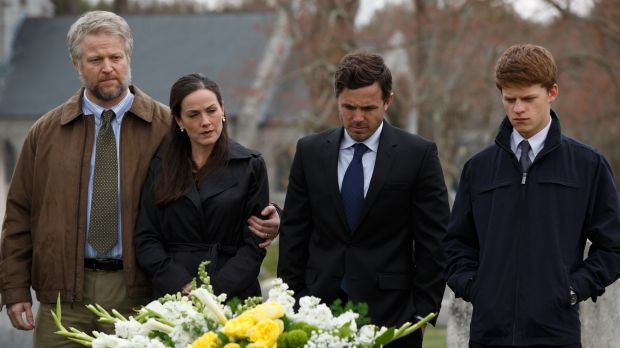
What Grief Looks Like When It Has to Keep Moving
The film’s engine is these two people trying to manage loss on completely different timelines. Patrick is grief-as-motion, he wants to keep going to hockey practice, keep juggling two girlfriends, keep the band rehearsals, keep every structure of his regular life intact because if he stops moving the thing he has been running just ahead of will catch up with him. Lee is grief-as-stasis, he has already been caught, years ago, and the strategy he landed on was just to make himself small enough that nothing else could find him.
Joe’s will creates a problem that is also, in the way the best films construct their mechanics, a kind of solution. Lee cannot move Patrick to Boston, Patrick’s whole life is in Manchester. Lee cannot move back to Manchester, the town has made that transaction impossible. So they are stuck together in the place that is worst for Lee, trying to figure out if there is a version of this arrangement that lets Patrick have something like a functional adolescence, and the film is not going to pretend this problem gets solved neatly.
Patrick has a moment in the middle of the film where he opens the freezer, sees the frozen food stored there, and suddenly the grief that has been running on a delay crashes through him completely. It’s physical and helpless and it doesn’t look like movie crying. Lee sits with him through it and doesn’t say anything useful, because there is nothing useful to say, and the film understands that sitting there without useful things to say is sometimes the whole job.
Randi
There is a scene late in the film that wrecks the average viewer more completely than any of the fire flashbacks. Lee runs into Randi on the street. She has remarried, she has a new baby, she has built a life on the other side of what happened, and she wants Lee to know that she doesn’t blame him and she is sorry for some of the things she said after, and the words are coming out of her and she means them. Watch what Affleck does. He is standing there trying to receive this, trying to let this woman’s forgiveness actually land somewhere inside him, and he cannot do it. The circuitry isn’t there. He gets about four words out before he has to walk away, and you understand that the forgiveness was real and it did not matter, because the thing blocking Lee is not Randi’s judgment, it is his own, and that is a jurisdiction she cannot reach.
Manchester By the Sea and What the Ending Is Actually Saying
The ending is not a failure. Every reviewer who walked out frustrated by the ending watched a different film than the one Lonergan made. Lee finds Patrick a guardian he can actually live with, his father’s old friend George, a man with a family and a house in Manchester who can give Patrick the stability Lee cannot provide. Lee gets himself a slightly better job, two buildings instead of one overloaded complex, a boss who doesn’t treat him like garbage. He tells Patrick he got a slightly bigger apartment, there’s a pull-out couch, Patrick can come whenever he wants.
That’s the ending. That is the entire ending.
Some people cannot be fixed by the plot. Some people have done a thing, or had a thing done to them, or both, and the honest answer is that they are going to carry it for the rest of their lives and the best available outcome is a life that is slightly less punishing than the one they had before. Lee is alive. Lee has stopped letting his employer treat him like a punching bag because he subconsciously agreed he deserved it. Lee has spent several months living outside the perimeter of his own damage because Patrick needed him to. He didn’t heal. He moved. In some circumstances, that’s the whole victory.
Joe knew something everyone else had given up on knowing. He put it in the will because he understood that Lee would never have chosen Patrick, and Patrick needed someone who had enough left in him to choose, even reluctantly, even badly, to be something for another person. That belief cost Joe nothing but a conversation with a lawyer. It cost Lee four months of the hardest thing he had done since the fire. The film thinks that trade was worth making. So do I.
The Manchester By the Sea Competing Theories
There are roughly two camps on what this film is finally about. The first camp reads it as a film about the limits of grace, about what forgiveness can and cannot do, about the gap between being forgiven by others and being able to forgive yourself, and Lee’s inability to accept Randi’s absolution as the central unresolvable knot. This is the reading that makes the ending feel tragic, because Lee has been offered the thing that should fix him and he is constitutionally unable to receive it.
The second camp reads it as a film about functionality versus feeling, about the difference between being healed and being able to function, and argues the ending is genuinely hopeful on its own modest terms. Lee is not okay. Lee is, for the first time in years, slightly more okay than he was. He extended himself for Patrick. He stopped contracting. The pull-out couch is an open door. This reading finds the ending closer to redemption than tragedy, just redemption at a very human scale, the kind that doesn’t feel like anything in the moment it happens.
There is a third, smaller camp that thinks the film is primarily about Joe, about the specific kind of faith a person places in someone everyone else has written off, and that the real subject is Lee’s brother believing in him past the point where belief was rational. Joe is dead for ninety percent of the runtime and he still manages to be the film’s moral center. That read is interesting and not wrong.
Moviesoapbox’s Favorite Theory
I’m thinking that the second camp is right, and I will tell you why. The film’s title is not Lee Chandler. It’s Manchester by the Sea. The town is the antagonist and also the thing Lee cannot leave behind, literally and psychologically, and the fact that he has stopped running from it, stopped pretending he can put enough geography between himself and what happened, is itself a form of moving through something. He goes back. He functions there. He keeps a door open for Patrick. Nobody on this earth is getting a standing ovation for that, and the film is specifically, deliberately not giving you one. But Lonergan is not saying Lee is broken beyond use. He is saying the repair looks like a pull-out couch and a two-building maintenance job and an open phone line, and that for a man who tried to take a gun off a cop in a police station ten years ago, that is a damn long way to travel.
Kenneth Lonergan got something true on screen. He had a cast that was serious enough to keep the studio from demanding a reshoot that explained everything at the end. He had an Amazon check that was large enough to protect the cut and small enough that nobody upstairs had built a franchise around it. The result is one of the few films made in the last decade that treats grief as a condition rather than a plot problem to be solved by the third act. Films like this don’t usually survive the process that makes films. This one did, barely, and you can feel the scars of that survival in how hard it refuses to give you what factory Hollywood would have given you instead. Be glad it exists. Watch it again when you are ready to not feel great for a few hours. It holds up.
🎬 If You Liked This…
- Pig — a man who has withdrawn completely from the world after loss, the same portrait of grief as something you don’t recover from but simply learn to carry in a different way
- Leave No Trace — a man for whom ordinary life is simply no longer available, living outside the world’s edges with someone he loves and trying to protect them from the fact that he can’t come back in
- Galveston — a man at the absolute end of his rope trying to do one decent thing before everything runs out, same working-class devastation and same refusal to let anyone off easy