
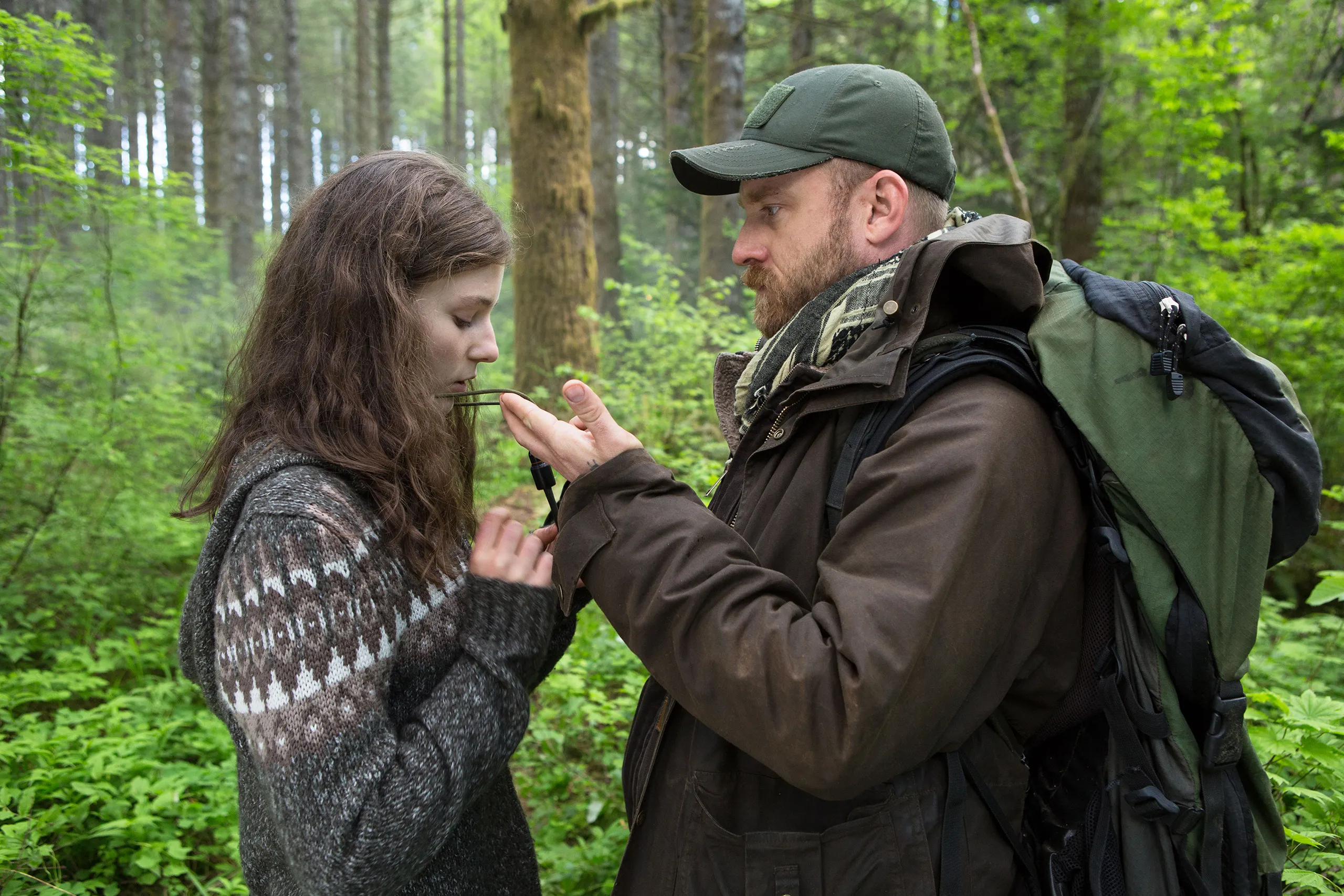
Hey there everyone! Welcome back to Movie Soapbox, the little corner of the internet that only you and I and that guy sleeping in the corner over there know about. This is the place where we find underappreciated indie films and we make sense of them. Today? We are doing a deep dive on Leave No Trace, a movie so quietly, surgically devastating that you don’t realize it’s taken you apart until you’re already on the floor staring at the ceiling wondering what just happened to you.
Fair warning before we go any further: everything from this point forward is a spoiler. The ending, the gut-punch line of dialogue that splits this film in two, the final image, all of it. If you haven’t seen Leave No Trace yet, close this tab, go watch it, come back. I’ll be here. It’s on multiple streaming platforms right now and it costs you nothing but ninety-four minutes and whatever emotional reserves you’ve got left. Go. The rest of you, stay close, because we have things to discuss.
Before we get into the beat-by-beat, I want to tell you something about what this film is, industrially speaking, because it matters. Leave No Trace is a Debra Granik film, and Debra Granik is the kind of filmmaker the studio system tolerates only when she attaches names that make the foreign sales spreadsheet work. The budget on a film like this, somewhere in the four-to-six million range by most reasonable estimates, puts it in that particular hell-zone where you’re too expensive to operate completely freely and too cheap for anyone at the distributor level to actually care whether the vision survives intact. At that tier, the pressure doesn’t come from one big studio note, it comes from a dozen small surrenders, a cast compromise here, a third act that gets sanded down there, a distributor who starts asking whether the ending tests. What you can tell watching this film is that Granik didn’t make those surrenders. The ending doesn’t test well. The father doesn’t get better. Nobody is redeemed on a timeline that satisfies a committee. That’s not an accident of budget, that’s a director who understood exactly what she was protecting and protected it. Films at this level that don’t have a Granik-caliber filmmaker in the chair, with a Ben Foster attached to give the sales team something to work with, don’t come out looking like this. They come out with a third act that explains everything, ties everything together, and costs the story everything that made it matter.
Leave No Trace Walkthrough
So. Will and Tom. Father and daughter, living in the woods of Forest Park in Portland, Oregon, running drills, changing campsites, staying invisible. We don’t get a biography on Will, played by Ben Foster with the kind of performance that makes you forget you’re watching a performance, we don’t get a diagnosis, we don’t get a backstory monologue. Granik gives you behavior and she trusts you to read it. Will is a veteran. He is somewhere on the wrong side of whatever line separates managing from not managing. He’s built a life in the forest because the forest doesn’t press in on him the way other humans do, the way enclosed spaces do, the way the whole dense, grinding texture of civilian life does. Tom, his daughter, played by Thomasin McKenzie in a performance that should have made her a household name two years earlier than it eventually did, has grown up in this. She knows the drills. She forages. She has adapted so completely that when we first meet her she isn’t suffering, she genuinely belongs out there. That’s the first thing Granik needs you to believe, and you believe it, because McKenzie makes you believe it.
They get caught. A jogger spots Tom, the authorities converge, and suddenly Will and Tom are processed into the system they have been hiding from. What follows is a stretch of the film that could have turned into a procedural, a social services thriller, a debate about parental rights, and Granik refuses every single one of those framings. The case workers are kind. The people who offer Will work on a Christmas tree farm are kind. The RV park owner toward the end is kind. The source material gets criticized for this, I’ve read the takes, people call it unrealistic, and maybe it is. But the point isn’t to document how the system actually treats veterans and their children. The point is to remove that excuse from Will entirely. The world is not persecuting him. The world is bending over backward to accommodate him. And he still can’t stay in it. That’s the tragedy. That’s the thing the film needs you to understand before it earns its ending.
Watch Will in the farmhouse. Watch the way Ben Foster plays those scenes, the subtle physical restlessness, the way a man looks when the walls are closing in on him even though the walls are not closing in on him. At one point he and Tom say to each other, “They can never take away our thoughts,” and it sounds like something you’d say to yourself in a prison cell, except they are in a house that someone gave them, on a farm, with work to do and food on the table. The imprisonment is entirely internal. Will cannot locate the mechanism that allows other people to simply live among other people. Whatever that mechanism is, the war, or the accumulation of years, or something that was already wrong before any of that, it’s gone. And the film never tells you which. Good. It shouldn’t. Granik is hunting something authentic, that’s the word Ben Foster used in his LA Times interview about working with her, watching her on set was like watching someone trying to save their own life, and the authentic thing here is that damaged people often can’t tell you exactly what’s wrong with them, and neither can the people who love them.
Tom, meanwhile, is changing. This is the actual story of the film. Not Will’s condition, his condition is fixed, it is the weather this film takes place in. The story is Tom realizing that the weather doesn’t have to be her weather. She joins 4H on the farm. She sings around the fire at the RV park. She watches how community functions, the way it catches people, the way it holds them, and she starts to want it the way you want something you didn’t know existed until you saw it. McKenzie plays this so carefully, there’s no single moment where Tom decides to want a different life, it accumulates, the way actual change accumulates, scene by scene, small choice by small choice, until one day she’s a different person and she couldn’t tell you exactly when it happened.
Which brings us to the ending, and the line of dialogue that the whole film has been building toward without you knowing it. Will’s leg is injured after a fall in the woods, they are back at the RV park, Tom has been quietly negotiating to extend their stay, quietly measuring the distance between what her father needs and what she needs, and then Will tells her they are leaving. He starts to say “We need to…” and Tom stops him. “You. YOU need… the same thing that is wrong with you, isn’t wrong with me.”
One sentence. The film’s entire argument, delivered by a teenage girl to her father on the edge of a forest. Granik sits on that line. She lets it breathe. She doesn’t cut away from it. You can feel the weight of everything it took Tom to say it, every adaptation, every drill, every cold night under a tarp, every small surrender of her own life to his condition, compressed into nine words.
They leave anyway. They head back into the woods. And then Tom stops. She gives her father her necklace. She hugs him. She turns around and walks back to the camp.
There’s a final image the film gives you, layered over this separation, about the RV park owner who has been leaving food hung from a tree in the forest for years, for someone who never shows themselves. The food always disappears. You don’t have to work hard to read that image. Tom will leave a light on. Will will be out there. They will love each other across a distance that neither of them chose and neither of them can close. That’s the ending. Nobody is healed. Nobody is redeemed. The daughter saves herself and loves her father anyway and that has to be enough because that is all there is.
Leave No Trace Movie Explained
Theory Number One
For the people who want a clean read on what this film is and isn’t saying: the film is not arguing that Tom is abandoning her father. It is not a story about a bad father. Will is not villainous. He is not even negligent in the ordinary sense. He loves Tom with everything he has. What he cannot give her is a life among other people, and what the film argues, gently but without flinching, is that love is not always sufficient to build a life around. Tom has to choose herself. The film believes she’s right to do it. It also believes she will grieve the choice for the rest of her life, and it doesn’t pretend otherwise.
Theory Number Two
The competing reads on this film mostly live in the question of Will’s interiority: is he a man who makes a series of bad choices, or a man who is medically incapable of making the choices that would keep his daughter? The film refuses to decide for you. The evidence supports both. A viewer who comes out of this angry at Will is not wrong. A viewer who comes out of this heartbroken for him is not wrong either. Granik earns both responses simultaneously, which is the mark of a screenplay, adapted from Peter Rock’s novel, that understands ambiguity as a structural choice rather than a failure of nerve.
Moviesoapbox’s Read on Leave No Trace
My read? Will knows. That’s what I think. I think he knows, somewhere under all of it, that Tom is right, that what is wrong with him is not wrong with her, and that the kindest thing he will ever do for her is let her go when she stops following. The necklace exchange. The way Foster plays that moment. He doesn’t argue. He doesn’t try to pull her back. There’s something in that stillness that reads, to me, like a man doing the only right thing left available to him. A man who has failed at everything civilian life asked of him finally getting one thing right. That’s the reading I’m planting my flag on.
Debra Granik made this film in the space the industry leaves for films it doesn’t fully understand and isn’t sure it can sell. She made it anyway, with a cast that believed in it, at a budget level that required every single shot to earn its place. The system that would have turned this into something cleaner, something more resolved, something with a third act a focus group could sign off on, didn’t get to it. You can tell by looking at the ending. Nobody let that ending out of a committee. Somebody fought for it. That’s the whole job sometimes, just fighting hard enough to let the real thing through. Granik did that here. Go watch it if you haven’t. Come back if you have. We’ll keep the light on.