
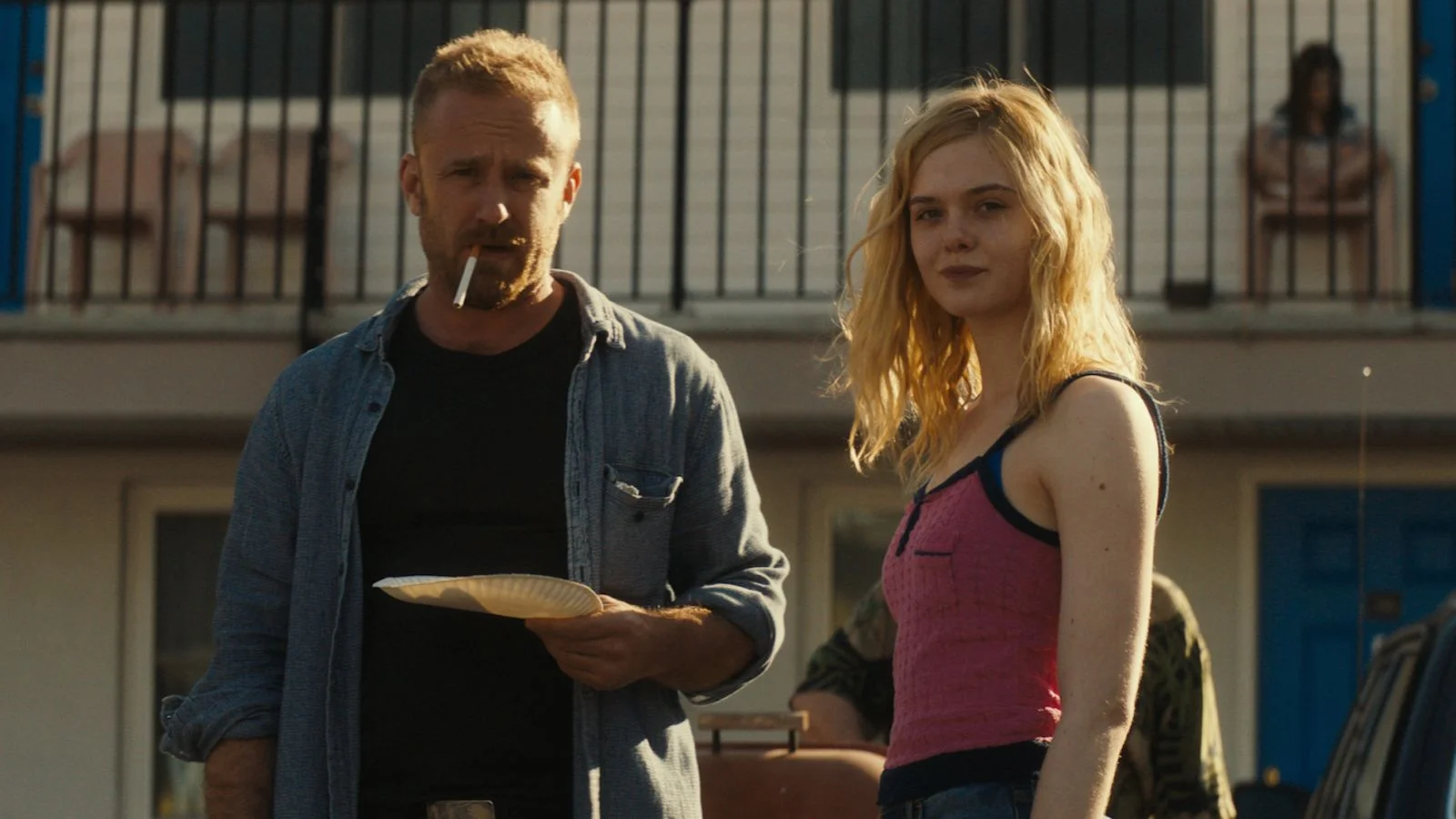
Hey there everyone! Welcome back to Movie Soapbox, the little corner of the internet that only you and I and that guy sleeping in the corner over there know about. This is the place where we find underappreciated indie films and we make sense of them. Today? We are doing a deep dive on Galveston, a movie so relentlessly, specifically dark that even the people who made it probably needed a few weeks in a bright room afterwards to remember what sunlight feels like.
Quick housekeeping before we go any further: everything from this point on is a spoiler. The whole movie. The ending, the death, the hurricane, the thing with Tiffany, all of it. If you have not seen Galveston and you care about going in clean, the door is right there and the film is absolutely worth that effort. Come back when you’re done. For everyone else, good, settle in, because we have some ground to cover.
First, Nic Pizzolatto wrote this screenplay. This is the man who wrote the first season ofTrue Detective. That single season is in my top three best shows of all time. Pizzolatto works in a very specific register: men who are already broken at frame one, violence that arrives without the courtesy of telegraphing itself, and moral questions that the film asks in full sincerity and then absolutely refuses to answer for you. Galveston is all of that, compressed into ninety-some minutes, and handed to a cast that had no business being this good in a film this size.
And that is where the industry context lands, because a film like this, a non-franchise, non-IP, R-rated neo-noir with a budget that probably wouldn’t cover the catering on a Marvel reshoots week, survives to exist in one of two ways: either nobody important noticed it long enough to ruin it, or the talent attached was just credible enough to keep the notes light. Ben Foster at the top of a cast tends to have that effect. He is not a name that sells a hundred million dollars in opening weekend tickets, but he is a name that makes a certain kind of development executive nervous about looking stupid in front of their peers if they push too hard. That nervousness, that specific social calculus inside a production office, is sometimes the only thing standing between a film like this and a version of itself that ends with Roy finding some kind of peace and Tiffany smiling in a doorway somewhere warm. The third act of Galveston reads like it was never seriously threatened by that version. Somebody held the line.
Galveston Movie Detailed Walkthrough
Roy works for Stan, a low-rent Gulf Coast mob operator, doing the kind of work that people in these arrangements describe with careful vagueness: collections, intimidation, the presence of a man in a room who looks like he has made specific choices in his life. Roy also, quietly, believes he is dying of lung cancer, which is the kind of detail Pizzolatto plants early not as a plot mechanism but as a moral weather system, because everything Roy does from that point forward is colored by a man who has already started settling his own account in his head.
Stan sends Roy to a house with instructions that should have registered as wrong the moment they were delivered: go there, scare some people, and do not bring a gun. Roy brings a gun anyway, which is the first and maybe most important decision he makes in the film, because the house is a trap. Stan has decided Roy is a loose end worth trimming. Roy’s partner dies in the opening exchange of gunfire. Roy survives because Roy is exactly the kind of man you build a Pizzolatto story around, not lucky, exactly, just slightly more durable than the violence aimed at him, and as he is getting out he finds a young woman named Rocky tied to a chair and cuts her loose and they run.
Rocky is played by Elle Fanning, and the performance is the film’s other structural support beam alongside Foster. Rocky is nineteen or so, has fled an abusive home, and has been surviving the way that specific combination of young and desperate and female and invisible tends to produce in stories set in this geography and this economic stratum. She was at the house because she was working. Roy and Rocky are now, whether either of them would have chosen it, bound to each other by the specific logic of people who have witnessed the same crime together and have nowhere else to go.
The road trip structure that follows is not a road trip in any genre sense. There is no loosening, no warmth gradually accumulating through shared miles. Rocky convinces Roy to swing past her childhood home, and he does, and she comes out with a small girl she calls her kid sister, Tiffany, and Roy understands in that moment that the geometry of what he has agreed to has just changed substantially. They hole up in an extended-stay motel, the kind of place that doesn’t ask questions because the clientele it attracts cannot afford to answer them, and Roy finds a newspaper article that tells him Rocky’s husband is dead and there is a missing daughter, and the arithmetic resolves in a way Roy does not like.
Roy spirals outward, goes looking for an old girlfriend, the kind of pilgrimage a man makes when he thinks he is dying and wants something to soften the inventory of his life. She does not provide that. He comes back with nothing resolved. Rocky, meanwhile, has gone back to the street because the money has to come from somewhere, and while she is gone a fellow motel resident, the specific human version of a loose end, figures out enough of what happened to try extortion. Roy kills him in a back alley. This is not presented as a dramatic turning point. It is presented as maintenance.
Eventually Rocky returns from what the film handles obliquely as a several-day disappearance, and Roy finds her, and she breaks open and tells him why she killed her husband, through the kind of crying that is not performed grief but accumulated pressure finally finding an exit. And then she asks him not to leave. Roy, a man who has by this point killed at least one person since the film began and is operating on borrowed time from Stan’s organization and believes he has lung cancer, agrees to stay. This is the film’s single gesture toward something that might be called tenderness, and Galveston is not a film that lets tenderness exist without cost.
Stan’s people find them. They hurt Roy badly enough that the film lets you understand he will not be winning this particular fight through violence. He finds Rocky. She is dead. The film does not linger on this in a way that aestheticizes it, which is one of the things that separates a Pizzolatto script from a lesser version of itself. It simply presents it as the thing that happened, the bill that came due, and Roy crashes his car getting away and ends up in a hospital.
He does not testify against Stan. This is implied rather than shown, and the implication carries a specific weight: Roy’s silence is not cowardice and it is not loyalty, it is the only remaining action available to him that functions as protection for Tiffany. He goes to prison. He gets out. A hurricane is bearing down on the coast, and Tiffany, now grown, finds him in it.
That is where the film ends. In a storm, with a girl asking a broken man for answers he does not have clean enough to give her.
The timeline of the film is straightforward once you hold the two threads clearly: the main action, Roy and Rocky on the run with Tiffany, and the frame of Roy’s post-prison present, where Tiffany tracks him down. The film does not play games with chronology the way a lesser script might, trying to manufacture mystery through fragmentation. The mystery in Galveston is not structural, it is moral, and it lives entirely in the question of what we are supposed to make of what Roy did and whether it added up to anything.
Theories To Explain the Movie Galveston
Galveston Theory Number One
The first read is the simplest: this is a redemption narrative in a world that does not permit redemption to land cleanly. Roy, believing he is dying, stumbles into a situation that gives him one opportunity to do something that is not purely self-interested, and he takes it, and the universe does not reward him for it, because the universe in this film is not in the business of reward. Rocky dies anyway. Tiffany survives, technically, but survives into the knowledge that her mother is dead and her father figure is a man who could not protect the person she needed him to protect. The math on Roy’s ledger does not balance. He knew it would not. He did it anyway. That reading is coherent and the film supports it.
Galveston Theory Number Two
The second read is darker and, I think, more honest to what Pizzolatto actually built here: Roy is not attempting redemption at all, because Roy does not believe redemption is available to him. He knows the account is settled already, and settled badly, and he is not trying to correct that. He is trying to do one thing that is not for himself before the lights go out, not because it will change anything, but because he still has the capacity to want to, and that capacity is the last thing he has that feels like it belongs to him rather than to Stan or to the life he built or to the cancer working through his chest. Rocky dies. Tiffany lives. That is the outcome. Roy goes to prison not because he was caught but because he chose it, chose silence and the cell over a testimony that would have put Tiffany in the crosshairs of whatever Stan’s organization wanted to do about loose ends. The protection is real even though he gets no credit for it and she does not know the full shape of what he did.
Galveston Theory Number Two
The third read, the one the film floats but does not commit to, is the question of whether Roy, standing in that hurricane at the end, is passively accepting a kind of death. Whether the storm is the judgment he has always understood was coming and he has simply stopped moving away from it. Tiffany arriving interrupts that, if it is what it is. Or she arrives to find a man who has finally run out of forward motion and has turned to face what’s behind him.
Moviesoapbox’s Take on the Movie Galveston
My read is the second one, and I want to be clear about why. The film’s final image is not a man destroyed by circumstance. It is a man who made every choice with full knowledge of the cost and paid it, and the cost was real, and the payment was real, and none of that adds up to redemption in any conventional sense, but it adds up to something. Roy protected Tiffany. Rocky is dead, and that is a failure he will carry, but Tiffany is alive and looking for answers, which means she is alive, which means something Roy chose to do with his silence after the fact held. The hurricane is not judgment. The hurricane is weather. Tiffany showing up in it is the only thing in this film that arrives without being sent by Stan or by violence or by Roy’s own accumulated wreckage. She came looking. That is not nothing.
What Galveston is really asking, underneath all of the noir mechanics and the Gulf Coast rot and the motel rooms and the blood, is whether it is possible to do something genuinely selfless inside a life that has been comprehensively selfish, and whether it matters if you do, and whether the answer to both of those questions changes anything about how we should think about the people who try. It does not answer these questions. Pizzolatto is too good a writer to answer them. He just builds the circumstance precisely enough that you cannot stop turning them over after the credits roll, which is, honestly, all a film this small and this dark can ask for.
Films like Galveston do not get made in the middle of franchise cycles by accident. They get made in the margins, when the right combination of a script somebody cared about and a cast credible enough to deflect the worst notes and a director willing to hold the darkness without softening it all land in the same place at the same time. Most of the films that could have been Galveston aren’t. They got fixed in development, test-screened into something survivable, given an ending that let the audience leave feeling like the ledger balanced. This one didn’t. Somebody got something true onto the screen, and it will wreck you, and that is the whole point.