
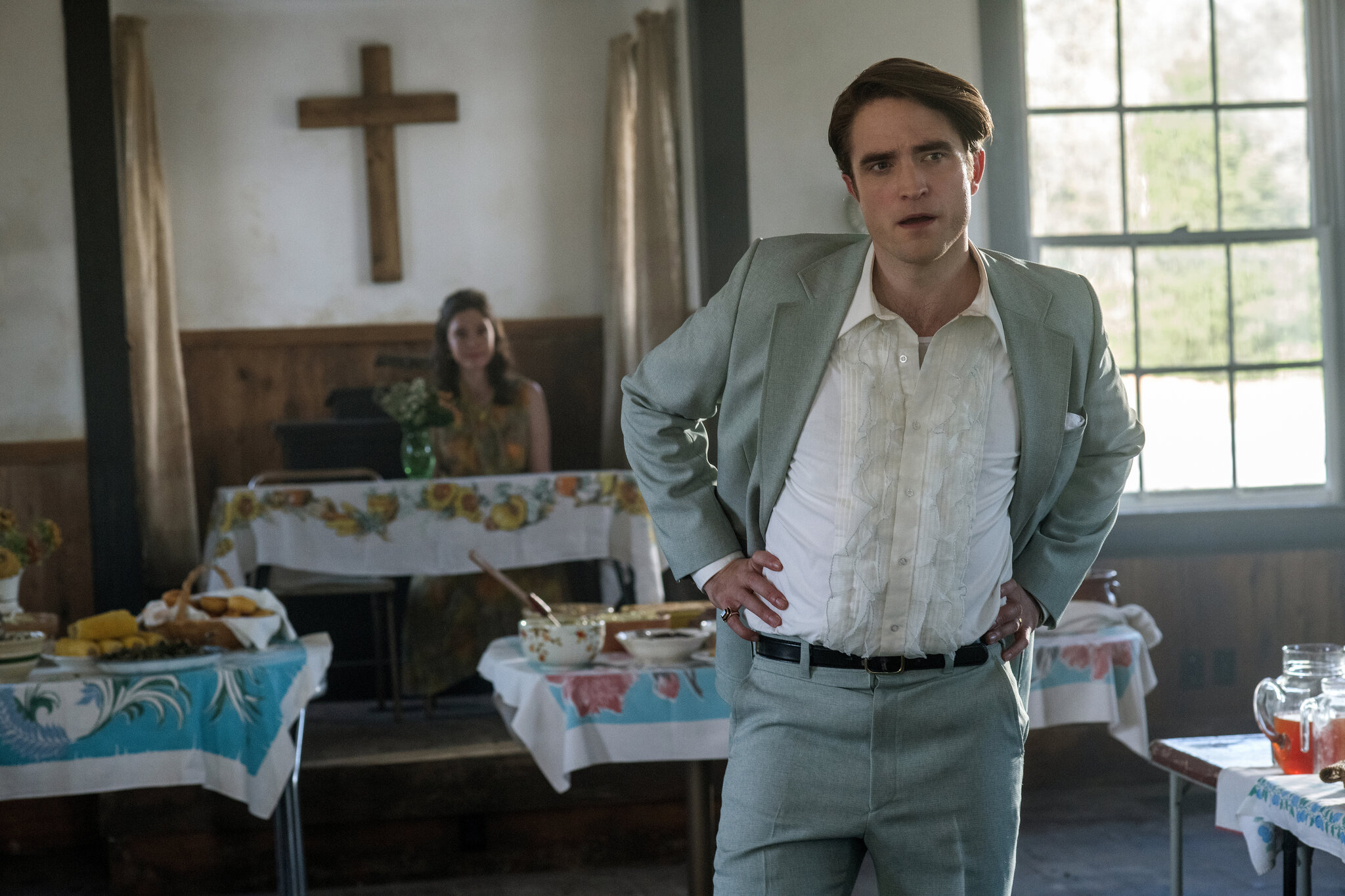
Hey there everyone! Welcome back to Movie Soapbox, the little corner of the internet that only you and I and that guy sleeping in the corner over there know about. This is the place where we find underappreciated films and make sense of them, not just the plot mechanics but the whole ugly machine that produced them. Today we are doing a deep dive on The Devil All the Time, a movie so relentlessly, methodically violent that by the time it’s done with you, you feel less like you watched a film and more like you survived a sermon delivered by someone who hates you personally.
Fair warning before we go any further: everything from this point on is spoilers, wall to wall, no exceptions, no gentle tiptoeing around the ending. If you haven’t watched it, go watch it, come back, and we’ll be here. If you have watched it and you’re still trying to figure out what the hell just happened and why you feel the way you feel, then you’re exactly who this post is for.
Now, before we walk the film beat by beat, there’s something you need to understand about what you were actually watching when you watched this movie, because it tells you something about how films at this budget tier and this level of literary darkness actually move through the system.
A film like this one, adapted from a well-regarded novel, with this cast attached, a Tom Holland playing hard against type, a Robert Pattinson essentially doing performance art in a supporting role, this combination usually means the director got more rope than he would have otherwise. Not unlimited rope. More rope. What that tends to look like in practice is that the first two acts stay close to the source material, because that’s what the talent read when they said yes, that’s the thing they signed on for. The third act is where you can usually tell how much of that rope got used up in negotiations. A third act that feels consistent with everything before it, in tone, in pacing, in the willingness to refuse easy catharsis, that’s the sign of a filmmaker who either had final cut or had allies in the room. This film’s third act feels consistent. That’s not nothing. A version of this movie exists where Arvin’s last twenty minutes get smoothed down into something more reassuring, more procedurally tidy, and that version would have been a betrayal of everything the first ninety minutes built. That version did not make it to your screen. Note that.
So. The film. It opens not with Arvin, our eventual center of gravity, but with Willard Russell, played by Bill Skarsgård, in the Solomon Islands during World War II. He finds a soldier named Miller Jones crucified and scalped, still barely alive, and he puts a bullet in the man’s head out of mercy. That image, the altar, the sacrifice, the mercy that looks indistinguishable from murder if you don’t know the context, that image is the entire movie compressed into a single scene. Everything that follows is just the unpacking of it.
Willard comes home. Stops in Meade, Ohio. Falls for a waitress named Charlotte, played by Haley Bennett, and they marry and settle in Knockemstiff, Ohio, which is a real place and sounds exactly like what it is. They have a son, Arvin. Simultaneously the film introduces Carl Henderson, played by Jason Clarke, an unemployed photographer who is also, it will turn out, a serial killer who photographs his victims, and his wife Sandy, whose brother is a local cop named Lee Bodecker. The film is building a web, and it is doing it slowly, and it is doing it on purpose, and if you got impatient in the first act you missed the architecture of the whole thing.
Meanwhile, a woman named Helen Hatton, played by Mia Wasikowska, was promised in marriage to Willard by his mother in a wartime prayer bargain, a deal God apparently declined to enforce because Willard wants nothing to do with Helen. Instead Helen falls for an itinerant preacher named Roy Laferty, played by Harry Melling, the kind of backwoods holy-roller who pours spiders on his own face to prove God cured his arachnophobia. Roy gets bitten by one of those spiders, locks himself in a closet for two weeks, and emerges with a divine instruction: God wants a sacrifice. Roy takes his wife Helen into the woods and stabs her in the throat, absolutely certain she will be resurrected. She is not resurrected. Roy, sensibly panicking, hitches a ride out of town, and the ride he catches happens to be Carl and Sandy’s car. Carl and Sandy kill him and put him in a shallow grave. Roy’s daughter Lenora is handed off to Willard’s mother to raise.
Willard, back in Knockemstiff with Charlotte and young Arvin, has built a prayer altar out in the woods behind the house. He is not a conventional believer. He is a man who came home from a war carrying images he cannot un-see, and the only place he can locate anything like God is in the dirt and the trees away from other people. He teaches Arvin two things at that altar: that prayer is serious, and that when evil comes for you or yours, you do not wait for it to finish, you escalate until it stops. Arvin absorbs both lessons completely. One of them will save him. The other will almost break him.
Charlotte gets cancer. Willard prays harder. Willard decides harder prayer requires harder sacrifice and kills Arvin’s dog Jack at the altar, asking God to take the dog instead of the wife. Charlotte dies anyway. Willard, having spent everything he had on a God that didn’t hold up his end, kills himself at that same altar. Arvin, a child, is now alone, and the film ships him off to Coal Creek to live with his grandmother Emma and his uncle Earskell, alongside Lenora, Roy and Helen’s daughter, who is being raised in the same house.
Arvin grows up into Tom Holland, and the film is careful about what it shows you of him. He is not an angry young man in the way movies usually traffic in angry young men. He is watchful. He is precise. He keeps track of things. When the boys at school start in on Lenora, he gives them a clear, calm warning and then, when they don’t take it, he puts several of them in the hospital with a methodical efficiency that reads less like a brawl and more like a correction. He is not enjoying it. He is doing what his father told him to do, and the film lets you sit with the complexity of that, the fact that the lesson was a poison and also the thing that keeps Lenora alive.
Enter Reverend Preston Teagardin, played by Robert Pattinson in what is genuinely one of the most skin-crawling supporting performances of the last decade. Pattinson plays him as a man who has discovered that the church is the perfect machine for targeting the isolated and the desperate, and he runs that machine with the relaxed confidence of someone who has never once faced a consequence. He worms his way into the Coal Creek congregation, into Lenora’s trust, and eventually into her bed. He gets her pregnant. When the pregnancy becomes impossible to hide, he does what men like Preston always do, he prepares to publicly reframe her as the unstable one, the delusional one, the problem. His sermon about Christ’s temptation in the desert, the one warning against believing in delusions, is not a coincidence. It is a weapon being loaded in front of the congregation.
Lenora, understanding what is coming and unable to see a way through it, goes to the barn. The film makes a deliberate choice here that differs from the source novel by Donald Ray Pollock: in the book, Lenora changes her mind at the last moment and the regret is clear and internal, she wants to live, but it is too late. The screenplay by Antonio and Paulo Campos frames it as an accident, a slip rather than a choice carried through to completion. Paulo Campos, when asked about this directly, described it as the narrator speaking from Lenora’s or Emma’s perspective rather than from a god’s-eye view of events, the narrator reaching for comfort in a moment that has none. It is a small deviation and a meaningful one, the film softening the agency in order to protect the audience’s ability to grieve cleanly. Whether that’s the right call is a legitimate argument. What’s not arguable is that the scene works, and that it lands Arvin exactly where he needs to be for the film’s final movement.
Arvin finds out from Lee Bodecker, now the corrupt sheriff of Knockemstiff, that Lenora was pregnant when she died. Arvin, who has already been quietly watching Teagardin, already tracking him the way his father taught him to track threats, now has the last piece. He goes to confront the preacher with his father’s Luger. Teagardin, seeing the gun and seeing that his charm has run out of road, makes a lunge for it. Arvin shoots him. This is the film being very deliberate about what it will and will not let its hero do: Arvin had cause, Arvin had patience, and Arvin did not pull the trigger until the threat moved first. The film knows exactly what it’s doing with that sequence. It is the same argument George Lucas eventually lost about Greedo, resolved here in Arvin’s favor by having the preacher make the move.
Arvin runs. On the road toward Cincinnati, he is picked up by Carl and Sandy. He doesn’t know who they are yet. The film has been tracking Carl and Sandy in parallel this whole time, Sandy growing increasingly disgusted with Carl’s escalating depravity, the two of them dragging their rolling horror show through small-town Ohio and West Virginia. Arvin senses something wrong when Carl pulls off to watch a sunset that no one is actually watching, and when Carl goes for him, Arvin shoots Carl and ends up in a standoff with Sandy. Sandy pulls the trigger on him. The gun fires blanks. Carl had loaded her gun with blanks at some point, whether out of distrust or some darker proprietary logic the film leaves deliberately open. Sandy is still a killer. Arvin shoots her. He survives not because he was smarter or faster, but because the specific form of Carl’s paranoia happened to protect him. You can call that fate. You can call it the wheel turning. The film doesn’t make you choose.
Lee Bodecker, who has spent the entire film burning evidence of his sister Sandy’s crimes to protect his reelection chances, pieces together that Arvin killed the preacher and has a Luger, and that his sister and Carl were killed by a nine-millimeter, and he knows where Arvin is going. He goes there to kill him. Not for justice, not for law, but because Arvin is a loose thread that could unravel the story Lee has been telling the county about himself. Arvin is at the old family property burying the bones of his dog Jack, the dog his father killed at the altar when Arvin was a child. Lee fires. Arvin shoots him in the belly. Before he leaves, Arvin plants Sandy and Carl’s evidence in Lee’s jacket, giving the next cop who finds the scene a story that will hold. Then he gets back on the road.
The film ends on Arvin in a car, drifting, and a vision or a memory of a boy running through the woods that could be himself as a child, could be his father as a child, could be a son he hasn’t had yet. The film does not tell you which. It does not need to. The cycle is the point. The question the film is actually asking is not whether Arvin was right, the film is quite clear that Arvin was right, but whether being right is enough to break the thing that made him necessary in the first place.
The Competing Theories To Explain The Devil All the Time
The competing reads on this film mostly organize themselves around that final image. One camp reads it as essentially hopeful: Arvin has closed the loop, buried the dead, punished the guilty, and is heading toward something resembling a future. The cycle ends with him. Another camp reads it as tragic: Arvin has become the thing his father trained him to be, and the boy in the vision is the next generation already in motion, already learning the same lessons at the same bloody altar. A third read, less common but worth naming, treats the whole film as a theological argument rather than a narrative one, the idea that every character who weaponizes religion against the vulnerable ends up destroyed by someone who took the underlying moral instruction seriously, that Arvin is not outside the religious framework of the film but is in fact its only honest practitioner.
Moviesoapbox’s Preferred Reading of the Film The Devil All the Time
The theory that holds up under pressure is the second one, shaded with the third. Arvin is not free at the end of this film. He is functional, which is not the same thing. He has buried his dog, settled his accounts, and gotten back in a car, and the boy in the vision is almost certainly himself, which means the last thing the film shows you is Arvin remembering what it felt like before any of this was required of him. That’s not a hopeful image. That’s an elegy.
What Aquinas called Just War theory and what this film is actually running on are the same framework: violence is only ever legitimate as a last resort, proportional to the injury, undertaken because no other option remained. The film walks Arvin through every test. He warned the bullies. He investigated Teagardin before he confronted him. He didn’t go looking for Carl and Sandy, they picked him up. He didn’t go to the old property to kill Lee. Every time Arvin pulled that trigger, the film had already established that every other door was closed. That’s not an accident of plotting. That’s the film’s entire moral argument, built into the structure scene by scene, so that by the time you get to Lee dying in the dirt you don’t feel like you watched a revenge fantasy. You feel like you watched a reckoning.
This is what the factory would have flattened. A version of this movie produced by committee, stress-tested through a dozen rounds of notes from executives who wanted a cleaner hero and a more legible ending, would have given Arvin a moment of explicit doubt, a scene where someone talks him back from the edge, a closing image that resolved rather than lingered. The fact that none of those scenes are in this film is the whole ballgame. Somebody in that process held the line. The film you watched is the film that survived.
🎬 If You Liked This…
- Frailty — a father who believes God has tasked him with killing sinners, the same Southern Gothic faith-as-violence DNA, the same portrait of religion as something that can be weaponized against the people closest to it
- Galveston — the same bruised Southern register, working-class men doing terrible things in landscapes that feel built for suffering, the same refusal to offer anyone a clean exit from what they’ve become