
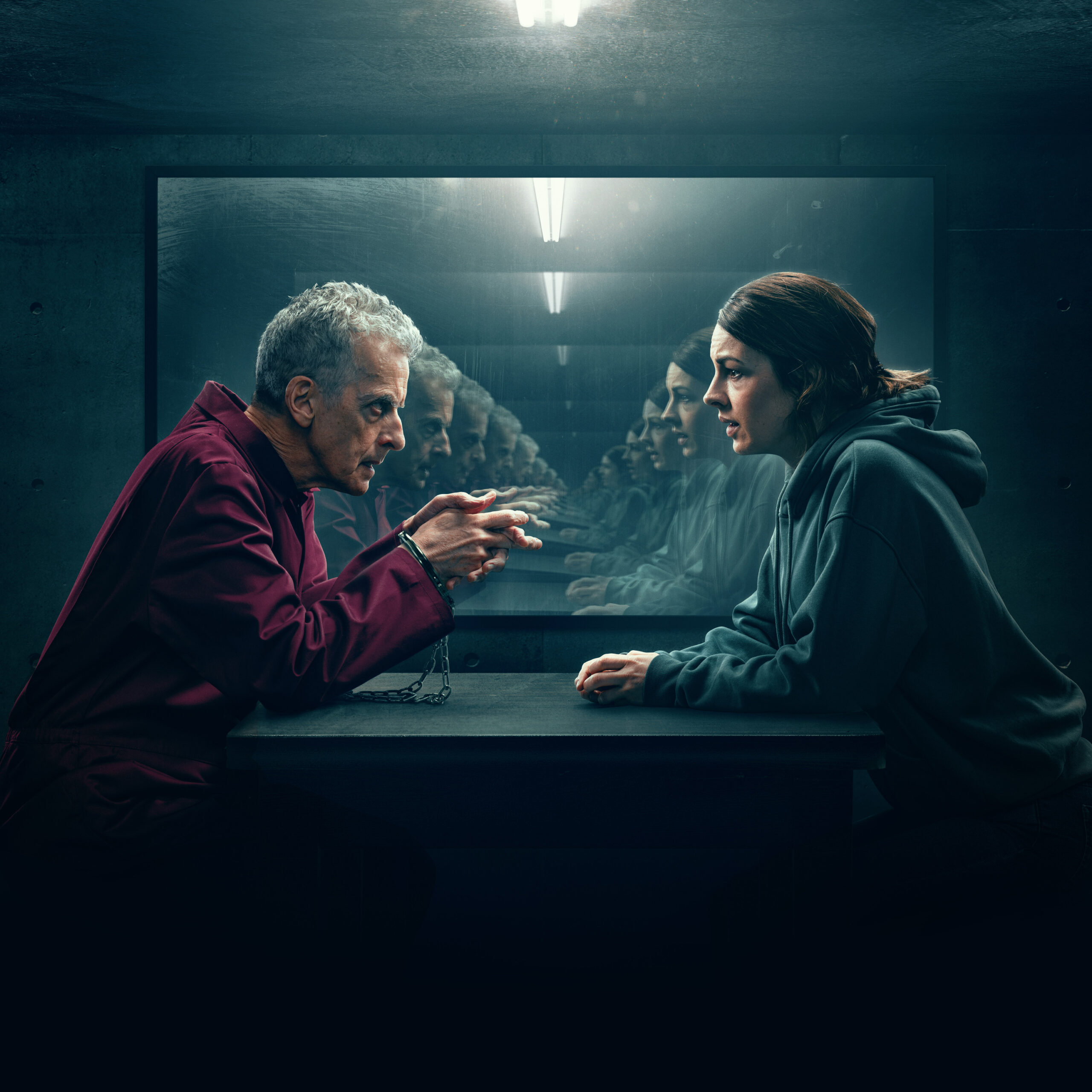
Hey there everyone! Welcome back to Movie Soapbox, the little corner of the internet that only you and I and that guy sleeping in the corner over there know about. This is the place where we find underappreciated indie films, and shows, and we make sense of them together. Today? We are doing a full deep dive on The Devil’s Hour, a six-episode Amazon Prime series so quietly, stubbornly strange that it managed to smuggle a genuinely ambitious Nietzschean time-loop thriller past the streaming algorithm gatekeepers and onto your screen without a single explosion or a recognizable IP attached to it. Which, in 2022, is its own kind of miracle.
Alright. You’ve watched it. Or you’re about to make a catastrophic decision and read this anyway. Either way, I’m going in hard from this point forward, and once we cross this line there is no coming back from the wreckage, because this show hands you its entire architecture in pieces and you do not understand what you were holding until the very end. So if you haven’t watched it yet, go watch it, all six hours of it, and then come back here and we will work through exactly what happened to you.
Still with me? Good. Let’s get into it.
What This Show Had to Survive to Exist
Before we get into the mechanics, you need to understand what you’re actually looking at when you watch The Devil’s Hour, which is a show built on the kind of structural ambition that development executives at every major streamer have been trained, systematically, to sand down into something safer. A non-linear time-loop narrative with no franchise hook, no established IP, a budget that forced the production to do everything with implication and performance rather than spectacle, and a lead in Jessica Raine who is not a household name in the American market, these are not the ingredients that survive twelve rounds of notes from a VP who wants to know where the cinematic universe is. Tom Moran wrote this thing, and the fact that it arrives on screen intact, with its internal logic coherent and its tonal discipline unbroken across six episodes, tells you something about what it costs to get a show like this greenlit on the strength of pure craft. Shows with this structure and this budget almost always end up either gutted in post or quietly buried. This one didn’t. That matters.
Gideon’s Powers, and the Philosophy Underneath Them
Nietzsche wrote about eternal recurrence as a kind of existential stress test, the idea that you are living your life on an infinite loop, every moment recurring forever, and the measure of who you are is whether you can affirm that, whether you can look at the boulder rolling back down and find something like peace in it rather than despair. The Devil’s Hour takes that idea and runs it through a very specific genre machine, because in this show the loops are literal, everyone is looping, everyone has always been looping, and almost no one knows it. The machinery just keeps turning.
Gideon Shepherd, played by Peter Capaldi with that particular quality he has of being simultaneously warm and frightening, is the exception. He can see across loops. Not in a clean, omniscient way, but in flashes, precognitive bleed from one iteration into the next, enough that he can identify the moments where a deviation from the established timeline will save a life, stop a crime, prevent a death that has been occurring on schedule for longer than any individual life can measure. He is not predicting the future so much as he is remembering it, which is a much lonelier thing.
Get that detail locked in, because the whole show rests on it. The loops are real. Almost no one remembers them. Gideon does. He uses that memory to intervene. And his interventions are what generate everything that follows.
How Gideon Became What He Is
It starts with a pine cone, which is the kind of specific, unglamorous origin detail that a committee-written origin story never allows through. As a child, Gideon picked up a pine cone in church, his father saw it, and what followed was abuse severe enough to leave a scar across every subsequent loop. In one iteration, Gideon simply did not pick up the pine cone, and the beating didn’t happen, and in that delta between the two outcomes he began to understand what he was and what he could do.
He also remembered his father killing all three of them, driving them off a cliff. Knowing it was coming, he killed his father first. Every time the police tracked him down afterward, he committed suicide, reset, and started the next loop with the full memory of everything he’d learned. He laid low by betting on sports outcomes he already knew. Then he watched a girl named Evelyn die in a car accident, realized he could prevent it in the next iteration, and did. That was the turn. From that point forward he began using what he knew to stop murders, rapes, abductions, fires, everything he’d watched happen on schedule. Sometimes that meant killing the perpetrator before the crime occurred, which is where the show gets genuinely thorny about him.
Lucy’s Original Timeline, and Why It’s the Root of Everything
Here is the piece of the architecture that the show lets you feel before it explains it, which is the right call dramatically, even if it means you spend several episodes slightly off-balance. In the timeline that existed before Gideon started intervening in Lucy Chambers’ life, Lucy’s mother committed suicide. That loss is what drove Lucy into the police force. She became a detective. She did not end up with Mike. She ended up with Ravi, her partner. And in that original configuration, Lucy worked the Fisher murders and was sharp enough, experienced enough, connected enough to the case history that she and Ravi kept arriving at Gideon’s crime scenes just ahead of his ability to disappear cleanly.
Every piece of knowledge Lucy has that she can’t account for, the physical instincts, the case intuitions, Chloe talking about her chest hurting after Gideon killed Shane before he could do what he was going to do, all of that is residue from the original timeline bleeding through. She is carrying knowledge from a version of herself she was never allowed to become.
The House, the Hauntings, and the Warrens
This is the one that the show makes look harder than it is, and once you have the key it unlocks cleanly. Lucy bought her house because the Warren family made a quote cheeky offer and presumably lost. In a previous timeline, the Warrens actually lived there. The father knocked down a wall in Isaac’s room. Every time Lucy or Isaac saw figures moving through the house, the woman in the kitchen, the activity that made no logical sense in their physical space, those were the Warrens, in the iteration where that was their home, going about their lives in a space that has since been reconfigured around them. The timelines are occupying the same physical address at slightly different configurations, and the house remembers both.
Why Gideon Is Fixated on Lucy and Isaac
This is the question the show withholds the longest, and the answer, when it comes, is one of those elegant structural ironies that justifies the whole delayed reveal. Gideon has been trying to fix things for an enormous number of iterations. Lucy, as a detective, keeps being there, at the wrong moment for him, the right moment for the people he was trying to protect. She and Ravi are the recurring interference pattern in his work. So he begins trying to remove the root cause, to find the prime mover moment that sent Lucy into the police force in the first place, which leads him to her mother’s suicide, which leads him to spend over twenty-five years, including a significant stretch in a futuristic prison that the show drops in your lap and trusts you to process, waiting for Lucy to trust him enough to answer one question about the worst thing that ever happened to her.
She tells him it was her mother’s death. He goes back and prevents it. And Lucy, freed from that formative trauma, does not become a detective. She becomes a child protection services worker. And she still finds Gideon. She cannot not find him. The shape of who she is keeps arriving at the same conclusion regardless of the path, and it is Gideon’s own interference in her timeline that leaves the residue of his previous actions in her memory, the echo of Harold Slade, Tilly Fisher, Aiden Stenner, all the cases that shouldn’t mean anything to her but do. His fixing is what makes him findable. The conundrum is total.
Isaac Was Never Abducted
Nobody took Isaac. This is one of the show’s cleanest explanations and it lands hard once you have the framework. Remember the scene where Isaac appeared to urinate on a bully’s backpack? He didn’t. He walked into a bathroom in another timeline, used the toilet that existed in that configuration of the house, and by terrible coincidence the bully’s backpack was sitting exactly where that toilet was in this one. The timelines are occupying the same physical space with slightly different furniture.
When Gideon ransacked Lucy’s house, the disruption unmoored Isaac from the current timeline and snapped him back to the original one, where Lucy was a detective and the Warrens lived at his address. He wandered to what he knew as home. The Warrens found a confused child at their door and did what you do, they called the police. The officers who took him in were Detective Lucy Chambers and Detective Ravi Dhillon. A version of his mother who had never had him, in a car he registered as wrong, dark and unfamiliar. When he flipped back to his own timeline and Lucy found him, he cried because she knew him. That’s the whole thing. She knew him.
What Actually Happens at the End of the Movie Devil’s Hour
Isaac starts a fire in his bedroom. His father, the false-timeline father, leaves him in it and lies about going back, and if you caught the strawberry ice cream detail earlier in the series you already knew he was lying before he opened his mouth. The fire spreads. Both houses are burning, the current timeline and the Warren house in the original, because Lucy broke the smoke detector when Ravi visited and never replaced it, and that detail is not an accident the show dropped in carelessly.
When Lucy runs into the flames to find her son, the evidence suggests she has crossed into the original timeline, which means she is running into the Warren house. The show gives her a flash-forward, her life with Ravi, the detective she was supposed to be, the trajectory Gideon spent lifetimes trying to prevent. A detective is called to the scene. The implication is that neither of them made it out.
But the show’s answer to that, the answer grounded in everything Nietzsche’s framework has been building toward, is that it doesn’t matter in the terminal sense. The loops continue. The next iteration will carry the accumulated weight of this one. Gideon will have another pass at the one detail that could change the outcome. And there is a version of this, if the show gets a second season to develop it, where Isaac himself is the one who remembers.
Moviesoapbox’s Take on The Devil’s Hour
I’ve seen the argument that the ending is ambiguous enough that Lucy and Isaac survived, that the detective called to the scene is just procedural, that the flash-forward is hope rather than eulogy. I don’t buy it. The show has been building toward the idea that the cost of Gideon’s interventions is real and accumulating, that you cannot spend this many iterations bending the timeline around one woman’s life without eventually paying a price that a single loop cannot absorb. Lucy’s death in this iteration is the weight the next loop has to carry. That’s not a tragedy, that’s the mechanism. The boulder rolls back down. Sisyphus pushes it up again. The question the show leaves you with is not whether they died but whether the loop that contains their death is the one where someone finally learns enough to stop it.
Tom Moran wrote something that factory television does not produce. A show with this much structural discipline and this much genuine melancholy, built on a philosophy of recurrence rather than resolution, that ends on an image of a woman running into fire toward a son she might not reach, because the alternative is standing outside and doing nothing, that is a show that survived a lot to get to you intact. Most shows with this architecture don’t. Remember that while you’re sitting with the ending.